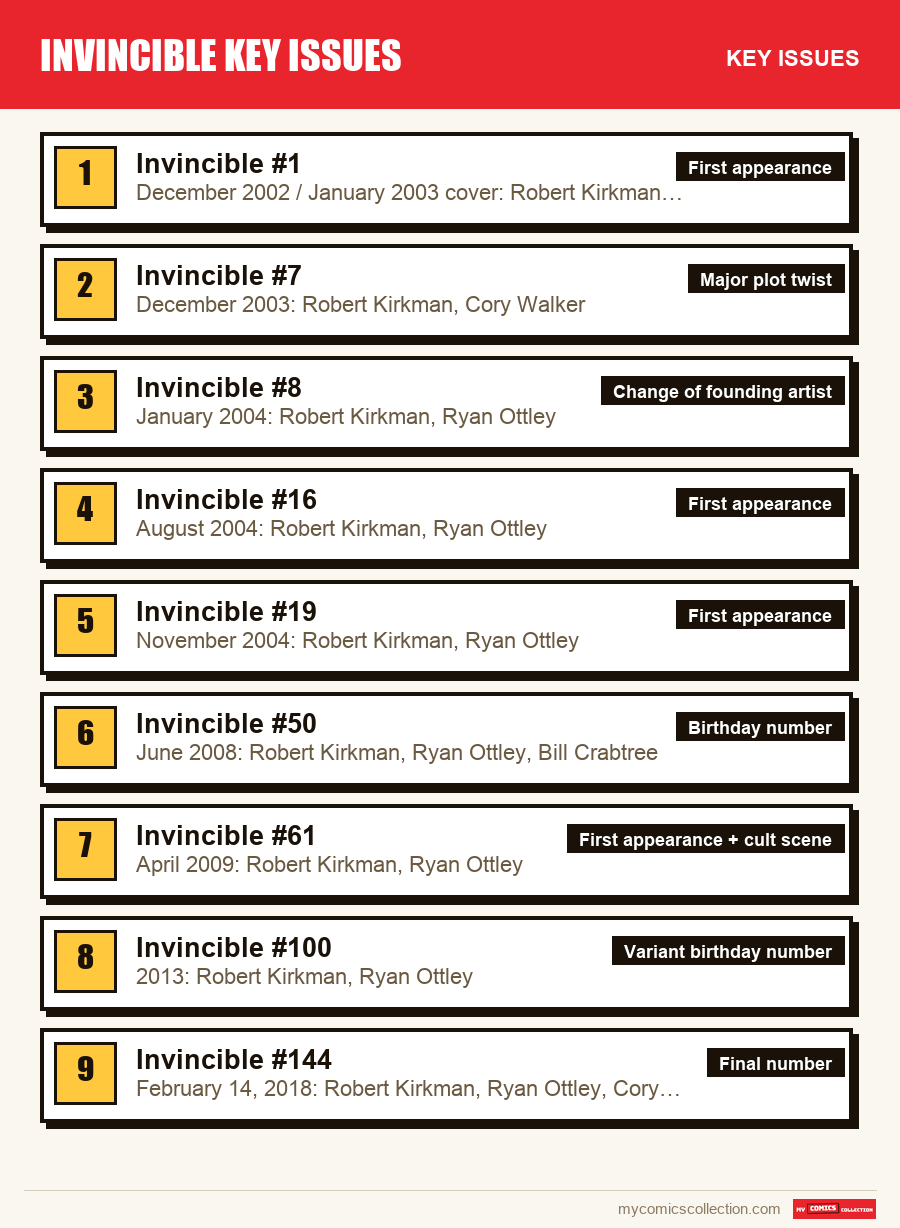
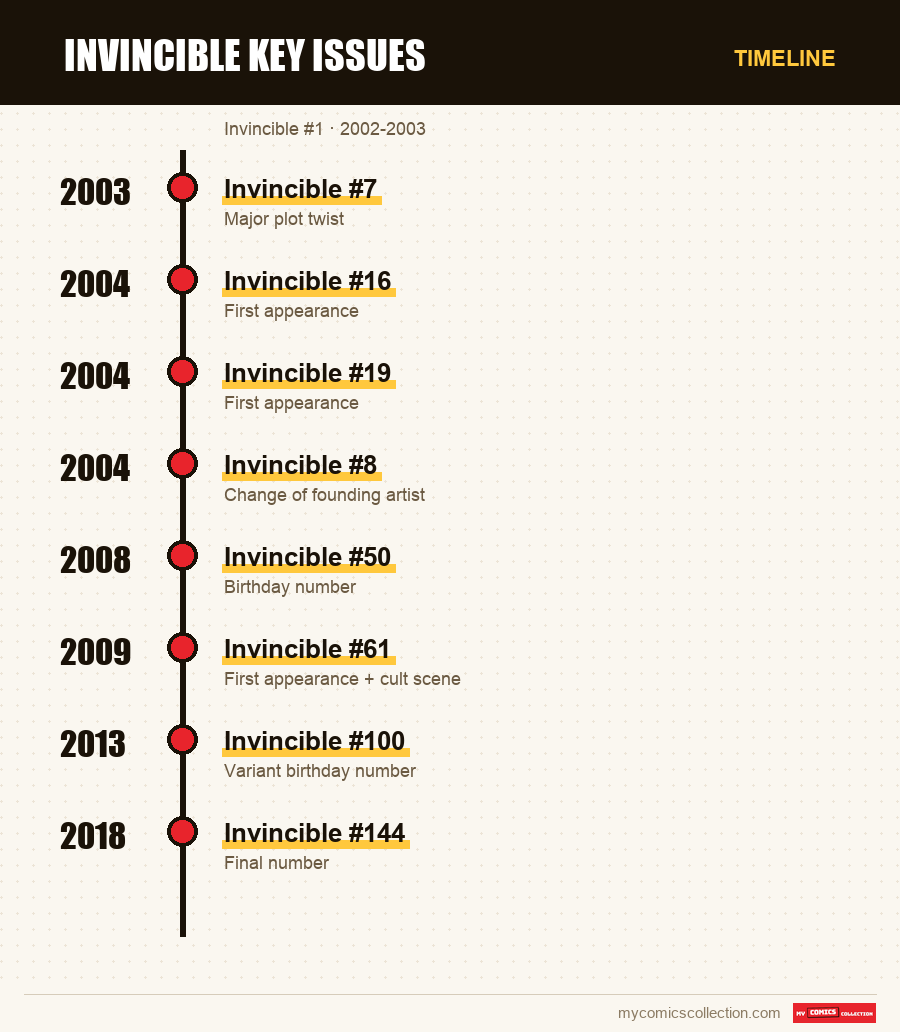
The essential key issues of Invincible are #1 (January 2003, first appearance of Invincible and Omni-Man, Robert Kirkman and Cory Walker), #7 (December 2003, massacre of the Guardians of the Globe and shock revelation of Omni-Man), #8 (January 2004, arrival of Ryan Ottley to the drawing), #16 (first appearance of Angstrom Levy), #19 (first appearance of Battle Beast), #50 (origin of Cecil Stedman), #61 (arrival of Conquest, fight that remains cult), #100 (anniversary issue with multiple variant covers) and #144 (final issue, February 2018). The #1 in CGC 9.8 generally trades between $3,500 and $4,500 depending on the label, with one-off sales significantly higher on exceptional copies.
Few superhero series created in the 21st century have experienced a rise comparable to that of Invincible. Launched in January 2003 at Image Comics at a time when the independent comics market was still looking for its second wind after the crisis of the 1990s, Robert Kirkman's series took nearly two decades to become a mainstream phenomenon thanks to its animated adaptation on Amazon Prime Video. This delay is precisely what makes the subject fascinating for a collector: unlike an Action Comics #1 or an Amazing Fantasy #15, whose popularity was built on generations of organic rarity, that of Invincible was built in accelerated fashion, before our eyes, between 2003 and today.
This guide lists the issues that really matter in the Invincible collection: those that feature a major first appearance, a founding plot twist, or a change in creative team. For each, we detail the real editorial context, the creators involved and, when the data exists and is verifiable, the rating range observed on the graded market. When no reliable value could be confirmed for a given number, we favor information on rarity, circulation or research in the CGC population rather than putting forward an invented number.
Invincible in the history of independent comics: editorial context
Invincible #1 hit newsstands on December 4, 2002 (with a cover date posted as January 2003, a common practice at the time to extend shelf life), published by Image Comics as part of the publisher's Malibu imprint. The screenplay is by Robert Kirkman, then still far from the notoriety that The Walking Dead earned him, and the drawing is by Cory Walker, with the colors by Bill Crabtree. The initial idea is almost provocative in its simplicity: to tell the story of a teenager, Mark Grayson, who develops superpowers like his father Nolan, aka Omni-Man, the most powerful hero on the planet. On paper, it's a rereading of the Superman/Superboy archetype. In fact, the series will quickly dynamite the codes of the genre by assuming graphic violence and narrative twists that the major historical publishers could not afford on their licensed characters.
Cory Walker draws the first seven issues before handing over the pencil to Ryan Ottley from issue 8, a handover that will visually define the series for the following one hundred and thirty-six issues. Ottley remains the artist associated with Invincible in the collective imagination of readers, to the point that his angular style and his outrageous fight scenes became inseparable from the franchise, well before the television adaptation. The series ends with issue 144, published on February 14, 2018, double format, marking the end of a fifteen-year adventure that saw Mark Grayson go from anxious high school student to cosmic hero.
What sets Invincible apart from most independent series of its generation is the relative rarity of its initial run. Upon release, the series sold modest numbers compared to heavyweights Marvel and DC of the time: it never ranked among the direct market's monthly top sellers in its early years. This limited print run, coupled with the almost total absence of floppy reprints for the very first issues, largely explains why these copies have become difficult to locate in high grade today, much more so than their age would suggest.
Invincible #1
The founding issue of the series: first appearance of Mark Grayson / Invincible, Nolan Grayson / Omni-Man, Debbie Grayson and William Clockwell, aka Titan. It's the absolute starting point of the entire Invincible mythology, and the most sought after issue in the collection by a wide margin. The original print, distributed only in direct circuit in floppy format without contemporary reprinting, makes it a rare piece in very high grade despite its modest age compared to comics from the Golden or Silver Age.
Invincible #7
Undoubtedly the most discussed issue of the entire series on a narrative level. Omni-Man summons the Guardians of the Globe, Earth's most powerful superhero team, and executes them one by one without suffering a single scratch, before revealing to his son that he is actually acting on behalf of the Viltrumite Empire. Robert Kirkman initially planned to place this twist much later in the series (at issue #25), before editor Jim Valentino convinced him to move the twist forward to issue #7, an editorial choice that changed the entire trajectory of the title. Final issue drawn by Cory Walker as regular artist.
Invincible #8
First issue drawn by Ryan Ottley, who remained the series' associated artist for most of its run, including the final issue. This issue also features Damien Darkblood, the recurring demonic detective, and Amber Bennett, Mark Grayson's girlfriend for much of the series. For collectors following Ottley's career, this is the official starting point for his association with the franchise, long before he became one of the most recognizable superhero comic book artists on the independent market.
Invincible #16
First appearance of Angstrom Levy, one of the series' most notable recurring antagonists, a scientist who became a multiversal traveler after an accident that disfigured him. The character returns several times throughout the run, notably in the multiversal arc which occupies a large part of the second half of the series. Very high grade examples remain difficult to locate, with specialist sellers regularly describing the number as “hard to find” on the graded market.
Invincible #19
First appearance of Battle Beast, a leonine-looking alien warrior who will become one of the most popular characters in the Invincible universe, to the point of obtaining his own spin-off mini-series, Invincible Universe: Battle Beast, launched in 2025 under the leadership of Kirkman and Ottley themselves. This recent editorial extension has mechanically strengthened collector interest in this original issue.
Invincible #50
Anniversary issue marking the first five years of the series, in 48-page format for a cover price of $4.99. The main story features a head-on confrontation between Invincible and Cecil Stedman, director of the Global Defense Agency, in a clash that permanently redefines their relationship. The issue also includes a short story titled “At Long Last. The Secret Origin of Cecil Stedman!” ", which reveals for the first time the character's past and the Chemical X gas incident that caused his scarred face. A pivotal number for anyone who wants to understand Cecil's evolution in the rest of the series.
Invincible #61
First appearance of Conquest, Viltrumite envoy charged with verifying that Mark Grayson is properly preparing Earth for annexation by the Empire. The ensuing confrontation between Invincible and Conquest, following the serious injury inflicted on Atom Eve, is considered one of the most notable fights in all of modern superhero comics for its level of graphic violence: Mark ends the fight by repeatedly headbutting Conquest until his brains are visible. Robert Kirkman himself said he waited years to see this exact scene adapted for the screen, which ended up happening in the animated series. The last page of the issue, drawn by Ottley, was used almost identically in the adaptation.
Invincible #100
Spectacular issue marking ten years of the series, published with a multitude of variant covers: a chrome wraparound cover by Ryan Ottley, a standard wraparound version, a limited “1 for 100” print run reserved for comic shops, as well as an exclusive Comixology black and white variant limited to 500 copies. The main cover pays direct homage to that of issue 1, a nod to the progress the series has made in a decade. A pivotal issue in the narrative arc of the second half of the series.
Invincible #144
Final issue of the series, double format, concluding the arc "The End of All Things". A rare and symbolic fact, the two emblematic artists of the series share the drawing: Ryan Ottley illustrates the first half devoted to the immediate consequences of the final conflict on Earth, while Cory Walker, artist of the very first issue in 2003, draws the second half which closes the story of Mark and Terra. An issue with strong symbolic value for any complete collection of the series, marking the end of fifteen years of continuous publication.
Collecting this series?
Track what you own, what you are missing and what your collection is worth. 7 day trial.
Start my trial →The impact of the Amazon Prime Video adaptation on the rating
The story of Invincible's rating cannot be understood without the animated adaptation produced by Amazon Studios and Skybound. The television series began on March 25, 2021 with the broadcast of the first three episodes of season 1, faithfully adapting the very first issues of the comic, including the Guardians of the Globe massacre scene and the twist from issue 7. Season 2 followed a two-part format, with a first part broadcast from November 3, 2023 and a second part released on March 14, 2024, notably covering the events related to Angstrom Levy and the war viltrumite. Season 3 then started on February 6, 2025.
This television exposure had a measurable effect on demand for the original comics. The reasoning is simple and widely documented by market observers: with each significant scene adapted for the screen, new spectators seek to go back to the corresponding number in paper version. Issue 1 is the clearest example, with auction sales regularly exceeding its theoretical market value as long as the copy is in exceptional condition and has blank pages. The same phenomenon affects number 7 for the revelation of Omni-Man and number 61 for the fight against Conquest, two sequences which marked the spectators of the animated series as much as the original readers in 2003 and 2009.
This context also has a practical consequence for the buyer: the price of a security supported by active adaptation evolves more quickly and in a less predictable manner than a security on a market that has been stabilized for decades. Before any purchase or sale, it is recommended to check an updated price range rather than relying on a figure recorded several months ago, particularly around release dates of new seasons which cause temporary spikes in demand.
Buying Guide to Collecting Invincible
- Prioritize page condition as much as numeric grade: on a series published on standard paper from the 2000s, the difference between white pages and light cream pages can represent a significant difference in value on issue 1, as shown by the difference between the current FMV rating and the record sale at Heritage Auctions.
- Clearly distinguish the blue CGC label from the yellow / restored label before any purchase of number 1: the difference in rating between the two can be significant, and an unscrupulous seller can play on the ambiguity of the visual of the hull. To understand precisely what separates two similar grades, consult our comparison CGC 9 vs 9.8, applicable to reasoning about any modern series.
- Don't Overlook Artist Transition Numbers: number 8, often eclipsed by the more spectacular number 7 story-wise, remains undervalued even though it marks the arrival of Ryan Ottley, central designer of the entire visual identity of the franchise.
- Beware of unreported reprints on the most popular issues such as #1, #7 and #61: always check the barcode and the printing notice on the back cover before any purchase other than a graded copy.
- Think about the variant covers of issue 100 if you are aiming for a thematic collection: limited editions (like the black and white variant of 500 copies) offer an objective rarity that is easier to document than a simple feeling of demand.
- Follow editorial announcements from Skybound and Image Comics: the recent launch of the spin-off Invincible Universe: Battle Beast immediately brought issue 19 back into the spotlight, a concrete example of how editorial news can rekindle interest in an older issue.
- Document your collection as you purchase it rather than after the fact: the collection management application allows you to centralize your numbers, their grades and their acquisition dates, a real time saver when the series has 144 regular numbers plus variants.
- Always compare several recent sales before setting a purchase price, in particular on numbers with high volatility like #1 or #7 whose odds have changed significantly since the launch of the animated series.