The sales reports published on February 6, 2026 estimate comics and graphic novel sales in the United States and Canada at about $2.2 billion in 2025, a level never reached before, above the peaks of the covid period. The specialty store channel is up nearly 30% and is approaching one billion dollars. Two major caveats: this is not a count but an extrapolation from the registers of more than 125 stores, since no distribution reports have been published since 2022, and the total is calculated at cover price. Above all, new and secondhand do not work on the same mechanics: one can increase its supply at will, the other cannot. Confusing the two leads to buying the wrong thing at the wrong time.
When a record revenue figure is announced for a sector you love, the reflex is to tell yourself that your objects are going to gain value. The reasoning seems unassailable: more people are buying comics, so demand rises, so prices follow. It is wrong, and wrong for a very simple reason that any bookseller could explain in ten seconds: when demand rises on a new issue, the publisher prints more copies. When it rises on an issue from 1973, nobody can make a single one more.
This article therefore starts from the published figures, takes them seriously, then carefully separates what they describe from what they do not. They describe new product: what comes off the presses and goes through the register this year. They hardly describe the secondhand market at all, which is exactly the market where a collector spends most of their time and budget.
It is October 1st, 2026, and these estimates are the most recent available for a full calendar year. All amounts cited below are in dollars, concern the United States and Canada, and come from published sales reports whose method is detailed further down. None concerns the French-speaking market. And none is a count: since 2022, no one publishes a total of actual direct market sales, which means the word "record" must be taken with the pinch of salt it deserves.
What the 2025 figures say exactly
The detail matters more than the headline. Here is the content of the published reports, wording by wording.
For 2025, in the United States and Canada, the estimate published on February 6, 2026 gives a total of consumer sales of about $2.2 billion, all categories and all channels combined. The accompanying commentary specifies that this level exceeds the highs reached during the covid period, which had already produced a considerable rise.
The breakdown is more interesting than the total. Direct market sales, that is, specialty stores, grew by nearly 30% over a year and bring this channel's total close to one billion dollars. Within this channel, single issues rise 30% and collected editions 28% over the year.
The point that surprised observers, however, is none of these percentages. It is that the specialty store channel is growing faster than the bookstore channel. For about fifteen years, general bookstores had grown faster, to the point of overtaking the direct market in 2019. That movement has reversed.
To gauge the size of the jump, you need the previous year. In 2024, still for the United States and Canada, the same type of report estimated the market at $1.94 billion, up 4.0% on 2023's $1.87 billion, a 2023 that had itself fallen 7% from 2022. And 2024 already stood 73% above 2019. In other words, the North American market for new product climbed one step during the pandemic, never came back down, and has just climbed a second.
One last figure, published on October 9, 2025 and therefore partial, gives the texture of the year: over January to August 2025, sales at the stores equipped with the tracked register system were up 27% against the same period of 2024, with 29% over the first four months and 25% from May to August. The rise was therefore broad and steady, not the doing of one exceptional month.
How these figures are made, and why the scope matters
A market figure is not a measurement, it is a constructed estimate. This one is constructed honestly, in the sense that the method is published and its limits are acknowledged by those who produce it. You need to know them before drawing anything from it, and they are severe.
First point, which conditions everything else: there is no longer any public total of actual North American direct market sales. The historic distributor stopped its monthly and annual reports in 2022, and its two main successors publish no sales figures. The last years documented by distribution reports therefore end in 2021. Everything announced for 2022 and after is estimate, and estimate alone.
For specialty stores, the estimate therefore no longer rests on distribution data but on sales recorded at the register by a system used by more than 125 stores. These variations are then extrapolated to the whole channel, which has more than 3,000 stores selling American comics worldwide. The authors of the report themselves write that the sample is small, non-random, and that if these stores do not evolve like the others, the estimate will be off by as much. They add that it is the largest aggregation of register data available and that there is no alternative.
For general bookstores, the data come from a retail sales panel covering more than 16,000 points of sale and about 85% of the American general-interest print book market. The report adds an estimate for points of sale outside the panel and for Canada.
Finally, and it is the point almost no one notes, all values are calculated at full retail price, without accounting for discounts or markups applied in store. The $2.2 billion figure is therefore not a sum of money actually collected: it is the value at cover price of what was sold. That invalidates nothing, but it changes what the figure means.
A direct consequence for us: a record expressed in value at retail price can be produced by two very different phenomena, or by a mix of them. Either more copies are sold, or the same copies are worth more each. The 2024 report is explicit on this point, and we come to it.
Who buys new, and for what reasons
The 2025 rise is not abstract: the reports give its cause, from interviews with retailers. It is new readers, in unusual numbers, and they are young readers.
Retailers interviewed in 2025 describe customers who walk in and ask how to start with comics. The October 2025 presentation notes the arrival of Generation Z in specialty stores at a level without recent precedent, which again reverses a long trend of readership aging. The reason put forward is simple and fits in three words: accessible, inexpensive, good-quality content.
On the editorial side, the titles cited as drivers are series designed to be picked up midway without baggage: DC's Absolute line, whose Absolute Batman was the top-selling single issue in specialty stores in 2025, Marvel's Ultimate universe, Invincible, and the Energon universe. DC held the top store market share in the fourth quarter of 2025. Retailers add a valuable observation: these new customers then gradually widen their purchases beyond the title that brought them in.
Let us retain the nature of this demand, because it determines everything else. It is demand for reading, carried by people who want stories that are readable immediately and cheap. It is not demand for scarcity, first printings or high grades. A market that grows because teenagers discover Batman does not have the same effects as a market that grows because investors buy key issues.
Collected editions are not single issues
Another confusion to clear up before any conclusion: the category measured. These reports add up two objects that collectors never confuse but that statistics gladly group together.
Across all channels, graphic novels and collected editions still weigh more than 2.5 times single issues in value. In 2024, they represented more than 76% of sales in value. The word "comics" in a press release's headline therefore mostly covers paperback books: omnibuses, collections of ongoing series, manga, children's albums, author-driven graphic novels that were never published as single issues.
Yet these books are not collected at all like single issues. They are reprinted as long as they sell, their resale value is low and stable, and their interest is in reading and preserving a text, not in holding a dated object. A collection reprinted twelve times never becomes rare. The subject is treated in detail in our comparison between omnibus and original issues and in the one between collected edition and single issue.
That said, the share of single issues is moving in the right direction, and it is the most relevant information for us. In 2024, single issues grew 12.2% in value while collected editions gained only 1.3%, and in 2025 the direct market saw both grow at almost the same pace, 30% against 28%. The single issue, announced as doomed for twenty years, has become an everyday consumer item again.
What a high print run today does to tomorrow's scarcity
We arrive at the heart of the subject. A rising market for new product means rising print runs, and rising print runs mean, mechanically, abundant copies in ten years.
The most instructive figure in the recent reports went largely unnoticed. In 2024, the single issue format reached $460 million in the United States and Canada, its highest level in fifteen years. But the same document immediately adds that several retailers interviewed indicated that their unit volumes were falling despite this rise in value. Translation: part of this record came from cover price, not from the number of copies sold.
This nuance is exactly the one a collector must keep in mind, because it works in both directions. A record in value does not prove that print runs are exploding. And a 30% rise in value in 2025 does not necessarily translate into 30% more copies in circulation.
We must be brutally clear on this point, because it is the most important limit of the whole exercise: the print run of no comic published since 2022 is known. Print run estimates by issue rested entirely on distribution reports, which stopped. For decades, a collector could compare the number of copies shipped on two competing issues and deduce which would be hard to find again. That information no longer exists for recent production, and none of the 2025 figures restores it: they concern dollar amounts at retail price, aggregated by channel and by format, never quantities by title.
An immediate practical consequence, and it is a rule of conduct more than an analysis: on a comic published after 2022, the variable that determines future scarcity has become unobservable. Anyone who tells you today that a recent issue is "low print run" does not know it, they suppose it. The only use whose return remains guaranteed on a new release is therefore reading, and that is exactly what the 2025 reports describe.
What remains true, on the other hand, is the underlying rule: the supply of new product is elastic, the supply of secondhand is not. If a series sells well, the publisher reprints, schedules a second printing, puts out a collected edition, then a deluxe edition. Demand always meets a supply. That is why a heavily ordered number 1 is almost never a rare piece: it was printed in response to that very demand. Our guides on how to understand a print run and to estimate an issue's real scarcity detail the mechanics, and our article on first printings versus reprints explains why the distinction plays out on the object and not on the title.
The practical consequence is counterintuitive. Years of strong growth in new product produce the most abundant deposits of copies in the secondhand market, fifteen or twenty years later. Decades of low production, for their part, produce the rarities. It is not an opinion: it is what the lasting gap shows between comics of the early 1990s, printed during a bubble and now everywhere, and those of the mid-1970s, printed in small numbers and impossible to find in good condition. Our piece on the signs of a speculative bubble returns to this precedent.
The most telling signal of 2025: secondhand is shifting
The reports published in October 2025 contain an observation that is worth more to a collector than the two billion of the headline. It fits in one sentence: according to the retailers interviewed, the secondhand market is sliding from the collector toward the reader, with sales of copies in graded slabs down and sales of inexpensive reading copies up.
Let us take the measure of what this says. At the very moment the new market reaches a record, the high end of the secondhand market, that of graded and sealed copies, slows in stores, while the low end, that of read copies at small prices, accelerates. The two markets are therefore not going in the same direction at the same time. It is the most direct demonstration of this article's thesis.
We must stay cautious about the scope of this observation: it comes from interviews with specialty store retailers in North America, not from a measurement of the whole secondhand market, a large part of which takes place between individuals and in public sales. It describes what booksellers see, which is already a lot.
But the logic holds perfectly. A new seventeen-year-old reader who has just loved a series wants to read the sequel and the past of that series. He therefore buys readable copies at the lowest possible price. He does not buy a high-grade graded copy, whose price is set by certified scarcity and not by content. The two objects carry the same story and do not meet the same need. Our article on the resale premium of graded copies details this gap.
Two markets, two clocks
Let us recap the structural differences, because they are what to keep in mind the next time a record is announced.
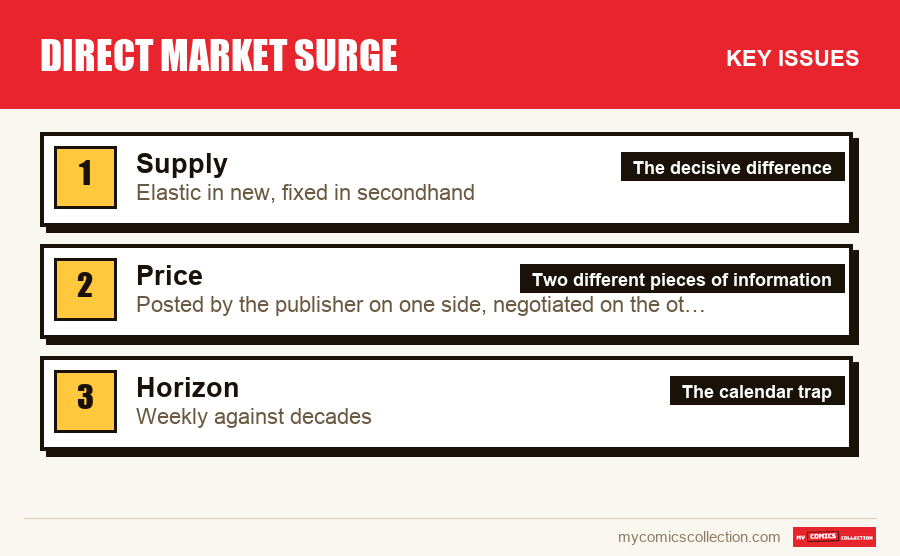
Supply
In new product, the quantity available adjusts to demand within a few weeks: restocking, second printing, collected edition. In secondhand, the number of existing copies has been frozen for decades, and it can only decrease. A rise in demand therefore produces two opposite effects: more objects in new, more pressure on prices in secondhand.
Price
The price of a new issue is decided upstream and printed on the cover. It contains no information about scarcity or desire. The price of a secondhand copy is the result of a meeting between a seller and a buyer, at a given moment, for a given condition. It is the only one of the two values that informs about the market.
Horizon
The new market is measured in release weeks and in orders the publisher does not take back. The secondhand market is measured in decades: what matters is the number of surviving copies in good condition and the character's permanence in the culture. A good year in the first says nothing about the second for a very long time.
What the rise still bodes well for
It would be absurd to conclude that this record is irrelevant. It is excellent, just not for the reasons one imagines, and its benefits are indirect.
First, a healthy network of specialty stores is the infrastructure of the secondhand market. These are the shops that keep bins of old issues, that buy back collections, that organize conventions and that train newcomers. A channel approaching a billion dollars in North America, after fifteen years of losing ground to general bookstores, is a network that reopens points of sale rather than closing them. For anyone hunting missing issues, that very concretely means more bins to explore.
Next, the arrival of young readers is the only thing that guarantees the value of a collection at thirty years. A collectible is worth something only if there are still people who want the object. The real risk hanging over comics was not the price of key issues, it was the aging of the readership. The 2025 reports say this risk is receding.
Finally, a dynamic new market produces tomorrow's key issues. The first appearances that will matter in 2050 are coming out right now, in the series that bring in these new readers. We do not know which, and that is precisely the problem, but the quantity of editorial attempts grows with the health of the market. Our piece on modern comics from 2020 to 2026 examines this period in detail.
The particular situation of the European reader
Everything above concerns the United States and Canada. A French-speaking reader experiences this market through a filter that changes several things, and of which none of the cited reports speaks.
The first gap is in time. An American series that triggers an influx of new readers in specialty stores across the Atlantic arrives in French later, most often as a collected edition, sometimes months after the end of the arc. By the time the French reader discovers the series everyone was talking about, the American new market has moved on, and the secondhand market for the first issues has already reacted.
The second gap is in format. French publishing favors the collected edition, that is, precisely the object that does not become rare. Buying a series in French is an excellent reader's choice and a neutral collector's choice: a reprinted French collection is not a deposit of value, and that is not its role. We devoted an entire comparison to the question of English versus the French edition, and a guide to old French editions, which have their own market, their own scarcity, and logics that have nothing to do with those of the North American market.
The third gap is the most practical: a European collector who wants to follow a booming new market runs into shipping costs, delays and duties. A new issue sold at cover price in North America does not have the same cost price once it has arrived in Europe, which shifts the balance between buying new and buying secondhand locally. Our collector's guide in France and our page on buying and reselling in France address these constraints.
We must therefore be clear on one point: the reports discussed here allow no conclusion about the French-speaking market, neither on its volumes nor on its growth. Asserting any would be making it up.
Five decisions this record should change, and one it should not
Do not change your secondhand budget on the strength of a new-product figure
The $2.2 billion total for 2025 contains no information about the price guide value of a 1984 issue. If you had a purchase plan on old issues, the rise in new product is not an argument to speed it up, nor to suspend it. The two markets do not speak to each other on this time scale.
Take advantage of the infrastructure, not of the mood
The real and immediate benefit of this growth, for you, is that there are more active stores, more bins of old issues and more collection buybacks. It is the time to look for what you are missing, not to buy what is coming out.
For new product, buy as a reader
The demand carrying this record is reading demand. Align with it: take what you want to read, in the main cover, without overpaying for a variant whose scarcity is not demonstrated. The expected appreciation on an issue printed in a record year is low by construction.
Record what you buy, in both markets
A new issue bought today becomes a secondhand one in fifteen years, and the only thing that will make a difference at that point will be your ability to prove what you have: the print run, the cover, the date, the condition. Enter it in your collection at the time of purchase, never after.
Reread the value of your collection without the news
The right frequency for reappraising a collection is yearly, and the right method is to look at real comparable sales on your own issues. A press headline about a sector record does not move a single line of your inventory. Our first estimate page and our valuation guide start from your copies, not from the market in general.
What does not change: preservation
Whatever the direction of the market, condition remains the only variable you control entirely, and the only one that acts on both markets at once. A well-stored copy stays negotiable in every scenario. A damaged copy never becomes intact again.
The question you should really ask
On reading these reports, the right question is not "will my comics go up." It is: "will these new readers stay."
Because that is indeed where the new market and the secondhand market meet, but with a generation's delay. A teenager who walks into a store in 2025 for a series that is easy to pick up midway, and who is still coming back in 2040, will at that point be a secondhand buyer, looking for the issues of his youth and those he missed. That is exactly what happened with the readers of the 1980s and 1990s, whose tastes today structure a large part of demand on old issues.
The reports say these readers have arrived. They do not yet say they have settled in. The retailers interviewed in January 2026 were in fact lucid about their own jumpiness: they buy with no possibility of return and must bet every year on the continuation of exceptional growth. That caution is healthy, and it holds for us too.
In the meantime, the course to follow is unchanged and almost boring: buy what you want to read, patiently look for what is missing, store properly, and keep an exact list. A sales record makes none of these four things more urgent, and none less useful.