
When you look for the 2003 Catwoman story on the second-hand market, it's mostly books that go back: paperback volumes, reissues, successive printings, promotional editions. The announcement report from August 29, 2026 shows this unambiguously: at the bottom of the range, the books are more numerous than the original issues. For reading, the collection is the best object. To document a collection, collection and booklet are not the same line and should never be merged into one.
There is a category of stories whose fame no longer comes through their original medium. We cite them, we recommend them, we offer them, and what we designate by naming them is a book. The 2003 story Catwoman falls into this category. Its reputation was built in the collection format, spread through the collection, and the second-hand market was organized around the collection. The monthly issue that first carried it still exists, it still circulates, but it has ceased to be the natural representative of history. It has become one piece among others in an offering dominated by the bound volume.
This move is not anecdotal for those who keep a collection. It changes what we find when we look, it changes the prices we see displayed, it changes the nature of what we buy while believing we are buying “the story”. And above all, it creates lasting confusion in inventories: two materially different objects, with different dates, different covers and different pagination, end up recorded under one and the same entry because the story inside has the same name. This article dismantles this mechanism and proposes a clean way to deal with it.
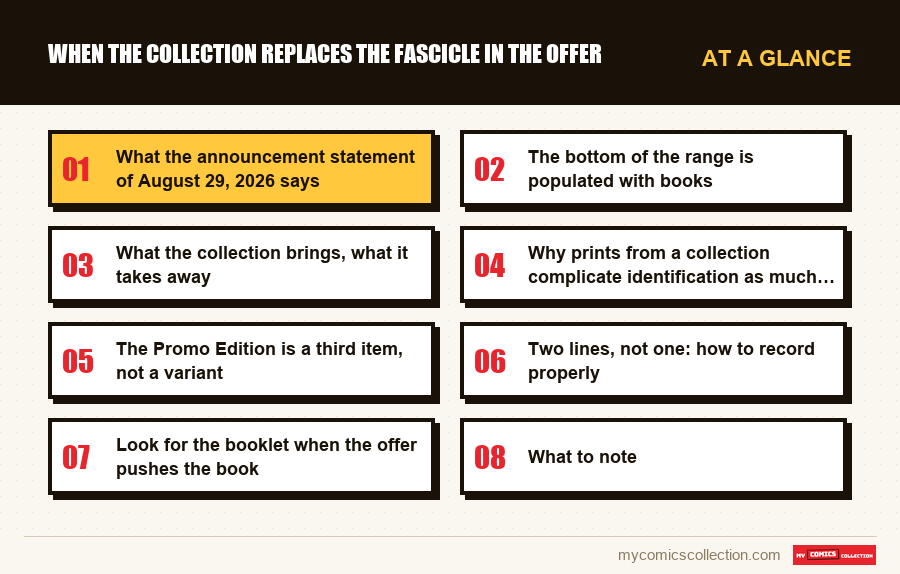
What the announcement statement of August 29, 2026 says
The figures below come from a listing count conducted on August 29, 2026. These are amounts claimed by sellers, never completed transactions: an ad says what a seller hopes to get, not what a buyer has agreed to pay. The distinction is crucial and it will be recalled several times in this article, because it is what prevents us from drawing abusive conclusions from a simple statement of offer. Of all the unverified proposals, there are 135 ads, ranging from $2.39 to $949.95, with a median of $14.25. On the verified subset, we fall to 14 listings, from $45.50 to $385.00, with a median at $75.00. Two populations, two realities, and a difference in median which firstly reflects a difference in composition between the two groups.
The bottom of the range is populated with books
A paperback volume announced as third printing: $2.39
The cheapest ad in the survey is not a booklet but a book, and a book for which the seller himself specifies that it is a later edition. This mention is information and not a defect: it indicates that the object was manufactured after the first batch, and it explains why it is at this price level. A seller who omits this is not doing anyone any favors.
A promotional edition distributed during a commercial operation: $3.99
Second low-end item, and again a print which is not the original monthly issue. An edition distributed as part of a commercial operation has its own manufacturing and distribution logic; it contains the story, it does not replace the initial publication and is not documented like it.
A used paperback volume in average condition: $4.68
Third proposition, third book. The declared condition is average, which, for a bound object, covers specific realities: spine marked, corners bumped, edge soiled, pages dog-eared. These defects have no exact equivalent in the usual vocabulary of the fascicles, and this is already an indicator that we are not talking about the same type of object.
An original booklet from the series: $4.95
You have to go down to the fourth row to finally find a copy of the monthly publication. It is not overpriced, it is not absolutely rare, it is simply less visible: drowned in an offer where the books occupy the first places, it appears after them in the lists sorted by increasing price.
The usable fact can be summed up in one sentence: on the cheapest proposals in the survey, books are in the majority ahead of booklets. This is not an opinion on the relative value of the two formats, it is an observation of the structure of the offer on a given date. It has an immediate practical consequence. The reader who discovers this story and who questions the market without specifying what he wants will be offered, as a priority, bound volumes. If he doesn't know the difference, he will buy a book thinking of buying "the story", which is perfectly legitimate for reading, and perfectly inappropriate if he thought he was acquiring a period object.
The unverified statement maximum, $949.95, should never be used as a reference. An isolated extreme point reflects the hope of a seller, nothing more. No conclusion about an item's value is built on a single ad placed at the top of a distribution.
The median is a more honest benchmark, but it remains a median of listings: $14.25 for the unverified set, $75.00 for the verified set, as of August 29, 2026. It describes what sellers were asking that day, not what an item is worth, and especially not what it will be worth.
What the collection brings, what it takes away
It guarantees the reading order
This is its strongest advantage. The volume presents the chapters in the intended sequence, with no gaps, no hesitation about what comes after what. The reader who reconstructs the same story in fascicles must first establish the list of the issues concerned, then bring them together one by one, bearing the delays and costs of each separate acquisition.
It removes the monthly rhythm
A story published in episodes was written to be read in episodes: reminders at the opening, tension maintained until the last page, waiting between two chapters. The collection smoothes it all out. What was a rhythmic construction becomes a transition among others, and part of the cutting work disappears in the fluidity of the continuous reading.
It makes individual covers disappear
Each booklet had its own. In the volume, they are either relegated to the end of the work in the form of a gallery, or absent. However, the cover is often the most identifiable element of an issue, the one by which a collector recognizes it on the shelves. The collection retains the story and loses part of its signage.
It holds up better over time
A paperback volume can be stored upright, handled without special precautions, transported or loaned. A stapled booklet becomes horny, folds, discolors and requires a cover and a rigid support. For repeated reading or for a library consulted, the book is objectively the most robust object.
It costs less per page
Bringing together several chapters in a single purchase mechanically reduces the unit reading cost, including shipping costs, since you pay one postage instead of several. This is the argument most frequently put forward, and it is valid as long as we are talking about reading. It ceases to be so as soon as the objective is to possess period publications.
It erases the period context
Advertisements, letters from readers, announcements of upcoming publications, legal notices of the period: everything that surrounded the story in its original form jumps out in the editing. This material is not history, but it documents the time of publication. The collection delivers the text, it does not deliver the context.
Why prints from a collection complicate identification as much as those from a booklet
We readily associate identification difficulties with booklets: discreet edition notices, cover variants, regional editions. The book would, by comparison, be a simple object. This is false, and the statement of August 29, 2026 gives a direct illustration of this with this announcement at $2.39 where the seller himself indicates a third printing. If he had said nothing, the buyer would have received a volume that he would have recorded as identical to the first, although it is not.
A collection that sells well is reprinted. Each reprint is an opportunity to modify the subject matter, and these modifications are almost never noted on the cover. The print mention, when it exists, is hidden in the copyright block, in small print, on a page that no one photographs in an ad. A pagination may change because a supplement has been added or removed, because a cover gallery has been extended, because a preface has been replaced. A revised edition may recompose the text, correct typos, adopt another paper or another format. The back can be enhanced with a new reference, the back cover rewritten, the collection logo updated.
The result is a set of objects that have the same title, contain the same story, and are not interchangeable. Two copies placed side by side can differ by around thirty pages without anything on the cover suggesting it. To a reader, this is of no importance. For an inventory, it is exactly the same problem as that posed by multiple editions of a booklet, with an additional difficulty: the vocabulary of the book is less codified than that of the booklet, and the sellers master it less well.
Collecting this series?
Track what you own, what you are missing and what your collection is worth. 7 day trial.
Start my trial →The Promo Edition is a third item, not a variant
The statement shows, at $3.99, a promotional edition distributed during a commercial operation. This type of print deserves special attention because it escapes the two usual categories. This is not the monthly publication: it did not circulate in the ordinary network, on the ordinary date, under ordinary conditions. It is also not the bookstore collection: it does not have the same commercial vocation and often not the same production.
A serious catalog treats these objects as separate entries, and it is right. Blending them into the story line would amount to creating an entry where no one would know what it contains. A collection that contains a promotional edition contains something precise, with its own distribution context, and this precision is lost as soon as it is placed under a generic label. The principle applies beyond this particular case: each physically distinct object must correspond to a distinct line.
Two lines, not one: how to record properly
The rule is simple to state and demanding to follow. The story is not a collection entry. The collection entry is the object that we have in our hands. If one has the bound volume and the original fascicles, one has two things, and the inventory must show two of them. If we only have the volume, the inventory must say that it is a volume, and if possible what edition.
Concretely, the file for a collection should include at least: the nature of the object (bound or paperback volume), the edition when indicated, the actual pagination noted on the copy, the year of printing appearing in the copyright block and not the year of the story, and the material condition described with the vocabulary of the book: spine, corners, edges, paper. The fact sheet of an issue carries other information: the number in the series, the publication date, the cover, the condition described with the vocabulary of the issue. Neither of these two sheets can replace the other.
A free note attached to each sheet resolves ambiguous cases better than any nomenclature. Writing “third printing, mention page 4 of the copyright block, 168 pages noted” takes ten seconds and is better than hesitation postponed until later. The collector who opens his inventory three years later must be able to recognize his copies without taking them out of their box. This is the only quality criterion that counts for an inventory.
Look for the booklet when the offer pushes the book
Since the market first presents volumes, the research must be formulated differently. The first reflex is to think by the series and the number rather than by the title of the story: a story title brings back books, a publication reference brings back booklets. The second consists of methodically eliminating words that indicate the book format in the titles, and not relying on the visual of the ad, often reused from one offer to another.
The third reflex is the most important: read the full title before concluding. The four examples at the bottom of the range noted on August 29, 2026 are all perfectly descriptive: the seller of the third edition announces his third edition, that of the promotional edition announces his promotional edition, that of the volume in average condition announces its average condition. The information was available in each case. What is missing is not the transparency of the sellers, it is the attention of the buyer in a hurry who only reads the price.
What to note
The format is noted above everything else. Before the condition, before the price paid, before the date of acquisition, a record must state whether the object is a booklet, a bound or paperback volume, or a promotional print. It is the information that conditions all the others: the status scale, the vocabulary of defects, the way of tidying up, the way of looking for additional information. A file that omits the format is unusable, even if everything else is there.
The print reference is noted when the package is opened. The copyright block of a volume often bears an indication of the edition, and this is the only time when it is easy to read: the copy is in hand, the issue is fresh. Postponing this verification means postponing it indefinitely, and finding yourself later with an inventory line of which we no longer know whether it refers to the first draw or the third.
Actual pagination is better than advertised pagination. The sales descriptions include catalog figures which sometimes correspond to another edition. Counting the last numbered page of your own copy takes a few seconds and gives reliable data, which will later allow you to distinguish two prints where the cover shows no difference.
The promotional edition occupies its own line. It is neither the booklet nor the bookstore collection, and putting it in one of these two boxes destroys information that nothing will allow us to reconstruct. Its file must mention its promotional nature and the known context of distribution, without extrapolating beyond what the object itself indicates.
The prices recorded are noted as requests, with their date. The values in this article are amounts claimed as of August 29, 2026: 135 listings from $2.39 to $949.95 with a median of $14.25 for the unverified set, 14 listings from $45.50 to $385.00 with a median of $75.00 for the verified set. Recorded as is, with the date and the mention that they are announcements, they remain usable. Recorded as values, they become misleading the next day.
To discover the story, the collection is the best choice: guaranteed order, single purchase, solid object. The reading from August 29, 2026 also shows that it is easy to find at the bottom of the range. The original booklets meet another need, that of possessing the publications as they existed, with their covers and their context.
By reading the title, first: the statement of August 29, 2026 contains an announcement where the seller explicitly indicates a third printing. Then by requesting a photo of the copyright block before purchase, then checking upon receipt. The cover almost never says anything about the print.
No. It means that, on that day, the 14 verified ads asked for amounts with a midpoint of $75.00, compared to $14.25 for the 135 unverified ads. These are two sets of different composition, and in both cases these are prices asked, not prices obtained.
Remove it from reasoning. An isolated extreme point expresses a seller's hope and indicates nothing about the market. The benchmarks that can be used are the median and the density of the offers, not the limits of the range.
This is technically possible and not recommended in practice. The two objects have different dates, paginations, covers and state scales. Merged, they produce a line of which we no longer know what it describes; separated, each remains identifiable years later.
Separate the book from the booklet in your inventory
My Comics Collection allows you to record each copy for what it is: format, edition, noted pagination, condition and free notes. The bound volumes cease to be confused with the original publications, and your collection becomes readable again for you and for a third party.