
The vintage VF comics market (1955-2005) is based on four major publishers: Arédit/Artima (1955-1989), Lug Editions (1969-1989), Semic (1985-1995) and Marvel France (1997-2005). The 2026 odds range from €10 for a current issue to €2,000 for a Strange #1 Lug 1970 in new condition. The rarity is due to the acidic paper, the small surviving print runs (5,000 to 20,000 copies) and the absence of reissue. Identifying the original edition (EO) before purchase remains the central skill of the vintage VF collector.
When we talk about comics in France, two markets coexist without really crossing paths. On the one hand, American original comics (Amazing Spider-Man, Action Comics, Detective Comics) whose global ratings are on the front page of Comic Book Resources and CGC Census. On the other, vintage French production: Strange, Spidey, Special Strange, Marvel Géant, Atemi Special, these booklets and albums which introduced superheroes to three generations of French-speaking readers between 1955 and 2005. This second market remains largely underpriced on an international scale, but since 2018-2020 it has experienced a slow and constant revaluation driven by French-speaking collectors who want to find the first comics that they read as children or adolescents. For those who know how to identify original editions and recognize VF key issues, this market offers purchasing opportunities at €10-30 which can reach €200 to €1,000 after storage.
This pillar guide aggregates all the data available on the vintage VF market in 2026. It covers the four major historical publishers (Arédit, Lug, Semic, Marvel France), the methods of identification between original edition and reissue, the current prices by publisher and by state range, the conservation techniques for old acid paper, reliable purchasing sources (Bedetheque, eBay France, specialized FR brokers) and the strategy for completing Lug/Semic runs for serious collectors. The figures presented come from the crossing between Bedetheque advertisements over 24 rolling months, eBay France sales sales 2024-2026, the catalogs of specialized booksellers (BD Net, Album, Pulps Comics, Gibert Joseph), the BDoublies and forumcomics.fr databases, and the legal deposit registers of the BnF. No source alone gives a complete vision: the cartography presented here results from the synthesis of these different benchmarks.
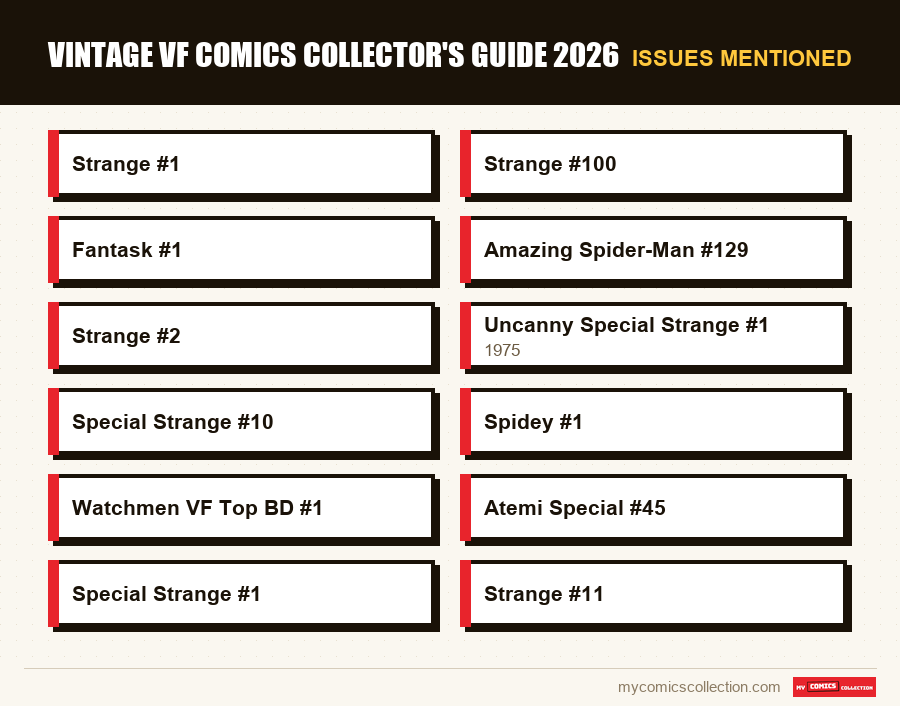
The 2026 context is special. The generation born between 1960 and 1985, who read Lug and Semic on newsstands in their childhood, today achieves the purchasing power of serious collectors. This structural demand pushes prices on key issues VF (first Wolverine VF in Strange #100, first Spider-Man VF in Fantask #1, first Special Strange issues) and gradually redefines the average price of the French vintage market. At the same time, modern Panini Comics and Urban Comics reissues remind us that the nostalgia of historical editions retains its own economic value: a Strange #1 Lug 1970 remains irreplaceable even when its contents are reissued in full Marvel Classic 2022. This paradox between availability of content and rarity of the object defines the entire dynamic of the current vintage VF market.
Vintage VF comics market in 2026: size, growth and niche structure
The French vintage VF market is defined in opposition to the modern Panini, Urban Comics and Glénat comics market post-2000. It covers all editions published between 1955 (first Artima translations of American stories) and 2005 (end of the Marvel France Tournon period). Within this scope, the total volume of surviving copies in French circulation is estimated at 600,000-900,000 units, distributed between established collectors, flea markets, specialized booksellers and dormant stocks with former readers. For comparison, the combined Panini and Urban production since 2005 exceeds 20 million copies distributed, which places vintage VF in a completely different category of structural rarity.
The total economic value of the vintage VF market in 2026 is estimated between 80 and 120 million euros at the median value of current prices. This figure remains modest compared to the $6 billion that the global comics market represents for all publishers according to Diamond and ICv2 estimates, but it is growing at an estimated rate of between 8 and 12% per year since 2020. Three factors are driving this growth. First, the demographic effect: readers born between 1960 and 1985 reach their peak collector purchasing power between the ages of 40 and 65. Secondly, the media coverage of US ratings which creates a spillover effect on the corresponding French editions. Third, physical scarcity: each year, a proportion of examples deteriorate beyond acceptable condition, which reduces the available supply in the very good condition and new segments.
The niche structure of the vintage VF market is due to three characteristics. First characteristic, the absence of an international market: a Strange #1 Lug 1970 is sold practically only to French-speaking collectors (France, Belgium, Quebec, French-speaking Switzerland, former colonies). This geographical limitation caps the odds compared to an Amazing Spider-Man #129 VO whose market is global. Second characteristic, the absence of recognized grading: CGC does not promote VF editions as official variants, which deprives the market of the effect of standardization and liquidity that grading brings to US comics. Third characteristic, dependence on visual identification: the distinction between original edition and reissue is based on technical details (indicia, barcode, paper, legal deposit notice) that the majority of amateur sellers do not master. This information asymmetry creates both the best buying opportunities and the biggest market pitfalls.
The price segments are divided into five bands across the entire VF vintage market. The lower bracket (€10-25) covers the current Lug, Semic and Arédit issues in average good condition without a specific key issue. The low-mid range (€25-80) covers the issues with documented first VF appearances and the Marvel Giant albums or DC Current Albums. The mid-high range (80-250 €) concerns VF key issues in very good condition and rare albums (Spider-Man Géant volume 1, X-Men Géant). The upper bracket (€250-800) covers the Strange #1-10 Lug in very good condition and the first Special Strange. The very high bracket (€800-2,000) concerns only exceptional copies: Strange #1 Lug 1970 in new condition, Fantask #1 Lug 1969 in new condition, first Special Strange issues with Wolverine on the cover. Understanding this structure allows us to arbitrate between vintage strategy and modern strategy according to the collector’s heritage profile.
The VF vintage market is finally distinguished by its specific seasonality. Sales peaks are in spring (March-May) for regional stock exchanges and autumn (September-November) for Angoulême and Lyon BD. Summer slows down significantly on eBay France and Le Bon Coin. The December-January period experiences a mini-peak linked to Christmas gifts and end-of-year clearance sales. This seasonality, more marked than in the modern comics market, directly influences the purchasing and resale strategy: buying in July-August when sellers are fewer, reselling in October or April when demand is maximum, remains the strongest rule of thumb.
Lug Editions 1969-1989: Strange, Spidey, Special Strange and the Marvel Revolution VF
Lug Editions is undoubtedly the most identified name in vintage French VF. Founded in Lyon in 1950 by Marcel Navarro and Auguste Vistel, the house began by publishing small western and detective formats before branching out into science fiction (Mustang, Zembla, Blek). The Marvel turning point came in 1969 with Fantask, the first French magazine to publish officially licensed Marvel superheroes. Fantask appeared in seven issues between February and August 1969, then ceased publication in the face of the censorship commission which deemed the content too violent for young people. This founding episode explains the exceptional rarity of Fantask: initial print run estimated at 60,000-80,000 copies per issue according to the figures relayed by BDoublies, but survival estimated at less than 3,000 copies in good condition for #1 containing the first Spider-Man VF.
Strange #1 appeared in January 1970 and became Lug's emblematic magazine. Newsstand format from 132 to 196 pages depending on the period, soft glossy paper cover, acidic newsprint interior. The title publishes Spider-Man, Daredevil, Iron Man and the original X-Men in parallel. The 2026 rating of the Strange #1 Lug 1970 ranges between €600 and €1,500 in very good condition, and reaches €1,800 to €2,000 in new, never-read condition. This high range is due to three factors: initial print run estimated at 80,000 copies, post-sale shelling of around 40%, and estimated survival of less than 2,000 copies in acceptable collector's condition. The following issues Strange #2 to #10 sell for between €150 and €400 in very good condition. The curve then gradually descends to the plateau of current issues at €15-35 for issues 50 to 200.
Special Strange appeared from 1975 and constitutes the second pillar of the Lug catalog. Color hardback album format of 196 pages, sold in newsstands and bookstores. The title publishes the Uncanny Special Strange #1 (1975) costs €80-180 in very good condition, but issues 5 to 15 (1976-1980) covering the genesis of the new X-Men reach €120-300 in very good condition depending on the covers. The issue containing the first VF appearance of Wolverine on the cover (Special Strange #10) peaks at €200-400. The Titans appeared from 1976 and published the Avengers, Fantastic Four and Thor, in a similar format. Average odds between €25 and €90 depending on numbers and condition. To better situate the historical place of these magazines in the Golden/Silver/Bronze Age classification, the Lug Bronze Age period (1969-1985) remains the most popular on the vintage VF market.
Spidey appeared from 1979 and completed the Lug offering with a shorter magazine format (96 pages) focused on Spider-Man and the Marvel children's series. The Spidey odds remain generally more modest than Strange: €10-40 for current issues, €60-120 for key issues like Spidey #1 or the issue containing the first Hobgoblin VF. Nova appeared in parallel (1978-1988) with a focus on Thor, Captain America and the cosmic series. Odds €8-35 for current numbers, €45-90 for key issues. Mustang continues on youth and western series. The entire Lug catalog includes over 1,800 different issues between 1969 and 1989, making it the largest vintage VF Marvel volume available on the secondary market.
The end of Lug came in 1989 when the house was bought by Semic Editions. The Marvel catalog then gradually passed to Semic which inherited the Strange, Spidey and Nova series until their successive cessation between 1990 and 1996. This Lug-Semic transition created a period of editorial overlap 1989-1990 where certain issues still bore the Lug logo while being published under Semic management. These “transitions” are little valued on the 2026 market (€10-25 on average) but constitute a useful benchmark for precisely dating production. The complete Lug catalog has been completely digitized by amateurs on Bedetheque and BDoublies, which facilitates the identification of original editions and the verification of estimated print runs.
Semic Editions 1985-1995: the Lug succession and the age of USA Comics
Semic Editions is the direct heir of Lug on the Marvel VF market. Founded in 1985 in Lyon by Marc Riquier and several former Lug collaborators, the house began by publishing Lug reprints on newsstands before absorbing the entire Marvel catalog in 1989. The Semic period 1989-1995 covers the transition between the Bronze Age issues that Lug published and the modern US comics of the late 1980s. It was under Semic that the arcs appeared in VF. Inferno, Acts of Vengeance, Infinity Gauntlet, Spider-Man Todd McFarlane and X-Cutioner's Song. This period is crucial in vintage VF history because it marks the transition from the very free "Lug" translation to a "Semic" translation more faithful to the original American text.
The Semic catalog is structured around five main titles. Strange (direct heir to Strange Lug) continued to appear until it stopped at number 332 in November 1997. Odds 2026 between €8 and €25 for current issues 200-332, €30-65 for key issues containing first VFs (first Cable VF, first Gambit VF, first Venom VF). Spidey continued to appear until 1996 and concentrated the Spider-Man clone saga arc in French, making it a collector's item appreciated by fans of this controversial period. Odds €8-30 for common numbers, €40-80 for key numbers. Special Strange continued in the hardcover album format until it was discontinued in 1996, with a stable price of around €20-65 depending on issues.
The “USA Semic Comics” constitute the most original segment of the house. Launched in 1989, these magazines compile in French modern US series (X-Force, X-Factor, New Warriors, Excalibur) in a 21 x 28 cm magazine format with 96 color pages. Forty-two issues appeared between 1989 and 1995, sold for 25-30 francs on newsstands. The 2026 rating oscillates between €8 and €30 for current issues, €40-90 for key issues containing the first crossovers X-Cutioner's Song and X-Tinction Agenda in French. The initial Comics USA Semic circulation was, according to BDoublies, between 15,000 and 25,000 copies per issue, with an estimated run-up of 25-35%.
Semic also published a series of Top BD albums between 1988 and 1996, which included in hardcover album format the most important Marvel long arcs: Watchmen VF (1988), Dark Knight Returns VF (1989), Batman Year One VF (1990, after the discontinuation of Arédit), Death of Superman VF (1993), Infinity Gauntlet VF (1994). These Top BD albums constitute the most valued segment of the Semic catalog in 2026. Watchmen VF Top BD #1-12 in complete collection in very good condition reaches €280-450, and the Dark Knight Returns VF Top BD complete sells for €120-200. The original editions are distinguished by their specific Top BD logo and their 24 x 32 cm format. To understand the gap in value between these original editions and the Panini Deluxe reissues which contain the same content, the historical object remains irreplaceable even when the story is republished.
The end of Semic came in 1996-1997 when the house gradually lost the Marvel licenses in favor of the new Marvel France structure launched in 1997. The Semic-Marvel France transition created a vague editorial zone where certain titles (Strange, Spidey) coexisted with the new publications. This transitional period 1996-1997 is little valued on the 2026 market (€10-20 on average) but remains precisely documented by Bedetheque. A detailed understanding of these editorial transitions is essential to correctly authenticate the issues and avoid period confusion.
Arédit/Artima 1955-1989: Marvel Giant, DC Albums and Atemi Special
Arédit/Artima represents the third major component of the vintage VF landscape, with a completely different positioning from Lug and Semic. The house founded by Émile Keirsbilck in 1949 in Tourcoing publishes small western, detective and science fiction formats (Sidéral, Météor, Cosmos) before branching out into superheroes from 1970. Unlike Lug and Semic which concentrate on Marvel, Arédit publishes Marvel and DC in parallel. It is notably the house which holds the rights to Superman, Batman, Justice League during the period 1982-1989 after the withdrawal of Sagedition. This Marvel + DC duality makes Arédit a unique publisher in the French vintage landscape.
The Arédit/Artima distinction remains a source of confusion for many collectors. In practice, Artima is the original commercial name used by Émile Keirsbilck between 1949 and 1968. Arédit took over from 1968 after the purchase by Éditions du Lombard, Belgian owners of the Tintin newspaper. This subsidiary allows the house to benefit from a broader Franco-Belgian distribution network. On superhero comics, the two brands designate the same editorial structure and must be considered equivalent in terms of origin. The complete guide Arédit Marvel collector 2026 details the entire catalog with current ratings.
The Marvel Géant range constitutes the Arédit heritage segment. Launched in 1979, this 21 x 28 cm hardcover collection offers 96-128 color pages on glossy paper. Fifteen volumes were published between 1979 and 1986, including the iconic Spider-Man Géant volumes 1-4, 000 copies. The Giant X-Men volumes 1 and 2 (1981-1982) cover the Claremont/Cockrum/Byrne arcs and reach €80-140 in good condition. The Giant Hulk volume 1 (1980) costs €50-95. These albums are distinguished by their Arédit logo on the back cover and their ISBN 2-7066-XXXX-X specific to the Arédit/Lombard group.
The DC Albums appeared in parallel between 1982 and 1988, in a slightly larger format (24 x 31 cm) with 128-160 color pages. Twenty-two volumes cover Superman, Batman, Wonder Woman, and Justice League of America. The 2026 rating oscillates between €35 and €95 depending on the title. The Justice League volumes containing the Crisis on Infinite Earths crossover (1985-1986) reach €70-95 in very good condition at specialist booksellers. The Atemi Special Marvel and Atemi Special DC series covers the most common adventures in small pocket format (14 x 18 cm), sold for 3 to 6 francs on newsstands. Current issues can be found at €5-15, but issues containing first VF appearances (first Joker VF in Atemi Special #45, first Killer Croc VF in #82) go up to €30-60.
Arédit's heyday was in 1985-1989 with the luxurious complete Batman Saga and Superman Saga, 25 x 32 cm color album format. These volumes contain the major arcs Batman Year One (1987), Death in the Family (1988), Killing Joke (1988), and Superman Crisis on Infinite Earths (1986). The Batman Year One VF Arédit, published in 1989 just before the company's bankruptcy, costs €95-180 in very good condition and constitutes one of the most coveted objects of vintage VF DC. The rarity is due to the massive shelling of the 1989 liquidation which destroyed a significant part of the unsold stock: less than 6,000 copies are still circulating today according to BDoublies estimates. The DC Arédit market paradoxically remains less competitive than the Marvel Lug/Semic market because few collectors master precise identification.
Marvel France 1997-2005: the transition to the US format and the end of vintage VF
Marvel France constitutes the fourth and final period of vintage French VF according to the definition used in this guide. Founded in 1997 under the name Marvel Comics France, then renamed Tournon-Marvel after acquisition by the Tournon group in 1999, the company marks a major editorial break with the Lug and Semic magazine issues. Marvel France abandons the traditional newsstand format to adopt the flexible US 17 x 26 cm format, which becomes the standard for the French comics market to this day. This transition corresponds to the professionalization of the market: better translation, better quality paper, regular monthly frequency, bookstore distribution in addition to the kiosk.
The Marvel France catalog is structured around three main ranges. The Marvel Monster Edition range (1997-1999) offers the Spider-Man, X-Men and Avengers long arcs in hardcover album format. These volumes remain unpopular in 2026 (€15-40) because the editorial quality seems modest compared to the Top BD Semic. The Marvel Méga Editions range (1998-2003) compiles the flagship series in VF into a 21 x 28 cm magazine. Current odds €8-20, key issues €25-50. The Marvel Top range (1999-2005) includes the US graphic novels (Daredevil Born Again, X-Men God Loves Man Kills, Spider-Man Kraven's Last Hunt) in hardcover albums. Odds €25-70 depending on title and condition.
The most sought-after Marvel France item in 2026 is the Spider-Man Clone Saga (1999-2000) box set, collector's edition which compiles the Clone Saga US arc into six hardback volumes. This complete box set in very good condition reaches €180-280. Individual volumes trade between €30 and €65. The second most coveted object is the complete Civil War VF (2007) published at the end of the Marvel France period, which marks the transition to Panini France. This complete original Marvel France edition reaches €90-160 in very good condition. To situate these editions in relation to modern versions, the comparison Panini Omnibus vs DC Absolute shows the editorial continuity between Marvel France and Panini France.
The end of Marvel France came in 2005-2007 when the Panini Comics group bought the Marvel licenses and absorbed the Tournon structure. This Marvel France-Panini France transition marks the official end of the vintage VF period as defined in this guide. Post-2007 publications fall into the "modern comics" category with very different ratings and their own market dynamics (reissue cycles, variant covers, omnibus). The Marvel France period 1997-2005 therefore remains clearly identifiable and constitutes the last moment when the vintage VF market produced collectible booklets with their own dynamics.
The Marvel France 2026 market has a particularity: demand is gradually increasing as the generation born between 1985 and 1995, who discovered comics as teenagers via Marvel France, reaches its collector purchasing power. This generational dynamic follows exactly the same movement as that which has carried the Lug ratings since 2015-2018. We can therefore anticipate a gradual revaluation of Marvel France issues between 2026 and 2032, with ranges which could reach €60-150 on key issues within five to seven years. This market signal justifies a reasoned purchase positioning on examples in very good condition currently available at €15-40. To follow this evolution, odds updated monthly give current benchmarks.
Original edition vs. reissue identification: indicia, barcode, paper
Correct identification of the original edition is the central skill of the vintage VF collector. Almost all of the differences in value on the market are due to this distinction: an original Strange #1 Lug 1970 edition costs €600-1,500, but a Lug 1985 reprint of the same issue does not exceed €80. The same story published in full Marvel Classic 2022 by Panini is only worth €25-35. Three technical elements make it possible to reliably distinguish EO and reissue: the indicia (legal notice), the barcode (or its absence), and the interior paper.
The indicia is the obligatory legal notice in France since the law of July 16, 1949 on publications intended for young people. It generally appears at the bottom of the back cover or on the first or last inside page, and includes five key pieces of information: name of the publisher, address, joint press commission number, legal deposit (month and year), and printer. To identify an original edition, check that the legal deposit corresponds to the expected first publication date. An authentic Strange #1 Lug 1970 displays "Legal deposit: 1st quarter 1970" with address "Lug, 26 rue Lakanal Lyon 7e". Any later mention (1980, 1985) indicates a reprint. This verification takes thirty seconds and eliminates 90% of identification errors.
The bar code appeared gradually in France between 1980 and 1985 for general public publications. Before 1980, no Lug, Semic or Arédit magazine displayed a barcode: their presence on a Strange #1 or a Special Strange #1 is therefore the sure sign of a modern reprint. For the 1985-2005 editions, the EAN-13 barcode begins with 9-77 for French periodicals: its presence is not enough to precisely date the edition but its absence on a booklet supposed to be post-1985 indicates either a very early original edition, or a problematic copy to be examined carefully. The complete method of identification original edition vs reissue details all special cases by publisher.
The interior paper constitutes the third technical benchmark. The Lug 1969-1985 issues use very acidic newsprint which yellows significantly in three to five years. An authentic 1970 Strange #1 Lug should present in 2026 an amber yellow to brown interior paper depending on conservation, with a slightly brittle feel. A white or pale cream paper indicates either a modern reprint or exceptional conservation (extremely rare over 56 years). The Special Strange Lug, on the other hand, uses a thicker glossy paper which yellows less. The Semic 1985-1995 booklets mix glossy paper and newsprint depending on the titles. Arédit albums use semi-matte glossy paper which retains its original color well.
The fourth benchmark concerns the cover. The original editions have a soft paper cover with offset printing typical of the period, slightly grainy to the touch. Reprints often use smoother, whiter paper, sometimes with a glossy lamination finish that did not exist on the original editions. The presence of a “reissue” or “Marvel Classic” logo on the cover clearly indicates the nature of the print run. For Lug reprints from the 1980s, check the mention "New Edition" sometimes discreetly printed at the bottom of the cover. The fifth benchmark concerns the printed price: a Strange #1 Lug 1970 displays “3 francs” on the cover, a 1985 reprint will display “12 francs”. Comparing the price to the actual cost of a magazine from the period (referenced on BDoublies) allows you to quickly date.
Collecting this series?
Track what you own, what you are missing and what your collection is worth. 7 day trial.
Start my trial →Current price by publisher and range: €10-2000 depending on rarity and condition
The complete map of vintage VF ratings in 2026 is structured in grids by publisher. For Lug, the overall range covers €8 (Spidey current 1980-1985 in average condition) to €2,000 (Strange #1 Lug 1970 in mint condition). Strange #1 to #10: €150-1,500 depending on condition. Strange #11 to #50: €35-180. Strange #51 to #200: €15-65. Strange #201 to #332: €8-30. Special Strange #1 to #15: €80-400. Special Strange #16 to #80: €25-90. Spidey #1 to #20: €60-180. Spidey #21 to #150: €10-40. Nova #1 to #50: €18-65. Titans #1 to #50: €25-90. Fantask #1 to #7: €350-1,800 (extremely rare).
For Semic, the ranges are generally more modest: Strange Semic #200 to #332: €8-25. Spidey Semic #150 to #220: €10-30. Special Strange Semic #75 to #135: €15-50. Comics USA Semic #1 to #42: €12-50. Top current comics: €30-80. Top BD Watchmen complete VF: €280-450. Top BD Dark Knight Returns complete VF: €120-200. Top comics Batman Year One VF Semic 1990: €80-150. Top BD Infinity Gauntlet VF: €60-120. Top BD Death of Superman VF: €90-160. Semic key issues focus on the first VF appearances of the characters 1990-1995 (Cable, Gambit, Venom, Carnage, Deadpool) which can reach €40-90.
For Arédit, the ranges are divided between small newsstand formats and hardback albums. Atemi Current Marvel Special: €5-15. Atemi Special Marvel key issues (Wolverine VF, Punisher VF, Ghost Rider VF): €25-65. Marvel Giant current volumes: €35-85. Giant Spider-Man volume 1: €65-180. X-Men Giant volumes 1-2: €80-140. Giant Hulk volume 1: €50-95. Current DC albums: €35-65. Justice League Crisis: €70-95. Batman Saga Year One Arédit 1989: €95-180. Killing Joke Arédit: €70-130. Superman Saga Crisis Rereleased: €65-120. For Marvel France, the odds remain in the €15-150 range: Marvel Monster Edition: €15-40. Marvel Mega Current editions: €8-20. Marvel Top albums: €25-70. Spider-Man Clone Saga complete box set: €180-280. Complete Civil War original VF Marvel France: €90-160. For accurately estimate your collection, expert evaluation remains the most reliable method.
The differences between condition bands follow a rule of thumb applicable to the entire VF vintage market. A booklet in “new, never read” condition costs 2.5 to 3.5 times more than a copy in “good condition”. A copy in “very good condition” costs 1.5 to 2 times more than a “good condition”. A copy in “fair” condition is 0.5 to 0.7 times the “good condition” rating. A copy in “fair or damaged” condition is rated 0.2 to 0.3 times the “good condition” rating. These ratios apply uniformly to Lug, Semic, Arédit and Marvel France, which simplifies rapid assessment based on a reference rating in average condition.
The evolution of the 2020-2026 ratings shows an average annual increase of 6 to 10% on key issues and 2 to 4% on current issues. This growth is not uniform: Strange #1 to #10 and Special Strange #1 to #15 saw their prices increase by 80-120% between 2020 and 2026, driven by structural demand from new adult collectors. On the contrary, the current Semic booklets have changed little. The odds grid above is updated annually based on Bedetheque and eBay France announcements, but intra-annual variations can reach 15-25% on key issues depending on stock rotations at specialized booksellers. The complete wealth management methodology is detailed in the complete guide to Comics Manager.
Conservation of old acidic paper: techniques and mistakes to avoid
The conservation of vintage VF issues is technically more demanding than that of modern US comics. Lug 1969-1985 newsprint contains a high level of lignin (15-25%) which degrades naturally by oxidation and hydrolysis. This degradation produces acidic compounds that yellow the paper, make it brittle and eventually disintegrate it. Without intervention, a 1972 Strange Lug booklet loses 40-60% of its mechanical strength between 1990 and 2026, and will continue to degrade. Active conservation therefore does not only aim to preserve the aesthetic state: it slows down real physical degradation which makes the examples unusable in the long term.
The basic method is based on three pillars: physical protection, climate control, and timely deacidification. Physical protection consists of inserting each booklet into a polyester sleeve (Mylar D or equivalent) in the appropriate format: 14 x 18 cm for small Atemi/Comics Pocket formats, 18 x 27 cm for standard Lug/Semic booklets, 22 x 30 cm for Special Strange and albums. The polyester pouch is chemically inert and prevents contact with air and humidity. An acid-free cardboard (neutral pH cardboard) inserted behind the booklet reinforces rigidity and prevents creases. This method costs €0.40 to €1.20 per issue depending on the formats and suppliers (E.Leclerc Culture, BD&Comics, Pulps Comics).
Climate control targets three parameters. The relative humidity must remain between 40 and 55%: above this, the paper becomes moldy; underneath it dries out and breaks. A digital hygrometer (€10-25) is sufficient to monitor conditions. The temperature should remain between 15 and 20°C, with variations of less than 5°C during the day. An unheated cellar is generally too humid; an uninsulated attic is usually too hot. The ideal remains an interior room in the house with a stable temperature. UV light should be prohibited: any storage exposed to direct sunlight or neon lights accelerates discoloration. Storage in a closed bookcase or in acid-free cardboard boxes in a cupboard are the simplest solutions.
Deacidification is a chemical technique that neutralizes the acids present in paper and stops degradation. The Bookkeeper treatment, developed by Preservation Technologies LP, uses a spray containing magnesium nanoparticles which penetrate the paper and permanently neutralize acidity. The cost is between €8 and €25 per booklet depending on the format, with documented effectiveness in stopping degradation over 200-500 years. The treatment does not restore the yellowed color but prevents further yellowing. For Lug 1969-1980 heritage examples in good condition, this treatment represents the most profitable investment in the long term. The complete method is detailed in the guide Bookkeeper deacidification comics before after.
There are five classic mistakes to avoid. First, store the booklets in PVC plastic pouches (cheap translucent soft ones) which release chlorine and accelerate degradation. Always use certified polyester or polypropylene. Second, stack the issues flat no charge during the trialboard, which creates creases and weakens the spine. Prefer vertical storage in acid-free cardboard boxes. Third, store in a damp cellar or unconditioned basement: mold can destroy a booklet in six months. Fourth, handle the booklets without cotton or nitrile gloves: skin oils stain the paper and accelerate local acidification. Fifth, use tape to repair a tear: all common adhesives will yellow and soak into the paper. For repairs, use Filmoplast P90 tape or equivalent available from antique book restoration suppliers.
Purchase sources 2026: Bedetheque, eBay France and specialized FR brokers
The French vintage VF market is structured around five major purchasing sources, each with its advantages and limitations. Bedetheque is the reference database: 1.2 million albums referenced in 2026, with cover photos, indicia, technical descriptions. The platform includes an integrated marketplace where individuals and professionals offer their copies for sale with detailed condition information. Bedetheque prices serve as a reference for the evaluation: they generally correspond to 80-110% of the average market rating. The platform takes a 5-7% commission from the seller and offers a documented authentication guarantee. For a beginner buyer, Bedetheque is the safest and most educational channel.
eBay France is the largest volume channel. Several thousand vintage VF ads active at any time, with rapid fluctuation. The “Comics and Comics” section then the “Comics and superheroes” subcategory allows you to filter effectively. The essential filters are: "Publisher" (Lug, Semic, Arédit, Marvel France), "Period" (1969-1989 for Lug, 1985-1995 for Semic), "Condition" (New, Very good condition, Good condition, Fair condition). Auctions often provide the best opportunities on key issues when few buyers are present. Immediate purchase makes it possible to secure copies in good condition before a specialized bookseller detects them. The seller's commission is 11-13%, which pushes some individuals to go through Le Bon Coin to avoid these fees.
Le Bon Coin remains an under-exploited channel by serious collectors, which creates opportunities. The "Leisure > Comics and magazines" section offers several hundred vintage VF ads, often from estates or family attics. Private sellers generally do not control the odds and offer attractive prices (40-60% of the Bedetheque odds). In return, precise identification rests on the buyer: require high-resolution photos of the cover, back cover, indicia and several interior pages before any purchase. For copies over €80, choose hand delivery rather than postal delivery.
Specialized booksellers constitute the fourth channel, with a different typology of offers. BD Net (Paris), Album (Paris, several addresses), Pulps Comics (Paris), Gibert Joseph (Paris and provinces), Comics Avenue (Lyon) offer sorted and authenticated copies at prices close to the Bedetheque rating. The negotiation margin is low (5-10% maximum) but the guarantee of authenticity and condition is solid. These booksellers also accept consignment for sellers: 25-35% commission, but access to a clientele of collectors ready to pay full price. For heritage copies above €250, consignment to a specialized bookseller remains the most profitable solution in the medium term. Details of good resale practices can be found in the guide comics France collector guide pillar.
The fifth channel brings together specialized FR brokers and regional stock exchanges. Several independent brokers operate in France on the vintage VF market, mainly based in Paris, Lyon and Marseille. Their model: source rare examples from collections in dissolution (inheritances, divorces, moves) and resell them to a network of advanced collectors. These brokers usually take 15-25% commission on transactions and provide advisory service on authentication and evaluation. The regional exchanges (Angoulême, Lyon BD, Brussels Comic Strip Festival, BD Forever Montreuil) remain the best sources for low and medium tier copies (€10-150). Attendance is concentrated on two to three days per event, which allows several sellers to be compared quickly.
Lug/Semic run completion strategy: method and budgets
Completing a Lug or Semic run is the ultimate goal of the serious VF vintage collector. A run designates all the issues of a series published by a publisher over a given period. Completing Strange Lug #1 to #199 (before the Semic transition) represents 199 issues to acquire in at least “good” condition. Completing Special Strange Lug #1 through #75 represents 75 hardback albums. Completing Strange Semic #200 through #332 is an additional 133 issues. Complete Comics USA Semic #1 to #42 represents 42 magazine issues. Each run involves a specific strategy in terms of budget, schedule and purchasing sources.
The basic method for completing a Lug Strange run follows five steps. Step 1: establish the starting inventory. List the numbers you already have with their approximate status. Identify the missing ones by bracket: 1-50, 51-100, 101-150, 151-199. This first analysis often reveals that the completion of numbers 1-30 and 150-199 represents 70% of the total budget, while it only represents 30% of the booklets to be acquired. The strategy is to purchase the rarest issues first while they are available, and then supplement the more accessible common issues. Step 2: Set the target status level. A run in “good condition” costs about 40% of a run in “very good condition” and 20% of a run in “new condition”. For reading and collecting purposes, good condition is more than sufficient.
Step 3: create targeted alerts on eBay France, Le Bon Coin and Bedetheque for each missing number. Effective filters combine "Strange Lug #XX" with "Very Good Condition" or "Good Condition". Alerts send an email as soon as a new matching ad appears, which allows you to react before other collectors. Step 4: Adopt purchasing discipline. Set a maximum monthly budget (for example €150 per month for a Strange Lug run), distribute between 2-4 acquisitions depending on opportunities, and refuse any ad above 120% of the average Bedetheque rating. Step 5: Document each purchase in a Comics Manager. Date of purchase, price paid, condition on receipt, photos, defects observed. This documentation becomes essential for future resale or home insurance.
Typical completion budgets follow an empirical grid. Strange Lug #1-50 in good condition: €4,500-6,500 total, over 24-36 months. Strange Lug #51-199 in good condition: €2,500-4,000 total, over 18-24 months. Special Strange Lug #1-75 in good condition: €3,500-5,500 total, over 30-48 months. Strange Semic #200-332 in good condition: €1,800-2,800 total, over 12-18 months. Comics USA Semic #1-42 in good condition: €800-1,400 total, over 6-12 months. Top complete Semic BD (45 albums) in good condition: €3,200-4,800 total, over 24-36 months. These ranges assume a patient buyer who hunts for opportunities without giving in to urgency: a buyer in a hurry will pay 30 to 50% more for the same result.
The classic mistake of the beginner completionist is to try to buy "the complete run" in one go from a specialized bookseller. This approach guarantees rapid results but costs 50 to 80% more than gradual completion over 18-36 months. Patience is the first discipline of the serious vintage VF collector. The second discipline is strict condition selection: never buy a copy in less than target condition with the idea of "replacing it later", because replacements cost a new purchase and reselling the first copy in less condition loses 30-50% of the purchase value. The complete method of comics collection approach in France details these principles for the entire French vintage and modern market.
For collectors who aim at both heritage completion and conservation, the winning combination consists of setting up two runs in parallel: a “reading” run in good condition to enjoy the content, and a “collection” run in very good or new condition for the heritage value. This dual approach doubles the budget but secures future resale value. For a complete Strange Lug in double run (#1-199), plan a total budget between €10,000 and €15,000 over 36-60 months. This strategy is suitable for collectors with a long horizon and a clear vision of their heritage. THE publishers like Bliss Comics also offer complementary modern editions which do not compete with the vintage VF but enrich it.
FAQ: Vintage comics VF collector 2026
What are the rarest vintage VF comics in 2026?
The top 5 rarest vintage VF comics in 2026 consist of Fantask #1 Lug 1969 (first Spider-Man VF, €350-1,800 depending on condition, less than 3,000 surviving copies), Strange #1 Lug January 1970 (€600-2,000 depending on condition, less than 2,000 copies in collector's condition), Special Strange #1 Lug 1975 (80-400€, first These five objects constitute the peak of the vintage VF market and reflect both the absolute rarity and the structural demand of French-speaking collectors.
How to authenticate a 1970 Strange Lug original edition?
There are four checks to authenticate an original edition Strange Lug. First, the indicia at the bottom of the back cover must display "Legal deposit: 1st quarter 1970" with address "Lug, 26 rue Lakanal Lyon 7e" and mention of the printer. Secondly, the price printed on the cover must be "3 francs" for #1 (1970). Any subsequent reprints carry a higher price. Third, the absence of an EAN-13 barcode: no Lug magazine before 1985 displays a barcode. Fourth, the interior paper should be yellowed to amber (never white or pale cream) in 2026 due to natural oxidation over 56 years. The combination of these four markers eliminates 99% of identification errors.
What is the difference in value between Lug, Semic, Arédit and Marvel France?
The four publishers occupy different segments of the vintage VF market. Lug dominates the heritage segment with prices from €8 (current issues 1980-1985) to €2,000 (Strange #1 in new condition). Semic constitutes the average segment with odds of €8 to €450 (Top BD Watchmen complete). Arédit offers a mix between small newsstand formats (€5-15 current) and hardback albums (€35-180 for Marvel Giant and Batman Saga). Marvel France 1997-2005 remains the least valued segment currently (€8-280) but is experiencing a gradual revaluation driven by the generation born 1985-1995. Overall, Lug represents around 50% of the total value of the vintage VF market, Semic 25%, Arédit 15%, Marvel France 10%.
Should you have your vintage VF comics CGC graded?
No, CGC grading has no economic interest on almost the entire VF vintage catalog. CGC has agreed to note French editions since 2018 but does not consider them official variants with international demand. The cost of a standard grading (€50 to €120 per copy depending on the service tier) exceeds the price of the majority of Lug/Semic/Arédit booklets. Only a few exceptional cases (Strange #1 Lug 1970 in new condition, Fantask #1 in new condition, Special Strange #1 in new condition) can justify grading to enhance resale to a demanding collector. For 95% of the vintage VF catalog, it is better to keep the copy in a polyester sleeve with acid-free cardboard and document the condition with high-resolution photos.
What budget should you plan for to start a vintage VF collection in 2026?
To start a significant vintage VF collection in 2026, plan an initial budget between €1,500 and €4,000 for the first twelve months. This budget makes it possible to acquire around twenty to thirty key issues representative of the four publishers: 3-5 Strange Lug between 1970 and 1980 (€250-600 total), 2-3 Special Strange Lug early range (€200-400), 5-10 issues Strange Semic and Comics USA Semic (€200-500), 2-3 Marvel Géant Arédit (200-400 €), 2-3 Marvel France emblematic albums (150-300 €), plus conservation material (polyester sleeves, acid-free cardboard, hygrometer, around 100-200 €). This starting base makes it possible to build real expertise on the four publishers and then identify targeted opportunities on the secondary market.