
Semic Spidey albums from 1980-1990 sell for €8 to €60 in decent condition, with spikes past €150 for the earliest issues and certain volumes containing Venom's first French-language appearance. Print runs, spine condition and the presence of the centerfold posters drive value on the French collector market.
Semic Editions took over the torch from Lug starting in 1985, a period during which Jean Frisano oversaw the Spider-Man editorial line in France. French-speaking collectors now seek out these magazines for their heritage value, their period translation and the print quality characteristic of the Sirven presses in Toulouse. Spidey, the central monthly magazine of the Spider-Man lineup, accompanied teenage readers through the 1980s, with painted covers signed by the in-house illustrators and a hardback pocket format that instantly sets Semic's output apart from rival productions of the era.
The 2026 value of these vintage French albums hinges on several measurable parameters: serial number, physical condition, presence of the original supplements and rarity of the print run. The bedetheque market, combined with Catawiki and eBay France sales, has formed a stabilized pricing grid since 2022, with an average rise of 18 to 25% on sought-after issues. Veteran buyers favor complete copies with no missing pages and an intact binding, while beginning collectors target entry-priced lots to rebuild a run. This guide details the editorial chronology, the Marvel US arcs adapted into French, the observed price ranges and the preservation criteria specific to Semic's 1980s-1990s paper stock.
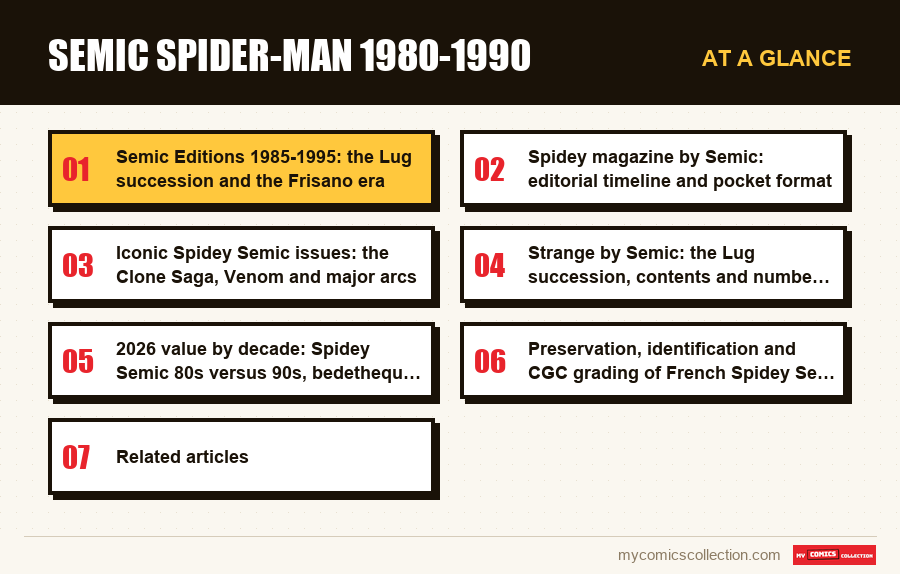
Semic Editions 1985-1995: the Lug succession and the Frisano era
The editorial history of Semic Editions officially begins in 1985, when the publisher took over the operations of Lug, the Lyon-based publisher that had been the historic home of Marvel comics in France since 1969. The transition unfolded gradually between 1985 and 1986, under the supervision of Jean Frisano, an illustrator and art director whose legacy left a lasting mark on the visual style of the Spider-Man, Strange and Titans magazines. The Paris offices took the reins, while the Sirven printworks in Toulouse kept the technical pipeline that Lug had refined over two decades.
This 1985-1995 period corresponds to the maturity of the French newsstand comics market. Semic inherited a rich Marvel US catalog, negotiated at favorable rates thanks to earlier agreements, and maintained the monthly cadence on its main titles. The Frisano era imposed a recognizable visual identity: gouache-painted covers, tightly typeset title blocks and harmonized price banners. That graphic identity is now one of the authentication criteria sought by collectors who want to catalog their comics with precision.
Commercially, Semic had to contend with emerging competition from publishers like Comics USA and then Marvel France, which changed the landscape starting in 1996. The 1985-1995 period nonetheless remains the publisher's golden age, with print runs ranging between 60,000 and 120,000 copies for Spidey depending on the year. Partial reprints, special one-shots and bound albums enriched the lineup, creating subcategories that collectors now distinguish carefully. Newsstand sales dominated distribution by far, with specialty shops occupying only a marginal share until the late 1980s.
Jean Frisano's gradual departure from day-to-day supervision, around 1992, opened a second phase within the same decade. Covers evolved, some formats changed, and print quality varied across batches. These nuances directly affect current value: copies predating 1992, known as the "full Frisano era," trade on average 15% higher than equivalent later issues in comparable condition.
Spidey magazine by Semic: editorial timeline and pocket format
The Spidey magazine is the cornerstone of Semic's Spider-Man offering. Launched in direct succession to the Lug formula in 1985, the title kept the bound hardback pocket layout, roughly 152 pages, with a glossy laminated cover. The monthly cadence held without major interruption until the early 1990s, when certain periods saw the appearance of double issues or exceptional quarterly editions that today rank among the hunting targets for expert collectors.
A typical Spidey Semic table of contents from the 1980s combines three elements: a long Amazing Spider-Man episode translated into French, a supporting story featuring another Marvel hero (Daredevil, Power Man, Iron Fist), and an editorial feature or a readers' letters page. The centerfold poster, often missing from secondhand copies, is a major completeness criterion when assessing value. Savvy buyers systematically check for its presence before committing to a transaction above €30, as the best practices for buying and selling comics in France remind us.
The selection of adapted US episodes followed a logic of narrative continuity, with an average lag of 18 to 24 months behind the American calendar. This delay let Semic offer complete arcs in French, with no gaps, but introduced occasional discrepancies whenever the Paris editorial team deliberately skipped certain episodes deemed too dependent on context. This editorial practice, inherited from Lug, now fuels the research of enthusiasts who want to piece together the full thread of the history of Amazing Spider-Man in French.
The Spidey pocket format evolved subtly between 1985 and 1990. The page count stayed stable, but cover thickness varied depending on the cardboard suppliers, and the quality of the interior paper went through phases of more or less yellowing. The 1985-1987 copies used whiter paper that has held up better today, whereas the 1988-1990 period shows a tendency toward accelerated oxidation on poorly stored copies. This technical trait affects preservation and therefore valuation, as detailed in the guide to protecting your comics.
Iconic Spidey Semic issues: the Clone Saga, Venom and major arcs
Several Spidey Semic issues draw collector attention because of their narrative content. Spidey issue 65 (1985), among the first of the Semic formula, opens the sequence by publishing US episodes 226-227 of Amazing Spider-Man, late Bronze Age material. Its 2026 value ranges between €25 and €55 depending on condition, with occasional spikes to €80 for near-mint copies complete with their original poster. Sharp buyers consult the guides to Spider-Man key issues to pinpoint the strategic editions.
The 1987-1988 period contains the first French-language appearances of Venom, the major antagonist introduced in Amazing Spider-Man 300 (US, May 1988). The corresponding Spidey issue, released by Semic in 1989-1990 according to bibliographic sources, is a coveted collectible. Its current value sits between €90 and €180 in very good condition, with documented transactions above €250 for graded copies. The history of Venom in French begins precisely with this Semic issue, which justifies the sustained heritage interest.
The Clone Saga, originally published in the United States between 1975 and 1976 and later extended in the 1990s, spans several Spidey Semic issues scattered across the 1985-1995 decade. Partial reprints of earlier arcs coexist with newly translated episodes, creating a complex map that only experienced collectors master. Issues containing previously unseen sequences of the Clone Saga trade between €18 and €45 in decent condition, with significant spreads depending on the rarity of that year's print run.
Other landmark arcs appear in the 1985-1990 Spidey Semics: the marriage of Peter Parker and Mary Jane Watson (US Amazing 290-292, 1987), the arrival of the black costume (sequences spread across several issues), and the battles against Hobgoblin. Each arc influences the value of the issues involved, with ranges documented on bedetheque and confirmed by Catawiki sales. Buyers looking to buy Spider-Man cheap in vintage French favor non-sequential lots, where the strategic issues stay diluted within bundles priced at an average per-unit rate.
Strange by Semic: the Lug succession, contents and numbering
The Strange magazine holds a particular place in the Semic galaxy. Initially launched by Lug in 1970, the title continued its run under Semic from 1985 onward without a break in numbering, keeping the original counter started 15 years earlier. This continuity explains why the Strange issues numbered roughly 180 to 300 split between the original Lyon publisher and its Paris successor, creating ambiguities that collectors resolve by checking the interior colophon.
Unlike Spidey, centered on the lead character, Strange offered a choral table of contents where Spider-Man shared the spotlight with X-Men, Daredevil, Iron Man and other Marvel heroes. Amazing Spider-Man episodes alternated there with those of Spectacular Spider-Man and Web of Spider-Man, companion series launched in the United States in 1976 and 1985 respectively. This editorial diversity makes Strange a title prized by collectors who want to build a general Marvel library without juggling subscriptions to several magazines.
The value of the 1985-1990 Strange Semics settles between €6 and €35 on average for standard issues, with spikes to €70-90 for double special editions or copies containing notable first appearances. The Strange Spécial Origines, a special issue devoted to the origins of the Marvel characters, is a prime target for newcomers, with a current valuation between €40 and €110 depending on the year. Specialty guides on comic print runs help put these figures in context based on the volumes printed.
The Lug-to-Semic transition on Strange can be pinpointed across issues 178 to 185, where certain layout attributes evolve: the title font, the position of the price on the cover, the publisher's mention in the footer. Collectors identify the first Strange Semics by these graphic details, sometimes confirmed by checking bedetheque records or specialized archives. This transition phase draws particular market attention, with prices slightly above average for the hinge copies of 1985-1986. To browse our full Spider-Man catalog, see the comics listed on the site.
Collecting this series?
Track what you own, what you are missing and what your collection is worth. 7 day trial.
Start my trial →2026 value by decade: Spidey Semic 80s versus 90s, bedetheque ranges
A comparative analysis of the prices observed on bedetheque, Catawiki and eBay France for 2026 reveals a clear split between 1980s and 1990s Spidey Semics. Issues from 1985-1989 show an average range of €12 to €45 in fair to good condition, with an average rise of 22% since 2022. Copies in very good condition, complete with their original advertising inserts and centerfold poster, regularly reach €60 to €90, or even higher for the iconic issues mentioned above.
For the 1990-1995 period, the pricing grid sits slightly lower, between €8 and €32 on average, reflecting the greater availability of these issues on the secondary market. The larger print runs at the tail end of the period, combined with better average preservation by buyers of the day, explain this trend. The exceptions concern the issues containing Venom's inaugural French-language appearances, whose value doubled between 2020 and 2026, tracking the parallel rise of the corresponding US editions documented in the modern comics investment guides.
The premium factors center on several measurable criteria: presence of the centerfold poster (+15 to 30%), absence of creases on the spine (+10 to 25%), a cover with no rubbing or lamination loss (+20 to 40%), and freshness of the interior colors (+10 to 15%). Conversely, the discounts penalize copies stamped by libraries or newsstands, those annotated in pen and those showing heavily yellowed paper with visible acidification. A free valuation can provide a contextualized estimate for significant lots.
Catawiki auctions are a reliable indicator for tracking the monthly evolution of value. Lots of 10 to 30 Spidey Semics regularly trade between €80 and €350 depending on the quality and rarity of the issues included. Single-unit sales almost exclusively involve strategic issues or graded copies. Specialty marketplaces such as PriceMinister or dedicated vintage comic shops often list prices 15 to 25% above the eBay averages, justified by curation and a guarantee of provenance. Cautious collectors systematically cross-check several sources before setting their target budget.
Preservation, identification and CGC grading of French Spidey Semics
Preserving Spidey Semic magazines comes with specific constraints tied to the bound pocket format and the interior paper used between 1985 and 1995. Ideal storage is flat or stored upright and snug, in a room kept between 18 and 22°C, with humidity between 45 and 55%. Exposure to direct light accelerates the yellowing of laminated covers, while temperature swings cause the bound signatures to gradually come loose. PVC-free plastic sleeves, known as archival Mylar, are the protection recommended by conservators.
Identifying an original Spidey Semic edition rests on several visual and textual markers. The interior colophon lists the publisher, the Sirven printworks, the legal deposit and the press registration number. Reprints or reissues are distinguished by a different legal deposit or a specific note in the footer. Experienced collectors keep a reference sheet for each issue, a methodology shared in the guide to cataloging your comics rigorously.
Professional CGC grading has officially accepted foreign editions for several years now, including the French Lug and Semic magazines. The procedure follows the standard protocol with a grade assigned on the 0.5 to 10.0 scale, with an explicit "Foreign Edition" note on the slab label. Spidey Semics graded CGC 9.4 or higher form a distinct market category, with a substantial premium over equivalent raw copies. The details of the procedure and the costs are documented in the complete CGC grading guide and the strategic focus on CGC vintage versus modern.
The particularities of grading Spidey Semics mainly concern the physical format: pocket binding presents constraints that CGC evaluates with adjusted criteria, notably on the spine and the quality of the opening at the back. Copies that have been read intensively systematically lose several tenths of a point on the final grade, due to the micro-cracking of the bound spine. Collectors considering a submission for grading prioritize copies that have never been read, kept in an archive box since their initial acquisition. Group submissions through specialized French intermediaries make it possible to share shipping costs to the American CGC labs.
FAQ: Semic Spider-Man 1980-1990
Which Spidey Semic is worth the most in 2026?
The Spidey Semic issues containing Venom's first French-language appearance, published between 1989 and 1990 depending on the edition, sit at the top of the 2026 value chart. Copies in very good condition reach €150 to €250 in direct sales, with documented spikes above €350 for versions graded CGC 9.4 and higher. Spidey issue 65, among the first of the Semic formula in 1985, also holds a strategic place with an average value between €25 and €80. Double specials and bound special editions, rarer in circulation, regularly exceed €100 for copies complete with their original inserts. Print-run rarity and the completeness of the supplements remain the central variables for assessing market price.
Spidey Semic or Strange Lug to get started?
The choice between Spidey Semic and Strange Lug mainly depends on the starting budget and the thematic orientation you want. Strange Lug issues predating 1985 show a higher average value, between €15 and €80 each, owing to their greater age and historic status. The 1985-1990 Spidey Semics stay accessible between €8 and €45 for most issues, which lets you quickly build a coherent collection base. For a beginning collector focused on Spider-Man, Spidey Semic offers a better content-to-price ratio with a clear thematic focus. Strange Lug appeals more to fans of Marvel versatility and historic editions. Reviewing the ages of comics beforehand helps structure the choice.
How do you identify an original Spidey Semic edition?
Authenticating an original Spidey Semic edition involves five successive checks. First, examine the colophon on the interior pages to confirm the "Semic Editions" mention and the legal deposit corresponding to the presumed year. Second, verify the presence of the Sirven printworks in Toulouse in the footer. Third, observe the typography of the title on the cover, which follows a precise standard for the 1985-1989 and 1990-1995 periods. Fourth, check the press registration number, specific to each administrative period. Fifth, measure the physical format: Spidey keeps a stable pocket format of roughly 13 x 18 cm, with no major variation. Any divergence from these markers suggests a later reprint or an altered copy.
Is CGC grading worthwhile for Spidey Semic?
CGC grading adds significant value on Spidey Semics considered strategic: first French-language appearances, iconic issues containing major arcs, copies in exceptional, never-read condition. For these categories, the grading-fee investment is justified by the market premium obtained on resale, generally between 40 and 120% over the raw equivalent. On the other hand, grading remains economically pointless for common issues in average condition, where the fees exceed the expected upside. Pre-selecting grading candidates is therefore a strategic step. Savvy collectors cross-reference the analysis of their lot with the documented feedback in the complete CGC guide.
Where can you find complete Spidey Semics in 2026?
Several supply channels coexist on the French market in 2026. Catawiki auctions run weekly sessions dedicated to vintage French comics, with lots assembled by both professional and private sellers. Vintage comic shops in Paris, Lyon and Toulouse often hold deep stock, with a guarantee of provenance and a sorting by condition. The eBay France and Leboncoin marketplaces offer a large volume but call for heightened vigilance on descriptions and photos. Specialty events like Paris Manga BD or regional conventions offer hunting opportunities with direct negotiation. For collectors determined to rebuild a complete run, consulting a professional dealer remains the most effective channel, despite a price premium of 20 to 30% over the auction market.