Organizing your comics by age means sorting them according to the six recognized publishing eras: Golden Age (1938-1956) , Silver Age (1956-1970) , Bronze Age (1970-1985) , Copper Age (1985-1992) , Modern Age (1992-2014) , and Heroic Age (2014+). Each era is defined by landmark boundary issues (Action Comics #1, Showcase #4, Giant-Size X-Men #1, Crisis on Infinite Earths #1) and calls for separate physical storage to preserve condition and protect value.
Sorting by publishing era isn't just an historian's quirk. It's the most widely used organizational method among serious resellers, auction houses, and collectors with 500+ issues, because it aligns physical storage with market logic. A Bronze Age Spider-Man is stored, valued, and sold according to entirely different rules than a Modern Age copy. This guide covers all six eras recognized by the comics community: their boundary issues, the technical characteristics of each period, how to assign an era to any comic you own, and how to tag all of it in a collection app. By the end, you'll know how to sort 2,000 issues by age in a single afternoon, without confusion.
Why sort by publishing era rather than raw publication date
Sorting strictly by cover date is tempting: you just sort by date. But that approach ignores the reality of the market and the craft of collecting. Era-based sorting has established itself for four technical reasons.
First: boundary issues mark genuine breaks, not administrative ones. The shift from Golden to Silver Age happens in October 1956 with Showcase #4 (Barry Allen's first appearance as The Flash): not in 1957. The Bronze Age begins with Conan the Barbarian #1 (October 1970) and Green Lantern/Green Arrow #76 (April 1970), two titles that introduced a grittier, more mature tone. Sorting by decade flattens those distinctions.
Second: preservation requirements differ by era. A Golden Age book on acid paper needs a Mylar bag, reinforced backing board, and relative humidity kept at 45-50%. A Modern Age glossy 60 lb issue can handle more relaxed conditions. Mixing the two in one box shortens the life of the Golden Age material. Sorting by era creates coherent storage zones. The article organizing your collection in longboxes covers the logistics.
Third: valuation follows distinct rules for each era. On eBay, buyers frequently filter by era before drilling down to a specific series. A search for "Silver Age key issues" generates about 8 times more traffic than a year-specific search. Cataloging by era in your app aligns your internal vocabulary with the market's.
Fourth: editorial narrative. Marvel and DC structured their output around specific aesthetic periods: cover styles, format, cover price, paper quality, the presence or absence of the Comics Code Authority seal. Sorting by era means reading your collection as publishing history, not just a sequence of dates.
For a full overview of alternative methods, see sorting your comics by series and sorting your comics by publisher. The pure chronological method is detailed in sorting your comics in chronological order.
Golden Age 1938-1956: the foundations
The Golden Age officially begins with Action Comics #1 (June 1938), the first appearance of Superman. That date marks the commercial birth of the modern superhero. Over the next 18 years, the industry grew from a handful of titles to more than 600 series in simultaneous publication at its peak (1947-1948). Dominant genres: superheroes, war, romance, horror, westerns. More than 90% of Golden Age books in circulation today grade somewhere between Fair and Very Good: Near Mint is statistically rare.
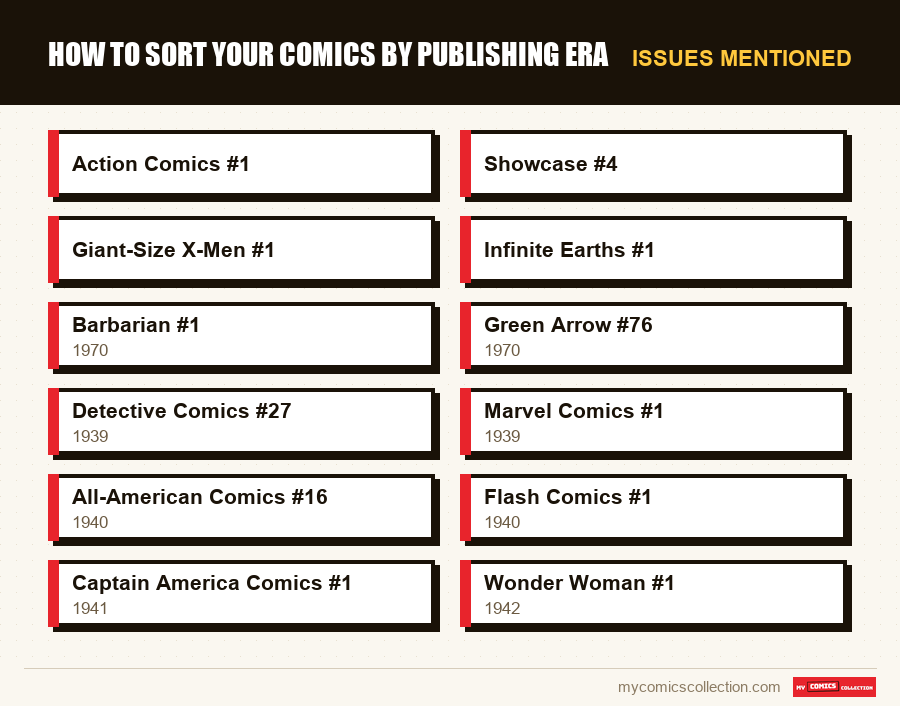
The key issues every Golden Age collector should know: Action Comics #1 (1938, first Superman), Detective Comics #27 (1939, first Batman), Marvel Comics #1 (1939, first Human Torch and Sub-Mariner), All-American Comics #16 (1940, first Green Lantern Alan Scott), Flash Comics #1 (1940, first Flash Jay Garrick), Captain America Comics #1 (1941, first Captain America), Wonder Woman #1 (1942), and Showcase #4, which in October 1956 closes the era by introducing Barry Allen.
Technical characteristics of a Golden Age book: format 7 x 10.5 inches (slightly larger than modern), 64 pages at 10 cents through 1948, highly acidic newsprint (pH below 5), no laminated covers. The physical fragility demands separate storage. For a mixed collection that includes a few Golden Age books, isolate them in a dedicated longbox with minimum 4-mil Mylar bags and acid-free backing boards. The article photographing your collection explains how to archive these pieces visually without handling them.
In a collection app, the "Golden Age" tag should apply automatically to any comic with a cover date before October 1956. Check how your Comics Manager handles this filter: in serious applications, the era field is pre-populated from the cover date. See building a personal comics database for field structuring.
Silver Age 1956-1970: the superhero renaissance
The Silver Age begins with Showcase #4 (October 1956), considered the first pure Silver Age comic. DC reinvented Flash, Green Lantern (Hal Jordan), the Atom, and Hawkman. Marvel followed in 1961 with Fantastic Four #1, which launched the "Marvel Method" and the modern flawed superhero. The period runs through roughly 1970, ending as several events converged: Jack Kirby's departure from Marvel, falling overall sales, and a shift in tone.
The key issues of the Silver Age rank among the most valuable in history: Showcase #4 (1956, first Barry Allen Flash), Showcase #22 (1959, first Hal Jordan Green Lantern), Fantastic Four #1 (1961), Amazing Fantasy #15 (1962, first Spider-Man), Hulk #1 (1962), Journey into Mystery #83 (1962, first Thor), Tales of Suspense #39 (1963, first Iron Man), X-Men #1 (1963), Avengers #1 (1963), Daredevil #1 (1964), Amazing Spider-Man #1 (1963), Strange Tales #110 (1963, first Doctor Strange).
Technical characteristics of a Silver Age book: format reduced to 7 x 10 inches (a standard that held through the early 1980s), 32 pages at 12 cents through 1969, still newsprint but slightly improved, Comics Code Authority seal present from 1954 onward. Preservation: conditions close to Golden Age, with slightly more tolerance. Silver Age books in NM 9.4 or better exist but are uncommon. For key issues, CGC or CBCS grading is essentially standard on the secondary market.
The Silver Age is the most active segment of the vintage comics market. Prices move quickly, which makes daily-updated valuation essential for this portion of your collection. Across 50 Silver Age issues, a monthly update can reveal $200 to $800 in upward or downward movement. Also track your collection's price history to identify trends.
Bronze Age 1970-1985: narrative maturity
The Bronze Age is marked by two nearly simultaneous milestones: Green Lantern/Green Arrow #76 (April 1970), Denny O'Neil and Neal Adams's "Hard-Traveling Heroes" arc, which brought social issues (drugs, racism) into mainstream superhero comics; and Conan the Barbarian #1 (October 1970) from Marvel, which opened fantasy to the mainstream. The period runs through Crisis on Infinite Earths #1 (April 1985), which restructured the DC Universe and conventionally marks the transition to the Copper Age.
The key issues of the Bronze Age are plentiful and strategically important: Amazing Spider-Man #129 (1974, first Punisher), Giant-Size X-Men #1 (1975, debut of the new X-Men: Wolverine, Storm, Colossus, Nightcrawler), Incredible Hulk #181 (1974, first full appearance of Wolverine), X-Men #94 (1975, start of the Claremont/Cockrum run), Star Wars #1 (1977, Marvel adaptation), Iron Man #55 (1973, first Thanos), Werewolf by Night #32 (1975, first Moon Knight), X-Men #129 (1980, first Kitty Pryde and Emma Frost).
Technical characteristics of the Bronze Age: stable format, 32 pages, cover price climbing progressively from 15 cents to 75 cents between 1971 and 1985, newsprint starting to incorporate more optical brighteners. The period saw the arrival of the direct market (comic shop distribution from 1979 onward), with specific cover editions distinct from newsstand copies. That newsstand vs. direct edition distinction is crucial for valuation: a direct edition in NM can be worth 2-3 times a newsstand equivalent on certain titles.
To catalog your Bronze Age books properly, always tag the edition (newsstand or direct) and the exact publisher. The method is covered in cataloging your collection: the methods. Bronze Age books often account for 30-40% of a collection built in the 1980s-90s, including through foreign reprint editions.
Copper Age 1985-1992: the independent turn
The Copper Age is bracketed by Crisis on Infinite Earths #1 (April 1985) at the start, and Image Comics with Spawn #1 (May 1992) or Youngblood #1 at the end. Seven intense years that saw the rise of creator-owned publishing, the dark superhero era (Watchmen , The Dark Knight Returns , Daredevil: Born Again), and the explosion of the speculator market. The Copper Age is sometimes called "late Bronze" by certain experts; its definition remains debated, but the current consensus separates it clearly from the Modern Age.
The key issues of the Copper Age are densely packed with classics: Crisis on Infinite Earths #1-12 (1985-86), The Dark Knight Returns #1-4 (1986), Watchmen #1-12 (1986-87), Amazing Spider-Man #298 and #299 (1988, first Venom cameos), Amazing Spider-Man #300 (May 1988, first full appearance of Venom), Batman #404-407 (Year One, 1987), X-Men #266 (1990, first Gambit), New Mutants #87 (1990, first Cable), New Mutants #98 (1991, first Deadpool).
Technical characteristics of the Copper Age: format still stable, cover price rising from 75 cents to $1.50 by 1991, paper starting to incorporate glossy coating on premium titles, emergence of prestige formats (The Dark Knight Returns) and hardcover graphic novels. The period also saw the mass proliferation of variant covers and "gimmick covers" (holograms, gold foil, embossing) that would peak at the start of the Modern Age.
The Copper Age holds a significant share of the current market's key issues: Venom, Deadpool, Cable, Gambit, Spawn, Hellboy. If you have a substantial Copper Age section, monthly valuation tracking pays off. For 100 Copper key issues, annual price swings can exceed $1,500. See organizing a collection of 1,000 comics for the right box sizing by era.
Modern Age 1992-2014: industrialization
The Modern Age opens with the founding of Image Comics in 1992 and Spawn #1 (May 1992), which brought creator-owned publishing to the mainstream at scale. The period spans 22 years and includes several sub-eras that experts distinguish: the Dark Age or Chromium Age (1992-1996, gimmick covers and speculation), the post-crash era (1996-2000, rationalization after the market implosion), Marvel Knights and Ultimate (2000-2008), and the Disney/Warner era (2008-2014). The conventional end of the Modern Age falls in 2014, with the launch of All-New, All-Different Marvel in 2015, or DC's Rebirth in 2016, depending on your school of thought.
The key issues of the Modern Age are numerous: Spawn #1 (May 1992), X-Men #1 Vol. 2 (October 1991, technically still Copper for some), Superman #75 (1993, Death of Superman), Batman #497 (1993, Bane breaks Batman's back), Preacher #1 (1995), Walking Dead #1 (October 2003, first issue), Walking Dead #19 (2005, first Michonne), Saga #1 (March 2012), Ms. Marvel #1 Vol. 4 (2014, first Kamala Khan), Hawkeye #1 by Fraction and Aja (2012).
Technical characteristics of the Modern Age: cover price climbing from $1.50 to $3.99 between 1992 and 2014, glossy 60 lb paper throughout, laminated covers on virtually every title, variants everywhere (sometimes 8 covers for a single issue, as with Star Wars #1 in 2015). The newsstand edition phased out gradually between 2013 and 2017: newsstand copies from that window are statistically scarce and have risen in value, sometimes to 3-10 times the direct edition equivalent.
For Modern Age books, quantity often trumps individual value. A typical modern collection skews heavily Modern Age. Age-based sorting becomes a mass-triage tool here: isolate the 5-10% of Modern key issues (first Kamala Khan, Walking Dead, Saga, Miles Morales), and keep the rest in standard storage. The Marie Kondo method applied to comics helps with trimming Modern bulk.
Collecting this series?
Track what you own, what you are missing and what your collection is worth. 7 day trial.
Start my trial →Heroic Age 2014+: the contemporary era
The Heroic Age, sometimes called the Twilight Age or simply Post-Modern, is a recent label that's still being debated. It refers to the period starting around 2014-2015 and continuing to the present day, defined by Marvel and DC's dominance at the box office, the consolidation of the direct market, editorial diversification (Boom! Studios, IDW, Aftershock, Behemoth, Bad Idea), and the era of sweeping universe-wide relaunches (Marvel All-New 2015, DC Rebirth 2016, Marvel Fresh Start 2018).
The key issues of the Heroic Age: Star Wars #1 (January 2015, first Marvel issue post-Lucasfilm acquisition), Squirrel Girl #1 Vol. 2 (2015), Black Panther #1 by Coates (2016), DC Universe Rebirth Special #1 (May 2016), Action Comics #1000 (April 2018), Spider-Man #1 by Bagley and Bendis (2016), Daredevil #1 by Zdarsky (2019), Immortal Hulk #1 by Ewing (2018), King in Black #1 (2020), Ultimate Spider-Man #1 Vol. 2 (2024).
Technical characteristics of the Heroic Age: cover price between $3.99 and $5.99 depending on the title, same format as Modern, high-weight glossy paper, an explosion of variant covers (sometimes 15-20 variants for a major #1), and the rise of "ratio variants" (1:10, 1:25, 1:50, 1:100, 1:200) that create artificial scarcity tiers. This variant inflation makes rigorous cataloging essential: without the exact cover noted, valuation is impossible.
For Heroic Age books, barcode scanning is the only viable method. Manual entry can't keep pace with the current weekly release schedule. The guides barcode scanning on iPhone and barcode scanning on Android cover best practices. For managing new weekly releases, see monthly collection maintenance routine.
6-step physical sorting method by era
Sorting a 2,000-issue collection by era takes an afternoon if you follow the method. Here's the proven procedure.
Step 1: set up six physical zones. Six longboxes or six distinct spots on the floor, labeled Golden, Silver, Bronze, Copper, Modern, Heroic. For smaller collections under 500 issues, Golden and Silver can share a box, as can Modern and Heroic, but eventual separation is still recommended.
Step 2: sort by cover date. Nearly every American comic prints the cover date beneath the title or at the bottom of the cover. For exceptions, check the copyright notice on the first interior page. A quick 8-second-per-book pace is realistic for Modern Age books; expect slower going with Bronze and Golden Age, where you may need to check the publisher.
Step 3: apply the date boundary grid. Before 1956-10 = Golden. 1956-10 to 1970-04 = Silver. 1970-04 to 1985-04 = Bronze. 1985-04 to 1992-05 = Copper. 1992-05 to 2014-12 = Modern. 2015-01 and later = Heroic. For ambiguous cases (April or May 1985, for example): pick one publisher convention and stick with it.
Step 4: insert a divider for each sub-series within each longbox. Once the era is assigned, secondary sorting within the box goes by publisher, then by series, then by ascending issue number. See sorting by series and sorting by publisher for the second-level method.
Step 5: label and number the longboxes. Number each box (Box 1, Box 2…) and enter that number in your catalog app in the "physical location" field. With 2,000 issues spread across 8 longboxes, you can locate any comic in 30 seconds instead of 20 minutes of digging. The complete method is in collection numbering systems.
Step 6: audit and photograph each longbox. Once sorting is done, photograph each open box with the contents visible. That photo becomes a quick reference for locating a series, and proof of inventory for insurance purposes. Store the photos in your collection app as attachments.
How to tag an era in a collection app
Every serious app handles the "publishing era" field, but with different conventions. Three typical scenarios.
Case 1: automatic tag from cover date. The app calculates the era from the official cover date: no manual input needed. This is the most common approach in modern apps. Still spot-check the boundaries (April 1985, May 1992) on a few samples: some apps use a different convention than yours.
Case 2: manual tagging required. In older apps or Excel spreadsheets, the "era" field must be filled in manually for each entry. For 2,000 books already entered without era data, filter by date and then bulk-update. In Excel, a nested IF formula handles it in 5 minutes:
=IF(B2<DATE(1956,10,1),"Golden",IF(B2<DATE(1970,4,1),"Silver",IF(B2<DATE(1985,4,1),"Bronze",IF(B2<DATE(1992,5,1),"Copper",IF(B2<DATE(2015,1,1),"Modern","Heroic")))))
where B2 contains the cover date. This formula returns the correct era tag in a single column.
Case 3: compound tag with sub-era. For the most detail-oriented collectors, the tag combines a main era and a sub-era: "Modern Early (1992-1996)", "Modern Mid (1996-2008)", "Modern Late (2008-2014)". This granularity helps with sub-period valuation but adds friction to data entry. Reserve it for collections of 5,000+ issues with a thematic specialty. See building a personal comics database for custom field structuring.
Common pitfalls and gray areas in age-based sorting
Four pitfalls come up repeatedly among collectors new to era-based sorting.
Pitfall 1: reprints and facsimile editions. A facsimile of Amazing Fantasy #15 published in 2022 is not a Silver Age comic: it's a Heroic Age book that reproduces Silver Age content. The era field should reflect the actual publication date, not the date of the original content. This distinction is critical for valuation: a facsimile is worth around $10; the original is worth $50,000+.
Pitfall 2: foreign editions. A French Lug or Aredit reprint from the 1980s reprinting Silver or Bronze Age American content: what era does it belong to? The dominant convention: assign the era based on the publication date of the copy you own. Your Strange #1 Lug from 1970 is a Bronze Age French edition, even if it contains Silver Age American material.
Pitfall 3: annuals and specials. Annuals, giant-size issues, and king-size issues follow the standard cover date rule. X-Men Annual #1 from 1970 is Silver; X-Men Annual #14 from 1990 (which contains the first Gambit along with X-Men #266) is Copper. No exceptions to the date rule.
Pitfall 4: European comics and manga. The Golden/Silver/Bronze age system is an American convention. Franco-Belgian comics and manga don't use this nomenclature. If your collection mixes US comics, European BD, and manga, create a separate "work type" field distinct from the "publishing era" field to avoid confusion.
To avoid these pitfalls from the start, read collection organization pitfalls, which covers classic structural mistakes.
FAQ: Sorting your comics by era
What is the exact boundary between the Silver Age and the Bronze Age?
The majority convention places the shift in April 1970 with Green Lantern/Green Arrow #76. Some experts prefer October 1970 with Conan the Barbarian #1. For your collection, pick one date and apply it consistently. The difference affects fewer than 2% of comics and has no impact on market valuation.
Should my French Lug and Aredit reprints be classified by American or French era?
By the era that matches their French publication date. A Strange #1 Lug published in January 1970 falls in the late Silver Age (since the Bronze Age begins in April 1970), even if it contains American comics from the 1960s. The era field should reflect your physical object, not the source material's original date.
Is a 2022 facsimile edition Silver Age or Heroic Age?
Heroic Age. The facsimile reproduces Silver Age content but is a physical object printed in 2022 on modern paper, with a barcode and current cover price. Its value (typically $10-$30) is a world apart from the original. Tag it "Heroic Age" and add a note, "facsimile of [original issue]", for traceability.
How do I classify a comic that has been reprinted multiple times?
By the print date of your specific copy, never by the original publication date. Amazing Spider-Man #1 exists as a first printing from 1963 (Silver), a "Golden Record Reprint" second printing from 1966 (Silver), a 1979 reprint (Bronze), and a 2020 facsimile (Modern/Heroic). Four different eras, same title.
Do I need a separate box for each era?
Once you have more than 200 issues in a given era, yes. Below that threshold, two eras can share a longbox (Golden + Silver on one side, Copper + Modern on the other) with a cardboard divider between them. For the Heroic Age, which grows quickly, plan for a dedicated box even at 100 issues: you'll fill it fast.
Is era-based sorting compatible with series-based sorting?
Yes, as a hierarchy: era at the first level (which longbox), series at the second level (divider within the box), issue number at the third level (ascending order). This three-level structure is the most common among resellers and scales cleanly to 20,000 issues without reorganization.
Are my Heroic Age books already obsolete in 2026?
No. The Heroic Age label covers 2014/2015 through the present with no established end date. Some observers anticipate a transition to a new era, sometimes called the "Streaming Age" or "Post-MCU Age", that could begin between 2025 and 2027, but the community hasn't reached a consensus. For now, every comic published post-2014 remains Heroic Age.
How long does it take to sort 1,000 issues by era?
Three to four hours for a raw sort with longbox labeling, without any database entry. Add parallel catalog updates in your app (era field + location field) and budget six to eight hours. The six-step method described above tracks to that estimate for a well-prepared collection.
Related articles
- Sorting your comics by series: the method
- Sorting your comics by publisher
- Sorting your comics in chronological order
- Numbering system for your collection
- Organizing your collection in longboxes
- Organizing a collection of 1,000 comics
- Cataloging your collection: the methods
- Tracking your collection's price history