For a comic book collector, knowing the history of the medium isn't a luxury, it's an indispensable compass. Understanding that a given issue belongs to the Golden Age immediately explains why it's worth thousands of dollars and why finding it in Near Mint condition is nearly impossible.
For a comic book collector, knowing the history of the medium isn't a luxury, it's an indispensable compass. Understanding that a given issue belongs to the Golden Age immediately explains why it's worth thousands of dollars and why finding it in Near Mint condition is nearly impossible. Grasping why the 1990s were a speculative bubble helps explain why most comics from that decade can still be found for a few dollars in convention bins. And understanding the MCU's impact on the market since 2008 helps anticipate which issues will surge in value during the next Marvel film release.
The history of American comics divides into distinct eras, each with its own visual codes, narrative conventions, print runs, and market dynamics. From Action Comics #1 in 1938 to the Spider-Man multiverse variant frenzy of 2021, here's a comprehensive overview, with key issues, pivotal dates, and lessons for your collection.
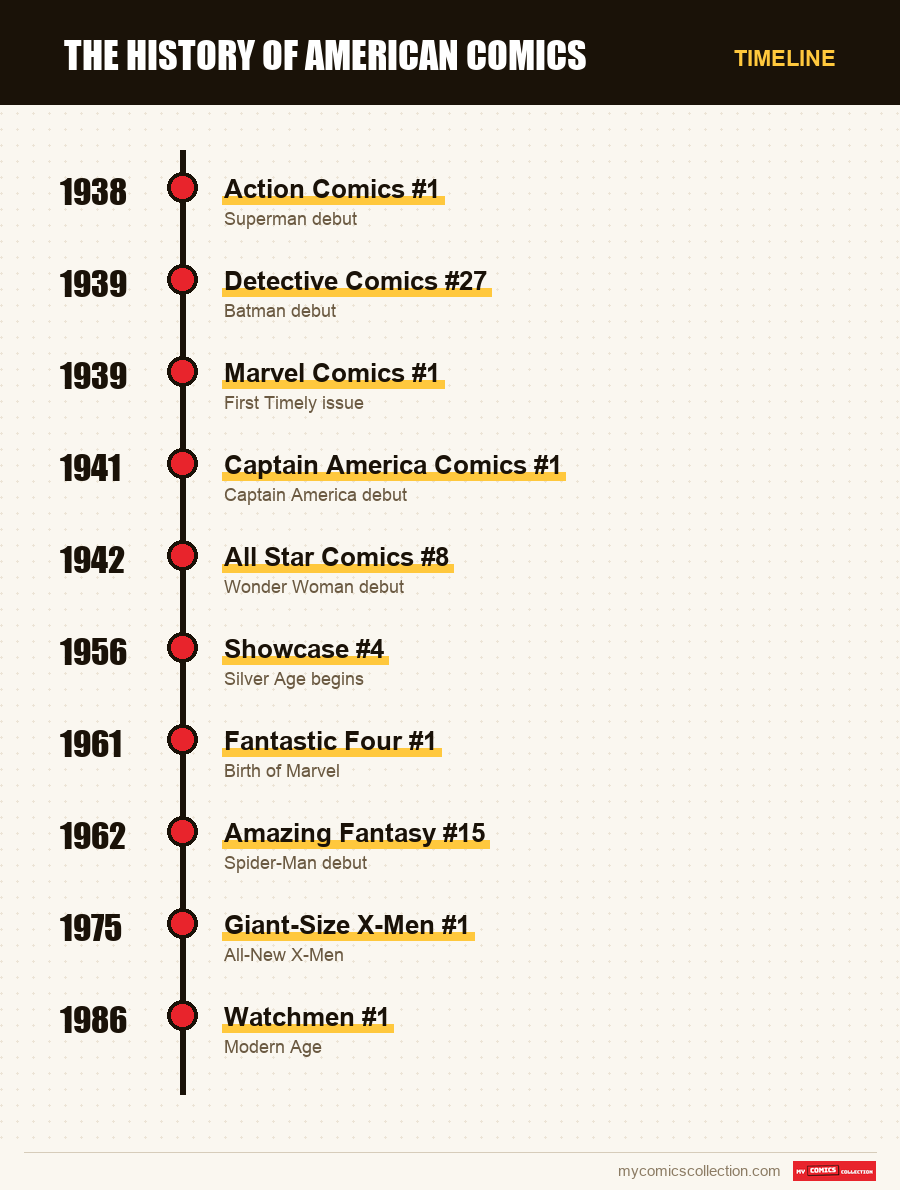
The Complete Timeline of American Comics
Five major eras structure the history of American comics. Each has its own stylistic characteristics, market conditions, and iconic issues that are the subject of collector desire today.
The Events That Changed Comic Book History
Beyond the major eras, certain specific moments radically reconfigured the industry, the market, and popular culture around comics. Here are the eight major turning points every serious collector should know.
Action Comics #1, The Birth of a Medium
The first superhero comic sold for 10 cents. Print run: approximately 200,000 copies. Current value in CGC 9.0: over $6 million. Fewer than 100 known copies survive.
The Comics Code Authority Censors an Industry
Following Wertham's Seduction of the Innocent and U.S. Senate hearings, publishers self-censored. EC Comics folded. The industry lost dozens of publishers overnight.
Fantastic Four #1, The Birth of the Marvel Universe
Stan Lee and Jack Kirby invent a coherent universe of flawed, human superheroes. A narrative revolution that still defines Marvel's storytelling structure today.
Giant-Size X-Men #1, The Run That Changed Everything
Relaunches a moribund X-Men franchise with an international team. Sets the stage for Chris Claremont's legendary 16-year run, the Dark Phoenix Saga, and Days of Future Past. The cornerstone of any X-Men collection.
DKR + Watchmen, Comics Become Literature
Two landmark works published the same year prove that comics can be as complex and ambitious as the finest novels. The medium would never be perceived the same way again.
Image Comics Is Founded
Seven star artists leave Marvel to create their own characters. Spawn #1 sells 1.7 million copies. The publishing model changes: creators can own what they make.
Iron Man in Theaters, The MCU Begins
The first Marvel Studios film turns millions of moviegoers into first-appearance hunters. Key issue prices explode durably. A thriving secondary market structures itself around adaptations.
Spider-Man: No Way Home, The Multiverse Boom
The film unites three generations of Spider-Man and triggers a spectacular boom on all multiverse-related comics. Ultimate Fallout #4 and Edge of Spider-Verse #2 see their prices multiply by 10 within weeks.
Organize your collection by era. My Comics Collection lets you tag each issue by era (Golden Age, Silver Age, Bronze Age…), track condition, and get valuations based on current eBay listings. Knowing you own a Bronze Age book in excellent shape completely changes how you evaluate your collection.
Collecting this series?
Track what you own, what you are missing and what your collection is worth. 7 day trial.
Start my trial →How to Collect by Era: Practical Strategies
Golden Age (1938-1955): Expert Territory
Collecting the Golden Age isn't for the uninitiated. Prices start at several hundred dollars for common issues and climb to tens or hundreds of thousands for key issues. Authentication is non-negotiable: never buy a Golden Age book without CGC or CBCS certification. The fragility of era pulp paper makes restoration fakes extremely common, a restored copy is worth 10 to 20 times less than an unrestored copy of the same apparent grade. To start in this era, target secondary issues from popular series rather than out-of-reach first issues.
Silver Age (1956-1970): The Accessible Alternative to Golden Age
The Silver Age represents the dream sweet spot for ambitious collectors today. Core Marvel key issues from this period, Amazing Fantasy #15, X-Men #1, Avengers #1, Fantastic Four #1, are still theoretically accessible at mid-grade (CGC 4.0-6.0), unlike their Golden Age equivalents. But prices climb fast: an Amazing Fantasy #15 in CGC 5.0 trades around $100,000. The winning strategy is to target second-tier key issues: first appearances of characters whose MCU adaptations haven't happened yet, or legendary run issues that remain undervalued.
Bronze Age (1970-1985): The Best Value in the Market
The Bronze Age is widely considered by experienced collectors to offer the best value for money right now. Narrative quality is often superior to the Silver Age (more complex themes, more mature art), print runs were sufficient that good-condition copies exist, but demand remains lower than for the Silver Age. Key issues like Incredible Hulk #181 (Wolverine), Giant-Size X-Men #1, or Amazing Spider-Man #121 remain relatively accessible at mid-grade. This is the ideal era for building a solid collection without breaking the bank.
Modern Age (1986-2011): Most Accessible, but Key Issues Are Rising
The vast majority of Modern Age comics, especially from the 1990s, have little value due to massive overproduction. An X-Men #1 by Jim Lee (1991) was printed in 8.1 million copies: it's easily found for $5-$15. But the genuine key issues of this era, New Mutants #98 (first Deadpool), Amazing Spider-Man #300 (first Venom), Batman Adventures #12 (first Harley Quinn), have seen spectacular revaluations since their film and TV adaptations. These are the issues to target, with careful condition checks before buying.
Independent Renaissance (2012-Today): Speculation and Opportunities
The contemporary era offers the best speculative opportunities for those who can anticipate. The key: identify first appearances of characters likely to be adapted to film or series before official announcements make them unaffordable. Edge of Spider-Verse #2 (Spider-Gwen) was a $5 book before the movie announcement, it now trades for hundreds of dollars. Limited-run variants from smaller publishers (Image, Boom Studios, IDW) can also represent opportunities, provided you select projects with strong adaptation potential.
Key issues to know
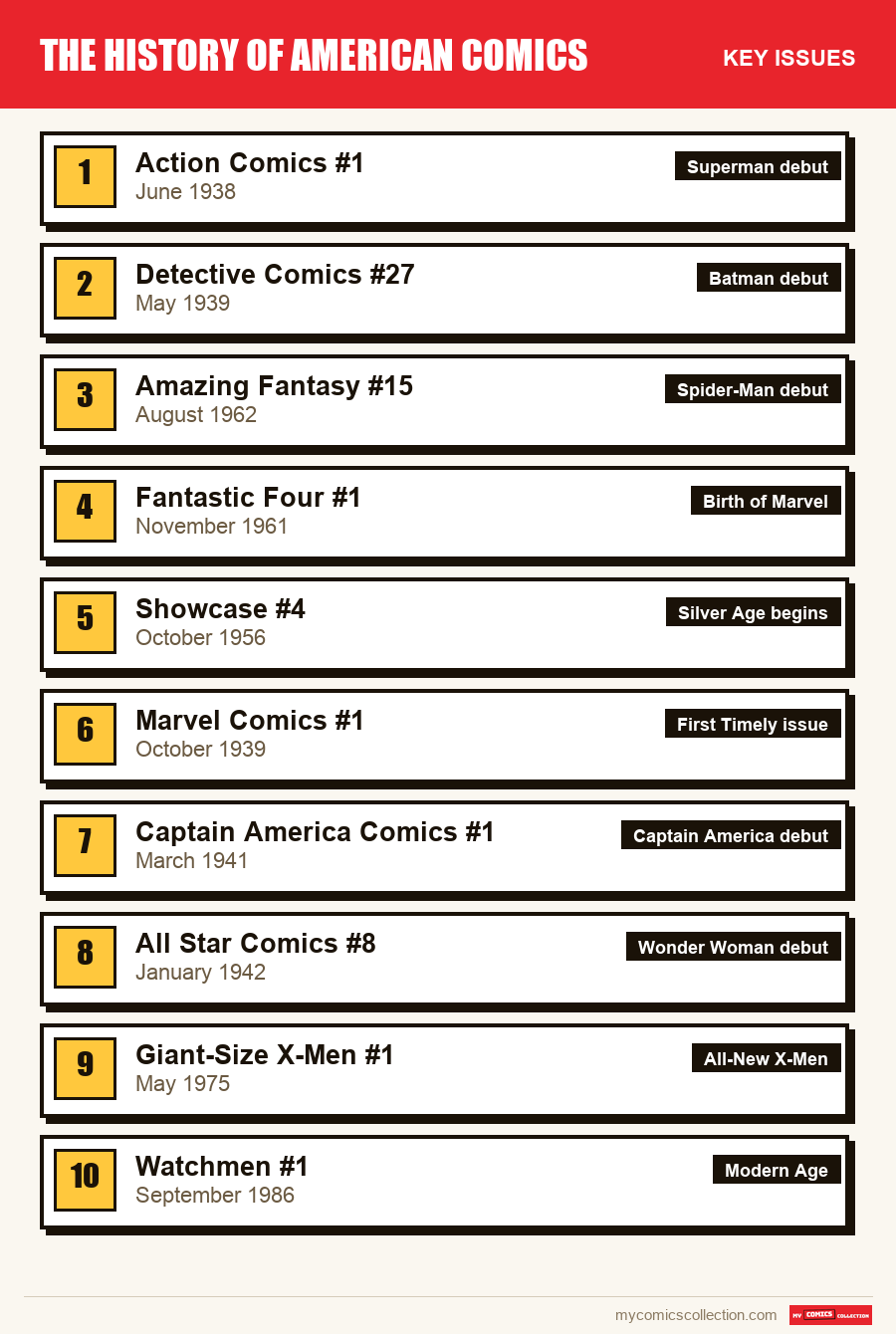
Action Comics #1
Jerry Siegel and Joe Shuster introduce Superman, a visitor from another planet with superhuman strength, in an anthology that sold for ten cents. The cover showing him lifting a car became the founding image of the genre. It is the birth certificate of the superhero and the most iconic comic of the Golden Age.
Detective Comics #27
Bill Finger and Bob Kane deliver "The Case of the Chemical Syndicate", the first adventure of the Bat-Man, alias socialite Bruce Wayne. Less than a year after Superman, this powerless vigilante paves the way for the dark detective hero. It is the Golden Age's other absolute pillar.
Amazing Fantasy #15
In the final issue of an anthology, Stan Lee and Steve Ditko introduce Peter Parker, a high school student bitten by a radioactive spider. Uncle Ben's death, which he could have prevented, teaches him that with great power comes great responsibility. The first flawed teenage hero changes everything.
Fantastic Four #1
Stan Lee and Jack Kirby bring together Reed Richards, Sue and Johnny Storm and Ben Grimm, transformed by cosmic rays during a space flight. These bickering heroes with very real problems launch the Marvel style. It is the starting point of the entire modern Marvel universe.
Showcase #4
Robert Kanigher and Carmine Infantino reinvent the Flash as Barry Allen, a police chemist struck by lightning amid a shelf of chemicals. This science-based rather than magic-based relaunch is regarded as the birth of the Silver Age. DC follows with Green Lantern and the Justice League.
Marvel Comics #1
Timely's first comic, the ancestor of Marvel. It features the first appearance of Carl Burgos's android Human Torch and an adventure of Bill Everett's Namor the Sub-Mariner. It is the founding issue of the house that becomes Marvel Comics.
Captain America Comics #1
Joe Simon and Jack Kirby create Captain America and his young sidekick Bucky, before the United States even enters the war. The cover showing the hero punching Hitler is one of the most famous in comics history. The issue embodies the patriotic Golden Age of World War II.
All Star Comics #8
Alongside the Justice Society's adventures, William Moulton Marston and Harry G. Peter introduce Wonder Woman, an Amazon princess who leaves her island for the world of men. She completes DC's trinity with Superman and Batman. A major Golden Age first appearance.
Giant-Size X-Men #1
Len Wein and Dave Cockrum relaunch the X-Men with an international team: Storm, Colossus, Nightcrawler and Thunderbird make their first appearances alongside Wolverine. Chris Claremont then takes over as writer. The starting point of the biggest franchise of the 1980s.
Watchmen #1
Alan Moore and Dave Gibbons open their twelve-issue maxiseries with the murder of the Comedian, which Rorschach sets out to investigate. Together with The Dark Knight Returns the same year, Watchmen establishes comics as an adult literary form. An essential milestone in the history of the medium.
Frequently Asked Questions About Comic Book History
Manage Your Collection Across All Eras
Whether you own hard-to-find Bronze Age books, valuable Silver Age keys, or Modern Age spec plays, My Comics Collection lets you organize, value, and track everything in one place.
Free 7-Day Trial, No Commitment