A French EO (édition originale, or first edition) is the first printing of an album on French soil. You identify it through the indicia, the legal deposit date, the ISBN code, and the "première édition" notice. Its value often exceeds the reprint by 30 to 100% on the secondary market for Panini Deluxe or Urban Absolute.
On the French comics market, two seemingly identical copies can show considerable price gaps. A 2013 Urban Absolute Batman: Year One trades between €80 and €120 as a first edition, versus €40 to €55 for the 2018 reprint. A 2008 Panini Watchmen Absolute tops €200 as an EO, while the 2014 Urban reprint caps out at €90. This gap is explained by relative scarcity, the limited initial print run, and the collector appeal of the original piece. Understanding the distinction between a first edition and a reprint is therefore an essential skill for anyone buying, selling, or appraising a French-language comics library.
Identification doesn't come down to a cover date. French publishers (Panini Comics, Urban Comics, Glénat Comics, Bliss Comics, Delcourt, Bragelonne, and formerly Lug, Semic, Arédit) apply different editorial conventions to flag successive printings. The EAN barcode, the legal indicia, the achevé d'imprimer (printing completion notice), and the copyright all serve as clues to cross-reference. This guide details the five technical criteria for telling an EO apart from a reprint on the French market, examines the EO premium across each publisher's flagship collections, and lays out an authentication methodology that applies just as well to 1970s Lug albums as to the latest 2025 Urban Nemesis releases.
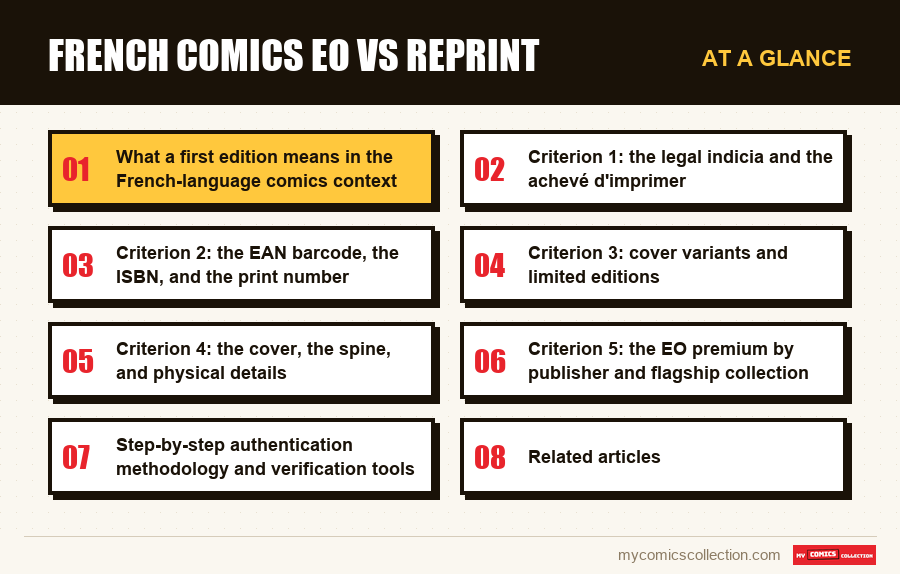
What a first edition means in the French-language comics context
The French first edition, abbreviated EO in collector jargon, refers to the very first printing of an album on the French-language market. It's clearly distinct from the American first edition (the US first print): a Marvel comic published in New York in 1979 might see its first French translation at Lug in 1982, then a Semic reprint in 1991, then a Panini omnibus in 2010. Each of these stages constitutes a French EO for its specific printing, even if the narrative content stays identical.
This definition takes on particular importance within the French editorial ecosystem. Lug, founded in Lyon in 1969 by Marcel Navarro, carried Marvel France until 1989 under titles like Strange , Spidey , Nova , and Titans. Semic Comics France took over between 1985 and 1995, an era when Strange continued in parallel. Panini Comics France recovered the Marvel license in 1996 and gradually structured the Deluxe, Best Of, and Marvel Now lines. On the DC side, Urban Comics succeeded Panini in 2012 and launched the Absolute, DC Renaissance, DC Rebirth, and DC Black Label collections. Each editorial transition generated distinct printings, sometimes for the same story, creating a patchwork in which the EO has to be identified case by case.
From a legal standpoint, the achevé d'imprimer has appeared mandatorily in every French book since the decree of January 12, 1995. This notice indicates the printer, the city, the month, and the year. For a genuine EO, this date must match, give or take a few weeks, the announced BNF legal deposit date and the first bookstore release. A second printing typically appears six to eighteen months later, sometimes faster for hits like Batman: Hush or Brian K. Vaughan's Saga. To understand the scarcity dynamics at play, see also the guide on comic print runs and the print run.
Criterion 1: the legal indicia and the achevé d'imprimer
The indicia is the most reliable element for authenticating a French EO. Usually located on page 2, page 4, or the last page depending on the publisher, it contains the original copyright, the French publisher's name, the head office address, the name of the publication director, the ISBN number, the legal deposit, and the achevé d'imprimer.
At Panini Comics France, the indicia has historically sat on the inside front page or the inside back cover. The standard 2008-2015 formula reads: "Première édition," followed by the month and year. A notice like "Deuxième édition, mars 2014" (second edition, March 2014) or "Réimpression 2017" (2017 reprint) immediately signals that this is not an EO. On Marvel Deluxe volumes, the achevé d'imprimer frequently mentions Grafica Veneta in Italy or a French printer like Pollina. A Civil War Deluxe EO is dated June 2007, while the 2016 hardcover reprint shows an achevé d'imprimer nine years later.
Urban Comics, more rigorous in its documentation since 2012, systematically includes the notice "Première édition : [month] [year]," followed where applicable by the reprint dates on the same line. An Urban Watchmen Absolute copy carrying only "Première édition : avril 2013" is an EO. If the next line reads "Deuxième tirage : septembre 2014" (second printing, September 2014), the copy in hand is a reprint. The Lug and Semic publishers, predating 1996, used a less standardized system: in that case you need to check the quarterly legal deposit number and the achevé d'imprimer date on the last page, often set in very small type. This method aligns with the one laid out in the complete guide to cataloging your comics.
Criterion 2: the EAN barcode, the ISBN, and the print number
The EAN-13 barcode printed on the back cover carries several pieces of information about the edition. The first three digits identify the country where the registration was filed (978 for books, followed by the country code). The publisher prefix lets you identify the imprint: 2-8094 for Urban Comics, 2-8094 for Glénat Comics, 2-7989 for Panini Comics, 2-7045 for Bragelonne, 2-8126 for Bliss Comics. The sequence number follows, then the check digit.
The ISBN also appears in the indicia. A key point: when a reprint is identical, the ISBN stays unchanged, which complicates authentication by this criterion alone. On the other hand, a new edition with modifications (different cover, reordered chapters, added afterword, revised translation) triggers a new ISBN. Neil Gaiman's Sandman, published by Urban in omnibus form since 2013, has gone through several successive ISBNs because the reissued Absolute and Black Label editions received distinct critical apparatus.
Some publishers print a print counter on the spine or back cover as a series of descending numbers (1 2 3 4 5 6 7 8 9 10 for the first edition, the smallest digit indicating the current printing). This convention, inherited from Anglo-American publishing, occasionally shows up at Delcourt Comics and Bragelonne. When it appears, the sequence "5 6 7 8 9 10" signals a fifth printing, so clearly not an EO. Cross-referencing these clues with the print run guide lets you estimate relative scarcity.
Criterion 3: cover variants and limited editions
The notion of an EO gets complicated by the proliferation of alternate covers launched at release. Panini and Urban regularly distribute standard bookstore editions and exclusive editions for festivals (Angoulême, Paris Comic Con, Comic Con Paris) or specialty chains (Fnac, Cultura, Album, Pulp's Comics). Sean Murphy's Batman: White Knight, released by Urban in March 2018, came in a standard cover and an exclusive Fnac cover with a cloth-bound spine. Both are EOs, but with very distinct print runs.
An exclusive edition limited to 500 or 1,000 copies will command a higher value than the standard edition printed in 8,000 or 15,000 units. Tom King's Mister Miracle at Urban Black Label (March 2019) circulated in a standard edition and a numbered, signed edition of 350 copies, the latter topping €180 once sold out, versus €35 for the standard version. Identifying the exact print run requires consulting period editorial announcements, Bedetheque entries, or the internal Urban and Panini catalogs.
At Bliss Comics, founded in 2013 by Cédric Illand, the Black & White collection offers translated American indie comics with very small print runs (sometimes 800 to 2,000 copies). Joshua Williamson's Birthright , Chris Dingess's Manifest Destiny , and Cullen Bunn's Bone Parish shipped with confidential EOs that became rare after two or three years. Glénat Comics, more oriented toward Image Comics and IDW, follows a comparable logic for series like Postal or Black Magick. The initial scarcity drives the EO premium up by 50 to 200% once a series sells out, as analyzed in the sleeper issues guide.
Criterion 4: the cover, the spine, and physical details
Reprints frequently feature subtle modifications that the trained eye spots. On Panini Deluxe albums, the move from first to second edition is sometimes accompanied by a change in lamination (matte to glossy), a tint variation on the cover background (different saturation), or even an adjustment to the collection logo. Daredevil Deluxe Bendis volume 1, released in 2008, shows a matte cover with a silver Panini logo in the first edition; the 2013 reprint displays a gold Panini logo and glossy lamination.
The book's spine also gives away clues. Urban Absolute EOs (large 22 × 32 cm format, cloth-bound spine, hardcover slipcase) include a spine with screen printing specific to the initial printing. Reprints sometimes replaced the hardcover slipcase with a cheaper laminated sleeve, which immediately distinguishes the two generations. A 2008 Panini Watchmen Absolute shipped in a black hardcover slipcase with an embossed logo is far more sought after than the 2013 Urban version, despite strictly identical narrative content.
Paper thickness and print quality can vary between the EO and the budget reprint. Reprints meant to broaden distribution sometimes adopt a lower paper weight (90 g/m² instead of 110 g/m²), reducing the volume's overall thickness by 2 to 4 mm on 400-page books. This difference doesn't affect reading but explains diverging production costs. To keep these editions in optimal condition, the comics preservation guide details the sleeves suited to the hardcover album format.
Collecting this series?
Track what you own, what you are missing and what your collection is worth. 7 day trial.
Start my trial →Criterion 5: the EO premium by publisher and flagship collection
The EO premium, the value gap between the first printing and reprints, varies widely by publisher, collection, and the title's scarcity. Based on eBay sold listings from 2024-2025, Vinted, Leboncoin, and Catawiki, several orders of magnitude emerge.
At Urban Comics, the Absolute collection posts the highest premiums. All Star Superman Absolute, EO 2014, trades at €130-160, versus €70-85 for the 2019 reprint, an 85% premium. Sandman Absolute volume 1, EO 2015, tops €200 once sold out, while the 2020 reprint caps at €95. The DC Black Label collection follows a similar trajectory: Brian Azzarello's Joker, EO 2008 Panini DC Deluxe, tops €60, versus €25 for the 2013 and 2018 Urban reprints.
At Panini Comics, the vintage 2007-2012 Marvel Deluxe collection is appreciating. House of M Deluxe, EO 2007, reaches €70-90 on eBay sold, versus €35-45 for the reprints. Civil War Deluxe, EO 2007, ranges between €80 and €110, a 60% premium over the 2016 reprints. The Best Of Marvel line, less sought after, shows smaller gaps (15 to 25% EO/reprint difference). On the Lug and Semic side, the Strange , Nova , Titans , and Mustang issues published between 1970 and 1995 carry highly variable values depending on the number and condition: a 1970 Strange #1 in decent shape tops €300, while #75 in mint shape is worth €25-40. The Marvel vs DC vs Image guide puts collection strategies by publisher into context. For a personalized appraisal, the free appraisal lets you put a number on a specific piece.
Step-by-step authentication methodology and verification tools
Authenticating a French EO requires a rigorous methodology, especially for pieces predating 1996, when editorial standardization was less systematic. The first step is to photograph the indicia, the barcode, the back cover, and the achevé d'imprimer on the last page. These shots will serve as a reference for comparison against Bedetheque entries, the publisher's official site, or specialized Facebook groups (Collectionneurs Lug, Strange Magazine France, Comics France).
For modern Panini and Urban editions, the Bedetheque.com database systematically lists first edition dates, ISBNs, and successive printings. Cross-referencing your copy's achevé d'imprimer date with the Bedetheque entry settles the question in a few minutes. For Lug and Semic issues, the forumcomics.fr site and Vincent Bernière's collector catalogs are the essential references. The specialty magazines Comic Box (1998-2012) and Scarce (1985-2010) also document the print runs of those pivotal eras.
For high-value pieces (above €200), authentication by a recognized expert (Hervé Lévy at Pulp's Comics Paris, Patrick Pinchart at La Bulle d'Or Lyon, or the specialized auctioneers at Drouot) secures the transaction. The French comics market remains less regulated than the Franco-Belgian BD market or the US market, but professionalization is progressing, particularly at the high end (out-of-print Urban Absolute, early Lug Strange numbers, Panini Marvel Knights omnibuses). To compare with the American grading scale, the complete CGC guide and the CGC vintage vs modern analysis offer transferable insights. The strategic investment guide and the list of the most expensive comics of 2026 round out this framework to guide your decisions.
FAQ: French comics: EO vs reprint
How can I tell if my Panini or Urban album is a first edition?
Open the album to the indicia, located on the inside front cover, the front matter page, or the last page depending on the publisher. Look for the notice "Première édition" followed by a month and a year. If only that line appears, with no mention of a reprint or second edition, you're holding an EO. If an additional line reads "Deuxième tirage" (second printing), "Réimpression" (reprint), or a later date, it's a reprint. Also check the achevé d'imprimer on the last page: the date should match, within about six weeks, the first bookstore release date announced by the publisher. Cross-reference with the Bedetheque entry or the publisher's online catalog to confirm.
Is the EO premium consistent across all French comics?
No, the EO premium concentrates on certain segments. It's strong (50 to 100%) on out-of-print premium collections: Urban Absolute, vintage 2007-2012 Panini Marvel Deluxe, numbered DC Black Label. It's moderate (20 to 40%) on standard albums by recognized authors still available as reprints. It's weak or even nil on recent reprints of major classics still in continuous reprinting (for example softcover Watchmen from Urban, standard V for Vendetta). The Lug, Semic, and Arédit issues follow a distinct logic based on the specific number and condition, with gaps that can exceed 500% between mint EOs and worn copies.
Is a hardcover reprint worth more than a softcover EO?
It depends on the editorial context. If the softcover version is the original edition (like the Lug or Semic magazines) and the hardcover is a later collector upgrade, then the hardcover can indeed exceed the softcover. Conversely, if the hardcover version is the premium EO (Urban Absolute, Panini Deluxe) and the softcover is a budget reprint meant to broaden distribution, the hardcover EO keeps its premium. The deciding factor remains the release chronology and the quality of execution: hardcover slipcase, cloth-bound spine, premium lamination, and fabric bookmarks strongly add value to an edition.
How do I authenticate a 1970s Lug Strange without standardized indicia?
Lug issues predating 1980 used a standardized but sparsely detailed format. Check the last page: quarterly legal deposit number (1st, 2nd, 3rd, or 4th quarter followed by the year), the printer's name (often Édit-Lyon or Le Buisson), and the achevé d'imprimer. The cover carries the number and the year. For the early Strange issues (1970-1972), the cover features a specific design listed in the Lug collector catalogs. Later reprints (the Spécial Strange collection or compilations) show a different format. When in doubt, photograph everything and post it to the Collectionneurs Lug Facebook group or check Bedetheque for comparison.
Is it better to buy an EO or wait for an omnibus?
It depends on your goal. For pure reading, a later omnibus generally offers better print quality, editorial bonuses, and a more practical format. For heritage value, the EO keeps a long-term edge, especially on premium collections printed in limited quantities. The EO of an album with strong critical potential (Eisner Award, Angoulême prize, Image Comics hit) will appreciate in the five to ten years following release, as Saga , The Walking Dead , and Paper Girls demonstrated. If the purchase is purely speculative, favor the numbered, signed EOs of limited collections (Bliss Black & White, numbered Urban Black Label, Glénat Comics Édition Spéciale).