In 2026, several independent new releases resold at several times their cover price in the days after release. Two documented cases at Image Comics: D'orc #1 by Brett Bean, released on February 4, 2026 at $3.99, sold out at the distributor the same day, and White Sky #1 by William Harms and JP Mavinga, released on February 18, 2026, also sold out on release day. The mechanism is not scarcity but the calendar lag: retailers place firm orders more than two months before release, and cannot restock when word of mouth starts. The publisher reprints, and the shortage closes in about four weeks. For a European buyer, the right reflex is to aim for reading then the collected edition, and let the overheating window pass.
There is a very short moment, in a comic's life, when its price says nothing about its scarcity or its quality. That moment lasts a few days. It begins on release Wednesday, when a title nobody expected much from turns out to be unfindable, and ends when the copies of the second printing reach the shelves. In between, the same $3.99 comic can change hands for ten, twenty or thirty times that amount. Several 2026 new releases followed this path to the letter.
This article tells this mechanism through two verifiable cases, and only with what is verifiable. The dates come from the publisher's announcements, the order volumes and observed prices come from the trade press that published them at the time, and the two series concerned still exist as these lines are written, on October 1st, 2026, which finally lets us look at the aftermath.
Because it is the aftermath that interests a collector. A surge is told very well in the moment and verified very poorly six months later. The real question is not how much an issue #1 sold for during its week of glory, but what is left once the shortage is filled, and how to recognize, in the heap, the title that settles in for good.
Two 2026 new releases, and what is really documented
The two titles most cited in the market analyses of the first quarter of 2026 are published by the same publisher, two weeks apart, and have nothing else in common. One is a fantasy comedy, the other a post-apocalyptic story. Neither relied on a known character.
D'orc #1
Series written and drawn by Brett Bean, colored by Jean-François Beaulieu and lettered by Nate Piekos. The comic is 24 pages for $3.99. On the very day it goes on sale, the publisher issues an announcement saying the issue is sold out at the distributor level and goes back to press immediately. The second printing is dated March 4, 2026, four weeks later. It will in turn sell out before reaching the shelf, which triggers a third printing scheduled for March 18.
White Sky #1
Written by William Harms, drawn by JP Mavinga, colors by Lee Loughridge. 32 pages, $3.99. A survival story in a devastated America, where a teenage girl and her father cross the country toward the ruins of San Francisco. As with D'orc, the publisher announces complete sell-out at the distributor on release day and launches a second printing, dated March 18, 2026. The announcement goes as far as advising readers to run to the shop to grab a first-printing copy before it vanishes from the shelves.
These two cases are not isolated. Between February and March 2026, the same publisher put out instant sell-out announcements for several other launches: Death Fight Forever by Andrew MacLean and Alexis Ziritt, Narco by Doug Wagner and Daniel Hillyard on March 3, then Tigress Island by Patrick Kindlon and EPHK on March 6, the latter sold out at the distributor even before going on sale. The trade press reported at the same time comparable tensions on new releases from two other independent publishers. The scale of the phenomenon is therefore measured less by one spectacular title than by a series of close sell-outs over a single quarter.
Why a little-ordered new release can take off
The cause fits in one sentence: the retailer's buying decision is made months before the reader has been able to open the comic. Everything else follows from it.
The calendar is public and can be verified at the catalogs' publication date. The release announcements for February 2026 were put online by the publisher on November 21, 2025, ten and a half weeks before D'orc #1 came out. Those for November 2026 were published on August 21. Between this announcement and release, the retailer must set a quantity, on the basis of a summary, a few preview pages and a creator's name. For a series with no known character and no adaptation in sight, caution is the rule, and it is economically rational: a box of unsold copies costs more than a missed sale.
Then comes release Wednesday. Word of mouth happens in a few hours, through short videos and messages in collector circles, well before a considered review is published. Demand starts to exist precisely when supply is fixed. The retailer would like to reorder, but the distributor's stock is empty, and it is this emptiness the publisher's announcements describe with the phrase "sold out at the distributor level".
At this stage, the secondhand market becomes the only place where you can still buy the issue. It then operates with very few transactions, and therefore with prices set by a handful of sellers and hurried buyers. That is the definition of an illiquid market, and it is what produces spectacular multipliers without any copy actually being scarce.
The case of D'orc #1 illustrates the gap between perception and reality. According to figures published by the trade press on February 25, 2026, from a source inside the publisher, issue 1 was approaching 100,000 copies ordered across all printings, and issue 2 had already accumulated about 75,000 orders. While the market treated this comic as an unfindable piece, the print chain was manufacturing enough to feed a hit series. The scarcity was a lag of a few weeks, not a physical fact.
What the reprint does to the price
A publisher that reprints is not trying to protect the first buyers: it is trying to serve a demand it has before its eyes, to sell the following issues, and not to let a readership get discouraged. Each reprint therefore brings back supply at cover price, and mechanically dissolves the premium tied to the shortage.
The volumes published in 2026 give the measure of this return of supply. The second printing of D'orc #1 is announced at more than 25,000 copies, one of the publisher's biggest second printings in years, and it sells out before going on sale, which leads to a third printing. For White Sky #1, the second printing exceeds 30,000 copies and surpasses the first.
This last situation is the most interesting for a collector, because it reverses an old intuition. A reprint is usually considered a reading object of no heritage interest, with only the first printing counting. Here, it is the first printing that becomes comparatively the scarcest document, not because of a small initial print run but because the reprint was printed more widely. The practical consequence is simple: on these titles, the distinction between printings is not a scholar's detail, it carries the entire value gap. We detail elsewhere how to separate them without error, in the guide first printing versus reprint and in the one devoted to reading a print run.
Third effect, less visible: incentive covers. Ratio variants, allocated to retailers based on their orders, keep a truly constrained supply, since they are not reprinted. On D'orc #1, the prices observed in mid-February 2026 by the trade press placed these objects in a category of their own, far above the standard cover. That is consistent with what we know of the mechanism of ratio variants, and says nothing about the title's own future value.
The lifespan of a surge, with figures and dates
The chronology of D'orc #1 is one of the few documented day by day, which lets us date the peak instead of guessing it.
February 4, 2026, release
The issue arrives in shops at $3.99. During the day, the publisher announces the sell-out at the distributor. The trade press notes resales around $40, about ten times the cover price, that same day.
February 18, 2026, two weeks later
The title appears for the second consecutive week at the top of the lists of most sought-after new releases. The same source reports a sale of the standard cover at $130, and far higher amounts on the presentation ashcan, the sketch cover and the incentive variants. The peak of the standard cover therefore sits around the second week.
March 4, 2026, second printing
Exactly four weeks after release, a new copy becomes buyable again at cover price, under a different cover. On March 18, a third printing follows. The physical shortage lasted a month, and the real shortage, the one where no copy was available anywhere at the normal price, much less.
Afterward, the silence of the sources
This is the point to remember honestly: amounts stop being published when the subject stops being news. Nobody writes an article to report that an issue is quietly reselling. The absence of a new documented surge after March 2026 is information in itself, but it does not allow announcing a figure.
This shape of curve, a sudden rise in release week, a peak around the second week, a return of supply at one month, is found on most sell-outs of this type. It has an unpleasant consequence for anyone buying at the top price: the release-day seller and the second-week buyer are not doing the same operation. The first arbitrages a shortage, the second pays for a shortage that is about to close.
Telling the title that settles in from the flash in the pan
The useful question is not "will this issue #1 go up", but "will this series still exist in a year". The two do not coincide: a mediocre series can produce an expensive issue #1 for fifteen days, and an excellent series can have no expensive issue. Four indicators can be checked without guessing.
Issue 2 orders. It is the only truly predictive signal, because it reflects a retailer decision made after readers have read issue 1. A sold-out issue 1 followed by a timidly ordered issue 2 tells of speculation. A massively ordered issue 2 tells of a readership. On D'orc, issue 2 orders exceeded 70,000 copies on February 18, 2026 and approached 75,000 a week later, which placed the series in a different category than a Wednesday's curiosity.
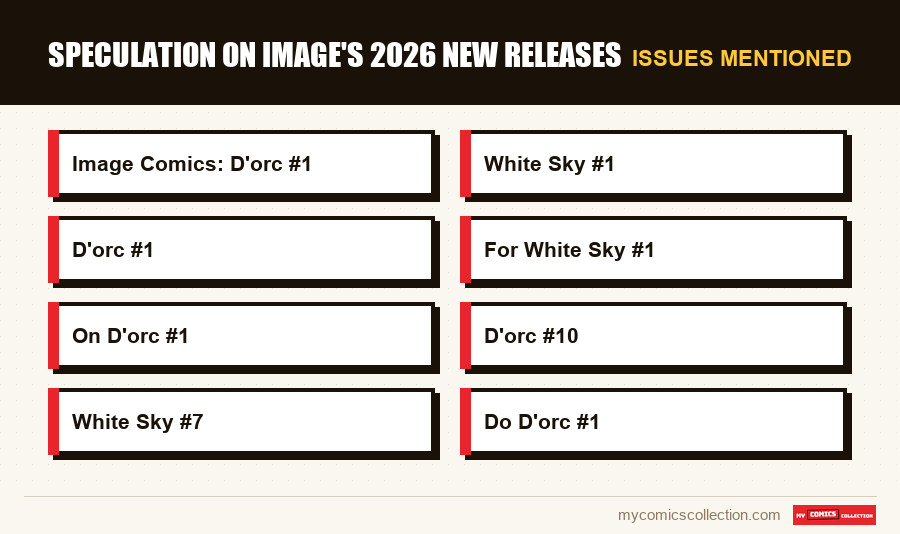
Calendar regularity. A series that keeps its pace has a team able to deliver, and a publisher that believes in it. The release announcements for November 2026, published on August 21, schedule D'orc #10 for November 18 and White Sky #7 for November 25, both at $3.99. Eight to ten months after launch, both titles are therefore still there, at a near-monthly cadence. That is the definition of a title that settles in.
The arrival of the collection. A publisher only schedules a bound volume if it expects sales in general bookstores, that is, a long life outside the new-release channel. The same November 2026 catalog announces a Tigress Island collection reprinting issues 1 to 5, for a series launched in March.
Stability of the creative team, with a nuance. A change of artist is not a bad sign in itself, but it changes the object you are collecting. On White Sky, issue 7 of November 2026 is drawn by Sumeyye Kesgin, with JP Mavinga credited on an alternate cover, whereas the first issues were drawn by Mavinga. For a reader, it is editorial information; for someone who was buying "Mavinga's series", it is a data point to take in.
Conversely, three signals should make you back off: the absence of any information on issue 2 several weeks after issue 1, a surge concentrated on incentive variants and almost absent on the standard cover, and a sales pitch that talks about scarcity without ever talking about content. We come back more broadly to this boundary in the article devoted to speculation versus investment, and on the particular case of adaptation announcements in the one covering the calendar of film and series announcements.
The reasonable position when collecting from Europe
A European collector cannot take part in the overheating window, and that is a stroke of luck. Between the American Wednesday, the shipping time and the fees, buying on release day at top price simply does not exist as a reasonable option. The geographical constraint therefore imposes the discipline that the rules of caution recommend anyway.
Three paths remain open, in this order of common sense.
Read first. The digital version of a new release is available on release day, with no shortage and no premium. It lets you answer the only question that counts before committing money: do I like this series? A title whose first three issues you have read is collected far better than a title whose summary you have read.
Buy the paper when supply has returned. For a series that holds, the second or third printing of an issue #1 is found at its normal price a few weeks after release, and the collection arrives within the year. These are fully satisfying reading objects, and they cost a fraction of what the same content cost during the shortage. The guide on reprints versus first printing details what you gain and lose in this choice.
Aim for the first printing later, with full knowledge. If you care about the first printing, the least unfavorable moment is when the title has left the news, that is, several months after release, when hurried sellers have already sold. It is also the moment when you can check the printing, the printing notice and the real condition, instead of buying a photograph in a rush.
A remark on grading, because it comes up systematically in these episodes. A comic printed at several tens of thousands of copies and bought new by careful collectors will produce many high grades. Getting a copy certified by CGC to hope to capture a scarcity premium on such a volume is a gamble, and the cost of the operation does not disappear if the gamble fails. The question of grading becomes relevant again when a series has proven its duration, not during its second week of existence. The reasoning on certified volumes is developed in the article on reading the CGC census.
What this episode says about the 2026 market
A retailer cited by the trade press in February 2026 put forward a comparison with 2012 and 2013: the success of a strongly creator-driven line at a big publisher awakens the appetite for creator-owned series, and the independents reap the benefits. The analogy is plausible and remains an analogy. What is established, however, comes down to three observations.
The first is that sell-outs multiplied over a quarter, at several publishers, on titles with no known character. The second is that the print runs involved were not small, and that the scarcity observed came from the order calendar, not from the quantity printed. The third is that the two most cited titles are still going eight months later, with a tenth and a seventh issue scheduled, which is the real success of the story and has nothing to do with the amounts of the first weeks.
For a collector, the lesson is almost boring, and that is a good sign. The series that settled in during 2026 did so because they found readers, and readers are counted on issues 2 and following, not on resales of issue 1. Following a series over time, knowing which printing you own and cleanly filling the gaps remains the only method that depends on no forecast. To put it into practice without keeping a table by hand, the collection tracking app and the free estimate cover the essentials, and the key issues of independent publishers give the historical perspective that is always missing in the middle of a surge.