In three months, from autumn into winter 2026, the two biggest American publishers line up more horror launches than any recent season: Marvel's Midnight line in October, three 40-page #1s at $5.99 under parental advisory; at DC, James Harren's The Demon and Jonah Hex and the Shadow of Death on October 7, Justice League: Dark Realm Special #1 on October 28, DC's Naughty List #1 on November 25; at Image, Ennis and McCrea's The Snail in November. Add to this the IDW Dark imprint, announced on October 18, 2024, one of whose #1s sold out at the distributor before it was even released. It is not a scheduling coincidence: three earlier horror waves obeyed the same trigger. And what they left in collections is always the same thing, which is never the label.
There are two ways to read a genre season. The first is to note that horror is coming back, deduce that the autumn's horror #1s are going to matter, and buy several copies. It is the most widespread reflex and the most expensive. The second is to ask why two competing companies, which schedule their releases six to nine months ahead and do not consult each other, arrive at the same crossroads the same week. This question has an answer, it is documented, and it has been the same since 1947.
The horror genre is not content like any other in the economy of the American comic book. It is historically the fallback genre: the one the industry turns to when it needs titles that are cheap to launch, readable without background, and able to capture a readership that the superhero does not capture. Three times in seventy years, this logic produced a wave. Three times, the wave fell back. And each time, it left behind a very small number of issues that still matter, according to a sorting criterion perfectly identifiable in advance.
This article therefore does three things, in this order. It inventories what the season actually puts on the shelf, with dates. It explains the mechanism that triggers a genre wave and the one that makes it fall back. Then it takes up the three precedents to extract what survived in collections, in order to draw a usable grid for the current wave, now, while it unfolds.
What the season actually puts on the shelf, and on what date
Let us start with the inventory, because an impression of a trend is worth nothing without the list. Here is what is dated and public as of October 2, 2026, sticking to the horror genre or clearly adjacent.
At Marvel, October carries the Midnight Universe line: three #1s, 40 pages each, $5.99, published under parental advisory, entrusted to Jonathan Hickman and Valerio Della Fonte, to Benjamin Percy and Brent Walker, and to Phillip Kennedy Johnson accompanied by SCIETRONIC. This line has its own guide on the site and we do not redo the detail here: see the complete guide to the Midnight line. What interests us is its very existence, and the fact that it is labeled.
At DC, October 7 sees two series released, each carried by a single creator: The Demon #1, where James Harren writes and draws Jason Blood, and Jonah Hex and the Shadow of Death #1, a six-issue miniseries entirely signed by Michael Walsh. On October 28 comes Justice League: Dark Realm Special #1, which is also Dan Mora's first script and introduces the origin of the Cadejos. On November 25, DC's Naughty List #1. And in December, the main line slips into the horror register another way: Superman #45, on December 23, takes the character into Nekron's Deadlands.
At Image, November brings The Snail, a horror one-shot by Garth Ennis and John McCrea, the same tandem that returns on December 9 at DC for Hitman: It Was the Nineties Special #1, twenty-five years after their original run. At IDW, the IDW Dark imprint was announced on October 18, 2024 as a dedicated horror line, and one of its 2026 #1s, The Exorcism at Buckingham Palace #1, sold out at the distributor before release.
Finally, two elements are not horror launches but belong to the same family of offering. Marvel Zombies: War Zone #1, a five-issue miniseries, came out in September. And among the top five sellers of the September 22 to 28 sales chart is Infernal Hulk Vs Wolverine #1. Over the week charted, in more than 600 equipped stores, the monstrous genre was therefore not a satellite of the catalog: it was at the top of the ranking.
Put end to end, that makes about ten genre launches in a quarter at the four best-selling publishers of the direct market. It is the volume that defines a wave, not the quality of the titles.
Why now, and why everyone at the same time
Four causes overlap, and none is editorial in the noble sense. They are industrial causes, which is precisely what makes the phenomenon predictable.
A readership that buys by genre, not by continuity. Retailers have described since 2025 the arrival of new and young readers, who walk in asking what to start with. A reader who enters through the genre has no backlog to catch up on: a 40-page horror #1 reads without knowing thirty years of publications. For a publisher, it is the cheapest entry door to manufacture. We analyzed this readership shift in the article on the direct market's rise, and it explains a good part of the rest.
A content ceiling that no longer exists. The industry's self-censorship mechanism died administratively in January 2011, when DC then Archie announced a day apart that they were ceasing to use it, Marvel having withdrawn in 2001. A publisher who wants to publish graphic horror in 2026 has no authorization to ask for anymore. It only has a commercial positioning choice to make, which is not the same constraint.
A minimal launch cost. Look at the makeup of the autumn's teams: Harren alone on The Demon, Walsh alone on Jonah Hex, Dan Panosian alone on Wolverine: Paradise, Wes Craig alone on Superman: The Stranger. A genre series carried by a single creator costs less, is decided faster, and does not commit the catalog's continuity. For a publisher, it is a small bet. For a retailer who must order firmly, it is a small risk. The two agree easily, and that is what lets a wave form without any spectacular decision having been made.
Screen demand pulling the genre. Horror and dark fantasy occupy a growing place in announced adaptations. Without going into a release calendar, it is enough to note that the characters of the monstrous fringe of both catalogs have become exploitable on screen again, which gives them back an editorial interest they had lost.
None of these four causes presupposes a new collective taste for fear. They describe an economic alignment. This matters for what follows: an economic alignment comes undone as fast as it forms.
The three precedents, and what they left behind
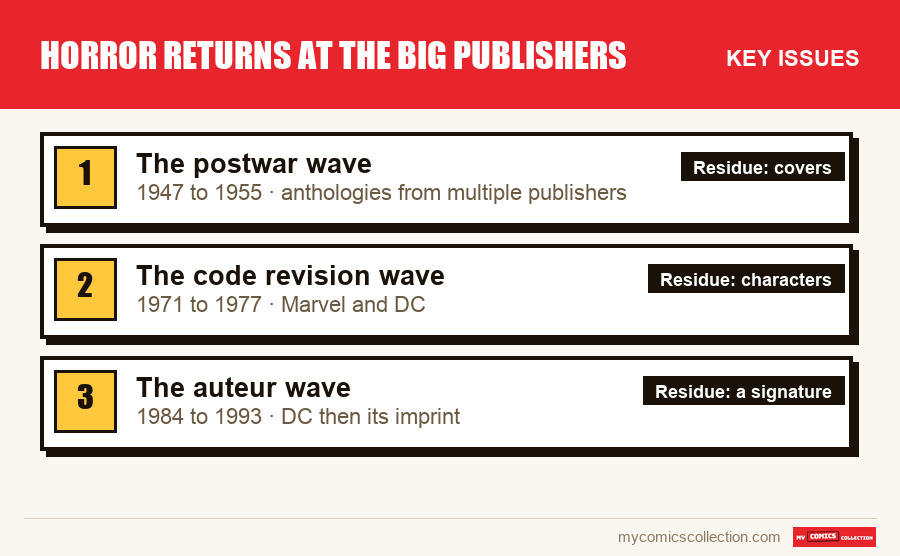
Three horror waves have crossed the American industry. They do not have the same scale or context, but they have the same curve and, above all, the same residue in collections.
The postwar wave
The first wave is also the most massive in proportion to the catalog published. It ends with the establishment of the self-censorship mechanism of September 1954, which literally bans the genre's words from a title. We do not redo that history here: it is covered in detail in the Golden Age horror guide, which gives its dates, hearings and material consequences.
What to retain from it from our point of view lies elsewhere. This wave left in collections a set of covers rather than characters. The anthologies created almost nothing recurring: each issue was a closed story, with no hero to bring back. As a result, the market for this segment is structured around images and condition, and almost not around first appearances.
The code revision wave
On January 28, 1971, the self-censorship mechanism is revised. Vampires, werewolves and ghouls become publishable again, on the condition, stated in black and white, of being treated "in the classic tradition," that of Frankenstein, Dracula and the authors read in class. Zombies, for their part, remain banned, lacking literary endorsement.
The publishers' reaction is immediate and can be dated to the month. Swamp Thing comes out in House of Secrets #92, dated July 1971, by Len Wein and Bernie Wrightson. Jack Russell, the werewolf, appears in Marvel Spotlight #2 dated February 1972. Johnny Blaze arrives in Marvel Spotlight #5, dated August 1972. The Tomb of Dracula starts in April 1972 and will run 70 issues until August 1979.
And it is inside these genre series that the two most in-demand issues today are found, for a reason that has nothing to do with horror. Blade appears in The Tomb of Dracula #10, dated July 1973, created by Marv Wolfman and Gene Colan. Moon Knight appears in Werewolf by Night #32, dated August 1975, by Doug Moench and Don Perlin.
The auteur wave
The third wave is born not from a regulation but from the takeover of a struggling series. In February 1984, with The Saga of the Swamp Thing #21, Alan Moore reconfigures the character's origin to make it a true monster. The title becomes, a few years later, the first mainstream series to do entirely without the self-censorship seal, starting with its issue 65.
It is in this same title that John Constantine appears, in Swamp Thing #37 dated June 1985, by Moore, Stephen Bissette and John Totleben. The character gets his series in 1988, which will become the longest continuously published title of the imprint founded in January 1993 by Karen Berger, which starts by taking over six series already in progress rather than launching six new ones.
A fourth wave, more diffuse, formed on the independent publishers' side from the 2000s on and never really closed. It obeys the same rule: it is a specific first issue that came out of it, not a label. Something Is Killing the Children #1, published on September 4, 2019 by James Tynion IV and Werther Dell'Edera, was ordered at 33,648 copies by North American retailers in its first month, and the series, planned for five issues, was requalified as a regular series before the first episode even reached stores. Its first twenty issues passed two million copies in two years. The Something Is Killing the Children #1 hub details its page.
What the three waves have in common
Set side by side, they give a surprisingly stable sorting grid. Four findings, all verifiable across the three periods.
The survivor is almost always a first appearance, not a first issue. In the 1971 wave, the two most in-demand issues are a tenth issue and a thirty-second. In the 1984 one, it is a thirty-seventh. None is a #1. The logic is mechanical: a genre series #1 is printed high because the publisher hopes, whereas the issue where a character first appears is printed at the real level of the series' sales, that is, low, because the hope has fallen back.
The label never survives. None of the successive labels, adult-readership imprint, genre line or collection name, has any value in itself on the secondary market. What has value is what was published under it. A 2026 reader who tried to build a collection by label would end up with a heterogeneous set whose coherence interests nobody but them, and which would have to be recut by creator and character anyway to make something of it.
The signature weighs more than the genre. In all three cases, the retrospective sorting operates on names. This is true of the 1984 wave, where the writer's name became the main criterion, and it has become retroactively true of the 1971 one, whose series are now read and sought for their artists as much as for their plots.
The wave falls back through exhaustion of the spring, not through censorship. Only the first stopped by regulation. The other two came undone because a genre that everyone publishes frightens no one anymore. We devoted an article to this structural difficulty of the genre in series form, which explains why so few horror titles last more than three years: serial horror in the 1970s.
The label is no longer a constraint, it is a selling point
It is worth following the thread of labels, because it illuminates exactly what the October 2026 parental advisory means, and what it does not mean.
In 1971, the label is a de facto legal constraint. The revised regulation authorizes certain creatures and not others, and publishers work around the restriction through format: a black-and-white magazine, sold at newsstands, does not fall within the mechanism's scope. That is how Tales of the Zombie came out from August 1973 to March 1975, ten issues and an annual, and could feature precisely the creature the regulation banned from the color single issue. Format was the only door available.
Fifty years later, the door is wide open and the label has changed in nature. DC's adult-readership imprint was announced in March 2018 and launched in September, its first title coming out on September 19, 2018. IDW's horror imprint was announced on October 18, 2024. And the parental advisory carried by Marvel's three #1s in October 2026 answers to no obligation: it serves to tell the retailer where to place the title on the shelf and to which reader to offer it.
The practical consequence is counterintuitive. Formerly, a label signaled a content constraint, therefore often a reduced print run and marginal distribution, therefore scarcity. Today, a label signals an identified commercial segment, therefore a confident retailer order, therefore a generous print run. The 2026 parental advisory is an indicator of volume, not of scarcity. Confusing the two is applying to a 2026 issue a reasoning that only held for a 1973 magazine.
The clearest sign of this reversal is the presence, in September 2026, of a miniseries devoted to zombies in a publisher's main catalog. The creature expressly excluded from the 1971 revision for lack of literary respectability has become a recurring franchise. Nothing remains of the ceiling.
The grid to apply to the current wave
Here, then, is the procedure, in the order it plays out, for a collector who sees ten genre launches go by in a quarter and must decide what to do.
Sort by signature, not by genre
The useful question is not "is it horror" but "who signs, and is it a first time." In the current season, two elements fall into this category: Dan Mora's first script on October 28, and the return of a tandem to a title they had left twenty-five years earlier, in December. These are creator facts, and the three past waves say that these are what remain legible in the rearview mirror.
Look for appearances, not #1s
An origin introduced in a special, a secondary character who gains depth in the third episode of a six-issue miniseries: that is what earlier waves turned into in-demand issues. This presupposes reading the series, not just buying its opening. It is the most uncomfortable point of this grid, and also the only one that worked three times.
Read the sellout as a signal, and only as that
A stockout at the distributor before release, like the one observed on an IDW Dark #1 in 2026, says something real: retailer demand exceeded the allocation. It says nothing about the total print run, since a second printing may follow, nor about future value. Treat it as availability information, not scarcity information.
Buy the end of miniseries along with the beginning
The genre series of this season are mostly miniseries of four to six issues. The last issue is systematically the hardest to find again two years later, because retailer orders decline episode by episode and nobody reprints it. If a miniseries interests you, it interests you in full.
Choose the format before buying, not after
For reading, the collection will arrive within the year and cost less than the sum of the single issues. For collecting, it is the single issue that counts. Deciding in advance which category each title of the season falls into avoids buying the same story twice, which is the most banal waste of a genre wave.
Record during, not after
A wave produces many short, poorly classified, quickly forgotten titles. They are exactly those you can no longer find on your own shelves three years later. Noting as you go what comes in, with its purchase date, is what distinguishes a collection from a pile.
The four mistakes a genre wave produces
They repeat in every cycle, and they are easy to name.
Buying several copies of a #1. It is the mistake that costs the most in volume. A #1 of a genre series launched by a major publisher is printed according to a hope, and therefore generously. The three past waves produced no case where the opening of a major publisher's horror series became harder to find than its mid-run issues.
Taking a label for a guarantee. A parental advisory, a dedicated imprint or a line name are shelf-placement tools. They have never been a value criterion on the secondary market, and the three earlier waves all saw their labels fade.
Reading a weekly chart as a market share. The September 22 to 28, 2026 sales chart covers more than 600 equipped stores and one week. It says nothing about the month, even less about the year, and no 2026 monthly data is published. We detail this reading in the article on weekly charts: a week carried by three big launches is not a trend.
Having issues graded too early. Having a new high-print-run single issue certified produces, in most cases, one more graded copy in a population already richly supplied with high grades, for a cost that is not recovered. Grading has real value, but on scarce or old material, and it is decided after understanding what you own.
Keeping the record of a wave while it unfolds
The last point is the most prosaic and it is the one that makes the difference three years later. A genre wave is precisely the configuration most hostile to a well-kept collection: many titles, short runs, creators who do not come back, series that stop without warning, and no long numbering to serve as a landmark.
Concretely, three reflexes are enough. Record each issue the moment it comes in, with its purchase date, because it is the only information you cannot reconstruct later. Mark miniseries as incomplete as long as an episode is missing, so you see them in a list of gaps rather than in a vague memory. And keep a trace of the exact edition, first or second printing, because it is the distinction that counts most in a season where reprints are numerous. The collection tracking app does these three things, and that is in fact what it is most useful for.
For the rest, the current season is judged in ten years, not in ten weeks. The three precedents say the same thing: the wave leaves little, that little was identifiable in advance, and it was almost always inside the series rather than at their opening. There is no serious reason to think this one will break the rule.