American Golden Age horror comics mostly cover 1947 to 1955, with a peak where nearly one comic in four published in 1953 was a horror title. The genre collapsed in 1954: Fredric Wertham's Seduction of the Innocent came out on April 19, 1954, the US Senate held hearings on April 21, 22 and June 4, 1954, and the Comics Magazine Association of America introduced in September 1954 a Code that literally bans the words "horror" and "terror" from a title. To enter this market, the order that works is always the same: first read in a modern collected edition, then buy common issues in modest condition, and only aim for a famous cover once you know how to recognize an undeclared restoration. The period's non-deacidified newsprint makes condition more decisive than the title itself.
There are two ways to approach pre-Code horror. The first is to immediately chase the covers you have seen reproduced everywhere, the ones with an axe, a jar and a melting face. It almost always ends in disappointment: either the budget does not follow, or the copy bought turns out to be reglued, trimmed or married. The second is to understand the physical object first, then the market, and only then the catalog. It takes an evening of reading and saves years.
This article takes the second road. It does not retell the genre's history in detail, other guides on the site do that: it starts from the question a buyer really asks in front of a seventy-year-old comic, namely what they are holding, what it was worth paying, and what should have raised a flag. Amounts are deliberately absent: in this segment, the same issue can trade at orders of magnitude separated by a factor of several hundred depending on two grade points. Talking about price without talking about condition makes no sense.
What "Golden Age horror" really covers
The vocabulary is fluid, and that costs money to anyone who ignores it. Three dates mark out the perimeter.
The first is December 1940, with Prize Comics #7 and Dick Briefer's serial New Adventures of Frankenstein, considered the first regular American series to fall squarely within the horror genre. We are still in an anthology comic dominated by superheroes: horror is a feature there, not an editorial identity.
The second is January 1947, with Eerie #1 at Avon, described as the first openly horror comic book. An important point for the buyer: that issue is a one-shot. Avon only revived the title in 1951, for a seventeen-issue series. An Eerie #1 from 1947 and an Eerie #1 from 1951 are therefore not the same object, and the second is much less scarce.
The third is fall 1948, with Adventures into the Unknown at American Comics Group, the first horror series with continuous publication. Its first issue pairs novelist Frank Belknap Long with artist Fred Guardineer, and already contains an adaptation of Horace Walpole's The Castle of Otranto by Al Ulmer. This series illustrates a dating trap: it runs for one hundred seventy-four issues, until August 1967. Three quarters of its pagination therefore postdates the Code, with fully toned-down content. Buying "an Adventures into the Unknown" without looking at the issue number amounts to buying at random across two unrelated markets.
In practice, the heart of what collectors call pre-Code sits between 1950 and 1955. The rest is historical upstream, interesting but marginal in volume.
The publishers to know, not just the most famous one
Collective memory has kept one house, Bill Gaines', whose three horror titles started in 1950. The Crypt of Terror takes over the numbering of Crime Patrol and starts at #17, dated April-May 1950; it becomes Tales from the Crypt from #20, dated October-November 1950, and ends at #46, dated February-March 1955. The Vault of Horror and The Haunt of Fear follow the same schedule. The Crypt-Keeper himself appears before the change, in Crime Patrol #15. These numbering details are not fussiness: they determine what is expensive and what is not.
But reducing the genre to that single catalog is a beginner's mistake, and a costly one, because it is precisely the segment where demand is most established. The real volumes are elsewhere.
Atlas
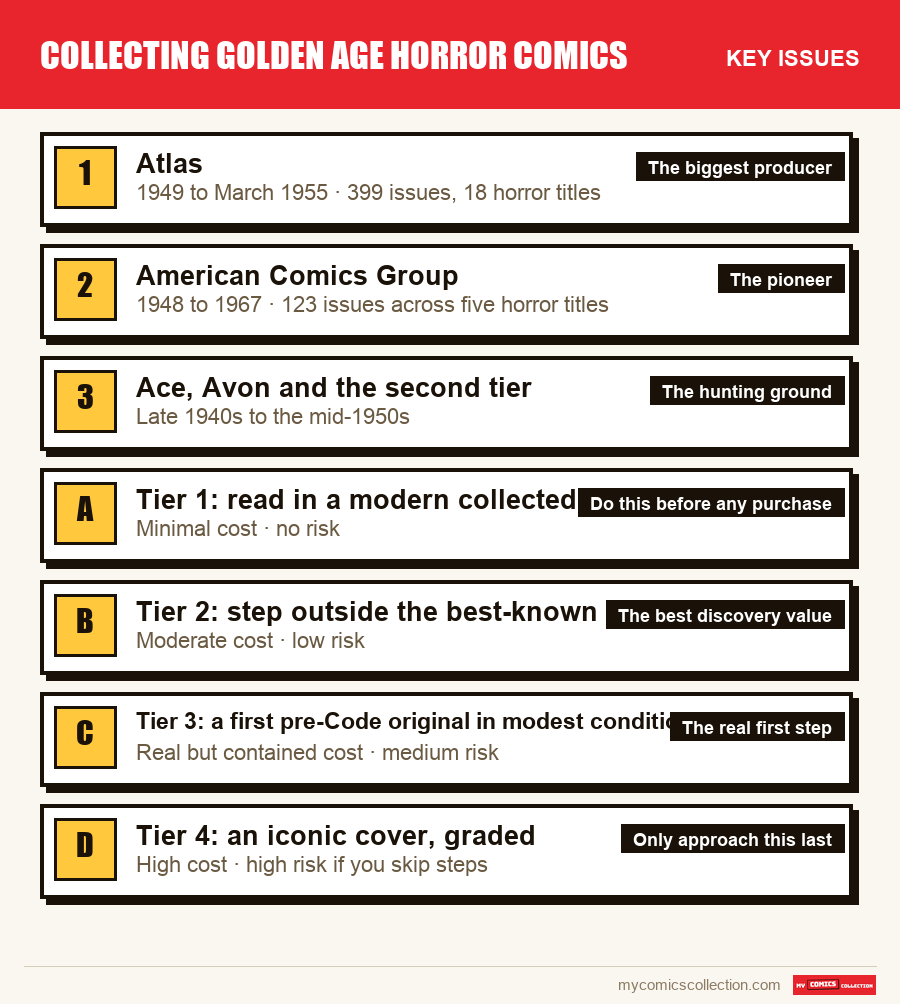
It is by far the biggest horror supplier of the period, and the direct ancestor of the publisher that would put out Spider-Man a decade later. That detail has a practical consequence: several of its anthologies survived the Code and became, in the early 1960s, well-known superhero series, as Journey into Mystery, Strange Tales and Tales to Astonish show. Their early 1950s issues belong to the horror market; those of the early 1960s belong to the Silver Age market.
American Comics Group
Predating the big boom, this publisher has the historical merit of the genre's first continuous series. Its tone is generally more restrained than that of its 1952 competitors, which let it get through 1954 without disappearing, at the price of transformed content.
Ace, Avon and the second tier
Ace accounts for 98 issues across five titles. Avon contributes, with Eerie, the 1947 milestone. Around them, a constellation of small publishers flooded the newsstands between 1951 and 1954, often with lower print runs and regional distribution. That is where the genre's real rarities lie, those of which few copies survive not because they were sought after, but because nobody kept them.
The figure that gives the scale of the phenomenon is that of 1953: nearly a quarter of all comic books published in the United States that year were horror titles. It was not a niche, it was the locomotive of American periodical publishing.
1954, and what censorship changed materially
The sequence of events is known in outline and documented in detail elsewhere on the site. What interests the buyer is its translation into available objects.
April 19, 1954: the book
Seduction of the Innocent, by psychiatrist Fredric Wertham, is published by Rinehart & Company. The book argues that comics are a serious cause of juvenile delinquency, and attacks horror titles and superheroes alike. You should know that an academic study by Carol L. Tilley, published in 2012, established that Wertham had "manipulated, exaggerated, compromised and fabricated" evidence, relying on a sample of teenagers already seen in clinics. The book that killed the genre rested on a flawed demonstration.
April 21, 22 and June 4, 1954: the hearings
The Senate subcommittee on juvenile delinquency holds three days of hearings devoted to comics. Estes Kefauver takes over the chair there, succeeding Robert Hendrickson. Wertham testifies and goes as far as comparing the industry to Hitler. Bill Gaines is questioned about a cover showing a severed head, that of Crime SuspenStories #22, and answers that he considers it in good taste "for the cover of a horror comic". The sequence is picked up by the press and finishes discrediting the publisher in the public eye.
Summer and September 14, 1954: the disappearances
Fifteen publishers cease operations over the summer. On September 14, after distributors refuse to carry his titles, Gaines ends his three horror series and his two suspense series. The point to remember: the genre's death came first from distributors' refusal, not from a legal ban. The newsstands closed before the texts did.
September 1954: the Code
The Comics Magazine Association of America is formed and sets up the Comics Code Authority, headed by Charles F. Murphy. The text is explicit: "No comic magazine shall use the words "horror" or "terror" in its title." It also prohibits "scenes dealing with, or instruments associated with walking dead, torture, vampires and vampirism, ghouls, cannibalism and werewolfism", as well as "all scenes of horror, excessive bloodshed, gory or gruesome crimes". It would take until 1971 for vampires, ghouls and werewolves to be readmitted, provided they were "handled in the classic tradition".
Direct consequence for a collector: authentic horror production stops dead over a window of four to five years. There is no catch-up, no period reprint, no second printing. The world stock of pre-Code horror comics has been closed since 1955, and it only shrinks, because the medium degrades.
Paper: the main variable, not a technical detail
This is the point investment guides treat too quickly, and it is the one that decides nearly all bad surprises.
These comics are printed on newsprint, obtained by a mechanical process from wood pulp with no chemical treatment meant to remove lignin. According to the technical documentation on this medium, it is precisely lignin that makes paper yellow and weaken when exposed to air and light. Newsprint is explicitly a non-archival medium: it was never designed to last more than a few weeks on a newsstand.
Three concrete implications.
First, condition is not a preference but a physical constraint. A 1952 copy whose pages have stayed supple and light is not just prettier: it is statistically abnormal, and that explains most of the price gaps in the period. On late Golden Age material, the difference between two neighboring grades weighs more than on 1980s material.
Second, a low-end copy is not a bad deal, it is a different product. A complete issue, brittle and browned, with a weak spine, perfectly fulfills the function of a documentary collectible. It will never fulfill the function of an asset, and you should not pay for it as one. Many disappointments come from there: you buy a reading copy at a speculative price.
Third, handling destroys value in real time. A seventy-year-old comic on mechanical paper is not leafed through like a book. The crease at the spine, opening it flat, the staple that works: every gesture is irreversible. It is the strongest argument in favor of reprints for reading, and of the original for preservation alone.
The four entry points, in order of rising cost
Here is the hierarchy that avoids regrets. You go through it in order, and nothing forces you to go to the end.
Tier 1: read in a modern collected edition
The corpus is very widely available in reprint, and it is the only reasonable way to find out whether you really like what you are about to collect. Three programs cover most of it. The EC Archives, hardcover and in color, launched under the impetus of Russ Cochran then published under the Gemstone label, were taken over by Dark Horse Comics from 2013 in the same format. Since 2012, Fantagraphics has run the EC Artists' Library, organized by artist and printed in black and white. And since 2010, IDW's Artist's Editions reproduce, at 15 × 22 inches, the original inked pages, with pasted lettering and editing marks included.
Tier 2: step outside the best-known catalog
The collections edited by Craig Yoe, published under the Yoe Books label with IDW since 2010, dig up precisely the output that the canonical anthologies ignore. The Haunted Horror series states its program in its subtitles, from Banned Comics from the 1950s in November 2013 to Comics Your Mother Warned You About in November 2014. The Chilling Archives of Horror Comics proceed by creator or theme, with for example Bob Powell's Terror in November 2011, Jack Cole's Deadly Horror in October 2013, Howard Nostrand's Nightmares in December 2014 or Tom Sutton's Creepy Things in January 2015. The Zombies volume came out in June 2012.
Tier 3: a first pre-Code original in modest condition
The right strategy is counterintuitive: aim for a common issue of a high-print-run anthology, in frankly low but complete condition, rather than a prestigious title in uncertain condition. Atlas' 399 horror issues offer the widest range of choice. You accept browned paper, missing corner bits, a tired spine, and in return you demand three things: that the copy be complete, that the defects be described in writing before purchase, and that you have photos of the back cover and the spine, not just the front cover.
Tier 4: an iconic cover, graded
This is the tier where the pieces you see reproduced sit, and the one where a mistake costs the most. The rule is simple: in this segment, you buy a grade and a label, not an image. A raw copy sold as "near mint" without third-party expertise, on 1953 material, deserves distrust by default.
The most sought-after titles, and the precise reason
Demand in this segment does not follow the usual logic of the first issue or first appearance. It follows three distinct engines, and knowing which one is at play avoids overpaying.
The historical engine. Eerie #1 from January 1947 and Adventures into the Unknown #1 from fall 1948 are sought for their milestone status, one as the first openly horror comic, the other as the first continuous series. It is document value: stable, documented, and independent of any fad.
The documentary fame engine. Crime SuspenStories #22, dated April-May 1954, cover by Johnny Craig, is very probably the most reproduced horror comic of the period, not for its content but because it was brandished before a Senate committee. Its lead story, In Each and Every Package, is drawn by Reed Crandall. An issue whose image entered American political history is not priced like an ordinary issue, and that is rational: demand also comes from collectors who do not read comics.
The artist engine. The roster Gaines assembled, from Al Feldstein to Harvey Kurtzman by way of Johnny Craig, Jack Davis, Graham Ingels, Wally Wood, Bernard Krigstein and Reed Crandall, durably pulls demand upward. It is also the engine most exploitable by a modest collector: the same hands worked at other publishers, on lower-priced titles. Following an artist rather than a title is the cheapest entry method there is for this period.
Conversely, pure cover spectacle creates volatile prices. A violent cover widely circulated as an image can be markedly less scarce than the next issue of the same series, which nobody talks about. The detailed overview of the most requested issues from 1950 to 1954 usefully complements this point, and our ranking of the best horror comics separates reading interest from collecting interest.
Fakes, undeclared restorations and married copies
This is the period's specific risk, and it is serious for a mechanical reason: the more fragile a medium, the stronger the temptation to repair it, and the easier the repair is to hide under a bag.
The official vocabulary of expertise distinguishes two families, and that distinction is the key to everything. Restoration designates an intervention meant to give the copy back its original appearance: color touch-up, filling of missing parts. Conservation designates an intervention meant to preserve the structural or chemical integrity of the object, and explicitly excludes cosmetic repairs like color touch-up and fills. Both are legitimate when declared. Both are fraud when they are not.
On the grading side, CGC materializes this grid with labels of different colors, detailed in our CGC grading guide:
Blue label, called Universal
The copy is graded without particular reservation. It is the implicit reference as soon as a seller announces a grade.
Purple label, called Restored
Applied to any comic showing traces of repair aimed at returning it to its initial appearance. The degree is codified along two axes: a quality rated A, B or C depending on materials and result, and a quantity rated 1 to 5 depending on the extent of filling and touch-up. The same issue in blue 6.0 and in purple 6.0 A-1 does not trade in the same order of magnitude at all.
Blue-gray label, called Conserved
Reserved for structural repairs aimed at long-term preservation: tear reinforcement, staple replacement, reattachment of a fragment, with listed materials such as rice paper, wheat paste, period staples and conservation tape.
Green label, called Qualified
Flags an isolated major defect that must be described explicitly. On Golden Age material, it is often the notation that reveals a missing page or a cut-out element.
Gold label, called Pedigree
Reserved for copies from recognized historic collections. It acts as a certificate of provenance, and therefore as insurance against the suspicion of old repair.
No Grade notation
Assigned notably when the entire cover is missing, or half or more of the interior pages. It is the most useful safeguard against reconstituted copies.
Alongside these categories, here is the inspection protocol to apply before any tier 3 or 4 purchase.
Measure. A copy noticeably smaller than its neighbors in the same series has probably been trimmed to hide damaged edges. Asking for the dimensions, and comparing them to a reference issue, costs one question.
Look at the spine and the edge, not the cover. Sale photos almost always show the front. Most of the structural information is elsewhere: staple area, alignment of the signatures, regularity of the cut.
Check cover-interior consistency. A married copy combines the cover of one copy with the pages of another. The simplest clue is the difference in tint between a cover paper and an interior paper that have not aged together.
Beware of local perfection. On seventy-year-old mechanical paper, a flawless corner among three tired corners is an anomaly, not a stroke of luck.
Distinguish reprint from original. The genre was massively reprinted, sometimes with the same title and a numbering that restarts at 1, sometimes decades later. The legal deposit date and the publisher notice on the inside page settle it; the cover does not.
Demand it in writing. Getting the phrase "no restoration or known intervention" into the exchange gives you a basis in case of dispute. A seller who refuses to write it has answered the question.
Documenting what you buy, while you remember it
A pre-Code horror collection is built through small scattered purchases, often abroad, over several years. After thirty issues, nobody remembers which copy had a restored page mentioned in a 2024 email, nor which one was paid how much, nor from whom. It is exactly the kind of collection where keeping a serious inventory produces more value than the choice of issues.
Three data points deserve to be recorded on each entry: the description of defects as the seller phrased it, the provenance, and the declared condition with its source. The collection management app lets you track this issue by issue, and the detailed tracking avoids duplicates on series whose numbering changes title along the way, which is the norm for this period. To place a set already built, the estimate gives a starting order of magnitude.
To extend your reading, our guide to Golden Age collecting in the broad sense places horror within the whole period, and the feature on the publishing house that defined the genre details the catalog this article has only touched on. Finally, to see what the 1954 ban produced once lifted, the genre's return in the 1970s reads as the direct sequel to this story.