Keeping horror in a monthly release poses a problem that the short format does not face: the fear does not survive repetition. A reader who encounters the same threat every month stops being afraid of it after three issues: it's mechanical. Long-term horror series must therefore renew the source of worry without changing the subject, and the solutions employed explain the very particular form of these stories.
This is the heaviest constraint of its kind in serial format, and the one we comment on the least.
This article explains the problem, the solutions used, what they impose, and why so few horror series last.
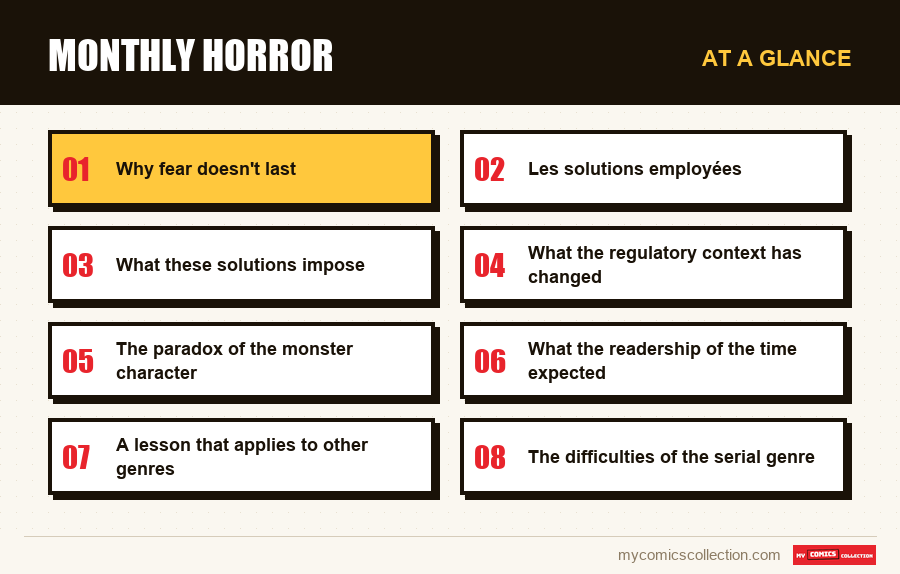
Why fear doesn't last
The mechanism is simple and relentless, and it applies to all media.
L'inquiétude naît de l'inconnu. A creature whose abilities, intentions and limits are unknown is frightening; the same creature after three encounters is an opponent whose behavior we know.
Chaque apparition informe. There is no way to show a threat without revealing something about it. The story therefore spends its unknown capital with each issue.
The format requires regular appearances. A monthly horror series has to deliver horror every month, which accelerates the burnout instead of sparing it.
The result is predictable: a horror series destroys its own raw material while operating, and the more she manages to show, the faster she becomes exhausted. It's the opposite of adventure, where exploiting a character strengthens them.
Les solutions employées
Shift Fear to Consequences
We stop scaring with the creature and we scare with what it leaves behind: the dead, the damaged survivors, the destroyed lives around.
This source does not run out, it accumulates.
Threaten hunters among themselves
The stalking group becomes the site of tension: rivalries, betrayals, disagreements over methods. The threat moves within.
Make victory impossible
If the objective is unattainable, each confrontation won resolves nothing. The concern then comes from the duration and not from the outcome.
Élargir sans expliquer
Introducing other figures without documenting them maintains a reserve of the unknown, provided you do not exploit them immediately.
What these solutions impose
Each has a price, and their combination produces a recognizable shape.
A distribution of victims. Scaring with consequences presupposes people to whom things happen: therefore numerous secondary characters, installed then lost.
Un antagoniste en retrait. The less it appears, the more disturbing it remains. The central figure of a long-running horror series is often absent from most of its issues.
Un rythme lent. Sparing the unknown implies not showing, therefore filling in another way: through conversation, investigation, atmosphere.
Strong continuity. The consequences are only frightening if they persist, which prohibits resetting the counters to zero between two numbers.
These four requirements describe exactly what you find in horror series that have lasted. They are not a matter of personal taste but of a format necessity, which explains their convergence among very different authors.
A counterintuitive consequence deserves to be posed. The best issues of a long-running horror series are often the ones where almost nothing happens.
An issue devoted to characters who speak, distrust, and wait maintains the reserve of the unknown while accumulating consequences. A confrontation number spends capital. Readers who demand action therefore demand, without knowing it, the exhaustion of what scares them.
Why do so few series last?
Three reasons explain the usual brevity of the genre in serial format.
Commercial pressure pushes you to show. A cover that promises confrontation sells better than a cover of atmosphere, and this logic applies every month.
The authors change. A successor who does not understand the system will exploit the creature further, believing he is doing the right thing, and will destroy in three issues a reserve built up over years.
Gender is poorly considered. The resources allocated are less, the teams less stable, and stability is precisely what this system needs.
These three forces work in the same direction. An enduring horror series is an anomaly held against its own milieu, and its rarity says nothing about the talent available.
What the regulatory context has changed
An element of period deserves to be posed, because it conditions what could be written.
A code of self-discipline had long prohibited American publishers from a large part of the genre's repertoire: certain creatures were banned by name, and the treatment of the supernatural was restricted to the point of emptying it.
Its relaxation at the beginning of the 1970s suddenly reopened a territory, and the wave of series that follows rushes into it. This explains the unusual ambition of some: there was a gap to catch up.
This also explains a more adult tone than the format led one to expect. The authors knew they were speaking to a readership who had grown up with the medium.
A modern reader, accustomed to everything being permitted, may find these stories wise. What seems prudent today was taking a risk, and knowledge changes the reading.
The paradox of the monster character
A particular configuration is worth isolating because it aggravates the overall problem while providing a way out.
When the creature is not just a threat but the main character, the story must give it time: therefore expose it, therefore demystify it. This is exactly what should be avoided.
The solution is to move what scares you. The monster ceases to be frightening because of its abilities and becomes so because of its indifference: it has no reason to cause harm and does it anyway, without it costing it anything.
This form of fear is not exhausted with information. You can know everything about a character's powers and still be uncomfortable with his complete lack of consideration for the people he meets.
It is an elegant and costly solution: it prohibits any redemption, any moral evolution, any tenderness. The character must remain exactly what he is for dozens of issues, which goes against the reflex of every screenwriter.
What the readership of the time expected
An element of context helps to understand choices that seem unusual today.
The audience for these series was not that of the superhero. It came in part from genre fiction, horror magazines, and horror cinema-forms that already practiced slowness, atmosphere, and unhappy endings.
These readers therefore accepted things that the main readership would not have tolerated: protagonists who fail, situations without resolution, issues where little progress is made.
It is this tolerance that made the devices described above possible. A horror series released for the superhero audience would have been forced to show more and wrap up more often.
The corollary is that a reader coming from superheroes will find these series slow and frustrating: not through an error of judgment, but because they were never written for him.
Collecting this series?
Track what you own, what you are missing and what your collection is worth. 7 day trial.
Start my trial →A lesson that applies to other genres
The mechanism of expending capital is not specific to horror, and recognizing it elsewhere has practical value.
Any work whose effect is based on retained information functions like this: the mystery, the investigation, the revealing story. Each episode consumes a part of what has not yet been said, and none escapes this arithmetic.
The solutions are also the same. Shift the focus towards consequences rather than revelation, introduce new gray areas without exploiting them, or make the resolution structurally impossible.
Recognizing this mechanism makes it possible to predict the lifespan of a series from its first issues. A work that quickly spends its capital without building new capital will run out of steam, whatever the talent of its authors.
This is probably the most transferable observation in this file, and it applies both to current series and to old catalogs that we hesitate to start.
The difficulties of the serial genre
Capital that is spent
Each appearance of the threat reveals something. The story destroys its raw material while functioning.
Une régularité contradictoire
The monthly requires delivering horror every month, which speeds up exactly what should be spared.
Covers that betray
They promise confrontations to sell, and reveal what the story was trying to remember.
A cover by others
A successor exploits the creature while believing he is doing the right thing, and destroys a reserve built up over years.
How to read these series today
Three recommendations to find something of the original effect.
Read in order and without skipping. The system is based on the accumulation of consequences; pecking at matchup numbers results in the exact opposite of what the series produces.
Don't look at the covers in advance. They regularly reveal what the story does. This is trivial advice and it really changes the reading of this genre.
Don't judge by quiet numbers. They are the ones who do the work. A reader who finds them slow is looking for something other than horror: which is legitimate, but then the genre doesn't suit them.
This last remark explains a good part of the divergent opinions on these series. Those who like them and those who find them boring value opposite numbers, and both correctly describe what they read.
Ce qu'il faut enregistrer
In a genre where the effect depends on what we still don't know, the sheet must follow the state of your own ignorance.
What you know about the threat at the end of each block read: capabilities observed, limits noted, questions still open. This is exactly the capital that the story spends, and the only way to perceive its management: a reader who does not follow this state does not see that the author is withholding information, he only sees that nothing is happening.
Keeping this list transforms reading: quiet numbers cease to be hollows and become visible choices.
Secondary characters introduced, with their fate: Fear comes here of consequences, knowing how many people were installed and then lost is the direct measure of what the series accumulates: information that no summary provides.
These two statements serve a genre whose effect is based on invisible management, and they are the only way to make it visible without deflorating anything.
Frequently asked questions
Because worry is born from the unknown and each appearance informs. There is no way to show a threat without revealing something: the story therefore spends its capital with each issue, and the monthly format accelerates what the genre should spare.
By shifting the source of worry to the consequences (deaths, damaged survivors, destroyed lives) which accumulate instead of being exhausted. Added to this is the tension within the group of hunters, a victory made impossible, and the introduction of tricks that are not immediately exploited.
Because an issue where characters talk, are wary and wait maintains the pool of unknown while accumulating consequences, while a confrontation issue expends capital. Readers who demand action unknowingly demand exhaustion from what scares them.
Three forces work in the same direction: commercial pressure pushes to show, a successor who does not understand the system destroys in three issues a reserve built up over years, and the genre being poorly considered receives fewer resources and less stable teams: while stability is precisely what this system needs.
Often, and it's an effect of perspective. A code of self-discipline banned a large part of the repertoire until the early 1970s, and its relaxation reopened an entire territory. What seems prudent now was risk-taking then, and knowing that changes the reading.
What do you still know about the threat?
This is the capital that the story spends, and tracking it is the only way to see its management.