This horror series from the 1970s can be read for a few dollars per issue, except for one, and that one alone concentrates the entire market. As of August 29, 2026, the whole shows $15.99 gross median out of 169 announcements, when the number containing a first appearance which has become considerable reaches 397,50 $en brut et 1 389,99 $in certified. Even more striking: 82 annonces certifiées contre 34 brutes on this number alone, the clearest inversion noted in this entire campaign.
It's a configuration that makes the series paradoxically accessible: all the money is concentrated elsewhere than in the reading.
This article describes what the series offers, explains the key number phenomenon, explains the certified-gross inversion, and gives the purchasing method.
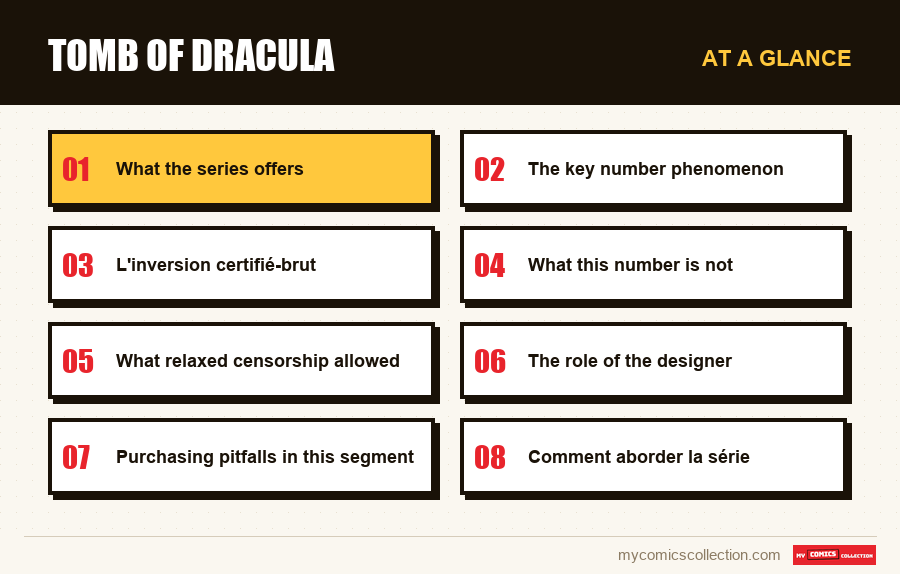
What the series offers
It belongs to a wave of horror that follows a relaxation of censorship rules, and it draws things from it that the genre did not allow until then.
An antagonist as the main character. The central figure is the monster, not his adversaries, and the story grants him an interiority (pride, boredom, contempt) which makes him interesting beyond his function.
A differentiated distribution of hunters. Those who hunt him form a heterogeneous group, with personal motivations and rivalries. They are the ones who carry continuity.
A long-running soap opera. The consequences persist, the characters die, and the arcs respond over dozens of issues: which was unusual in a genre treated as closed stories.
Un dessin en clair-obscur. The designer works in dark masses and low lighting, with inking that supports this direction. This is what makes the series instantly recognizable.
The set lasts for dozens of issues without wearing out. It is an adult horror serial released in a mainstream setting, a rare combination and one that explains the enduring reputation of the series.
The key number phenomenon
Le numéro concerné
Brut : 34 annonces, $14.99 to $10,000.00 asking, median 397,50 $. Certifié : 82 annonces, $185.00 to $12,994.95, median 1 389,99 $.
It contains the first appearance of a character who later became very popular.
The rest of the series
Brut : 169 annonces, de 2,99 à 155,00 $demandés, médiane 15,99 $. Certifié : 19 annonces, médiane 150,00 $.
Regular numbers at $3.95 are common.
Les apparitions suivantes
The fourth issue where the character returns wonders 37,99 et 47,76 $. The appearance rank is paid in a rapidly decreasing manner.
Les éditions étrangères
Versions published abroad appear explicitly in the statement, 45,00 et 47,76 $: distinct objects that the title alone does not indicate.
L'inversion certifié-brut
This is the most remarkable fact of the survey and it deserves a complete explanation.
On almost every series examined in this campaign, raw ads far exceed certified ones: often by a factor of ten or more. Here, on this specific number, the relationship is reversed: 82 exemplaires certifiés en vente contre 34 bruts.
The mechanism is economical. When a copy is worth several hundred dollars, certification costs a fraction of its value and secures a risky transaction. Almost all copies in good condition therefore end up certified.
What remains in raw form is mainly composed of copies that the operation did not justify: weak states, foreign editions, or reprints. The gross median of $397.50 therefore describes a degraded population, not a cheaper alternative to the same object.
This is the most important practical conclusion of this article: on this issue, a moderately priced raw copy is almost never a good deal, it's another object.
The extreme values of this reading are particularly misleading. There are requests for $10,000.00 gross and $12,994.95 certified, isolated and without neighbors.
In a segment where the medians are already in three and four figures, these amounts seem plausible even though they are no more so than elsewhere. The reflex remains the same: read the median, count the announcements, and ignore anything that has no neighbor.
What this number is not
Il faut lever une confusion fréquente, car elle coûte cher.
It's not the best issue in the series. It contains a first appearance, which is a bibliographical fact and not an assessment. The story it contains is correct and nothing more.
This is not an entry point. It arrives after several issues that establish the cast and tone. Reading it in isolation gives a poor idea of the series.
This is not necessary for reading. The material has been reprinted multiple times and can be read for a few dollars in other forms.
What it is: a collector's item whose value is due to a convention: the rank of appearance, and not a property of the book. It's perfectly legitimate, provided you buy it knowingly.
What relaxed censorship allowed
The regulatory context of this period explains part of what the series could do, and it is worth asking.
For two decades, a code of self-discipline had prohibited American publishers from a large part of the horror repertoire: the classic creatures of the genre were banned by name, and the supernatural could only be treated with precautions that emptied it of its substance.
The relaxation of these rules in the early 1970s suddenly reopened an entire territory, and the publishers jumped on it. This series is part of the immediate wave, which explains its ambition: there was some catching up to do.
This also explains its tone, more adult than the format led one to expect. The authors who entered this territory knew that they were addressing an audience that had grown up, and the treatment reflects this.
A modern reader, accustomed to everything being permitted, may miss this dimension. What seems wise today was taking a risk, and the series is better read knowing it.
Collecting this series?
Track what you own, what you are missing and what your collection is worth. 7 day trial.
Start my trial →The role of the designer
We must devote development to the graphic side, because it is inseparable from the text in the present case.
The designer of this series works with masses of shadow and partial lighting, with a rendering that owes as much to photography as to comic strips. The faces are often half-hidden, the settings treated in depth, and the movement rendered by blurs rather than by speed lines.
It's a slow drawing, in the sense that it demands to be looked at, which is perfectly suited to an atmospheric story and would be poorly suited to an action series.
Inking plays a decisive role here and is rarely emphasized: an inker who would have hardened these sketches would have destroyed most of them. The series benefited from stable collaboration on this position, which explains its visual consistency over dozens of issues.
For a buyer, this has a practical consequence: print quality matters more here than on a solid drawing. A poor print dulls the halftones and destroys exactly what makes these plates valuable: this is a criterion that is best considered as a priority, even before the general condition of the paper and the cover.
Purchasing pitfalls in this segment
Foreign editions
They appear in the same searches at much lower prices. They are distinct objects, correctly described but easily confused.
Reprints
The content has been republished numerous times. An announcement mentioning the story does not necessarily relate to the original edition.
A paper from 1973
Fragile support that yellows and breaks. High states are rare and the price gap between two states is considerable.
The deceptive crude
A moderately priced uncertified copy is almost always in poor condition or from another edition.
Comment aborder la série
Three recommendations, which clearly separate the reading from the collection.
To read, buy regular issues in bulk. At $2.99 and $3.95 each, twenty consecutive issues cost less than a single copy of the key issue and give the series as it read.
Don't try to start at the beginning at all costs. The serial builds up gradually and any block of consecutive issues in the middle gives a fair idea of what the series is up to.
Treat the key issue as a separate project. If you want it, buy it certified and accept the price; if you don't want it, the series can be read entirely without it.
This separation is key to the entire segment. Confusing the two projects leads either to giving up reading an accessible series, or to buying a degraded copy at the price of one.
What to record
In a series where a single number concentrates the value, the sheet must deal with two distinct regimes.
For the key number: the edition, the country of publication, and the certification status with its number. Foreign editions and reprints are circulating in the same searches at unrelated prices, and nothing on the cover still allows us to decide. On a three or four-digit item, this precision is what makes a resale possible.
For the rest of the series: nothing more than the number and condition. It's a few dollars' worth of reading, and making the sheet heavier wouldn't do anything.
This asymmetry is deliberate and should be applied as is. The level of detail of an inventory must follow the issue, and a series where the issue is concentrated on a reference does not require the same rigor everywhere.
This is the opposite of what most inventories do, which apply the same form to all copies and discourage by their cumbersomeness where it is useless.
Frequently asked questions
Because it contains a first appearance that has become sought after. This is a bibliographic fact and not an assessment: the story it contains is correct and nothing more, and its content has been reprinted multiple times. Its value is due to a collection convention, not to a property of the book.
Because at this price level certification costs a fraction of the value and secures a risky transaction: almost all correct copies end up certified. What remains in the rough is mainly composed of weak states, foreign editions or reprints.
Almost never. The gross median of $397.50 describes a degraded population and not a cheaper alternative to the same item. An uncertified copy clearly below is in poor condition or from another edition: it's another item, not a second-hand item.
No, and that's what makes this series enjoyable: all the money is focused elsewhere than in the reading. Twenty regular issues at $2.99 and $3.95 cost less than a single copy of the key issue and give the series as it read.
Nothing usable. There are requests for $10,000.00 gross and $12,994.95 certified, isolated and without neighbors. In a segment where the medians are already high, these amounts seem plausible without being more so than elsewhere: read the median and ignore what has no neighbor.
Original, foreign edition, or reprint?
On a four-digit item, this precision is what makes resale possible.