Start with its 1970s horror series, not its 1980s hit, and the market is unexpectedly confirming that advice. As of August 29, 2026, the horror series displays $15.99 gross median out of 169 ads, versus $10.00 for the much more famous superhero series. The lesser known costs more, and the explanation has nothing to do with quality: it was printed less and read more.
This screenwriter has marked two decades in two opposing registers, and the reading order is not self-evident.
This article situates the two periods, explains the paradox of the reading, gives the order of entry, and specifies what you need to know before buying.
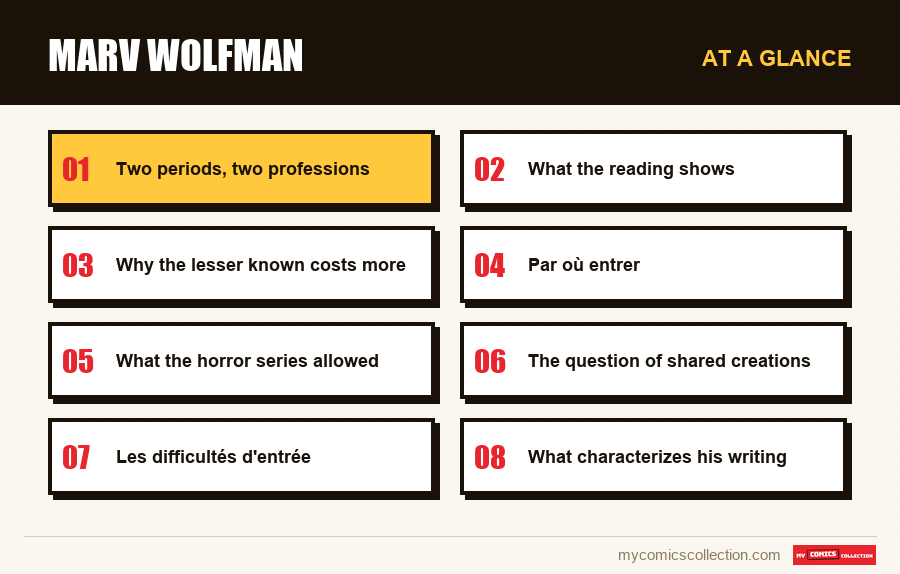
Two periods, two professions
Both sides must be considered, because they have almost nothing in common other than their author.
The 1970s: serial horror. A long series dedicated to a classic terror character, in a gothic register, with a designer with a very marked style. The format is serial, the tone serious, and the success remained modest.
The 1980s: the team superhero. A group series which became one of the biggest commercial successes of the decade, with a virtuoso artist and a cast of characters largely created for the occasion.
The mid-1980s: the remaking of universes. A large-scale editorial event intended to put decades of contradictory continuity in order: a technical exercise as well as a narrative one.
These three sides require different skills. Few screenwriters succeed in all three, and that’s what makes this journey interesting to follow.
What the reading shows
The figures below come from fixed price advertisements taken on August 29, 2026, raw and certified copies counted separately. These are prices asked by sellers.
The horror series
Brut : 169 ads, of $2.99 to $155.00 requested, median $15.99. Certified: 19 ads, median $150.00.
The higher raw median of the two, on the lesser known series.
The team series
Raw : 134 annonces, of $1.87 to $450.00 demandés, médiane $10.00. Certified: 30 ads, median $199.95.
More certified copies and a lower gross median.
Lowest entries
Numbers to $1.87 and $1.99 requested on the team series, against $2.99 on the floor for the horror series.
The certified inverted slope
Thirty certified announcements for one, nineteen for the other: the organized market was formed on the cheapest raw series.
Why the lesser known costs more
The paradox is perfectly explainable and it illustrates a general mechanism.
The prints differ by an order of magnitude. A 1970s horror series was printed for a limited audience; a successful team series from the 1980s was sold in considerable quantities, at a time when the market was buying a lot.
Attrition is not the same. Issues from the 1970s were read, loaned, dog-eared and discarded: they were expendable items. Those from the 1980s began to be preserved, protected, sometimes purchased in duplicate.
Demand does not compensate. The team series is more sought after, but the supply is so plentiful that this additional demand does not increase list prices.
The result is what we see everywhere in this campaign: rarity trumps notoriety when it comes to ordinary numbers. Notoriety is only paid for by precise references, which is confirmed by the certified version.
The certified side tells the opposite story and the two must be read together. The team series has thirty certified listings at $199.95 median, compared to nineteen at $150.00 for the other.
In other words: on current issues, seniority and rarity dominate; on collector's items, notoriety takes over. These are two separate markets in the same series, and citing one for the other leads to false claims.
Par où entrer
Three recommendations in an order that follows neither chronology nor notoriety.
La série d'horreur d'abord. This is where we see what this screenwriter knows how to do alone: build tension over time, keep a small cast, write characters who are not archetypes. The Gothic register is aging remarkably well.
La série d'équipe ensuite. It shows the same know-how applied to a restrictive commercial framework, with characters to create and a demanding periodicity. We see the author negotiating between his intentions and the format.
The universe overhaul last. It is a technical exercise which requires knowing what it is putting into order. Read without this context, it seems confusing, and it is, structurally.
This order has one merit: it goes from the most personal to the most constrained, which makes it possible to measure what each framework imposed rather than judging the author on his most ordered exercise.
What the horror series allowed
A point of context illuminates the transition from one register to another and it is rarely noted.
Writing a long-term horror series in the 1970s meant working with censorship and format constraints much heavier than those of superheroes. The genre was tolerated, monitored, and its audience considered unreliable.
These constraints forced a know-how of ellipse and suggestion which then finds itself in a completely different framework: not showing, letting people guess, making the threat come from what we cannot see.
This explains why his superhero series include truly disturbing moments, something uncommon in a genre where the threat is generally spectacular rather than dull.
In other words, the lesser known side of his work provided the tools for the better known. This is a movement that we often observe among authors trained in minor genres, and which justifies starting there.
The question of shared creations
One aspect of this bibliography deserves clarification, because it complicates attribution.
Several characters who have become considerable have been created in collaboration with a designer, in conditions where the part of each is not documented. A screenwriter suggests a function and a temperament, a designer gives a silhouette and a presence, and the character is born from the encounter.
Attributing a creation to one or the other is therefore generally abusive., and discussions on this subject are often based on late and self-serving testimony.
What is observable, on the other hand, is what a character becomes over time: the narrative decisions which construct him volume after volume are clearly a matter of writing.
This is the most honest criterion for judging the contribution of a screenwriter: not what he invented, but what he kept. A creation is an instant, a trajectory is a work: and this is the second that can be read in the numbers.
Collecting this series?
Track what you own, what you are missing and what your collection is worth. 7 day trial.
Start my trial →Les difficultés d'entrée
Very long series
The two main sets have dozens of numbers, which is daunting before you even begin.
Une continuité extérieure
The redesign of the universe refers to decades of publications that have not been read and which have not been summarized.
Un rôle de scénariste
His name appears on hundreds of covers. Distinguishing what he wrote from what he supervised requires checking the bear.
Un papier fragile
The issues from the 1970s are on a support that yellows and breaks, which limits the copies in good condition.
Finally, let us note a practical consequence of the contrast of prints explained above. On the series from the 1980s, abundance allows you to be demanding: at this price level and with this offer, there is no obligation to accept a tired copy, and waiting costs nothing. On that of the 1970s, the logic is reversed: the paper has aged badly, beautiful copies are rare, and a copy in good condition offered at a reasonable price deserves that we decide quickly rather than waiting for something better.
What characterizes his writing
Three features recur from one slope to the other and allow us to recognize it.
Numerous and differentiated distributions. He writes bands, and each member has a distinct voice, motivation, and rhythm. This is a rare and costly skill in pages.
Continuity maintained over time. Consequences persist, characters remember, and old events return. He writes with what has been published in mind rather than the current episode.
A taste for flawed characters. His most successful figures are those who fail, doubt or betray, including in a heroic setting where this was not common.
These three traits explain why his work holds up well to rereading. A series written with duration in mind rewards those who read it over time, which was not the norm in the serial format of those decades.
What to record
On this author, the file must resolve an ambiguity which runs through his entire bibliography.
Their exact function on each issue: screenwriter, co-writer, or editorial manager. He played all three roles on neighboring series and sometimes simultaneously, and his name appears on the cover in all three cases without distinction. A collection built on the name alone mixes works that do not engage the same degree of involvement.
This is the condition for judging his writing on issues he actually wrote, which is not guaranteed by the cover.
The associated designer, because his writing visibly adapts to his partners: dense and gothic with one, airy and spectacular with the other. Following these couples is the fairest way to read his work.
These two mentions respond to what a prolific screenwriter poses: distinguishing the work from the catalog that bears his name.
Frequently asked questions
Through his horror series from the 1970s, where we see what he can do alone: tension over time, restricted cast, characters who are not archetypes. The 1980s team-up series comes next, and universe overhaul last: it requires knowing what it's reordering.
Because the print runs differ by an order of magnitude and the attrition is not the same: issues from the 1970s were consumable items, read and discarded, while those from the 1980s began to be kept. On ordinary numbers, rarity trumps notoriety.
No, the opposite: thirty certified ads at $199.95 median for the team series versus nineteen at $150.00 for the other. On collector's items, notoriety takes over. These are two separate markets in the same series, and citing one for the other produces false claims.
By checking the bear, because he occupied three roles (screenwriter, co-writer, editorial manager) sometimes simultaneously on neighboring series, and his name appears on the cover in all three cases without distinction. A collection built on the sole name mixes very unevenly personal works.
Large casts where each member has their voice, continuity that is truly maintained over time: the consequences persist and the characters remember -, and a taste for figures who fail or betray, including in a heroic setting where this was not common.
Screenwriter, co-writer, or editor?
Three roles, one name on the cover, and a collection built on it mixes everything up.