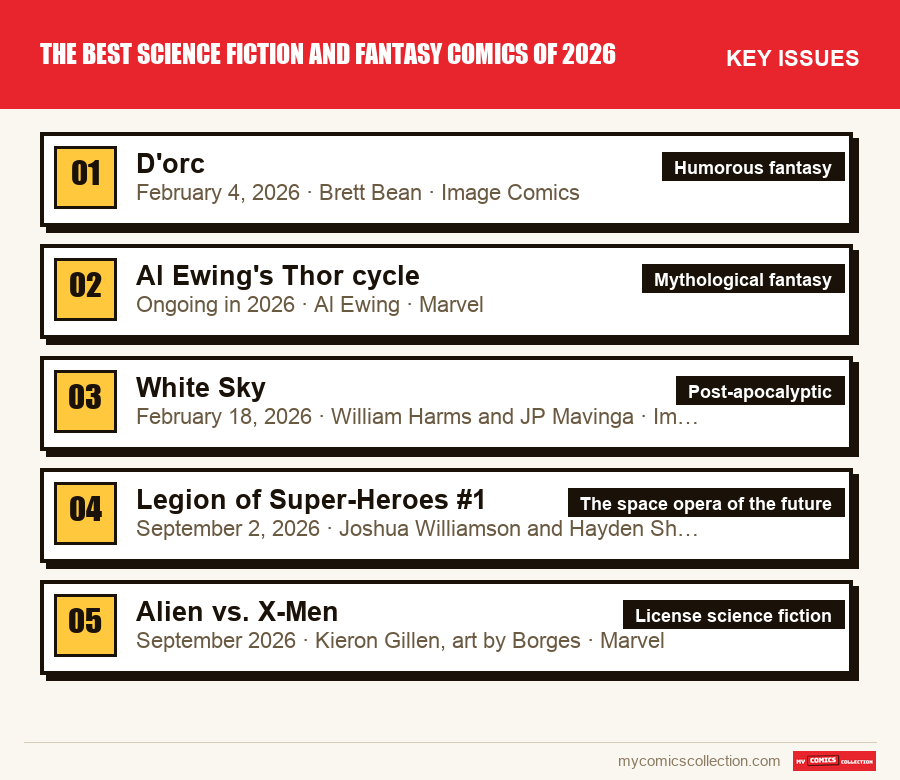
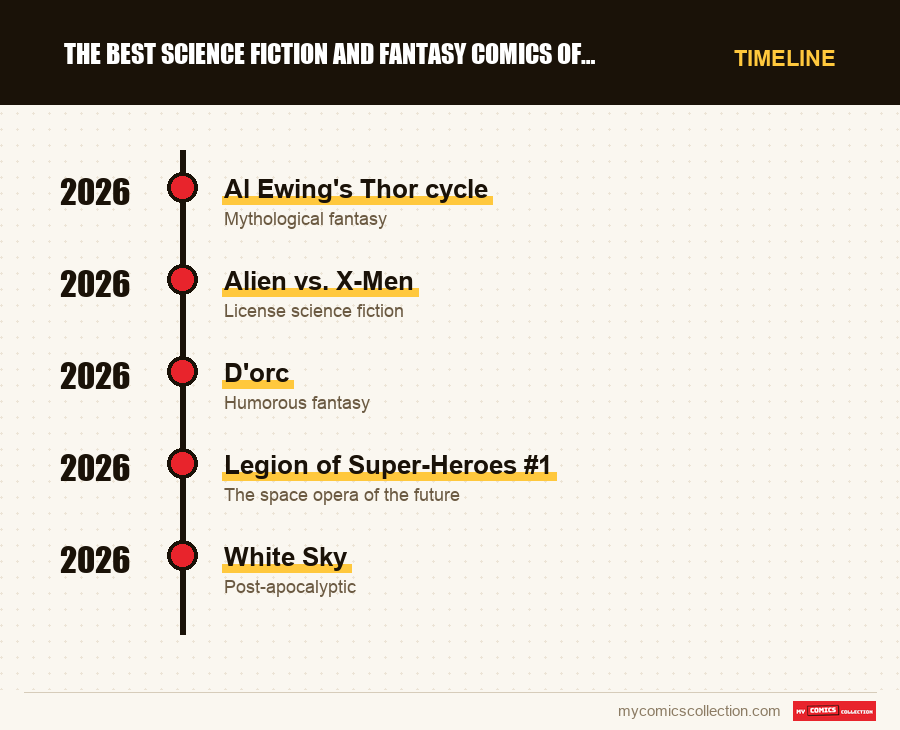
As of early October 2026, the science fiction and fantasy comics that marked the year are, on the fantasy side, D'orc by Brett Bean (Image, February 4), a heroic fantasy comedy that became one of the winter's surprise hits, and Al Ewing's long mythological cycle on Thor, continued with The Mortal Thor. On the science fiction side, White Sky by William Harms and JP Mavinga (Image, February 18), a post-apocalyptic story; Legion of Super-Heroes #1 by Joshua Williamson and Hayden Sherman (DC, September 2), the return of the 31st century team; and Alien vs. X-Men (Marvel, September), a four-issue miniseries by Kieron Gillen with a new story by Chris Claremont. Horror, covered elsewhere, is excluded. This review stops in September: nothing is said here about October to December.
Science fiction and fantasy hold a curious place in American comics. They are everywhere and nowhere: everywhere because superheroes themselves constantly borrow from both genres, with their aliens, their gods and their alternate futures; nowhere because the series that fully embrace one or the other remain a minority in sales. Taking stock of a genre year is therefore first a matter of deciding what you count.
Our rule is simple: we keep the series whose genre is the heart of the story, and not a backdrop. A hero fighting an alien does not make a science fiction series; a team living in the 31st century does. This review is written as of October 3, 2026, on the current year alone. For an all-era overview, see our rankings of the best science fiction comics and the best fantasy comics. Horror, which had a wave of its own this year, is covered in our article on horror at the big publishers in 2026.
A genre year carried by creator-owned works
The first observation of 2026 is that the most noticed fantasy and science fiction did not come from the big publishers, but from Image, at the very start of the year. In February, two original creations with no preexisting character were announced sold out at the distributor on their release day: a fantasy comedy and a post-apocalyptic story. Two genres, two tones, and the same reader reaction.
It is no accident. Genre creations are the easiest to jump into: they require no prior knowledge, no continuity, no reading backlog. For a reader arriving at a specialty store without knowing superheroes, a fantasy or science fiction series is a natural entry point. It is one of the explanations for the growth of the specialty-store audience since 2025, and genre launches benefit directly.
The second observation is that the big publishers mostly used science fiction through their existing properties: a future team relaunched at DC, a film license crossed with the mutants at Marvel. These are catalog operations more than creation bets, but they produced solid reads.
Fantasy: the titles of the year
D'orc
A half-dwarf, half-orc orphan, accompanied by an enchanted shield that never stops talking. Brett Bean writes and draws, Jean-François Beaulieu colors. Issue 1 sold out on release day, was reprinted in March, then reprinted again. It is the most-read fantasy of the year, by far.
Al Ewing's Thor cycle
Al Ewing continues in 2026, with The Mortal Thor, the long cycle he devotes to the god of thunder. It is the most clearly mythological series from the big publishers: a story of gods, realms and fate, closer to epic fantasy than to the superhero story.
The 2026 fantasy therefore remains split between two very distant poles: the adventure humor of a creator-owned work, and the long-running mythology of a catalog character. In between, little broke through, and that is an honest observation rather than a gap in this review: pure fantasy remains a niche genre in the American direct market, where it is more present in collected and graphic-novel form than in single issues.
Science fiction: the titles of the year
White Sky
A teenage girl and her father cross a devastated America toward the ruins of San Francisco. Colors by Lee Loughridge. Sold out on release day, issue 1 saw its second printing exceed 30,000 orders, more than the first. It is the most noticed independent science fiction of the year.
Legion of Super-Heroes #1
The Legion of Super-Heroes, a team of young heroes of the 31st century, returns in a ninth volume carrying this title, under DC's Next Level label. The art goes to Hayden Sherman, artist of Absolute Wonder Woman, which signals the importance given to the project.
Alien vs. X-Men
A four-issue miniseries that pits the mutants against the creature of science fiction cinema. The first issue contains as a backup a new story by Chris Claremont, who returns to the extraterrestrial creatures he himself introduced in Uncanny X-Men #155 in 1982, largely inspired by the film.
Two other titles deserve a mention, with a caveat. Mind MGMT: New & Improved, the return of Matt Kindt's psychic espionage series, flirts with science fiction through its mental powers and secret organizations, and its issue 1 sold out at the distributor before release. And Absolute Martian Manhunter by Deniz Camp and Javier Rodríguez, launched in March 2025 in DC's Absolute line, was honored this year: it is a first-contact story more than a superhero one, in the sense that its extraterrestrial is first of all a foreign consciousness. Neither is a 2026 creation in the strict sense, but both are among the most singular things read in the genre this year. Our guide to the key issues of the Absolute universe places this series.
What these titles have in common
Put side by side, these titles draw a clear trend. The 2026 science fiction and fantasy were not carried by big concepts, but by simple forms: a journey, a quest, a team, a confrontation. None of these stories requires encyclopedic knowledge. Even the Legion, reputed to be intimidating, is relaunched with the explicit aim of being accessible.
Second common point: the place of the creator. Brett Bean writes and draws D'orc. Al Ewing has built a personal cycle over several years. Gillen and Claremont are strong signatures. Even in catalog operations, it is a name that makes the promise. This trend runs through all of 2026, beyond genres.
Third common point, more unexpected: proximity to the image. White Sky has the structure of a survival film, Alien vs. X-Men crosses a film license, D'orc borrows from the codes of role-playing games and animation. Genre in comics is in constant dialogue with other media, and readers arriving through those media find their place there.
How to choose your genre reading
Start from the tone
Adventure humor or gravity, intimate story or grand fresco: tone matters more than subgenre. D'orc and White Sky came out two weeks apart and have strictly nothing in common.
Prefer the creator-owned work to begin with
An original series reads with no prerequisites. A team relaunch or a long-running cycle sometimes asks a little context, even when it aims to be accessible.
Read in collected form
Genre stories build over time: a journey, a quest, a war. The collected edition, which gathers a complete arc, does these structures more justice than the monthly single issue.
Do not confuse a sell-out with scarcity
The genre number 1s sold out in February were reprinted in March. Paying full price for them in release week has no interest for a reader. Our article on speculation on Image new releases shows this in detail.
What this review leaves aside
We have excluded horror, which has its own article, and superhero series that use science fiction as mere backdrop. We kept only titles whose date, team and publisher are verifiable, which leaves aside series that may be excellent but that we could not document precisely. We cite no price guide: none of the sources consulted publishes verifiable recent prices on these issues. Finally, we say nothing of the October to December 2026 launches: they will be judged after release, not before.
To go back to the classics of the genre, the page for Saga #1 presents the space fantasy series that showed, in 2012, that a creator-owned work could blend both genres and become a phenomenon.