Alien vs. X-Men is a Marvel miniseries of four issues, launched in September 2026, written by Kieron Gillen and drawn by Borges. Its collecting appeal does not come first from the showdown the title promises, but from the backup slipped into the first issue: a previously unpublished story by Chris Claremont featuring Kitty Pryde and the Brood, the very creatures the writer introduced himself in 1982 in Uncanny X-Men #155. In other words, Marvel is crossing a movie license with the in-house creature that was already inspired by it, and handing the bridge to the man who built it. Two things to remember before buying: licensed crossovers vanish from reprints as soon as the contract ends, and a one-off contribution from Claremont is not a first appearance.
A title like Alien vs. X-Men takes three seconds to read and is misunderstood almost as fast. The poster promises a fight, so attention goes to the winner and to the flashiest cover. For someone who shelves comics rather than posters, the interest lies elsewhere and is far more solid: this miniseries connects a movie license to a creature the publisher manufactured forty-four years earlier to fill exactly the same narrative slot.
The creatures in question are called the Brood. They were born in 1982 under Chris Claremont's pen, just as the space horror that came from the 1979 film was settling into popular culture. In 2026, the publisher holds the film license, and it asked Claremont to come back and write his own creatures facing the original.
This article sorts things out: what is established about the miniseries, the history of crossovers between outside licenses and superheroes at this publisher, and the direct question of what a previously unpublished Claremont story is worth in 2026. It is October 2, 2026 and no recent price figure has been published for this series, so there will be none here.
What is established about the miniseries
Let's start with the exact scope, without widening it. Alien vs. X-Men runs four issues and began in September 2026. Kieron Gillen is on script, Borges on art. The first issue contains a short backup story signed by Chris Claremont, devoted to Kitty Pryde and the Brood.
Gillen is no passing guest on the franchise. He took over Uncanny X-Men in the early 2010s after co-writing it, then handled Immortal X-Men from 2022, the series that carried the internal politics of the Krakoan era, before writing Rise of the Powers of X in January 2024 and X-Men: Forever in March 2024, the two texts that closed that period. Handing this writer a crossover with a horror license is not a filler choice.
On the other hand, anything not in the previous paragraph is unverified to date. The precise schedule of issues 2 to 4 is not publicly documented, nor are the details of the variant covers, the print runs, or the story's place in main continuity. The New York convention runs October 8 to 11, 2026 and panels are scheduled there: details are expected, but nothing has been said yet as these lines are written. In the coming weeks, be wary of any key-issue list that announces 2027 content.
The Brood, or the Alien the publisher built for itself in 1982
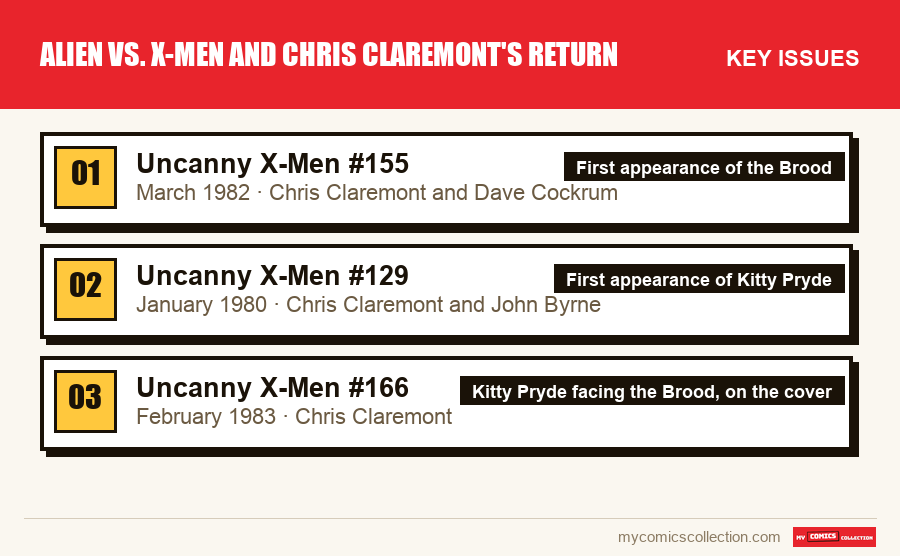
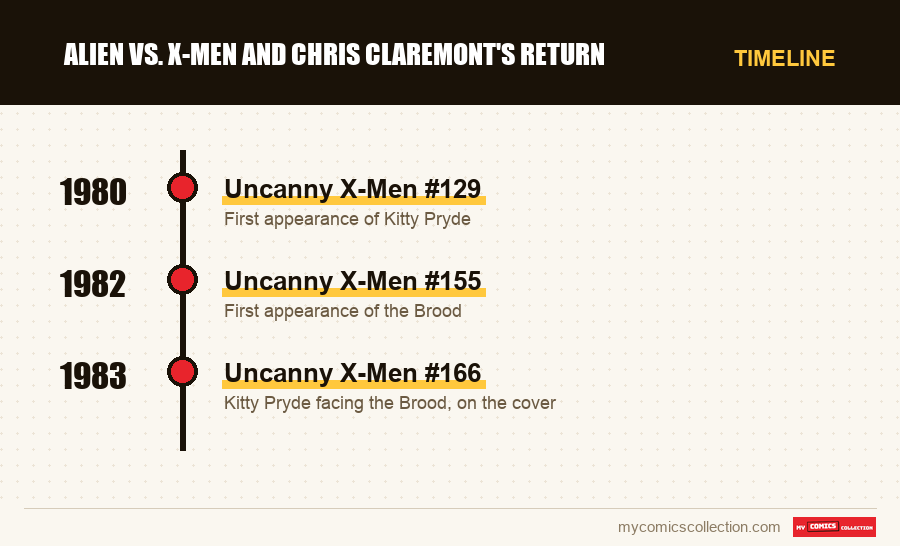
This is the point that makes this miniseries interesting rather than ordinary. The Brood first appears in The Uncanny X-Men #155, dated March 1982. The species was developed by Chris Claremont on script and Dave Cockrum on art. According to the artist's own account, these creatures were originally conceived as alien sidekicks to accompany Deathbird, and he simply drew the most repulsive thing he could imagine.
The result shares several traits with the xenomorph of the 1979 film: reproduction through the forced implantation of an egg in a host, followed by the host's transformation. That is not mood detail, it is the entire dramatic engine. A creature that kills makes a monster; a creature that turns you into itself makes a tragedy, because it forces the story to show the victim during the transformation.
Kitty Pryde comes along for the ride. She appears on the cover of Uncanny X-Men #166, dated February 1983, grappling with these creatures alongside the X-Men. At that date she is the newest member of the group and the most physically fragile, which makes her the ideal hostage for a threat based on the body. Putting her back in front of the Brood in 2026 under the pen of its co-creator is therefore anything but arbitrary.
Uncanny X-Men #155
The species' origin issue, and the real root of the 2026 miniseries. This is not a superhero first appearance but the first appearance of a hostile species, a category the market treats differently: demand is slower to build and more dependent on publishing news. An official crossover with the license that inspired it is precisely the kind of news that puts such an issue back in the spotlight.
The starting point of the character Claremont returns to in 2026. She takes the name Sprite in issue 139, then Shadowcat during the six-issue Kitty Pryde and Wolverine miniseries, published in 1984 and 1985: that is the identity that stuck to her. This issue 129 is a recognized pillar of the period, and its price has nothing to do with that of a modern licensed comic.
Uncanny X-Men #166
The direct visual reference for the 2026 short story. An issue in the middle of an arc rather than at its opening stays accessible for a long time, because it appears on no first-appearance list. It is the profile of piece that an attentive collector buys before publishing news points to it.
Forty years of outside licenses, and a lesson few people know
Crossovers between a licensed property and the house superheroes are not new to 2026. The publisher has been doing them since the late 1970s, and the history of these titles holds a collecting lesson you will not find in general guides: a licensed comic stops being reprinted as soon as the contract ends. The text does not disappear, but it becomes inaccessible other than by buying the original issues, sometimes for decades.
The X-Men and the Micronauts is a four-issue miniseries published from January to April 1984, co-written by Bill Mantlo and Chris Claremont, drawn by Jackson Guice, often credited as Butch Guice. It is the closest precedent to what is happening in 2026: a toy license crossed with the mutant team, and already Claremont on script. The main series Micronauts had run from January 1979 to August 1984, that is fifty-nine issues and two annuals. After the second volume ended in May 1986, the license expired, and the publisher could no longer republish anything from that set. It only recovered those rights in 2023, through a new agreement with the brand's holder, before publishing an omnibus collection with restored pages the following year.
Rom: Spaceknight tells the same story on a larger scale. Seventy-five issues and four annuals, from December 1979 to February 1986, written by Bill Mantlo, drawn by Sal Buscema and then by Steve Ditko from 1984. The character crosses paths with the mutant team in Uncanny X-Men #187 and #188, dated November and December 1984, around the threat of the Dire Wraiths. After the rights were lost, no reprint was possible, and the phenomenon spilled over onto neighboring titles: episodes of other series where the character made an appearance were left out of the budget collections of the time. Again, the reacquisition of the license in 2023 reopened the door, with facsimile editions and omnibuses from 2024.
Remember the mechanism, because it applies word for word to Alien vs. X-Men. If the contract binding the publisher to the film license ever lapses, this miniseries will drop out of reprints and digital offerings, and the four original issues will become the only reading copy available. That is not a value prediction, it is a material constraint. To place this title among the franchise's other showdowns, the overview of X-Men crossovers covers the internal events.
The Alien and Predator wave since 2021
The immediate context is a series of methodical crossovers, and it is useful to see them lined up. The publisher recovered the Alien license following the studio's acquisition by its parent group, then launched Alien #1 to #12 from May 2021 to July 2022, written by Phillip Kennedy Johnson, who followed up with a second volume of six issues from November 2022 to April 2023. Other short volumes followed, including a four-issue anthology from April to July 2024.
The first major crossover with the house heroes is Aliens vs. Avengers, four issues entrusted to Jonathan Hickman and artist Esad Ribić, launched in 2024 and finished in 2025. During the same period, the neighboring license produced a remarkably regular trilogy, all written by Benjamin Percy: Predator vs. Wolverine, four issues from September to December 2023; Predator vs. Black Panther, four issues from August to November 2024; Predator vs. Spider-Man, four issues from April to July 2025. A fourth installment is scheduled for November 2026 with Predator vs. Punisher, in four issues, written by Frank Tieri and drawn by Jesús Saíz.
What this run of titles tells a collector is simple and not very flattering to speculation: the format has become a regular product. A licensed crossover issue 1 now arrives once or twice a year, on a tight four-issue schedule with a clean ending. Scarcity therefore cannot come from the format itself, since it repeats. It can only come from two things: content that exists nowhere else, or a genuinely limited print run. In the case of Alien vs. X-Men, the first condition is met by Claremont's story. The second is unknown.
What a previously unpublished Claremont story is worth, in 2026
The question deserves a frank answer, because the lazy answer is to say that everything this writer signs on the X-Men becomes precious. That is false, and his own career proves it.
Chris Claremont wrote Uncanny X-Men from issue 94, dated May 1975, until 1991, that is sixteen years as the main writer, a record run on the title. During that time, the series became one of the best-selling comics in the world. He co-created or developed more than sixty characters, including Kitty Pryde, Rogue, Mystique, Emma Frost and Gambit. His last act of that era, X-Men #1 in 1991, co-written with Jim Lee, is still certified by the record book as the best-selling comic of all time, with more than 8.1 million copies.
That figure is the central argument against the idea of automatic scarcity: eight million copies are out there. The writer's returns to the franchise after 1991 were numerous, and none produced a collectible comparable to the issues of his founding period: Uncanny X-Men with Alan Davis in the mid-2000s, X-Treme X-Men in the same decade, X-Men Forever in 2009 in a parallel universe, Nightcrawler from April 2014 to March 2015. None became a sought-after piece.
The reason is structural, and it holds for any legendary writer. What gives a collectible comic its value is not the signature: it is what the issue introduces into the universe and what other stories then reuse. A short backup in a licensed issue 1 almost never introduces anything reusable, by construction, because it has to stay compatible with an outside contract. It brings something else, not negligible but not financial: reading an author returning to his own creatures forty-four years later, which is more document than investment.
Put another way: buy this issue because this meeting of author and creature will not happen again, not because you think you will resell it. To measure the gap between the two logics, the ranking of the best X-Men runs and the list of the franchise's key issues show well which issues have truly made history, and how few they are compared with the volume published.
How to approach this miniseries in practice
Here is a procedure that avoids the two usual mistakes: buying too much at the start, and giving up before the end.
Decide your goal before buying
Reading, tracked collection, or one-off piece? For reading, a single standard copy of each issue is enough, and the digital version does the job. For collecting, issue 1 is the only one that carries the new backup, so the only one that justifies special attention. For a one-off piece, there is nothing to do today: no print run data has been published.
Choose one cover edition, and only one
Licensed crossovers systematically come with a range of variant covers. Collecting them all multiplies the spending without adding anything to the text, which is identical. Take the main cover if you aim for readability and easy resale, a variant if you like it visually, but decide before walking into the shop.
Log all four issues in your tracking from the first one
This is the move that changes everything on a miniseries. A four-issue series spread over several months gets lost easily, especially when it belongs neither to the regular X-Men series nor to the license's own. Record the expected set as soon as you buy the first issue, and let the missing list remind you what is left to find.
Go back to the background rather than to variants
If you want to spend beyond the four issues, the best use of that budget is the 1982 and 1983 background, not a fifth cover of the same issue. The Brood's initial appearance and issue 166 have a history, a real scarcity tied to their age, and a direct reading connection with what you have just bought.
Wait before certifying anything
On a modern comic bought new, a high grade is not a rarity: it is the normal state. Store it properly, let the fourth issue come out, and then decide whether the item has earned a place in your collection. A well-kept copy can always be certified later, the reverse is not true. The CGC grading guide details this calculation.
One last note on the calendar: the mutant franchise is in heavy demand right now, between the horror line launched this month, whose contents the guide to the key issues of Midnight X-Men details, and the return of several veteran writers in December. Add up the releases before committing: four parallel miniseries cost more than a regular series, and that is often where a year's budget dissipates. To find out what your collection already contains, the free estimate gives a starting point.