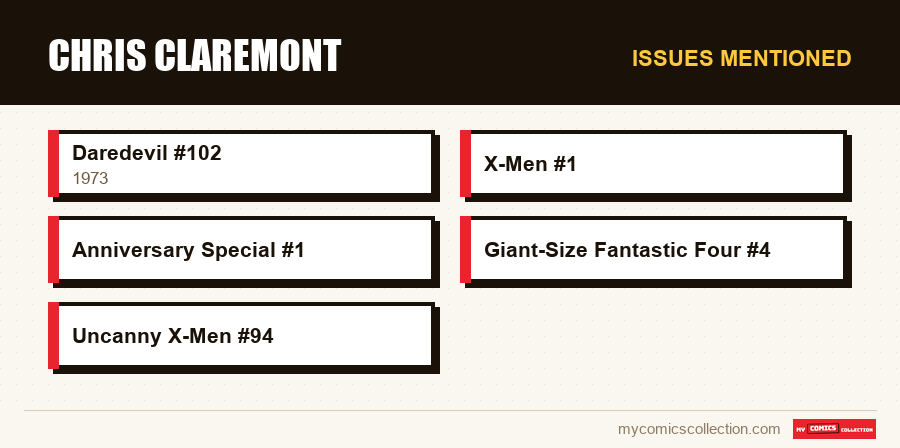
Chris Claremont, born in London on November 25, 1950, is the writer who turned the X-Men into a major franchise. He joined Marvel in 1969 as an assistant, wrote his first script in Daredevil #102 (1973), then took over Uncanny X-Men at issue 94, in 1975, and kept it for sixteen years, until 1991, a record. He is responsible for "The Dark Phoenix Saga" and "Days of Future Past" with John Byrne, and the co-creation of dozens of characters, including Kitty Pryde, Rogue, Mystique, Emma Frost, Sabretooth, Gambit and Captain Britain. His 1991 X-Men #1, with Jim Lee, remains certified as the best-selling comic of all time. In 2026, he returns twice: a new story in Alien vs. X-Men #1 in September, and a contribution to the Captain Britain 50th Anniversary Special #1 of October 14, 2026, for the fiftieth anniversary of a hero he co-created.
There are writers who write a good series, and writers who change its nature. Chris Claremont belongs to the second category. When he takes over the X-Men in the mid-1970s, the title has just been relaunched after years of reprints, with a brand-new international team. When he leaves it in 1991, it is the best-selling comic in the world, the matrix of half a dozen spin-off series, and the model of the multi-character superhero serial.
This article traces his whole career, before, during and after the X-Men, without going over the major arcs in detail, which our ranking of the franchise's runs already analyzes. The aim is to understand a writer's path, and to know which issues to read to grasp each stage.
An Englishman raised on British comics
Christopher Simon Claremont was born in London. His family moved to the United States when he was three, and he grew up on Long Island. As a child, he read American superhero comics less than the British weekly Eagle, to which his grandmother subscribed him, and the adventures of Dan Dare. He also devoured Robert Heinlein's science fiction and the adventure novels of Kipling or C.S. Forester.
These readings matter. They explain his taste for serialized stories, for female action characters, and for a certain idea of collective adventure. They also explain why he was, later, the natural writer of a British hero. Claremont himself linked his attachment to marginal characters to his status as an immigrant, roughed up on his arrival because he looked different.
At university, he studied political theory and theater, and dreamed of becoming a stage director. He nonetheless joined Marvel as early as 1969, still a student, as an editorial assistant. He graduated in 1972.
The beginnings: Daredevil, Iron Fist, Madrox
His first professional script was Daredevil #102, dated August 1973. He was then given the Iron Fist feature in Marvel Premiere, from issue 23 in 1975, where he was joined two issues later by artist John Byrne. The duo continued in Iron Fist's own series, fifteen issues, where Sabretooth in particular was born. At the same time, Claremont created Madrox, the Multiple Man, in Giant-Size Fantastic Four #4.
It was the editor in chief of the time, Len Wein, who gave him the X-Men. Wein and Dave Cockrum had just launched a new team. The series was in such bad shape that handing the title to a young writer upset nobody. Claremont approaches it like a method actor: he builds each character from their motivations and desires.
1975-1991: the sixteen years of Uncanny X-Men
Uncanny X-Men #94
Claremont's first issue on the series. In the following issues, he introduces Moira MacTaggert in 96 and Lilandra in 97, then transforms Jean Grey into the Phoenix in issue 101. Byrne arrives on art at issue 108, in 1977.
With Byrne, Claremont wrote the two stories that define the franchise. "The Dark Phoenix Saga", which culminates in issue 137, tells the fall of Jean Grey; historians compare it to what the Galactus trilogy was for Lee and Kirby. "Days of Future Past", in issues 141 and 142 in 1981, imagines a future where mutants are hunted. Issue 129, in 1980, introduces both Kitty Pryde and Emma Frost with the Hellfire Club. For a detail of the issues of this arc, our article on the key issues of the Dark Phoenix Saga is the right stop.
The list of his co-creations is dizzying: Rogue, introduced in 1981 in an Avengers annual; Mystique, who appeared in 1978 in Ms. Marvel; Destiny, Selene, Rachel Summers, Madelyne Pryor, Mister Sinister, Forge, Jubilee, and Gambit in issue 266 in 1990. He also creates the Brood, those extraterrestrials who appeared in issue 155 in 1982, whom we find again in 2026.
During these years, he multiplies parallel projects: the Wolverine miniseries with Frank Miller in 1982, the graphic novel God Loves, Man Kills the same year, which would inspire the second X-Men film, the launch of New Mutants in late 1982, a crossover between X-Men and Teen Titans with Walt Simonson, then Excalibur with Alan Davis and the Wolverine series in 1987 and 1988. He also writes Ms. Marvel, Spider-Woman and Marvel Team-Up.
His style becomes a signature: abundant thought balloons, subplots running over years, characters crying with rage at the bottom of the page. A former editor of the series told how, when out of ideas, all she had to do was pick up the threads Claremont had left dangling for a year or two. For an overview of his place among the franchise's great writers, see our ranking of the best X-Men runs.
1991: the best-selling issue in history, then the departure
X-Men #1
In 1991, the publisher launches a second mutant series, co-written by Claremont and artist Jim Lee. The first issue, released in several covers then in a gatefold cover that united them, exceeds 8.1 million copies sold, a figure certified by the record book.
The triumph is also an ending. Claremont left the franchise after the first three-issue arc, following disagreements with the series' editor. He had written the X-Men for sixteen years; he leaves at the commercial summit, in a climate where star artists had taken power.
The 1990s: elsewhere
The following decade takes him away from Marvel. He narrowly misses being among the founders of Image, with a personal project that would not find an artist in time. He writes a Star Trek graphic novel, an Aliens and Predator miniseries, a few issues of WildC.A.T.s, then launches his series Sovereign Seven at DC, which lasts thirty-six issues. He also devotes himself to novels: a science fiction trilogy, and a trilogy co-written with George Lucas that extends the film Willow.
In 1998, he returns to Marvel as editorial director and writer of Fantastic Four, where he creates Valeria Richards. He stays twenty-nine issues on the title, his longest stint outside the X-Men.
The returns to the X-Men
The 2000s and 2010s are the decades of returns. He rewrites Uncanny X-Men and X-Men in 2000, then launches X-Treme X-Men. He returns to Uncanny in 2004, with Alan Davis, his Excalibur partner in crime. He co-writes a JLA arc at DC with John Byrne, whom he finds again twenty-five years after their X-Men. In 2009, X-Men Forever lets him pick up the thread where he had left it in 1991, in a parallel continuity. In 2014, he writes a Nightcrawler series, until March 2015, then reunites with Bill Sienkiewicz in 2019 for a single New Mutants issue.
None of these returns had the impact of his founding period, and that is logical: you do not refound the same franchise twice. But they kept his voice alive, and showed that he remained the most attentive guardian of his characters.
Captain Britain: the hero of the fifty years
This is a lesser-known aspect of his career, and the one that 2026 news puts forward. In 1976, the publisher launches in the United Kingdom a weekly devoted to a British hero, Captain Britain, and Claremont, English by birth, is its co-creator. The hero's twin sister, Betsy Braddock, appears there the same year; she will become Psylocke in the X-Men. Claremont would then take up the character in Excalibur, with Alan Davis.
The Captain Britain 50th Anniversary Special #1, scheduled for October 14, 2026, brings together Alan Davis, Chris Claremont, Dan Abnett, Paul Davidson and Kelsey Ramsay. It celebrates half a century of the character. To understand why first appearances published in the United Kingdom form a market of their own, read our article on Marvel's British comics and their first appearances.
2026: Alien vs. X-Men
The other return of the year is more unexpected. The miniseries Alien vs. X-Men, launched in September 2026 by Kieron Gillen and Borges, contains in its first issue a new Claremont story, devoted to Kitty Pryde and the Brood. The writer finds his own creatures again there, born in 1982 in a context where the cinema's space horror was settling into popular culture. Our article on Alien vs. X-Men and Claremont details what such a contribution is worth to a collector.
Where to start
The Byrne period
From issue 108 to issue 143: the Phoenix, her fall, then Days of Future Past. It is the essential reading.
The 1980s
God Loves, Man Kills, the Wolverine miniseries, then the rest of Uncanny through the late 1980s. Our list of X-Men key issues helps you choose.
Captain Britain and Excalibur
For the British side, ahead of the October 2026 anniversary issue.
The returns
X-Men Forever for those who want to know what he had planned after 1991, then the two 2026 contributions.
On the recognition side, Claremont was inducted into the Eisner Awards Hall of Fame in 2015, at the same time as John Byrne. He donated his writing archives to the rare books library of a major New York university in 2011.