No key issue of Midnight X-Men can be named today, and that is a fact of method, not a show of caution. A key issue is defined by content: a first appearance, a first version of a known character, a lasting death or transformation, a costume taken up afterward. Yet as of October 1st, 2026, Jonathan Hickman and Matteo Della Fonte's #1 has not come out and its content remains unknown. The useful precedent is House of X / Powers of X in 2019: seven years later, the issues the market remembers are not those expected at the announcement, but those that carried a new character or a structuring revelation. This article explains what to look for in the first twelve months of Midnight X-Men, how to recognize a first appearance on a series with no history, and why issue 1 is the most overrated candidate on the list.
The question always arrives in the same order. First "when does it come out", then "who writes it", and finally, very quickly: "what will the key issues be". The first two have a factual answer. The third has none, and yet it is asked everywhere before each launch, with affirmative answers that rest only on the wish to be right early.
This article therefore delivers not a list but a grid. A key issue is not an opinion, it is a bibliographic property: this issue contains something that did not exist before it and that you read nowhere else. This is established after reading, never before. On the other hand, the types of content that produce this status are perfectly known, and the announced premise of Midnight X-Men lets us say where they are likely to appear. For the general framework of the line and its calendar, we refer you to the complete guide to Marvel Midnight.
A key issue is not an important issue
The confusion between these two words explains most bad purchases at the launch of a series. An important issue is one that matters for the story: a dramatic peak, a twist, an arc's end. A key issue is one that matters for the bibliography: it introduces an identifiable entity that readers, databases and other series will then have to cite.
The two rarely coincide. A spectacular confrontation in issue 7 can be the best episode of the year without adding anything to the catalog, whereas a mediocre issue 4 where, in two panels, a figure appears who will carry the series for ten years will be sought long after the confrontation of 7 has been forgotten.
Four kinds of content produce almost all lasting demand on modern comics.
The first appearance of a new character. It is the most solid, because it is unique and non-reproducible: there is only one issue in the world where a creation appears for the first time. The character still has to take hold. Series publish dozens of new faces a year, almost all of which disappear without leaving a bibliographic trace.
The first version of an already-known character. The central case in a parallel universe. If the Midnight version of an established mutant becomes a figure cited outside the line, the issue that first shows it becomes a reference, even if the character himself has sixty years of existence elsewhere. This is exactly the mechanism that made the value of the first issue of the Ultimate line in 2000: not the novelty of the hero, but the duration of this precise version.
Death, or irreversible transformation. Much more fragile, because largely reversible in the genre. A death announced with great noise and undone eighteen months later leaves nothing. A transformation that holds, however, makes a before and an after that any later reading has to cross.
The costume, or the visual attribute. Underestimated, and yet one of the most reliable over the long term, because a visual travels: it spreads into figures, cover illustrations, adaptations. The issue that first shows a silhouette that became iconic survives the forgetting of the story around it.
You will notice what this list does not contain: the writer's name, the media noise of the launch, the number of covers available, and being a number 1. None of these elements is content. They influence the printed volume, that is, exactly the opposite of scarcity.
The 2019 precedent: what Hickman really produced on the X-Men
Jonathan Hickman returns to the X-Men seven years after House of X and Powers of X, two six-issue series published in parallel between July and October 2019, drawn by Pepe Larraz and R. B. Silva respectively. It is the only serious point of comparison we have, and it has the advantage of being old enough to be judged with hindsight.
At the time of the announcement, attention was on the first issue of House of X. It was the event object: the title series, the launch, the image of the franchise's relaunch. It sold about 185,000 copies, a considerable figure for 2019, and that is precisely what kept it from becoming rare. The print run matched the expectation.
Seven years later, the issues collectors still talk about are not those the calendar put forward.
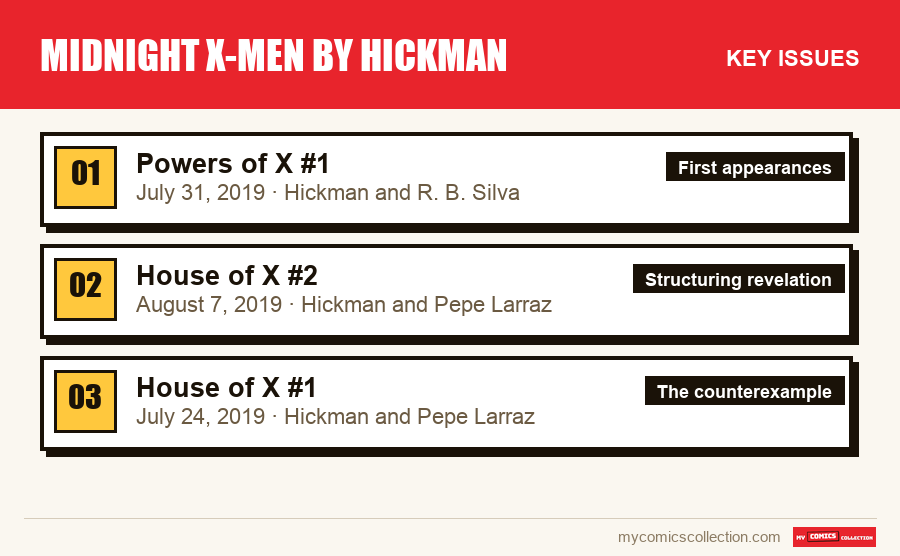
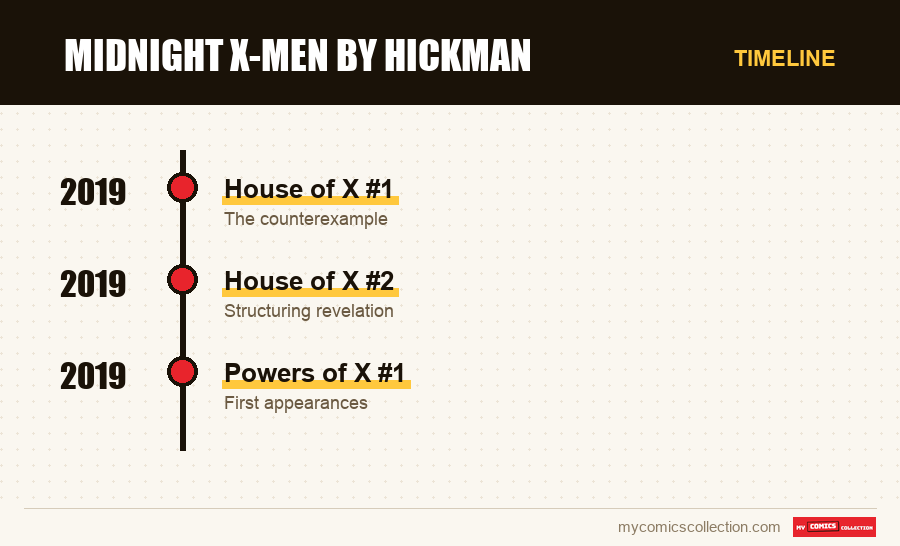
Powers of X #1
The secondary series, the one whose title was puzzling and which sold about 168,000 copies, markedly less than its twin. Yet it is the one that contains the diptych's most solid content: the first appearances of Rasputin IV and Cardinal, two creations from the distant future imagined by Hickman. A less-ordered issue that contains identifiable creations, against a heavily ordered issue that contains none: the bibliography ruled in the opposite direction of expectation.
House of X #2
Titled "The Many Lives of Moira X", this issue reveals that Moira MacTaggert, the X-Men's human ally for decades, is actually a mutant whose power consists of restarting her life. The revelation retroactively rewrites the entire history of the franchise and serves as the engine of five years of publication. In the strict sense, it is not a first appearance, since the character had existed since 1975. Part of the market nonetheless treats it as the first appearance of "Moira X", that is, of a version. The gray area is instructive: a key-issue status is negotiated, it is not decreed.
House of X #1
The issue that opens the overhaul, the one everyone bought. It remains an indispensable entry point for reading, but as a collectible it combines two handicaps: an enormous initial print run, and reprints triggered by demand. It has therefore stayed easy to find, in all conditions, permanently. It is not a failure of the series, it is the mechanical effect of success on availability.
The 2019 lesson fits in one sentence, and it applies word for word to October 2026: with Hickman, the content that becomes a reference rarely arrives where the marketing is looking. His habit is to lay an architecture in the first issues and have the decisive creations come out of it later, often in the margins of the main series.
What Midnight X-Men's premise lets us foresee
The announced starting situation is precise, and it is usable. The shadows of New York are roamed by vampires and mutants, two species linked by a fragile peace about to break, with factions inside each camp. Hickman himself describes the project as an open mythology mixing old and new ideas. This vocabulary is not trivial for a collector.
A mythology to build means entities to name. A conflict between two species means chiefs, lineages, treaties, dissidences. It is the most fertile ground there is for producing first appearances, and it is exactly what Hickman had done in 2019 with his mutant nation: the political structure of a story is a factory of secondary characters who become indispensable.
Three zones of content therefore deserve particular attention.
The power figures of the vampire camp. In a story of factions, the chiefs are named early and return durably. If they are creations specific to the line, and not reuses of the publisher's existing horror catalog, their introduction issues are the best candidates of the first half-year.
The Midnight versions of established mutants. Magneto, Storm, Jean Grey or Mystique rewritten in a horror register do not all appear in issue 1: they arrive one by one, and each of these issues contains a first version. Which will matter? Those the line keeps at the center. Unknown at this stage.
The silhouette that will stand out. In horror, the visual weighs more than elsewhere: a mask, an anatomy, a color is enough to make a memorable character. The issue that reveals this silhouette may very well be an intermediate issue with no apparent narrative importance.
The first twelve months: where to look
Here is the method we apply, in order, to any new series.
Issues 2 to 5, before anything else
This is the zone where orders fall fastest while the story gets to the heart of things. Retailers adjust downward after issue 1, opportunistic readers drop off, and the print run contracts while the writer introduces his real cast. Lower print runs on richer issues: that is the definition of a serious candidate.
The issue where the opposing camp speaks
In a two-species story, there is always an episode that switches to the antagonists' point of view. That is where the opposing camp's hierarchy is named and shown. It generally falls between the fourth and the eighth issue.
Arc endings, for transformations
On a modern series, an arc is five or six issues. The last concentrates deaths and changes of state. Careful: only those that hold beyond the next arc count, which means you can only validate such an issue with six months' delay.
The first crossover with the other two series
The line is designed so that the titles answer each other. The first issue where an element of Midnight Spider-Man or Midnight Fantastic Four explicitly enters Midnight X-Men is a landmark: it proves that the shared mythology really exists, and it draws collectors of all three titles to a single issue.
The issue that leaves the line's frame
The real signal of maturity arrives when a Midnight creation appears somewhere other than in the line. That day, its origin issue changes status, because demand ceases to be limited to readers of the title. It is the mechanism that established the 2019 creations over time.
How to recognize a first appearance with no history
On an old series, the information is documented: databases, indexes and forty years of discussion have settled it. On Midnight X-Men, there will be none of that for several months. The advantage therefore belongs to the one who reads and takes notes, not to the one who waits for a ranking.
Read the issue the day you buy it. A first appearance is seen when reading, often in a background panel, never on the cover. A copy stored without being read teaches you nothing.
Distinguish the appearance from the mention. A name spoken in dialogue, a shadow, a hand out of frame do not constitute a full appearance: the convention retained by the market requires a visible, identifiable character. A so-called partial appearance is always worth less than a full appearance, and knowing which one you hold will spare you a disappointment.
Note the number, the date and what you saw. Three lines on a record are enough. In eighteen months, when a character has taken hold, it is your note that will tell you where you first met them, and whether you already own that issue.
Be wary of announcements prior to release. A character announced in a publisher communication may appear later than planned, in another title, or in another form. The only proof is the printed object.
Keep the whole series, not only your favorites. It is the most profitable lesson of the 2019 precedent: the issue that mattered was not the one being watched. On a new line, the complete run is the only coverage against your own lack of information.
The number 1 trap
It must be said clearly why Midnight X-Men #1 is, of the whole upcoming series, the issue least likely to become a rare piece, while being the most bought.
A major launch number 1 is ordered according to expectation, which is at its maximum before anyone has read a page. Here, this expectation is carried by three cumulative factors: a writer's return to a franchise he overhauled, the opening of an entire line, and a release day with no other Marvel novelty. The print run will therefore match. In other words, the number of copies in circulation will be the highest of the whole series, for an object whose bibliographic content is by construction the most uncertain: a first issue sets a scene, it does not yet reveal the architecture.
This does not mean you should do without it. Midnight X-Men #1 is the entry point of the story, and a run without its first issue is an incomplete run, which has a real cost at resale. The right formulation lies elsewhere: buy it because it opens the series, not because it would be key. Its status in ten years will depend entirely on what it contains, and nobody knows yet, not even those who wrote it, since key status is also manufactured by what the following issues decide to keep.
The symmetric of this trap deserves to be said: the most ignored issue of the first year has the highest probability of being the hardest to find again. Not because it will be better, but because it will be less printed and less preserved. On the great series of the 1970s and 1980s, the current hierarchy of sought-after X-Men issues owes much to this gap between what was expected and what was printed.
Keeping the record while the information is fresh
All of the above boils down to a memory problem. The elements that will let you know in three years whether you own a key issue are known today and forgotten tomorrow: the exact issue, the purchase date, the cover, the print run, and what you noticed when reading.
In the app, the gesture takes two minutes a month. Create the series from the first issue, so that the missing issues list builds itself as releases come out. Enter the print run at the time of purchase, because it is the only information that disappears completely once the object is shelved. And use the notes field to record what you saw: "suspected first appearance, page 14" is worth more than any estimate.
What to remember before October 7
There is no list of key issues of Midnight X-Men, and any list proposed right now is fiction. There is a reading grid, a documented precedent and a known premise, which are enough to direct attention without inventing figures.
The reasonable position is to take the series from the start, read it as it comes, note what appears and have nothing graded before you have an identifiable reason. At issue 12, you will know. The others will be looking for issue 4 on the secondary market.
Frequently asked questions
None, to date, and it is not an evasive answer. As of October 1, 2026, the series has not come out: its first issue is out on October 7, 2026. A key issue is defined by verifiable content, that is, a first appearance, a first version of a known character, a lasting death or a visual attribute taken up afterward. None of these properties can be established before reading. What you can do, however, is know where to look as soon as it is released: issues 2 to 5, the episode that gives the vampire camp a voice, the arc endings, and the first explicit crossover with the line's other two series.
Impossible to say, and the known elements encourage caution rather than enthusiasm. A highly anticipated number 1 is ordered in large quantity, and a reprint is likely if demand exceeds initial orders. Many copies in circulation, on an object whose bibliographic content is still unknown: it is the classic configuration of a comic that stays available for a long time. The 2019 precedent goes in this direction, the first issue of House of X having stayed easy to find despite the relaunch's success. Buy it because it opens the series and your run would be incomplete without it, not for a gain.
The two issues that stand out with hindsight are Powers of X #1, released on July 31, 2019, which contains the first appearances of Rasputin IV and Cardinal, and House of X #2, released on August 7, 2019, which reveals that Moira MacTaggert is a mutant and rewrites the franchise's history. A notable fact: the Powers of X series sold less than House of X at its first issue, about 168,000 copies against 185,000. It was therefore the secondary title, less ordered, that carried the most solid content. Nobody foresaw it before release.
By reading the issue, on the day you buy it. On a series with no history, no database will be able to inform you for several months, so the information is gained through reading. Three precautions help: require a visible, identifiable character, because a spoken name or a shadow is not a full appearance; note the number, the page and what you saw on a record, because you will have forgotten it in six months; and do not trust publisher announcements prior to release, since an announced character may arrive later, elsewhere, or in another form.
Yes, and it is more frequent than you would think. The mechanism is arithmetic: retailers order number 1 according to a maximum expectation, then adjust downward from number 2, at the precise moment when the writer begins to introduce his real cast. Fewer copies printed, more new content. House of X #2 illustrates the case in 2019, with a revelation that structured five years of publication. On Midnight X-Men, issue 2 is announced for November 18, 2026, six weeks after the first: a gap large enough for a buyer of number 1 to forget to come back.
On a new series, buying all of the first twelve issues is the most rational strategy, precisely because you do not know which ones matter. It is the only way to cover your own lack of information, and the cost is known in advance. The alternative is to buy three or four issues chosen at random from the news, then buy back two years later, on the secondary market and at the price of demand, the one that proved decisive. The question of choice arises for an established series whose bibliography is documented, not for a series that is starting.
No, as long as no identifiable content justifies it. Grading has a fixed cost, and on a modern comic bought new, a high grade is nothing exceptional: it is the expected condition. Having an issue graded without knowing whether it contains something amounts to paying to certify the condition of an ordinary object. The reasonable sequence is the reverse: read, spot content, wait to see whether this content takes hold in the line, and decide afterward. A copy kept clean remains gradable years later, whereas a handled copy will never be new again.
Rather, yes, and it is the most encouraging element of the file. A story built on two species in conflict, with internal factions and a peace that breaks, requires naming chiefs, lineages and dissidents. It is a structure that mechanically produces secondary characters meant to last. Hickman had proceeded the same way in 2019: the political organization he had invented for the mutants generated far more lasting creations than the diptych's action scenes. Still, the probability of having first appearances does not say in which issue they will fall.