What to expect from Midnight X-Men #5: the release date is February 17, 2027, with Jonathan Hickman on the story, Matteo Buffagni on the art and a veiled cover A credited to Dike Ruan. For the story, Marvel presents a meeting between Ronin and Reaver, bound by a pact made in Hell, where accounts will be settled and the peace must hold. It is the last issue solicited to date.
An upcoming issue isn't read, it's prepared for. This one has a peculiarity: its solicitation puts two names face to face, Ronin and Reaver, each of which points back to a long tradition in the Marvel universe. This article focuses on that double lineage, to say what it offers the reader and the collector before release.
As always in this guide, we only state verified information (creators, issue numbers, dates); the analysis is ours, with no reproduction of protected pages or dialogue.
The credits for issue 5
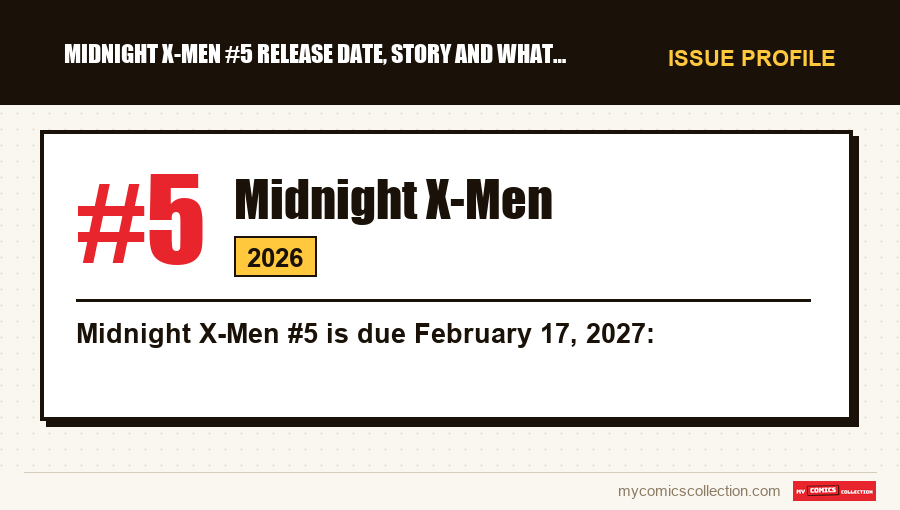
Marvel announces Midnight X-Men #5 for February 17, 2027. The story is by Jonathan Hickman and the art by Matteo Buffagni, already credited on the series' #4. Cover A is by Dike Ruan and, like those of issues 2 through 4, it is veiled: the announced artist is presented as such, without our being able to say he will be the final credit. No first appearance is announced for this issue.
We are writing on November 6, 2026, and this issue is more than three months from release. So for now there is only a single presentation sentence, which we reword. Everything that follows is context and method, not a reading.
What Marvel announces
The presentation fits in few words. Ronin and Reaver come face to face. What binds them is a pact made in Hell, and the solicitation indicates that old accounts will be settled. It adds a watchword: the peace must hold.
Three elements stand out, and only three. The first is the presence of two characters designated by a working name rather than a civilian name. The second is the place of the agreement, Hell, which puts the origin of the conflict outside New York, outside the world of the living. The third is the line about the peace, which points back to the situation set up from #1: the series rests on a peace negotiated by Nightcrawler among vampires, mutants and humans, and on the political struggles that threaten it.
Nothing in this presentation says who is behind these two names, what the pact was, or who comes out ahead from the meeting. We don't fill in those blanks. The discussion that follows concerns what these names mean in Marvel's history, because that is verifiable and because it is what the collector can use right now.
The Ronin name in Marvel history
The Ronin title predates the Midnight line: Marvel has already given it, over the years, to several characters. In the classic series, the identity appears in 2005 in New Avengers #11, by Brian Michael Bendis and Joe Quesada, where Maya Lopez, also known as Echo, takes it on to investigate the Silver Samurai in Wakanda. Clint Barton then picks it up, after the superhero civil war, when he rejoins the New Avengers; he tries to give the costume back to Maya Lopez, who refuses and leaves it to him. Other characters have worn it since, among them Alexei Shostakov, Eric Brooks and Bullseye.
The identity has also crossed over to the screen: Clint Barton as Ronin appears in the film Avengers: Endgame, and Maya Lopez in the series Hawkeye and Echo. For the single-issue reader, the lesson is simple: a title carried by several hands since 2005 doesn't, on its own, designate one person.
What this changes for this issue is modest but useful. When a solicitation announces "Ronin" with no further detail, a rigorous inventory notes the title as published and waits for the reading before attaching the character to any entry from the classic series. That is the caution we apply here: the solicitation names no one behind the title, and neither do we. For the same reason, the one-eyed ronin mentioned in the previous issue's announcement is not, at this stage, a character we identify.
The word itself comes from Japanese: it denotes a samurai without a master. The etymology explains why Marvel turns to it for figures who act outside a hierarchy, but it says nothing about the Midnight series' character, and we stick to that observation.
Reaver: a name that points back to Uncanny X-Men
The second name has a history more closely tied to the X-Men. The Reavers are, in the classic series, a team of criminal cyborgs who appear in Uncanny X-Men #229, in May 1988, created by Chris Claremont and Marc Silvestri. Bonebreaker, one of its members, debuts in the same issue. Donald Pierce, who will later lead the group, appeared well before, in The Uncanny X-Men #132, in April 1980, created by Chris Claremont and John Byrne. The Reavers were adapted for the big screen in the film Logan, in 2017, where Donald Pierce is played by Boyd Holbrook.
We need to be clear about what this connection does and doesn't allow. It allows us to say that the word Reaver has belonged to the X-Men vocabulary since 1988. It does not allow us to say that the Midnight X-Men character is a Reaver in the sense of the classic series, or descends from one: the solicitation doesn't indicate it, and a name is not an identity. Midnight's characters are reinvented in a horror setting, which the complete guide to the line describes: kinship of a name is not lineage.
For a collector, the practical point is this. If issue 5 turned out, after reading, to contain a new version of a known name, it is that reading that would allow us to say so. Until then, the right position is to file the issue as a regular single issue of the series, without loading it with a meaning no one has yet observed. That reading discipline is the one behind the page on Midnight X-Men key issues.
Do you collect this series?
Track what you own, what you are missing and what your collection is worth. 7-day trial.
Start my trial →
A pact in Hell, accounts to settle: reading the phrasing
The solicitation pairs two ideas, the pact and the debt. In the horror genre, which is the line's, the infernal pact is an old device: an agreement made from a position of weakness whose deadline comes round. We point it out as a trait of the genre, not as a prediction about the plot. The announcement says only that old accounts will be settled, and that the peace must hold; it doesn't say in what order, or at what price.
The line about the peace is the most instructive, because it links back to the start of the series. At the outset, #1 of October 7, 2026 sets up a precarious balance among vampires, mutants and humans. #4 announces letters, summonses and threats from both sides. #5, the last issue solicited to date, picks up the word peace at the end of that sequence. The consistency of vocabulary is an observation by a reader of solicitations, not a revelation.
On form, a series of five announced issues reads readily as a first season, even though Marvel has given no length for the series. We draw nothing else from it beyond a collector's precaution: #5 is, to date, the last issue whose credits are known, and a series tracker deserves updating with each new announcement.
Cover and artist
For cover A, signed by Dike Ruan, Marvel keeps the image hidden as on the previous issues, and its unveiling happens when you open the single issue. The announced artist is presented as such, and you will note "announced" in your inventory until you open the copy. For the Midnight cover families and how to read the ratios, see the page devoted to Midnight variants.
On the art side, #5 is Matteo Buffagni's second issue on the series. The details of his background belong to #4, where the change of artist takes place, and we don't repeat them here: all that matters for this issue is that the Hickman and Buffagni duo stays in place from one month to the next, which gives the announced meeting a continuity of pencil with the previous month's summoning.
February 2027: three series, three issue 5s
Midnight X-Men #5 closes out the line's known schedule: Midnight Spider-Man #5 is announced for February 3, Midnight Fantastic Four #5 for February 10, and the X-Men issue for February 17, 2027. The one-week gap between each title has been constant since #4 (January 13, 20 and 27), so the X-Men series always arrives last of the trio.
For anyone following all three series, that means three consecutive weeks of February with a weekly appointment. For anyone following just one series, it is a chance to check that the shop order is registered under the right title. The complete guide details the overall schedule and the formats.
What the collector can do right now
- Reserve the issue with your shop if you follow the series: dates are announced, not guaranteed, and veiled covers can only be recognized once opened.
- Log the entry as "announced" with the solicitation's credits (Hickman, Buffagni, Dike Ruan for cover A), and update it once you've read it.
- Attach nothing to the classic series before reading: neither Ronin nor Reaver is identified by the announcement.
- Keep a record of the release date and where you bought it, useful if a copy needs to be found or appraised later.
No price guide is put forward here, and no forecast: an issue that hasn't come out has no track record, and our content analyses come after reading, in the blog section.
Frequently asked questions
Marvel announces it for February 17, 2027, one week after Midnight Fantastic Four #5 (February 10) and two weeks after Midnight Spider-Man #5 (February 3). As of November 6, 2026, only the solicitation exists: the date may still be adjusted.
Jonathan Hickman writes and Matteo Buffagni draws, as on #4. Cover A is credited to Dike Ruan, but it is veiled: the artist is presented as announced, and the full image only appears inside the single issue.
A meeting between Ronin and Reaver, bound by a pact made in Hell. Old accounts must be settled and the peace must hold. Marvel doesn't specify who is behind these names or what happened: we will make no hypothesis before reading.
The announcement doesn't say. The Reavers, a team of cyborgs, appear in Uncanny X-Men #229 in 1988, by Chris Claremont and Marc Silvestri. The name therefore belongs to the X-Men vocabulary, but a shared name doesn't prove a lineage in the Midnight line.
No first appearance is announced for this issue. A key issue is established after reading, on the real content of the single issue. The safest approach until then is to treat it as a regular issue of the series and log it with its announced credits.
Do you already have 1980s Uncanny X-Men or other issues tied to the Reavers? Get them estimated for free.
Estimate my comic