
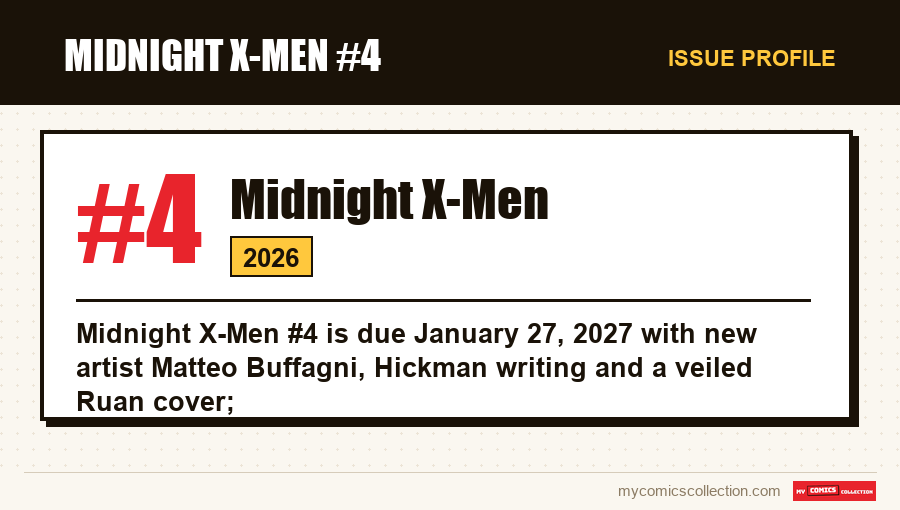
Midnight X-Men #4 is announced for January 27, 2027, with a new artist: Matteo Buffagni takes over the art from Matteo Della Fonte, who drew the three previous issues. Jonathan Hickman stays on the story, and Dike Ruan keeps the veiled cover A. Marvel lists 32 pages rated Parental Advisory, letters going out, factions summoned and a clue that threatens old plans, plus a set of variants.
In a monthly series, a change of artist is the most visible event after the cover: you read it on the first page, and it changes how a run of issues sits on a shelf. Midnight X-Men #4 is precisely that pivot issue, and this article deals with it alone.
As always in this guide, we only state verified information (creators, issue numbers, dates); the analysis is ours, with no reproduction of protected pages or dialogue.
The credits for issue 4
Here is what Marvel has published about this issue. Release is set for January 27, 2027, two weeks after Midnight Spider-Man #4 and one week after Midnight Fantastic Four #4: the three series advance at the same pace, but the order of arrival in stores puts the X-Men last of the trio.
The story is by Jonathan Hickman. The art is by Matteo Buffagni. Cover A is by Dike Ruan. The single issue lists 32 pages under the Parental Advisory label, against 40 pages for #1. Colors and lettering don't appear in the announcements we consulted, so we credit them to no one.
This is an announcement: the issue hasn't come out as of this writing, November 6, 2026. Everything that follows about its content rests on Marvel's solicitation, which we reword, and not on a reading.
Three issues, then a different pencil
The art timeline is simple to lay out. Matteo Della Fonte draws #1 of October 7, 2026, #2 of November 18 and #3 of December 16. From #4, the art credit passes to Matteo Buffagni, who is also credited on #5 of February 17, 2027. In other words, the series has three issues from a first artist, then at least two from a second.
For the collector, the established fact is enough: a clean change, at an issue boundary, with no transition issue by two pencilers in the announcements.
Another element doesn't move, and it matters for visual coherence: at Marvel's New York Comic Con panel on October 9, 2026, the character designs presented for the series were signed by R.B. Silva (Selene, Iceman, Kitty Pryde, Magik, Magneto, Forge and Beast). These designs are creative references, not pages from the series.
The cover, for its part, stays with Dike Ruan. On an issue with an interior artist change, that is an anchor point for the eye: on the shelf, the five spines of the series keep the same cover A signature, while the interior changes hands at the fourth.
Who is Matteo Buffagni
Matteo Buffagni is an Italian artist, born in 1984. In Italy, he is known for having renewed the look of Diabolik, and his covers for the series were the subject of an exhibition in Bellinzona in 2024. Before Marvel, he went through illustration and storyboarding, an apprenticeship in breaking down scenes that counts for a suspense story.
His career at Marvel begins in the early 2010s, with several issues of Daken: Dark Wolverine. A profile like that, trained in the European school and passed through storyboarding, says something about his method without our having to invent any commentary: he is at home with narrative page layouts, which is precisely what a story where mutants, humans and monsters clash demands of the pencil.
What he has already drawn, from X-Men to genre graphic novels
The list of his Marvel work is long, and several titles touch directly on the mutant world. It includes Dark Wolverine (from 2011), Avengers Assemble, Astonishing X-Men (the third volume), Ultimate Comics: Iron Man, Inhumanity (2015), The Amazing Spider-Man (fourth volume), X-Men: Blue, Asgardians of the Galaxy (2018) and Hunt for Wolverine: Weapon Lost (2018). He has also worked on titles in the Star Wars universe published by Marvel, including Star Wars: Age of Rebellion - Lando Calrissian (2019).
Outside Marvel, his recent credits include The Magic Order. That genre series, tied to magic, is a useful clue: the artist isn't confined to the spandex superhero register, and the supernatural horror of Midnight X-Men is not foreign ground for his line.
For a collector, two lessons. The first is that Buffagni's X-Men credits are already numerous: he has drawn mutants in several team books. The second is that his name appears on issues of very different series, which makes hunting for his issues richer than for an artist who stayed ten years on a single title: by sorting by artist rather than by series, you get a fifteen-year reading thread.
We give no price guide or value here: that isn't our subject, and #4 hasn't come out.
What the solicitation announces
Marvel's solicitation, which we reword, presents a summoning issue. Two sets of letters go out, and every faction is called to appear. Threats come from both sides, from humans as well as mutants. A one-eyed ronin finds a clue capable of undoing long-laid plans, while a half-healed wound stays lurking in the shadows.
What can be said without extrapolating: the issue is presented as a moment of correspondence and gathering, rather than a confrontation. That is consistent with what #1 sets up, where the negotiated peace between vampires, mutants and humans forms the heart of the series. The solicitation speaks of factions, mutual threats and old plans: the vocabulary is that of diplomacy under tension.
The solicitation stays elliptical on the ronin's identity, on the plans in question and on the wound, and we draw no hypothesis from it. A ronin, in the Japanese tradition the word comes from, is a samurai without a master.
Do you collect this series?
Track what you own, what you are missing and what your collection is worth. 7-day trial.
Start my trial →
Covers and variants for #4
Cover A is by Dike Ruan. Like all the line's A covers from #2 on, it is "veiled": Marvel states that the full image is only visible inside, on the first page, and that the artist announced for this cover may not be the final credit. We therefore present Dike Ruan as the announced artist, nothing more.
The announced variants are as follows: B is by Declan Shalvey (Midnight Bloodbath family, the bloody covers), C by Skan (Midnight Special), D from the Midnight Horror Homage family with an artist still to be announced, and E by Mark Spears (Midnight Gallery), at a 1:25 ratio. The other ratios don't appear in the announcements. For the general mechanics of ratios, how to read them and how to find your way, the page devoted to Midnight variants details it, and we don't go back over it.
One point specific to this issue: variant D has no artist. Until one is announced, it is impossible to log it properly in an inventory; a line reading "artist to be confirmed" is better than a line filled in at random.
Filing a series whose artist changes
A change of artist raises a small inventory problem that collectors run into everywhere. Two methods exist. The first sorts strictly by issue number: you keep the order of the series, and the art credit becomes a simple data point on the entry. The second adds a second axis, by artist, which lets you find every issue by the same pencil in one query.
For Midnight X-Men, the second approach has a concrete advantage: the series splits cleanly between #1 to #3 and #4 onward. If you decide later to keep only one artist's issues, or to set aside the transition issues, you just need to have noted the credit at the time of purchase. We recommend copying the credit as it appears in the issue's credits line, not as it appeared in the announcement, since the covers are veiled and announcements can change until release.
The work of spotting the series' key issues rests on the same discipline: noting what an issue actually contains, after reading. A change of artist is not, in itself, a key issue criterion; it is a production fact that adds to the entry.
What the change means for the series
We need to distinguish what we know from what we assume. We know the series passes from Della Fonte to Buffagni at the fourth issue and that the writer stays Jonathan Hickman. We know the cover stays with Dike Ruan. We don't know how the pages of #4 compare to those of #1: nobody has seen them.
The connection the announcements allow is one of schedule: #3 of December 16 is Della Fonte's last issue, and #4 is the one whose solicitation talks about letters, summonses and factions. That is an observation of dates, not proof of intent.
The broader framework of Jonathan Hickman's collaboration with the artists of the moment is detailed in our analysis of his return to the X-Men; the complete guide to the line places the whole thing within the schedule of the three series.
What a collector should check before January 27
Here is a short list, applicable to any issue with a changing credit.
- The art credit: confirm in the single issue that Buffagni is indeed credited, since the veiled cover doesn't say.
- The cover A credit: note it as "Dike Ruan (announced)" until you have opened the copy.
- Variant D: it has no artist in the announcements; wait for Marvel's announcement to fill it in.
- The ratio of variant E: 1:25 for the Mark Spears cover, according to the announcements.
- The date: January 27, 2027, to be reconfirmed with your shop, since the schedule can shift from one month to the next.
These steps take two minutes when a single issue arrives, and they spare you bulk corrections six months later.
Issue 4 within the run of five
Issue 4 is where the series changes artists, and that may be why it makes a good reading test. A reader following the series monthly notices the change within seconds; a reader waiting for the collected edition will see only a continuous sequence. For a collector of single issues, the point is important: the single issues keep the trace of this boundary, with the credits line specific to each issue.
The series continues with #5, announced for February 17, 2027 with the same duo, Hickman and Buffagni, and the same cover A by Dike Ruan. In the meantime, the monthly rhythm of the three Midnight series puts each issue in a three-week window around the two other titles, which makes it easier to track a grouped order if you follow all three.
Frequently asked questions
Marvel announces it for January 27, 2027. It follows Midnight Spider-Man #4 by two weeks and Midnight Fantastic Four #4 by one week. The issue hasn't come out as of November 6, 2026: only the solicitation is known, and it may change by then.
Matteo Buffagni, who replaces Matteo Della Fonte, the artist of the first three issues. Jonathan Hickman stays on the story and Dike Ruan on cover A. The announcements we consulted give neither the colorist nor the letterer for this issue, so we don't name them.
The solicitation presents letters going out, factions summoned and threats coming from humans and mutants alike. A one-eyed ronin finds a clue capable of undoing old plans, and a half-healed wound stays in the shadows. Nothing more is announced.
B is by Declan Shalvey (Bloodbath), C by Skan (Special), E by Mark Spears (Gallery, 1:25 ratio). The artist for D (Horror Homage) is still to be announced. Cover A, by Dike Ruan, hides its image: you only see it in full by opening the single issue.
No, not on its own. A key issue is defined by its content, a first appearance or a transformation, and is established after reading. The change of artist is a production fact to note on the entry, useful for filing the series, but it doesn't create scarcity.
Do you already own issues of the series or older X-Men drawn by Matteo Buffagni? Get them estimated.
Estimate my comic