Legion of Super-Heroes #1 came out on September 2, 2026 under the DC Next Level label, written by Joshua Williamson and drawn by Hayden Sherman, the artist of Absolute Wonder Woman. DC announced it in June 2026. It is the ninth volume to carry this title, and the sixth reset of the team since 1958. For the collector, the difficulty is not the relaunch: it is that the issues that matter are almost never in a series called Legion. The first appearance is in Adventure Comics #247 (April 1958), and the first appearances of the most sought-after members are scattered across Adventure Comics, Action Comics and Superboy. This article gives the complete map, continuity by continuity.
There is a simple reason a curious reader puts the Legion of Super-Heroes back down after ten minutes of searching: they cannot find the beginning. With other teams, the question "where do I start" has a one-line answer. Here, it has nine, because nine different series have carried the same title in sixty-eight years, at least five of them tell incompatible versions of the same team, and the numbering restarts sometimes from zero, sometimes not at all.
The September 2, 2026 relaunch adds a ninth issue #1 to this pile. Taken alone, it is one more release. Taken as an occasion to sort things out, it is something else: a pretext to finally lay out flat what sixty-eight years of publication have left behind, and to separate the issues with demonstrable historical value from those that merely hold a position in a chronology.
We are writing on October 2, 2026, a month after release. The exercise that follows is therefore not about the quality of the current story, and even less about a price guide: it is about the geography of the title. Where each continuity begins, which issue marks a date in it, and which of those issues an English-language buyer can actually get without buying single issues piece by piece for three years.
What the 2026 relaunch establishes, and what is not yet public
Let us start by distinguishing the verifiable from the assumed, because the gap is wide on this file.
What is established comes down to four points. DC announced in June 2026 a new Legion of Super-Heroes series within its Next Level label, entrusted to writer Joshua Williamson and artist Hayden Sherman. Issue 1 came out on September 2, 2026. The publisher itself dated its wave of launches: the label's trailer posted on its site carries the mention "Coming in September 2026". And the series is the ninth volume to carry this exact title, which can be verified by counting, as we will do below.
A fifth point is worth noting, because it can be checked in two clicks and says something about the investment made. Hayden Sherman has been the artist of Absolute Wonder Woman since that series' launch on October 23, 2024, with Kelly Thompson writing, a title twice honored at the Eisners and sitting at the top of the publisher's sales. Moving this line to a dormant team is not a cost-saving measure.
What is not public, on the other hand, is precisely what a reader would like to know: the exact makeup of the roster retained, the planned length, and the relationship this version has with the previous ones. No source consulted publishes these elements in verifiable form, and we will not invent them. A convention takes place in New York from October 8 to 11, 2026, with panels scheduled by the publisher: it is reasonable to expect clarifications there, and it would be dishonest to write today what has not yet been said there.
Still, the lack of details does not prevent work. The rest of this article covers what the relaunch makes useful: the map of the past.
Why this team is intimidating, and what the intimidation is made of
The Legion's difficulty is usually attributed to the number of its members. That is an incomplete explanation. About thirty characters can be remembered, poorly but remembered, and several titles manage it.
The real obstacle is elsewhere, and it is bibliographic. It comes down to three mechanisms that stack up.
The first is the discontinuity of the media. For the first fifteen years, the Legion never had a series in its name: it lived in the pages of Adventure Comics, then Action Comics, then Superboy. A collector looking for "Legion of Super-Heroes 1958" finds nothing, because the object does not exist.
The second is the instability of the numbering. It restarts at 1 eight times, but not always: in January 1980, when the title finally becomes The Legion of Super-Heroes, it inherits issue number 259 of the Superboy series it succeeds. And in October 1994, the new continuity starts not at 1 but at 0, in the numbering of the previous series. Two exceptions that are enough to ruin any mechanical reasoning.
The third is the cohabitation of versions. Between 1984 and 1987, two Legion series were published simultaneously, one of which ended up reprinting the other. Between 1993 and 2000, two titles shared the same team. A buyer comparing two comics with the same team name and the same year has no obvious way of knowing whether they hold two different stories or the same one twice.
These three mechanisms explain the feeling of intimidation far better than the roster. They also explain why the mapping work that follows has immediate practical value: it makes purchases possible.
The map of continuities, and where each begins
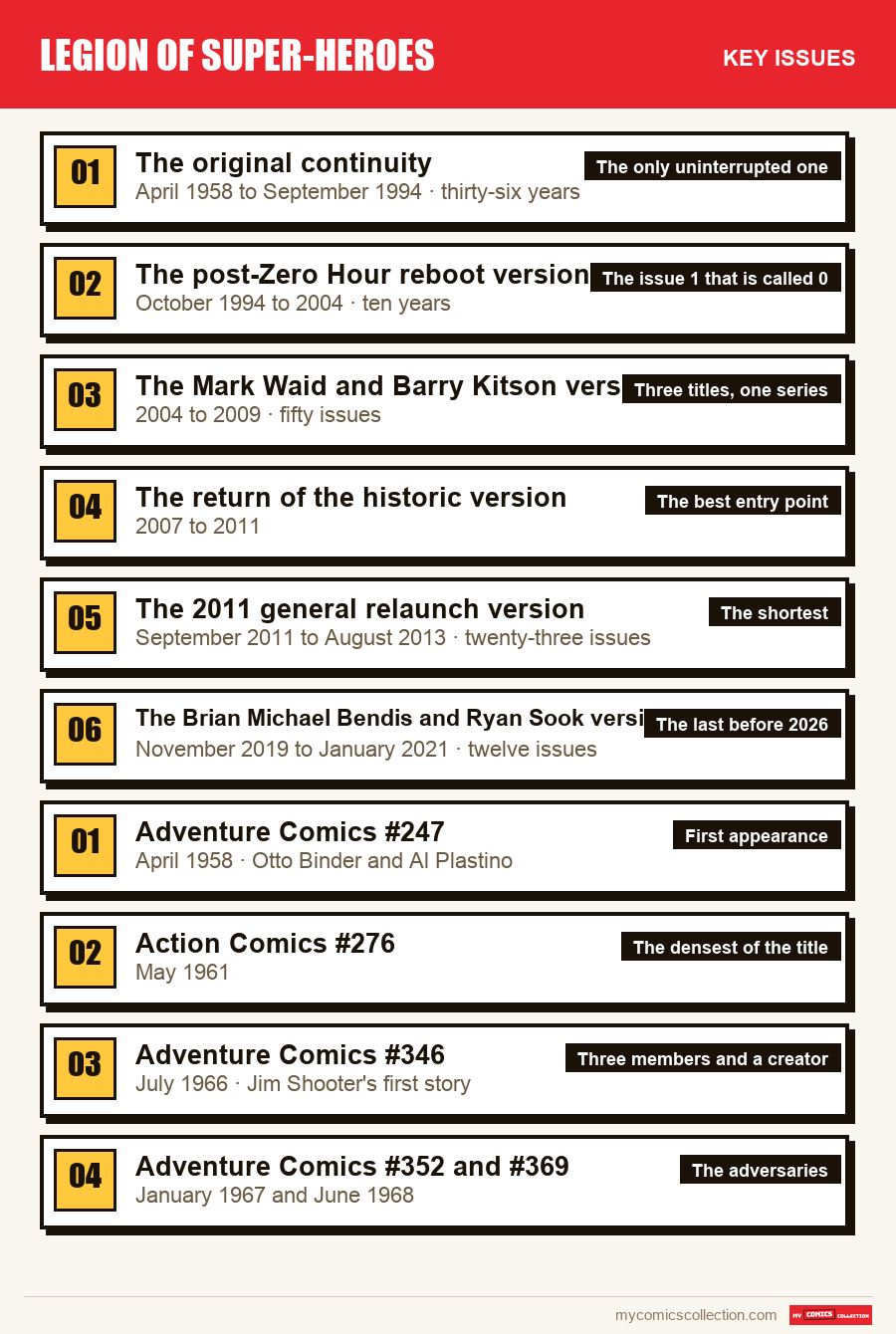
Six continuities, and a seventh ongoing. Each entry gives the real entry point, not the nominal issue #1.
The original continuity
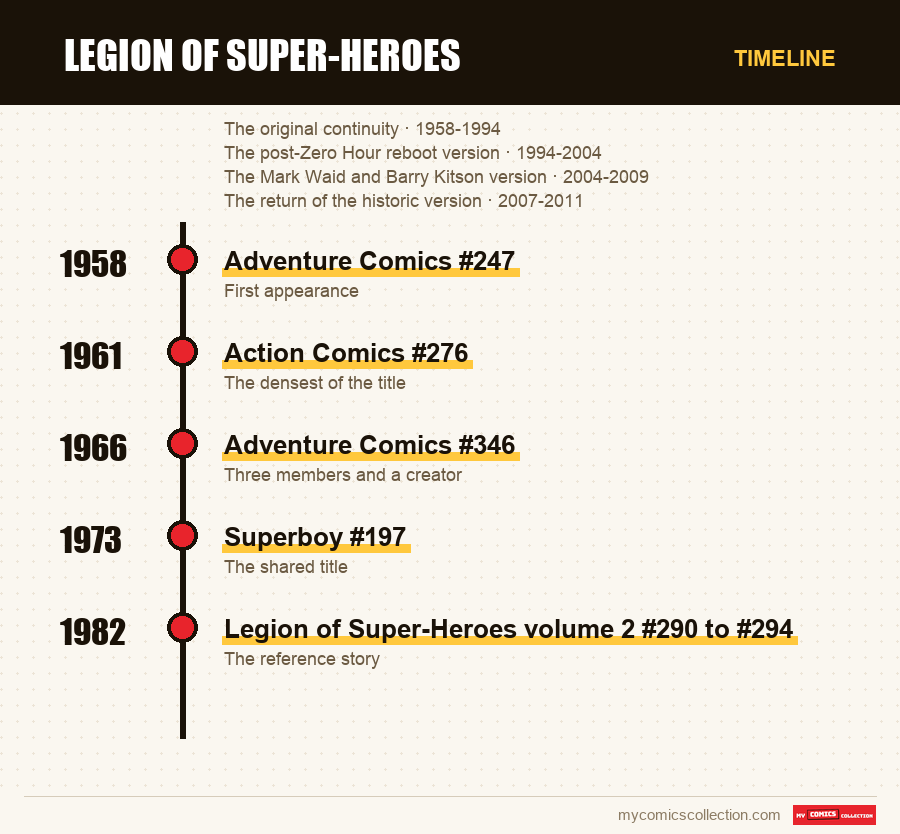
It begins in Adventure Comics #247 (April 1958) and ends in Legion of Super-Heroes volume 4 #61 (September 1994), at the time of the Zero Hour event. In between, the same continuous story changes medium six times: Adventure Comics until #380 (May 1969), a stint as a backup in Action Comics #377 to #392 (1969 and 1970), a return as a backup in Superboy from #172 (March 1971), taking over the title at #197 (August 1973) under the name Superboy starring the Legion of Super-Heroes, a new change of name at #231 (September 1977), then autonomy at #259 (January 1980), when Superboy leaves the team and the title becomes The Legion of Super-Heroes while keeping the numbering.
The post-Zero Hour reboot version
Entry point: Legion of Super-Heroes volume 4 #0 and Legionnaires #0, both dated October 1994. The team is restarted from zero, made younger, and told in parallel in two series that read together. This continuity closes with the series simply titled The Legion, canceled at its issue 38.
The Mark Waid and Barry Kitson version
It opens with a special issue pairing the Teen Titans and the Legion, published in November 2004, then continues in the fifth volume. Buying trap: the series changes name twice along the way, becoming Supergirl and the Legion of Super-Heroes at its issue 16, then reverting to its original title at issue 37. It ends at issue 50.
The return of the historic version
A three-step sequence reinstates the pre-1994 Legion. It starts in Justice League of America volume 2 #8 to #10 (2007), continues in Geoff Johns and Gary Frank's Action Comics run, and culminates in Final Crisis: Legion of Three Worlds #1 to #5, published from August 2008 to September 2009 by Geoff Johns and George Pérez, where three incarnations of the team meet. A sixth volume follows, from May 2010 to August 2011, written by Paul Levitz, paired with an Adventure Comics series devoted to the team's academy, from September 2009 to October 2011.
The 2011 general relaunch version
Seventh volume, launched in September 2011 as part of the general overhaul of the catalog, stopped at its issue 23 in August 2013. A parallel series, Legion Lost, sends seven legionnaires to the present and serves as a point of contact with the rest of the universe.
The Brian Michael Bendis and Ryan Sook version
Preceded by Legion of Super-Heroes: Millennium, two issues published in September and October 2019, the eighth volume lasts twelve issues, from November 2019 to January 2021. The entry device is Superman's son, summoned to the thirty-first century, who serves as a guide for the reader.
The seventh milestone is the 2026 series. Let us count: four volumes through 1994, the fifth in 2004, the sixth in 2010, the seventh in 2011, the eighth in 2019, the ninth in 2026. The number announced in the introduction can thus be verified without having to trust anyone.
The issues that matter, and why they are not the ones you think
Here is the hierarchy as we retain it, limiting ourselves to issues whose significance can be shown through a first appearance or a dated editorial fact. Everything else is a matter of taste.
Adventure Comics #247
First appearance of the Legion, and of its three founding members: Cosmic Boy, Saturn Girl and Lightning Boy, the latter renamed Lightning Lad when the team returned in Adventure Comics #267 (December 1959). A one-off story, which planned no sequel.
Action Comics #276
A single comic contains the first appearances of Brainiac 5, Phantom Girl, Triplicate Girl, Sun Boy, Shrinking Violet and Bouncing Boy. Six members at once, including the most famous of all after the founders.
Adventure Comics #346
First appearances of Karate Kid, Princess Projectra and Ferro Lad. And the first published story by Jim Shooter, who was fourteen and who would become, years later, editor in chief at another publisher.
Adventure Comics #352 and #369
#352 contains the first appearance of the team's recurring opposing group, created by Jim Shooter. #369 that of its major magical adversary, Mordru, created by Shooter and Curt Swan.
Superboy #197
Issue where the Superboy series becomes Superboy starring the Legion of Super-Heroes. First time in fifteen years that the team's name appears on a cover as a main title.
Legion of Super-Heroes volume 2 #290 to #294
Five issues that make up the most cited story in the title's entire history, with follow-ups in #287 and in two annual issues. Script by Paul Levitz, art by Keith Giffen, inks by Larry Mahlstedt.
The most sought-after members, and the issue where to find them
Here is the point where the Legion sets itself apart from all other teams, and where a table beats a paragraph. The legionnaires' first appearances are spread across three series, none of which carries the team's name.
- Star Boy: Adventure Comics #282, March 1961.
- Mon-El: Superboy #89, June 1961.
- Ultra Boy: Superboy #98, July 1962.
- Matter-Eater Lad: Adventure Comics #303, December 1962.
- Element Lad: Adventure Comics #307, April 1963.
- Light Lass: Adventure Comics #308, May 1963.
- Dream Girl: Adventure Comics #317, February 1964.
- Timber Wolf: Adventure Comics #327, 1964, under another name.
- Shadow Lass: Adventure Comics #365, February 1968.
- Wildfire: Superboy #195, June 1973, under another identity.
- Tyroc: Superboy #216, April 1976.
- Dawnstar: Superboy #226, April 1977.
- Blok: Superboy and the Legion of Super-Heroes #253, July 1979.
- XS: Legionnaires #0, October 1994.
Two practical remarks emerge from this list, and they are worth money.
The first concerns a search trap we see coming up again and again. Adventure Comics #267 and Action Comics #267 both exist, carry the same number, both date from the same period, and both contain a Legion milestone: the team's return for one, the first appearances of Chameleon Boy, Colossal Boy and Invisible Kid for the other, dated August 1960. Mixing up the two series is the most frequent mistake on this title, and a seller acting in good faith can make it as easily as a buyer.
The second concerns a notable absentee. Supergirl joins the Legion, but her first appearance does not belong to the title's corpus: it is in Action Comics #252, dated May 1959, an issue whose demand is driven by the character and not the team. We devote a separate entry to it: Action Comics #252. The distinction matters, because an issue whose value comes from elsewhere will not react to the Legion's news.
Where to enter, depending on what you are really looking for
The question "where do I start" actually covers three different requests, which do not have the same answer. Here are the three, in the order we recommend them.
To understand the team in a single purchase
The 2008-2009 story that has three incarnations of the Legion meet was written exactly for this: to make the overlay of continuities understandable to someone who does not know them. It assumes familiarity with the rest of the publisher's universe, but none with the Legion. It is the most effective door, and incidentally the only one available in French in the active catalog, we return to it below.
To read the best of the title
The five issues from August to December 1982 of the second volume. They read as a standalone story, they require almost no prerequisites, and they show what the Legion can do that nobody else does: mobilize about thirty characters without the reader losing the thread, because the team is an institution before being a group.
To start at the beginning, really
The Adventure Comics issues from 1958 to 1969, taken in order. It is a collecting approach, not a reading one: you have to accept hunting comics more than sixty years old, scattered over a series of a hundred and thirty issues, most of which contain only about a dozen pages of Legion. To read, a collected edition is enough; to collect, it is the only path.
To follow the news without committing a budget
The 2026 series, issue by issue, starting now. A recent issue #1 is the least risky object in the catalog: it is available, it carries no scarcity premium, and it lets you decide on the spot after six issues whether the series is worth following. We detail that calculation in the last section.
What a French-language collector can actually get
This section is the one you find least elsewhere, and also the most disappointing. Let us say it frankly: most of the Legion's corpus does not exist in French.
What exists in the French publisher's active catalog comes down to a single volume, and fortunately it is the right one. Titled Superman la Légion des super-héros (2006), published on September 12, 2025 in a softcover reissue collection, it has 376 pages and gathers the Action Comics #858 to #864 run by Geoff Johns and Gary Frank with the full Final Crisis: Legion of Three Worlds #1 to #5 by Johns and George Pérez, translated by Thomas Davier. It is exactly the entry point we recommended in point 1, in a single new, available object.
What exists but has become scarce comes down to three titles published in 2020 and 2021. The French publisher published, in the same week of late October 2020, the first volume of the 2019 series and a volume devoted to the great 1982 story. The second volume of the 2019 series followed on August 27, 2021: 152 pages, issues 7 to 12 of the series, translated by Laurent Queyssi. As of October 2, 2026, only the entry for this second volume is still accessible on the publisher's site; those of the first volume and the 1982 volume no longer are. That is the usual sign of an out-of-print title, and it means these two volumes are now found secondhand, on terms that have nothing to do with the bookstore price.
What does not exist, finally, and you need to know it before looking: no French edition reprints the Adventure Comics run from 1958 to 1969. Neither the beginnings, nor the gradual arrival of the members, nor the first appearances listed above. A French-language reader who wants this period has to move to the original version, in single issues or collected editions.
The practical consequence is uncomfortable but clear. For the Legion, the French collection and the reference collection are two separate projects, and one does not lead to the other. We have detailed elsewhere what a French edition is worth against an original edition: see our comparison original edition or French reprint.
The trap of the ninth issue #1
Let us finish with the question the relaunch asks directly, and which deserves a clear answer.
A ninth issue #1 is not a scarcity event, and it cannot be. The previous eight exist, they are all accessible, and none of the last seven produced significant value. The statistics even run against it: the 2011 volume lasted twenty-three issues, the 2019 one lasted twelve. Buying a Legion issue #1 betting on its future scarcity amounts to betting against sixty-eight years of data.
On the other hand, a recent issue #1 has another use, and it is the one we retain. It is the only object in this corpus that costs the price of a new comic while giving access to the title's news. If the series settles in, you will have its starting point without having hunted for it; if it stops at the twelfth issue like the previous one, you will have lost the equivalent of a coffee a month. The asymmetry is favorable, provided you do not confuse this purchase with an investment.
For the historic issues, the reasoning is the reverse and it is reassuring. Their value does not depend on any adaptation, since the Legion has never had a film, and its television run is treated separately in our comparison of the animated series and the comics. A monthly series relaunch does not move the price of a 1958 comic: it maintains a notoriety, which is much slower and much sturdier. The other two teams relaunched the same day pose the same question in different terms, by the way, and we cover them in our guides to the Teen Titans and Doom Patrol.
One last recommendation, specific to this title. Keep a written record of what you own, by series and by issue, before buying anything old. On a corpus where six continuities overlap, where one series changes name twice and where two distinct titles carry the same issue 267, general impression is not enough. That is precisely what our collection tracking tool is there to produce, and it is on the Legion that it best demonstrates its usefulness.