In the Absolute universe, the first issue to chase is not Absolute Batman #1 but DC All In Special #1 from October 2, 2024: it is where the Absolute versions of Batman, Superman and Wonder Woman first appear, a week before the first series launched. Next come the six founding #1 issues, from October 9, 2024 to April 2, 2025, then Absolute Evil on October 1st, 2025, which opens the line up to an earlier generation of heroes. The problem is well known: these issues were printed in industrial quantities. By December 2025 the line had sold more than 8.5 million copies, and Absolute Batman #1 was on its eleventh printing in March 2026. Scarcity will therefore never come from the print run. It can only come from three things: truly restricted ratio variants, first printings identified as such, and the peripheral one-shots that were under-ordered.
Hunting key issues normally follows a simple rule: you look for the first appearance of a character who matters, in an issue that few people kept. The Absolute universe breaks the second half of that rule. Everyone kept these issues, because everyone bought them, because they were everywhere, and because DC restarted the presses every time a title came close to selling out.
That does not make the list useless, quite the contrary. A line that produces some thirty identifiable first appearances in two years, some of them for entirely new characters, creates a precise hunting ground. But the hierarchy here is not the one you are used to. What matters is the issue's place in the building of the universe, and then the exact form of the copy you are holding in your hands.
This article therefore lists the issues, their dates and their creative teams, while consistently separating two things that people constantly confuse: the first appearance of the Absolute version of a character who already existed, and the first appearance of a character who existed nowhere before. Both can be collected, but only one of them can ever become a first appearance in the strict sense of the term. What the line is, how it reads and what narrative rules it imposes on itself are covered elsewhere: see the guide to the Absolute line.
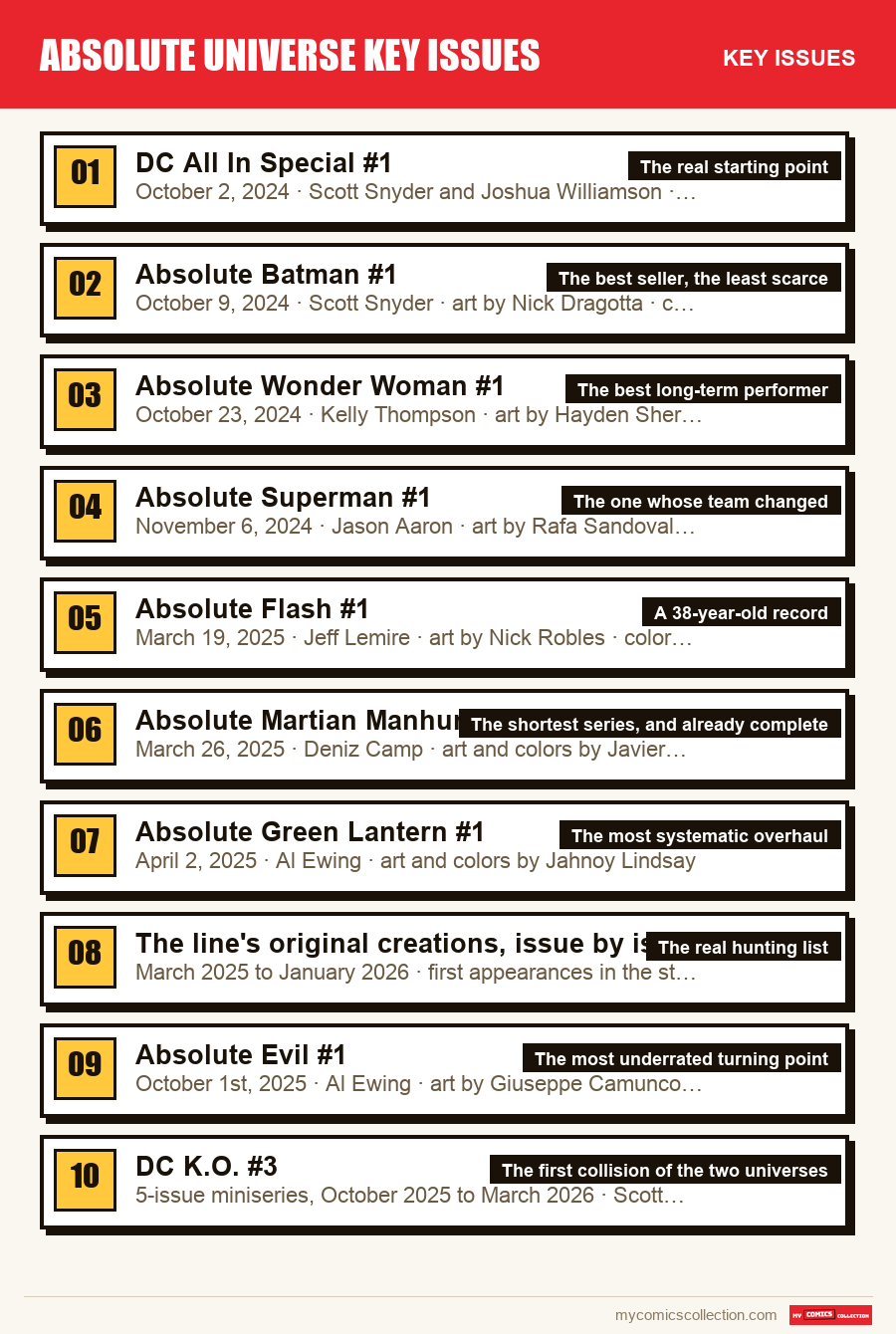
The zero issue of the hunt: the DC All In Special
There is an almost universal collecting logic: the #1 of a series carries the first appearance. Here that is false, and it is the first mistake to avoid.
DC All In Special #1
Published a week before Absolute Batman #1, this issue contains the first appearance of the Absolute versions of Batman, Superman and Wonder Woman, as well as that of the Omega Legion serving Darkseid, about twenty characters from the Legion of Super-Heroes reconfigured all at once. It is also where the mechanics of the universe are set up: Earth-Alpha reshaped by the essence of Darkseid, a world where heroes are outsiders rather than institutions. Colors are by Mike Spicer and Alejandro Sánchez.
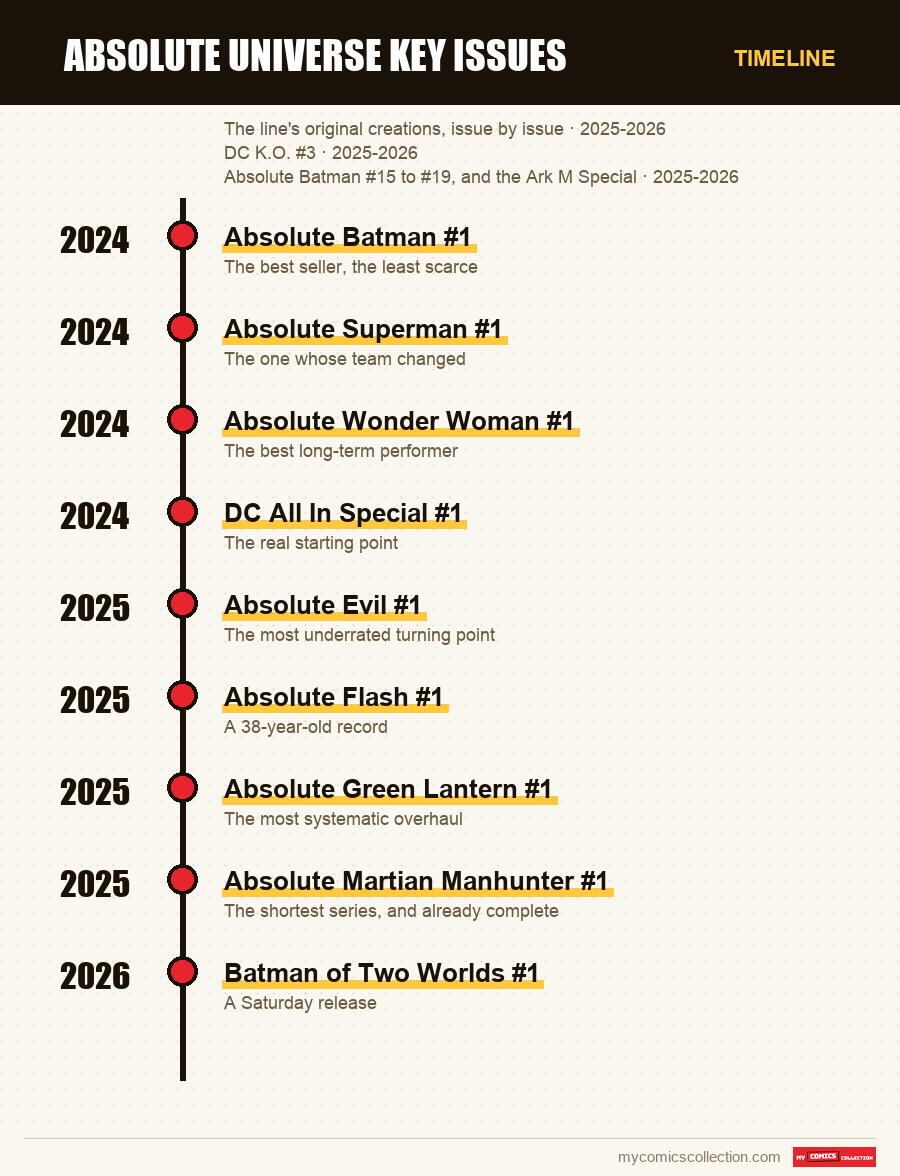
The six founding #1 issues, in order of release
They are spread over six months, in two waves. The first wave carries the trinity, the second widens the line to supporting characters that DC had never relaunched at this level of ambition.
Absolute Batman #1
First appearance of a Bruce Wayne who is a penniless civil engineer, whose mother Martha is alive, and whose childhood friends from Crime Alley carry the names of his future enemies: Waylon Jones, Edward Nygma, Harvey Dent, Oswald Cobblepot, Selina Kyle. Alfred Pennyworth is an MI6 agent. The issue also carries the first appearance of Jack Grimm, this universe's Joker, whose surname is unique to the line, and those of Commissioner Harvey Bullock, Mayor Jim Gordon, Roman Sionis and Joe Chill.
Absolute Wonder Woman #1
Diana grows up in Hell, raised by her adoptive mother Circe and taught by the Greek gods, separated from the Amazons at birth by Zeus. It is the most radical overhaul of the three, and the one that surprised readers the most. Apollo and Pegasus make their first appearance in the Absolute universe here.
Absolute Superman #1
Kal-El grew up on Krypton before its destruction, and lives on Earth as an undocumented worker, accompanied by Sol, an artificial intelligence that serves as both his cape and his Fortress of Solitude. Lois Lane is a corporate soldier for Lazarus Corp and Jimmy Olsen is a member of the Omega Men. Jor-El is among the issue's first appearances.
Absolute Flash #1
Wally West is a soldier's son who accidentally kills Barry Allen while acquiring his powers, and becomes a fugitive accompanied by a mutant ape named Grodd. The issue carries the first appearance of the Absolute versions of Barry Allen, Grodd, Rudy West and the Rogues: Digger Harkness, Jesse James, Sam Scudder, Leonard and Lisa Snart.
Absolute Martian Manhunter #1
The only series in the line designed from the start as a finished story: twelve issues, from March 26, 2025 to July 1st, 2026. John Jones is an FBI agent whose mind is invaded by a bodiless Martian entity after a head trauma. Issue #1 also carries the first appearance of Bridget Jones, his wife.
Absolute Green Lantern #1
Ewing does not rewrite a character, he rewrites a system. The emotional spectrum is reduced to four colors, Qard, Rao, Sur and Aur, and light wielders are classified by prefixes according to how they were chosen. Sojourner Mullein is a former police officer turned anomalous user of green light. Issue #1 carries the first appearance of this Hal Jordan, who is not a hero but a Black Hand.
First appearance of a version, first appearance of a character
This is the distinction that separates an informed collector from a buyer of covers. In everything above, almost no first appearance is a first appearance in the strict sense. Jack Grimm is the Joker, Diana is Wonder Woman, Hal Jordan is Hal Jordan. These are reinterpretations: characters who have existed for decades, reborn in another form. On the market, this type of first appearance behaves like a series item, because the character does not need this issue to exist.
There is, however, a handful of characters in the line who existed nowhere before. They are the ones who carry a real first appearance, and they are all in issues that nobody has been tracking.
The line's original creations, issue by issue
Victor Fries Sr., in Absolute Batman #7 (April 2025), the issue that also introduces this universe's Mr. Freeze. Mary West, in a brief appearance in Absolute Flash #2 (April 2025). Elenore Thawne, in Absolute Flash #3 (May 2025), who is also one of the five members of this universe's Justice League, an alliance of the powerful made up of the Joker, Ra's al Ghul, Hector Hammond, Veronica Cale and herself. Dora Luthor, wife of Lex Luthor, in Absolute Evil (October 1st, 2025). Harvey Harris, an FBI agent whose death was staged by the Joker, in Absolute Batman #15 (December 2025). Elizabeth Arkham, mother of Amadeus Arkham, in the Absolute Batman: Ark M Special (January 7, 2026). Akrolis, a centaur, in Absolute Batman #16 (January 2026).
The issues where the line changed direction
A two-year-old line already has an internal history. Four moments divide it, and each one materializes in a specific issue.
Absolute Evil #1
Until this one-shot, the Absolute universe had no past. Absolute Evil gives it one, installing all at once a generation of earlier vigilantes: Wesley Dodds, a masked chemist of the 1930s, Ted Grant, bought off into silence and turned boxing gym owner, Carter Hall, a former hero turned hitman in the service of the Justice League, and Iron Munro, a socialist vigilante of the 1950s. Lex Luthor appears for the first time in this universe, as a Missouri gas station attendant. Oliver Queen appears and dies in it, murdered by Hawkman.
DC K.O. #3
At the end of this issue, the Absolute versions of Batman, Wonder Woman and Superman burst into the mainline continuity, corrupted and fighting for Darkseid. The whole event revolves around Darkseid's desire to transform the main Earth in the image of what he did to Earth-Alpha.
Absolute Batman #15 to #19, and the Ark M Special
The sequence, titled Devil's Workshop in the collected editions, reveals the origin of this universe's Joker and sets up the Robin program. The Absolute Batman: Ark M Special of January 7, 2026, written by Snyder and Frank Tieri and drawn by Joshua Hixson, adds Amadeus Arkham and this universe's Deathstroke, a mercenary and former MI6 agent in the Joker's service. Absolute Batman #16 (January 2026) explicitly opens a new era and introduces Lucius Fox as foreman and Bruce's boss. Absolute Batman #19 (April 2026) reveals five characters at once: Stephanie Brown, Jonathan Crane, Tim Drake, Duke Thomas and Jason Todd.
Batman of Two Worlds #1
Announced in July 2026 and published for Batman Day, this one-shot puts the two Batmen side by side in two parallel tales, summed up by Snyder in a single phrase: two stories, one crime. Colors are by Tomeu Morey and Frank Martin.
The second generation of series, and what it changes for the hunt
Starting in 2026, DC expands the line with second-tier characters. The change matters for a collector: initial orders are lower there, and the sellouts are real rather than theatrical.
Absolute Green Arrow #1 came out on May 20, 2026, written by Pornsak Pichetshote, drawn by Rafael Albuquerque and colored by Marcelo Maiolo. The issue was sold out at the distributor a week before its release and was going to a second printing before it even reached stores. In July 2026, DC extended the series from its initial format to twelve issues. Issue #1 carries the first appearance of Brittany Brandon, among seven characters. Since Oliver Queen had already been introduced and killed in Absolute Evil, the series does not start from a blank page, which is unusual in this line.
Absolute Catwoman #1 came out on June 10, 2026, written by Scott Snyder and Che Grayson, drawn by Bengal, colors by Giovanna Niro, over six issues. It too went back to press, with a second printing scheduled for July 15, 2026 featuring a revised Bengal cover and new variants by Guillem March and Kaare Andrews, including a foil edition. Issue #1 carries the first appearance of this universe's Selina Kyle and that of Cassandra Cain.
Between issues #3 and #4 of this miniseries comes Absolute Cassandra Cain: The Shadow's Hand, a one-shot written by Che Grayson and drawn by Matías Bergara, released in September 2026, which tells Cassandra's origin in this universe and carries the first appearances of David Cain, Scandal Savage, Michael Sommers, Ben Turner and Tatsu Yamashiro. A one-shot that slots into the middle of a miniseries is, structurally, the issue a regular reader is most likely to miss, and therefore the one a store orders most cautiously.
An Absolute Black Canary one-shot, by Pornsak Pichetshote and Belén Ortega, was announced in July 2026 as a spin-off of Absolute Green Arrow. It is worth watching for the same reasons as the previous one, and for the particular place of Dinah Lance in DC's editorial history.
The immediate calendar, and what to expect from it
It is October 2, 2026. The dated releases between now and the end of the year are as follows: Absolute Superman #24 on October 7, Absolute Flash #20 on October 21, then Absolute Wonder Woman #25 and Absolute Batman #25 on October 28. In November, Absolute Superman #25 on November 4, where Jason Aaron closes one sequence and opens another, and Absolute Batman: Beyond Ark M #1 on November 11, by Snyder and Frank Tieri with Francesco Francavilla on art. Then a special issue #26 in January 2027 devoted to Barbara Gordon, and the return of the regular series at issue #27 in February 2027 with Snyder and Dragotta. The absence of Absolute Batman in December 2026 is covered in our analysis of the December pause.
Two methodological remarks. First, a #25 is not a key issue because it is a round number: it is one if something happens in it, and in this line the #25s are mostly collected-edition boundaries. Second, a successful series changing hands is the real signal to watch: that is what happens on Absolute Superman in November. DC's three September 2026 relaunches follow a different logic and are covered in our Next Level guide.
The central problem: a line built not to be scarce
Here are the numbers, all public, and they need to be read together.
In February 2025, four months after launch, the line had sold more than 2.5 million copies. In December 2025, the total exceeded 8.5 million, including nearly 3 million for Absolute Batman alone. The series' writer now puts its circulation at nearly 500,000 copies per month. And in February 2026, DC announced the simultaneous reprinting of fifty issues of the line for March 2026, covering Absolute Batman #1 to #14, Absolute Wonder Woman #1 to #11, Absolute Superman #1 to #10, Absolute Flash #1 to #5, Absolute Green Lantern #1 to #4 and Absolute Martian Manhunter #1 to #6, all brought to at least their third printing. Absolute Batman #1 received its eleventh printing there.
That last point is the one worth understanding rather than lamenting. A permanent reprint policy is the opposite of a scarcity policy: it guarantees that no issue of the line becomes impossible to find, because as soon as an issue gets hard to find, DC prints more. The publisher chose reading over speculation, and it chose it explicitly.
The consequence is mechanical. On this line, scarcity cannot come from the print run, and no reasoning based on print run scarcity holds up. It is exactly the opposite of the reasoning behind hunting low-population copies, which assumes from the start an object produced in small quantity. Here, there is none.
What still has a chance of mattering, and what has none
Three real levers remain, and you have to be able to separate them from the noise.
Truly restricted ratio variants
A ratio cover only exists in proportion to a store's orders of the main cover. On a title printed in the hundreds of thousands, a high ratio produces an object whose quantity is known, bounded, and unrelated to the general print run. It is the only mechanism in the line that manufactures arithmetic scarcity. Foil editions and covers signed by a highly sought-after artist follow the same logic, provided you check that they are not open order.
The first printing, and proof that it is one
When an issue exists in eleven printings, the only distinction left is the one between the first and the others. It is only legible on the indicia and sometimes on the cover, and it disappears completely as soon as the copy changes hands without its record. This is the point where the question of later printings stops being academic: on this line, it is the entire gap.
Peripheral issues and atypical dates
The DC All In Special, the one-shots spun off from a miniseries, the Batman Day issue released on a Saturday, the free distribution edition of May 2025 written by Dan Slott and Jeff Lemire: these objects were ordered for what they looked like, not for what they contain. It is the only place in the line where a lasting gap between importance and availability is already in place.
And here is what has no chance of mattering, said plainly. Open-order covers of the founding #1 issues, because they exist in the hundreds of thousands and the publisher reprints them on demand. Second and third printings, which are by construction the answer to demand that has already been satisfied. Round-number issues with no internal event. And any purchase based on the idea that the animated series in development at Warner Bros. Animation and DC Studios, announced in June 2026 with Snyder as showrunner and Dragotta as producer, will push Absolute Batman #1 up: an adaptation shifts demand, it does not reduce supply, and here supply is elastic.
Grading, and when it is pointless
Having a modern issue graded makes sense in two cases: when the copy is scarce and its condition makes the difference between two nearly equivalent objects, or when the object is meant to circulate and must be authenticated. On this line, the first case is almost always false.
An issue printed in the hundreds of thousands, released less than two years ago, bought new and stored properly, will get a high grade from most of those who submit it. An abundant high grade distinguishes nothing: it places the copy in a population of thousands of identical objects. The reasoning changes for a high-ratio variant, where the total number of existing copies is small and where the graded population becomes a useful indicator. It also changes for a copy authenticated as signed, which is no longer just a comic but an object dated by an event. For everything else, grading adds a cost without adding any distinction.
The question of the long format arises differently. The line's collected editions come out at a regular pace, and anyone who wants to read without chasing twenty-five single issues has every reason to look at them. We have compared the available collected formats elsewhere: the choice is made on use, not on market value.
A priority list, to finish
If you had to reduce everything above to a hunting order, it would fit in six lines. The DC All In Special #1 of October 2, 2024, for the three first appearances it contains and the little attention it received. Absolute Evil of October 1st, 2025, for the entire generation it installs. Absolute Flash #3 of May 2025, for Elenore Thawne. Absolute Batman #19 of April 2026, for its density of first appearances in a mid-arc issue. The spin-off one-shots, the Cassandra Cain one and the one announced around Black Canary. And, for each of the six founding #1 issues, a first printing that you can prove is one, recorded as such in your tracking.
What is not on it is as instructive as what is. The line's best-selling issues are not on this list, because being the best seller and being hard to find are, literally, two opposite properties. It is the main lesson the Absolute universe leaves collectors, and it was better to learn it on a line you enjoy reading than on a title you had bought as speculation. To place this line in the publisher's broader history, see our guide to the DC universe.