Hunting for issues with a low certified population has become a common buying strategy because the top of the market has gone out of reach: a copy of Action Comics #1 in CGC 9.0 went for $15 million in a private sale on January 9, 2026. Unable to aim at those pieces, many collectors turn to lightly graded objects: regional variants, low-distribution editions, last issues, atypical formats, neglected genres. The method is defensible, but it rests on a dangerous confusion. A rarity nobody is looking for is not worth more: it is only harder to resell. This article describes what this hunt really targets, how to sort a rarity that matters from a curiosity with no market, and the holding horizon it imposes.
There are two ways to react when the pieces you covet become inaccessible. The first is to give up and collect something else. The second is to change criteria: since prestige is out of reach, you might as well buy what is objectively little represented, hoping the rarity ends up being recognized. It is this second path that more and more collectors have taken for two years, and it got a name on English-language forums before having one in French: low-census hunting.
The reasoning is seductive because it is partly right. It is also one of the most effective ways to durably tie up money in objects that will not resell. What separates the two outcomes is neither luck nor flair, but a question we forget to ask before buying: how many people in the world are actively looking for this object?
This article does not explain what a census is nor how to read it by grade. That work is already done in our guide on reading the CGC census. Here, we assume you know how to consult a certified population, and we deal with the only thing left: what to do with it as a buyer.
Where this strategy comes from: a market that split in two
Low-census hunting is not an aesthetic fashion, it is an arithmetic consequence. Over 2025, a public market index tracking prices by major publishing era gives an unambiguous picture: modern gains 2.36%, the Golden Age 1.69%, but the Copper Age loses 5.34%, the Silver Age 6.18% and the Bronze Age 6.66%. In other words, the two ends hold and the whole middle recedes.
The analysis accompanying these figures uses the image of a K-shaped market: those with significant means kept buying the Golden Age's big pieces, while the core range of the 1960s to 1990s was flattened, and the average collector shifted to cheaper modern. To measure the spreading of the branches, two sales suffice. A copy of Superman #1 in CGC 9.0 changed hands for $9.12 million at the end of 2025, then a copy of Action Comics #1 in the same grade for $15 million in a private sale on January 9, 2026. That copy of Action Comics #1 had been bought for $150,000 in 1996, stolen, recovered in 2011, then resold at auction for $2.16 million.
These numbers say one useful thing and one misleading thing. The useful one: the top of the market is no longer a horizon for anyone, and there is no point projecting a strategy onto it. The misleading one would be to conclude that everything else is cheap. The reading taken over the twelve months before September 2026 shows modern up by about 18 to 20% driven by high-grade demand, a Copper Age recovering 6 to 7%, and a Silver Age and Bronze Age that found a floor at the turn of 2025 and 2026 before slowly recovering. The mid-market is not dead: it has become selective.
It is in this gap that low-census hunting has settled: if the issues everybody identifies are either inaccessible or already risen, there remains the immense mass of those nobody identifies, a handful of which have a measurable characteristic. It remains to know what this information is worth.
The five families of objects this hunt targets
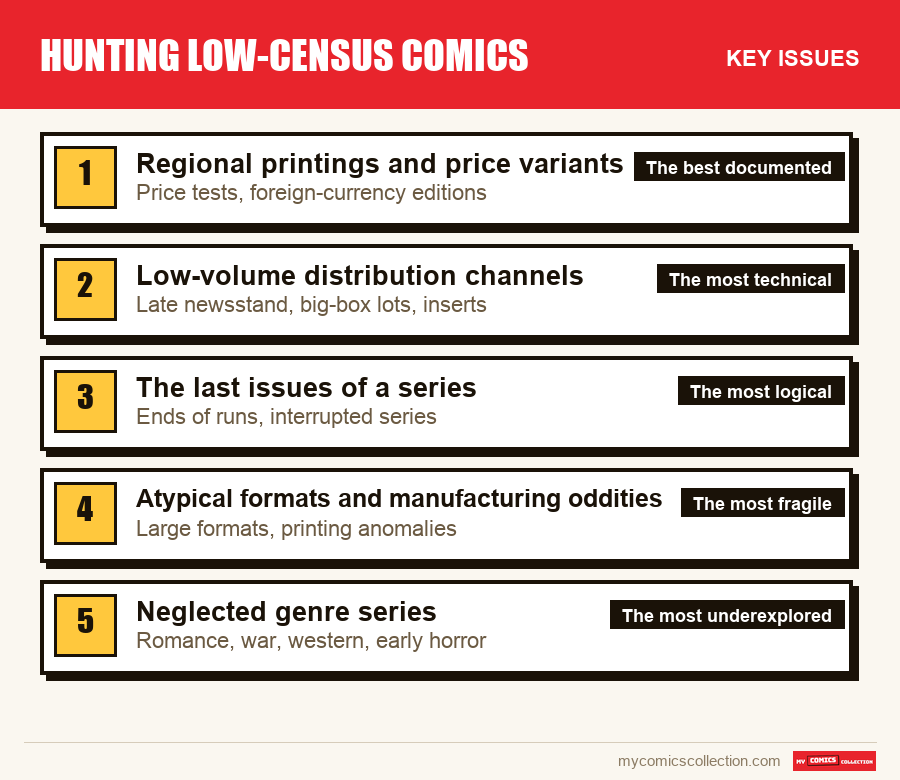
Buyers who practice this approach do not search at random: they return, year after year, to five categories whose low population is not accidental but structural. Knowing these families is half the work, because it is what lets you look somewhere other than where everyone is looking.
Regional printings and price variants
The same issue sometimes circulated with several cover prices, because part of the print run aimed at a distinct market or served to test a price increase in a limited area. These copies are identical to the rest of the print run but for one detail, which explains both their low certified population and their decades of anonymity. It is the best-mapped family, and thus the least likely to hold surprises: these objects are now recorded and sought by an identified community of buyers.
Low-volume distribution channels
An issue may have been massively printed while circulating in low volume on a specific channel. As the specialty shop became dominant, the share sold at newsstands shrank to a fraction of the print run, and these copies are distinguished by their barcode. Same logic for copies sold in lots under film, or carrying an insert slipped into only part of the distribution.
The last issues of a series
A series stops because it no longer sells. Its last issue therefore has, almost mechanically, the smallest print run of the collection, and was ordered by the fewest points of sale. Thirty years later, it is the issue missing from so-called complete collections, and its certified population is often derisory next to that of issue #1.
Atypical formats and manufacturing oddities
Everything outside the standard format survived badly: large formats did not fit in boxes, thick bindings warped. Add manufacturing accidents, which produce unique objects. A Superman #13 with a triple cover, presented as the oldest example of a triple cover certified by CGC to date, was offered at auction in September 2026 with a bid at $1,300, in middling grade.
Neglected genre series
Whole swaths of production were read, damaged and thrown away without anyone thinking of keeping them, for lack of seeing a character promised a second life. Their survival rate in good condition is very low, and their certified population is lower still, since nobody incurs fees on an object whose value they ignore. It is the most intellectually interesting family and the riskiest financially.
The central trap: what does not resell has no price
It must be said bluntly, because it is the point on which this strategy loses money. A rare object nobody wants is not an undervalued object awaiting recognition: it is an object with no market, and its asking price is a fiction until proven otherwise.
The reason is mechanical. A price exists only when a buyer and a seller meet. If there is only one potential buyer, there is no market price: there is the mood of that person on the day you sell. And if they already own the object, there is no one left. Extreme scarcity thus produces a counterintuitive effect: the less the object circulates, the less it is known, and the more the circle of buyers shrinks.
The same index says it explicitly in 2026, and it is its most useful observation. The Golden Age shows thin liquidity: transactions are rare, and a single isolated sale is enough to move the index. The Bronze Age on the contrary shows deep liquidity across many grades. Translation for the buyer: on a thick segment, you sell when you want at a price known in advance; on a thin segment, you sell when someone comes by, at a price the sale itself will define. It is not a difference in quality, it is a difference in nature.
The decisive counterexample comes from modern. Absolute Batman #1 combines everything this strategy teaches you to flee, a huge print run and a certified population climbing fast, and yet, in fall 2026, transaction volume and prices hold at a high level. The explanation lies in a notion English-language analysts call demand density: what supports a price is not the small number of copies available, it is the large number of people absorbing them as they arrive.
Operational conclusion, and an uncomfortable one: between an object with twenty certified copies that three people are looking for and an object with twenty thousand certified copies that ten thousand people are looking for, the second is a better asset and the first is a better collectible. Both choices are legitimate. Confusing them is not.
What distinguishes a rarity that matters from an anecdotal one
Not all low populations are equal. Here are the criteria that, in practice, separate an exploitable rarity from a mere singularity.
Is the rarity nameable? A rarity that matters carries a name buyers use. It belongs to a recognized, described category, whose checkpoints are documented and whose value can be verified. An anecdotal rarity is described by a long, personal sentence, of the type "this copy is special because." If you cannot explain in five words what makes the object rare, no buyer will be able to look for it.
Is there a collection that demands it? Demand, for a niche object, almost never comes from the object itself: it comes from a collecting project that needs it to be complete. A last issue interests whoever gathers the series; a price variant interests whoever gathers price variants. An isolated printing accident belongs to no collection, except that of an enthusiast of printing accidents, and there are few.
Is the low population mature? A low population on a recent title measures nothing but the time elapsed since its release. On an old title, it measures half a century of failures to produce better, and that is far more solid information. This point is developed in the guide dedicated to the census.
Does the rarity survive verification? A low population sometimes only means the copies are spread across several poorly sorted entries, and that adding them up brings you back to a commonplace object.
And the question that settles it: who would be your buyer? Not "how much is this object worth," but "to whom do I resell it." If you can describe the person's profile, say where they look and why they need this precise object, the rarity counts. If the answer is "someone will eventually understand," you are buying an object, not an asset, and that is fine provided you know it.
The selection method, step by step
Here is the sequence this strategy assumes. It is deliberately slow, because its value is precisely to slow down the purchase.
Choose a family, not isolated objects
Decide first on which of the five families you work, and stick with it for at least a year. This approach's advantage never comes from a stroke of luck on one object, it comes from accumulated competence on a category: recognizing the object at a glance, knowing its checkpoints, knowing what it sold for previous times. A buyer who flits between families pays full price everywhere.
Check demand before scarcity
Reverse the usual order. Before even looking at a population, find out how many transactions have taken place on this type of object over the last twelve months, all grades combined. Several regularly spaced sales: the market exists, and scarcity becomes an argument. One only, or none: scarcity has nothing to apply to. This step eliminates most candidates, and that is its usefulness.
Date the population before believing it
Record the certified population, then ask yourself how long the object has been eligible for certification. Fifteen copies on a 1954 title and fifteen copies on a 2024 title describe two opposite realities: in the first case the scarcity is established, in the second it has not yet begun to be measured.
Set your maximum price before looking for the object
On a thin market, no price guide will hold you back, and the object may not appear twice in the year. This combination pushes toward overpaying, because giving up seems final. Write down your ceiling before having the object in front of you, accepting in advance to let it go: missed opportunities on a narrow segment cost far less than forced purchases.
Buy the condition, not only the object
The temptation is to accept any condition on the pretext that you will not find better. It is sometimes true, and often a mistake: on a narrow market, the final buyer is a specialist, hence demanding. A mediocre copy of a rare object accumulates both handicaps, the scarcity that limits buyers and the condition that discourages some of them.
Document immediately, and weigh certification
You are buying an object whose rarity is not visible: on resale day, it is up to you to demonstrate it. Note from purchase the exact reference, the distinguishing mark, the population recorded on that date, the price paid and the provenance. Certification only makes sense if the particularity appears on the label and becomes indisputable to a stranger. Otherwise, you pay fixed fees to attest a condition that is not the point.
The time horizon, and why it disqualifies quick resale
This strategy assumes a long horizon, and not for the reason you might imagine. It is not that the value would take time to rise. It is that the sale itself takes time.
On a liquid segment, selling is an operation whose price and timing you know in advance. On a thin segment, selling means waiting for a buyer to show up, and this wait is not compressible: it depends on the number of people looking for this object and the moment they devote a budget to it. Speeding up is only possible by lowering the price, which cancels the point of the operation. That is the definition of illiquidity, and it is independent of the object's quality.
There is a second, more structural reason. What makes a niche object rise is almost never an outside event: it is the gradual widening of the circle of those who know it exists, a catalog that lists it, a category forming, buyers beginning to look for the same thing. This process is counted in years, sometimes decades, and it may never happen.
The consequence is clear. Whoever buys thinking to resell in eighteen months has the wrong strategy: they need on the contrary highly demanded objects, even abundant ones, because demand is what lets you exit. The subject is treated in our comparison between long holding and quick resale, and low-census hunting is unambiguously on the long-holding side. It is hardly compatible with the idea of recovering your stake on a chosen date, especially since shipping, certification and the resale commission do not go down because the object is rare.
Who this strategy really suits
It suits a precise profile, and it is better to know whether it is yours before starting.
It suits whoever enjoys the search itself. Most of this approach's return is not financial: it is the time spent understanding a category, identifying an object the seller has not identified, assembling a set nobody else owns. If this part bores you, the approach will lose its meaning before producing anything. It also suits whoever does not need this money: you must be able to consider the sum committed as tied up for an indeterminate duration, and that is a condition, not a precaution.
It suits whoever keeps records. On a collection of recognized pieces, memory and obviousness suffice; on a niche collection, information is most of the value, and that is exactly what a tracking tool is for retaining.
It does not suit whoever is looking for an alternative to the big pieces that have become too expensive, and it is the most widespread misunderstanding. Hunting low census is not a cheaper way to buy established values: it is a different exercise, where liquidity is sacrificed for discovery. Whoever wants the security of a deep market must accept buying what everybody buys, less often and at a higher price.
The healthiest case is in fact mixed. A collection resting on a few demanded pieces, whose resale price and timing are known, can afford alongside a niche exploration owned as such, funded by a small share of the budget and judged over twenty years. Low-census hunting is then what it does best: the interesting part of a collection, and not its insurance.