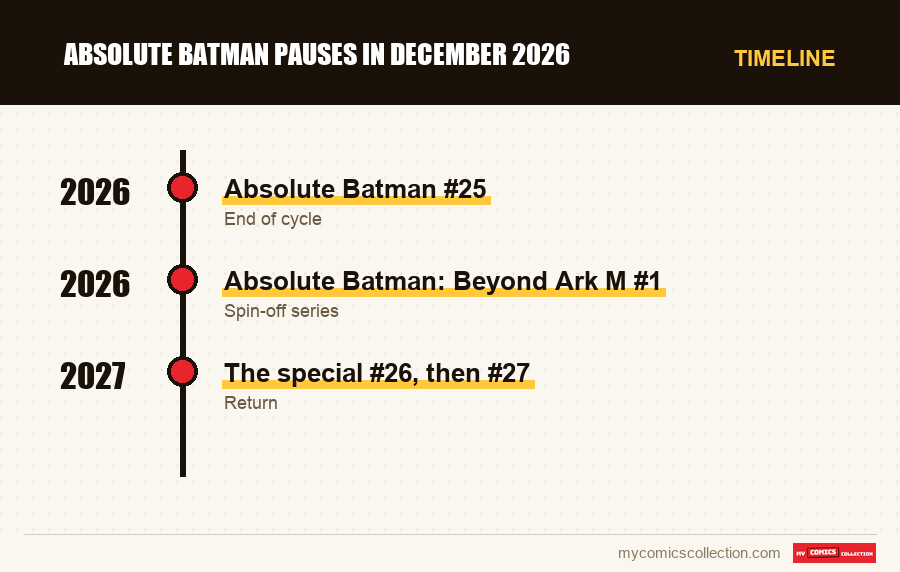
Absolute Batman stops after #25 on October 28, 2026. There will be no issue of the series in December 2026: the baton passes to Absolute Batman: Beyond Ark M #1 on November 11, 2026, then to a special #26 in January 2027 devoted to Barbara Gordon, before the series resumes at #27 in February 2027 with Scott Snyder and Nick Dragotta. Its writer puts the title at nearly 500,000 copies a month, so it is the market's top seller that vanishes from one calendar month. This pause is announced and dated, which sets it apart from a delay and even more from a disguised cancellation. For the issues already out, it creates no scarcity: a series printed at this level stays abundant.
An issue that does not ship is, on the surface, a non-event. There is nothing to buy, nothing to file, nothing to do. Yet the absence of Absolute Batman in December 2026 is one of the most instructive pieces of news at the end of the year, because it exposes mechanics that ordinary months conceal: how a retailer builds its cash flow, how publisher percentages reshuffle without anyone changing their mind, and how a collector almost always misreads a gap in a calendar.
The case is especially clear because the title involved is no ordinary series. Launched on October 9, 2024 by Scott Snyder and Nick Dragotta as the first title of DC's Absolute line, Absolute Batman became the best-selling single issue on the market, to the point that retailers cite it as one of the entry doors for new readers. When an item of that size goes missing, the effects are not symbolic.
It is October 2, 2026. This article describes what has been announced, then separates what can be inferred from what cannot. And it starts by defusing the trap that nearly all commentary on this subject falls into: believing that a monthly market share is available. It does not exist.
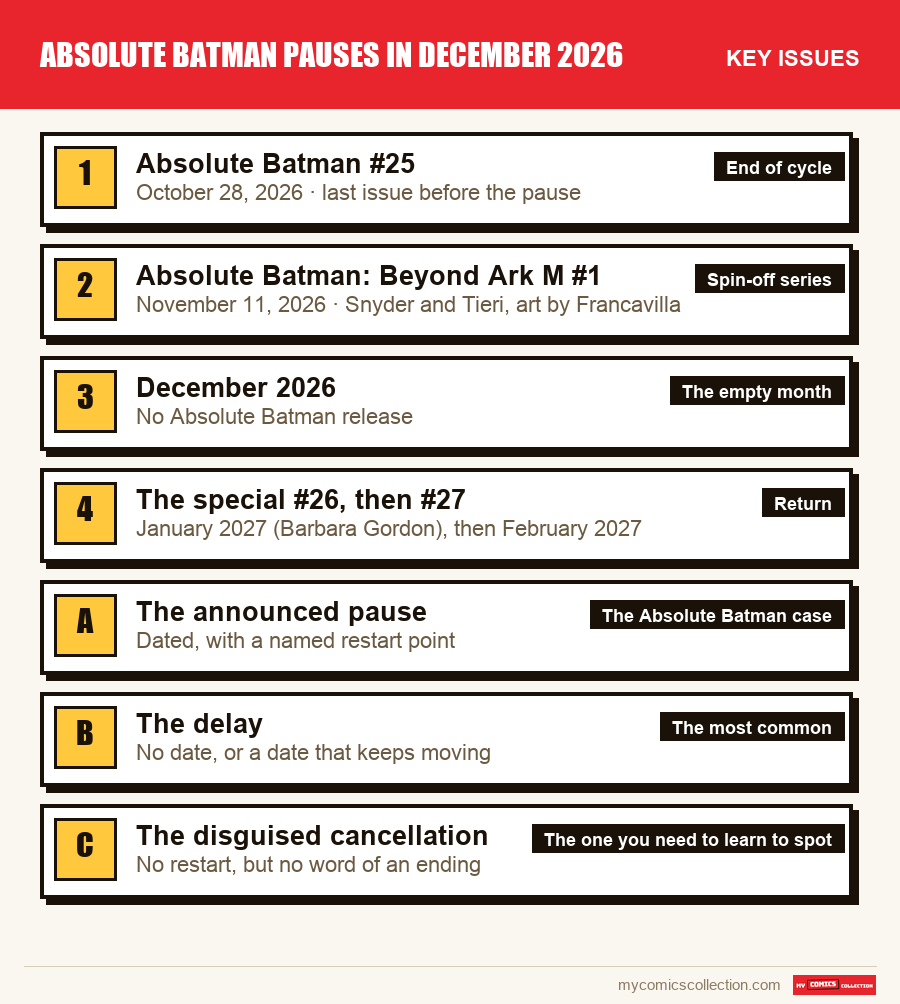
What is announced, date by date
Let us begin with the facts, without interpretation. The sequence spans four months and involves three distinct items that must not be confused.
Absolute Batman #25
#25 ships the same week as Absolute Wonder Woman #25, in an October that is already busy for DC. It is the last regular episode of the series before the break.
Absolute Batman: Beyond Ark M #1
In November, the name Absolute Batman stays on the shelf, but on a different title, with a different art team. It is not the main series under another cover: it is a separate item that carries its own number 1.
December 2026
No issue of the series, no spin-off, no one-shot. The best-selling title on the market is absent for a full calendar month, while the rest of the December schedule is dense at every publisher.
The special #26, then #27
In January 2027, a special numbered #26 is devoted to Barbara Gordon. The series then picks up again at #27, in February 2027, with Scott Snyder writing and Nick Dragotta drawing, which is the launch team.
One note on scope, because it conditions the reading: the detailed contents of the January 2027 wave have not been published to date, beyond the existence of this special. Anything circulating about its plot would be guesswork, and we will write nothing about it.
The trap of the number: what the data we have really measures
Before talking about market share, we need to know what we are talking about, and the answer is uncomfortable: there is no monthly or annual market share published for 2026. The question "what is DC's market share in 2026" has no public answer, and this is not a detail of method, it is a structural gap.
The reason is simple. For decades, publisher percentages came from the monthly reports of the historic distributor of the North American specialty market, which published totals by publisher and by title. Those reports stopped in 2022, and the players who took over distribution do not release sales figures. Since then there has been no monthly market total, and no annual ranking comparable to the earlier ones. The detail of this break and its consequences for estimating the market is covered in our piece on the rise of the direct market and what it changes, which examines the method: how to read these reports deserves its own treatment, and we do not redo it here.
What exists in its place, and it is valuable, is of a different nature. For the week of September 22 to 28, 2026, a point-of-sale report covering more than 600 stores that use the same checkout system gives the following breakdown: DC 41.29%, Marvel 28.62%, Image 19.07%, IDW 2.99%, Titan 1.98%, Boom 1.81%, Mad Cave 1.19%, Dark Horse 1.09%, Ignition 1.02%, Oni 0.95%. Six DC titles were among the top ten sellers, and the top 5 was made up of Absolute Batman #24, Absolute Wonder Woman #24, Muppets Take the Marvel Universe #1, Infernal Hulk Vs Wolverine #1 and Absolute Flash #19.
Now let us list what this figure is not. It is not a measure of the market: it is a non-random sample of stores that share the same checkout tool. It is not a monthly measure: it is one week, dominated by whatever came out on Wednesday. It is neither the global market nor the French-speaking market: these are specialty stores, mostly North American. It is not the publisher's sales: it is what goes through the register on the customer side, not what was shipped. And it is not a measure of volume: the report publishes shares as percentages, without the number of copies or the sample's revenue, which rules out converting it into anything.
The consequence is harsh and has to be accepted as it is: writing "DC holds 41% of the market" is false. The only defensible sentence is "for the week reported, in the stores of this sample, DC accounts for 41.29% of recorded sales." The difference seems picky. It is in fact enormous, and the pause of Absolute Batman will demonstrate it in an almost experimental way.
What a month without the top seller does to a shop
The retailer is the only player in the chain for whom the absence of an issue is immediately a money problem. A specialty store orders its issues weeks in advance, in firm quantities, and as a rule cannot return unsold copies: each copy is a bet paid in advance. In this model, a title that sells for certain is not only a margin, it is a cash-flow instrument. At nearly 500,000 copies a month across the market, Absolute Batman is precisely that. Three effects occur when it is missing, each of a different kind.
Lost foot traffic
A big title brings customers in on a known date. Some come only for it, and buy something else along the way. When it does not ship, it is not just its own sale that disappears, it is the associated sale: the second issue picked off the rack, the collected edition browsed, the back issue spotted in a bin. This effect is more costly than the missing line in the catalog.
Deferral, not disappearance
The regular reader of a paused series does not stop buying comics in December. Their budget moves to something else, most often in the same shop. For the store, the net loss is therefore smaller than the missed sale, sometimes much smaller. For publisher percentages, however, this shift changes everything, and not necessarily in the expected direction.
The risk of drop-off
This is the real danger of a break, and retailers know it well: a monthly habit that stops does not always resume. Between October's #25 and February's #27, more than three months go by for a reader of the main series. A spin-off in November and a special in January serve exactly to keep the name on the shelf through this crossing.
In this logic, it is easier to see why December is the month that stays empty. November has its spin-off, January has its special. December is the densest month of the year for competing releases and year-end purchases: it is also, for a retailer, the month where a missing title is most easily offset by the rest of the offering. The gap falls where it costs the network least.
Why publisher relative share will not read the way you think
Here is the most widespread reasoning error, and it is seductive: if DC loses its top seller in December, DC must fall in the percentages. This reasoning assumes two false things.
The first is that buyers of Absolute Batman would spend their money nowhere else. Yet part of their budget will land on other DC titles, and December 2026 does not lack them: Wonder Woman #40 concludes the Wonder War and the run of Tom King and Daniel Sampere, Poison Ivy #50 marks a milestone of G. Willow Wilson's run, Hitman: It Was the Nineties Special #1 brings Garth Ennis and John McCrea back to the title after twenty-five years on December 9, not to mention Batman #16, Action Comics #1105, Detective Comics #1116 or Superman #45. A publisher that loses its locomotive for a month does not lose its readers.
The second error is subtler: it forgets that these percentages are relative. A publisher's share does not move only when that publisher changes, it moves when the others change. If a competitor places an exceptional number 1 in the same week, DC's share drops without a single DC reader having gone missing. The reverse is true too. A weekly percentage is a balance of forces between that week's releases, not a thermometer of a publishing house's health.
A recent illustration of this volatility does not even involve DC. Amazing Spider-Man #1000, out on September 30, 2026 with more than 400,000 preorders and nine covers sent back to press, was sold out on release day, with unfilled orders announced for November 4, 2026. Part of its sales will therefore not land in the week the reader wanted it, but five weeks later. Weekly percentages absorb this shift without flagging it.
The practical conclusion is thus both modest and firm. In December 2026, a weekly report may show DC down, or may not. In either case, that report will not tell us whether the absence of Absolute Batman cost DC share over the month, since no monthly figure will be published to check it. So we should avoid any conclusion drawn from a single week, in either direction.
Why a publisher agrees to cut its biggest title
Which leaves the most interesting question: how does a publishing house come to remove from the calendar, voluntarily, the item that sells best? Let us state up front that DC has not published a statement of its reasons, and that what follows is a reading of the announced facts, not a publisher statement.
The most telling fact is the makeup of the team on the return. The February 2027 #27 is announced with Scott Snyder and Nick Dragotta, that is, exactly the launch duo. A monthly series drawn by a single artist at this density of artwork is an exercise that the calendar always ends up catching. Two solutions exist then: bring in fill-in artists as you go, which damages the product and shows immediately on the shelf, or arrange a breather and keep the artist, which costs a month of sales. The rest of the sequence reads the same way: a spin-off handed to another team in November, a special from a different angle in January, two items that hold the commercial space while the main series builds up a lead.
Finally, there is a deeper trade-off that goes beyond this title. A series that brings in new readers has value to a publisher only if it lasts, and sacrificing one month to protect two years of regular publication is a rational calculation when the title is a pillar of the line. Note that the Absolute line continues without interruption around it: Absolute Superman #25 on November 4, 2026 opens a new era under Jason Aaron's pen, and Absolute Wonder Woman and Absolute Flash keep their numbering. The pause concerns one title, not a universe, and our DC 2026 calendar lets you place the sequence within the full program.
Reading a series interruption: three cases never to confuse
For a collector, the stakes go well beyond this title. A series that stops appearing falls into three very different situations, which call for different decisions. Confusing them is one of the costliest errors in research time.
The announced pause
Recognizable signs: a restart date, a restart number, a named team, and most often a substitute item during the interval. The publisher owns the gap publicly because it decided it.
The delay
Recognizable signs: the issue stays in the catalog but changes week, sometimes several times. No editorial communication, or a technical mention. Often, an artist struggling with the schedule or a production step that has slipped.
The disguised cancellation
Recognizable signs: the last announced issue comes out, then nothing more shows up in the following waves. The arc is not concluded, the characters reappear elsewhere, and the collected edition stops midway. The word "cancellation" is never spoken.
The method for telling these three cases apart comes down to one habit, and it requires no special tool: look at the next two or three waves of releases. A title on announced pause appears there on its date. A delayed title appears there, shifted. A title on its way out no longer appears at all. This is also why it is useful to keep a list of your ongoing series rather than rely on memory: our guide to completing an ongoing series details this discipline, and the 2026 release calendar serves as a point of comparison.
What the pause changes, or does not, for the value of issues already out
Let us now address the question everyone is asking, and the answer is frank: a publication break does not create value on issues already released. We should even go further, because the opposite reasoning is very widespread.
A single issue's scarcity depends on the number of copies in existence and their condition, not on the regularity of the calendar. Yet the number of copies in circulation, here, is considerable. The series' #1 sold slightly under 400,000 copies across all printings, #15, which revealed the Joker's origin, passed 300,000 copies, and the series as a whole totaled around three million copies sold by the end of 2025. A series circulating at this level is, by construction, one of the most abundant of the modern market. No three-month pause removes a single copy from this mass.
We must add a methodological caveat that holds for all recent comics, and it is a severe one: since distribution reporting stopped in 2022, the real print run of a published issue is no longer public data. The figures cited above come from publisher communications and creator statements, not from an independent count. They give an order of magnitude, not a measurement. Anyone claiming to know the exact print run of a 2026 issue is mistaken or is misleading you. The mechanism is detailed in our guide on how to understand a print run.
We will also not publish any price quote or numeric price movement on this series: no source consulted publishes any for the recent period. What can be said safely is structural. On a very abundant series, the secondhand supply stays wide and the price holds at the level of a reading copy, except for particular items: low-allocation covers, copies in very high certified grade, authenticated signatures. The price hierarchy plays out inside the title, not on the title itself.
One point does deserve real attention, however, and it is purely practical. The numbered special #26 of January 2027 is a hybrid item: it carries a series number without being a regular episode of the arc, and it is devoted to another character. For anyone who wants a complete series, this is exactly the configuration that produces filing mistakes five years later, when nobody remembers the context. Noting its nature right now, and not just its number, is the only collecting gesture this announcement justifies. An issue-by-issue tracker makes this work trivial, where a title list does not allow it.
What to do between October 2026 and February 2027
Let us recap in concrete actions, since most spontaneous reflexes are useless or counterproductive here.
Do not buy in a rush
An announced pause is public, hence already absorbed by the market by the time you read it. There is no information advantage to seize, and no reason to pay for a recent issue above its usual level because the series stops for three months.
Secure #25 and #27 with your point of sale
The real risk of an interruption is not price, it is availability on the return. A retailer who has seen sales stop for three months orders the restart issue cautiously. Telling them in advance that you want it is the only precaution that pays off. Our article on preordering as a strategy sets out the mechanics of firm orders.
Distrust market readings based on one week
Between December and February, commentators will announce a shift in the balance of power between publishers. Always ask which period the quoted figure covers. If it is one week of register data in a sample of stores, it describes nothing more than that week.
One last word on what this affair says about the 2026 market. The year has been marked by a string of sellouts at every publisher: Absolute Green Arrow sold out a week before release, Mind MGMT: New & Improved #1 and The Exorcism at Buckingham Palace #1 sold out at the distributor before publication, Terminal #1 printed at 300,000 copies where 100,000 had been hoped for. Demand that regularly exceeds forecasts and a publisher pulling its top seller from a calendar month describe the same market: one where volume is no longer the limiting factor, and where the constraint has shifted toward the ability to produce on a regular schedule. A context that is favorable to reading, neutral for scarcity. Our analyses of the most anticipated titles of 2026 and of the signs of a speculative bubble extend this reading, and the Batman hub places the Absolute line in the long history of the character.