There are two irreconcilable emotions in a comic collector's life. The first: the almost physical satisfaction of finally closing a run, holding in your hands the last missing issue after months of searching.
There are two irreconcilable emotions in a comic collector's life. The first: the almost physical satisfaction of finally closing a run, holding in your hands the last missing issue after months of searching. The second: the frustration of knowing you're missing that Amazing Spider-Man #129 (first Punisher appearance), which now trades for hundreds of dollars and which you saw three times at conventions without buying because the price seemed too high.
Completing a comic series is an art that requires method, patience and a good dose of strategy. This guide gives you all the keys to approach this goal efficiently, whether it's a short 12-issue run or a 700-issue behemoth.
Precisely identifying your missing issues
The first mistake collectors make when wanting to complete a run is heading into the hunt without knowing exactly what they're looking for. Before visiting a convention, scrolling eBay pages or pushing open a specialty shop door, you must have a precise list of your missing issues.
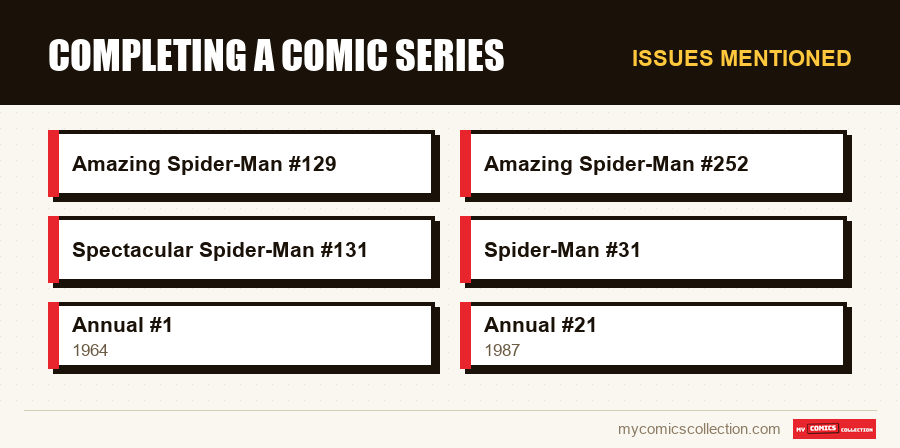
This prep work seems obvious, but is often rushed. Knowing "I'm missing some numbers in the 80s of Amazing Spider-Man" isn't enough. You need the exact list: Amazing Spider-Man #252, #258, #300, #316: each issue counts.
Inventory what you already own
Start with a rigorous inventory of your collection. With My Comics Collection, you mark each owned issue and the app automatically generates the missing list by series. No tedious manual entry: series import is automatic from a worldwide comics database.
Define your run's scope
A run can mean just the regular series, or include annuals, specials and one-shots. Define your scope from the start. For Amazing Spider-Man, do you include numbered annuals? Giant Size? Holiday specials? This decision directly impacts the number of issues to find.
Have the list with you at all times
Your missing list must be consultable in mobility, anytime. A convention can pop up on a Saturday morning, a shop can have a flash sale. With the My Comics Collection mobile app, your list is always in your pocket.
Prioritize: complete run, key issues or narrative arcs?
Before throwing yourself into hunting missing issues, ask yourself a fundamental question: what are you really trying to accomplish? There are three main approaches, and each has its merits.
The complete run, issue by issue
The most ambitious and expensive goal. You want to own every issue of the series, without exception. For a series like Amazing Spider-Man with over 900 issues (counting relaunches), it's a multi-year, multi-thousand-dollar project. Realistic for short series (12-50 issues), demanding for long classic series.
Key issues only
You target only high-interest issues: first appearances, noteworthy deaths, iconic covers. This approach is more financially accessible but can prove costly because key issues are precisely the most sought-after and expensive issues on the market.
By narrative arcs
The most balanced strategy. You target coherent narrative arcs: for example the Kraven's Last Hunt arc (#293-#295 + Spectacular Spider-Man #131-#132 + Web of Spider-Man #31-#32), or the complete McFarlane arc (#298-#329). Each arc is an achievable goal with a pre-defined budget.
Where to find back issues
Once your list is in pocket and your strategy defined, time for the hunt. Back issues are found in several circuits, each with advantages and drawbacks.
Specialty comic shops
First instinct: your local shop. Good comic shops maintain back issue bins sorted by series and number. The advantage is seeing and touching the comic before buying, assessing condition, and often negotiating price. Downside: stock is limited and varies by shop.
eBay and online marketplaces
eBay remains the world's largest comics marketplace. You'll find almost any issue, in any condition, at very varied prices. Always filter on sold listings to evaluate the real market price before bidding or buying. Hipcomic is a comics-specialized alternative with often very serious sellers.
Comic conventions
Conventions are ideal hunting ground for collectors. Prices are often more negotiable than in shops, vendor density is exceptional, and you can sometimes make unexpected finds. Prepare with your missing list and a pre-defined budget per issue.
US specialized sites
Specialized US retailers offer considerable online back issue catalogs. Prices are often reasonable but shipping from the US adds up quickly. Prioritize grouped orders to offset fees.
Tip: On eBay, create alerts (Saved Searches) for your most-sought issues. You'll be notified as soon as a listing matches your criteria, without manually checking daily.
Understanding values to not overpay
The back issue market can be opaque to the uninitiated. Asking prices vary 5x for the same issue depending on seller and platform. Never pay without verifying market value.
eBay Sold Listings: the reference
On eBay, filter results on "Sold Items" (completed sales). What you see there is what real buyers accepted to pay for that issue in that condition. It's your market reference. A seller asking $55 for an issue that regularly sells for $22 on eBay sold can be negotiated down.
GoCollect and PriceCharting
These two platforms aggregate eBay sales data and offer price histories by issue and condition. GoCollect is particularly useful for CGC-graded comics. PriceCharting also covers raw (ungraded) comics with histories freely accessible.
Collecting this series?
Track what you own, what you are missing and what your collection is worth. 7 day trial.
Start my trial →Very long runs: strategy by arcs
Amazing Spider-Man has over 700 issues in its first series (1963-1998) before the 1999 relaunch, and several hundred additional issues since. Wanting to "complete Amazing Spider-Man" without strategy means setting yourself up for an endless quest.
Solution: break the run into arcs or editorial eras, each constituting an autonomous project.
- The Stan Lee / John Romita Sr. era (#39-#100, 1966-1971): the series' early maturity years, with Mary Jane, Kingpin, Rhino, Vulture introductions. Issues from this period are expensive but iconic.
- The Gerry Conway / Ross Andru era (#111-#185, 1972-1978): death of Gwen Stacy (#121-#122), Punisher (#129), the Jackal. Crucial issues at more affordable prices.
- The Roger Stern era (#224-#250, 1982-1984): some of the series' best stories, with the mysterious Hobgoblin and very well-constructed stories.
- The McFarlane era (#298-#329, 1988-1990): the most sought-after run in art terms, with Venom's introduction (#300, full first appearance).
- The Michelinie / Larsen / Bagley era (#330-#400, 1990-1994): Carnage (#361), Maximum Carnage, continuation of the symbiote era.
Practical advice for long runs
- Define one target arc per quarter maximum
- Set a budget per arc before starting
- Buy "ordinary" (cheaper) issues first, then key issues
- Use conventions to stock up on "filler issues" at low prices
- Track progress arc by arc in My Comics Collection
Annuals, specials and one-shots: the run's forgotten ones
Every major comic series has generated over the years a cohort of annex publications: annuals (often one per year), thematic specials, event-linked one-shots, crossover tie-ins. These are often ignored by collectors building their run: until the day they realize they're missing important narrative elements.
A few notable examples in Amazing Spider-Man:
- Annual #1 (1964): the title's first annual, reprint of several villains' first appearances. Important collection issue.
- Annual #21 (1987): Peter Parker and Mary Jane Watson's wedding. Major key issue.
- Spectacular Spider-Man #131-#132: necessary to read Kraven's Last Hunt in order.
Practical rule: decide once and for all whether your run includes or excludes annuals and specials, and stick to that decision. My Comics Collection lets you mark them separately for precise tracking.
Completing a run locally vs. importing from the USA
For international collectors, the supply question often comes up: buy locally (shops, regional eBay, conventions) or import directly from the US?
Buying locally
Advantages: no customs fees, short delivery times, ability to see the comic before purchase, easier returns. Disadvantages: stock often limited to common or very-in-demand issues, prices sometimes marked up vs. the US market.
Importing from the USA
Advantages: access to massive stock (specialized US retailers have millions of issues in stock), often lower prices for common back issues. Disadvantages: high shipping costs (offset by grouped orders), 2-to-4-week delivery times, transit risks for valuable comics, and potentially customs fees for orders exceeding $165.
For US orders: group your purchases as much as possible into one order to dilute shipping costs. One package of 20 issues costs much less than 4 packages of 5 issues. Check our complete guide on buying vintage comics internationally for details.
FAQ, Completing a comic series
Find all your missing comics with My Comics Collection
Inventory your collection, identify missing issues automatically and head out hunting with the right list in pocket. Series import in seconds.
🚀 7-day free trial, no commitment