The most hyped comics of 2026 are, at the top, the event Armageddon by Chip Zdarsky, the launch of Absolute Green Arrow , the crossover Superman/Spider-Man (Waid & Jiménez) and the X-Men event Shadows of Tomorrow. This tier list classifies the outputs according to the buzz and wait that they generate, not just their quality. Titles and creators from 2026 publisher announcements; schedules can slip.
The “hype” is the wait: the announcements that get people talking even before they appear, the mystery events, the launches watched by speculators. This tier list does not measure quality but level of anticipation around 2026 releases: useful for spotting what could become hot on the collection side. Handle with caution: hype does not guarantee value.
Ranks according to buzz, facts verified (creators, publishers). A snapshot of 2026 news.
Collecting this series?
Track what you own, what you are missing and what your collection is worth. 7 day trial.
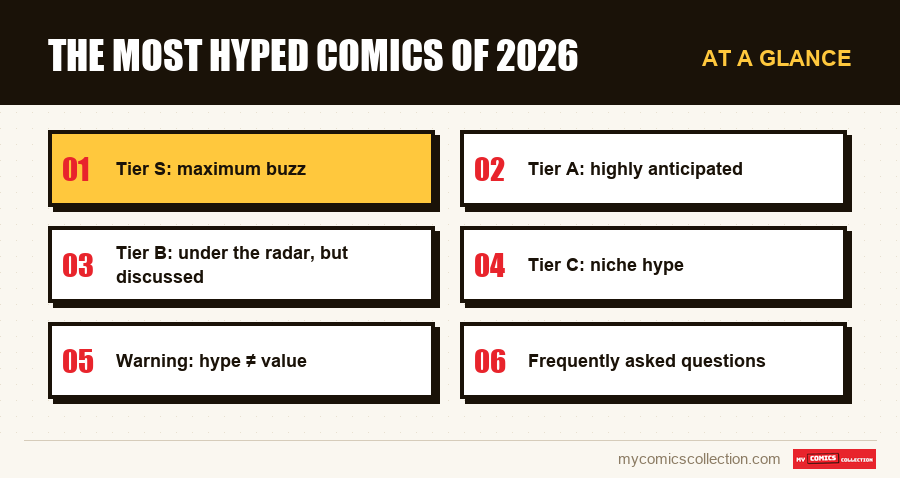
Start my trial →Tier S: maximum buzz
Armageddon, Chip Zdarsky's mystery event announced for June 2026, is one of the most anticipated releases of the year: Marvel voluntarily maintains secrecy. The launch of Absolute Green Arrow is among the most sought after in the Absolute line. The crossover Superman/Spider-Man (Mark Waid, Jorge Jiménez) brings together the two biggest publishers, and the event Shadows of Tomorrow revives interest around the X-Men.
Tier A: highly anticipated
Absolute Batman remains a hype magnet with each issue. THE Batman #7 by Matt Fraction (March 2026) promised an arrival of the Joker “like we’ve never seen”. The revival Iron Man by Joshua Williamson and the launch of Absolute Catwoman complete this much-commented tier.
Tier B: under the radar, but discussed
The revival Daredevil and his new nemesis Omen arouse curiosity. The mini Wonder Man, Barbara Gordon: Breakout (May 2026) and the Flash by Ryan North liven up the conversation without dominating the buzz.
Tier C: niche hype
On the indie side, We're Taking Everyone Down With Us (Image) gets demanding readers talking. Absolute Wonder Woman et The Mortal Thor benefit from a more subdued but faithful wait. Real hype, on a smaller scale.
Warning: hype ≠ value
- The buzz increases the print runs: a very hyped #1 is often overproduced, therefore not rare.
- Mystery events (Armageddon) can create first appearances to watch out for.
- Don't speculate on hype alone: always check the actual rating after a few months.
- Each title refers to the character file concerned.
Frequently asked questions
The mystery event Armageddon by Chip Zdarsky (June 2026) and the launch of Absolute Green Arrow were among the most anticipated releases of the year.
Caution: hype pushes publishers to overproduce, which limits scarcity and therefore future value. Better to aim for real first appearances and check the actual rating after the fact.
Monitor them first appearances in events (like Armageddon), rather than simple #1 raises. A striking new creation has more potential than a hyped issue with a print run of hundreds of thousands of copies.
How to read the hype without aiming at the wrong target
Hype feeds on announcements, revealed covers and rumors, but it says nothing about what will matter in ten years. For a collector, the useful question is not "which title is people talking about?" but "what does this issue actually contain, and how many copies exist?" Here is a simple method to sort the year's releases before any purchase.
Telling a launch from a first appearance
A relaunch #1, however eagerly awaited, reuses characters that already exist. What gains value over time is the first appearance of a character, a costume or a team. In a mystery event, the issue to watch is therefore not necessarily the first chapter: it is the one where a brand-new creation truly steps onto the stage, and you often only know that after reading.
Beware of inflated print runs
The more eagerly a release is awaited, the higher the retailers' orders, and the more plentiful the supply. Market history is a reminder: X-Men #1 (1991) is the best-selling comic of all time, and Superman #75 (1992) was printed in the millions in a polybag. In both cases, common copies are worth little, because popularity and scarcity are two different things.
Reading the variant ratio
A 1:50 ratio variant is shipped at only one copy for every fifty ordered by a retailer: the higher the ratio, the rarer the cover. Variants tied to an important story arc generally hold their value better than those that rest on aesthetics alone. Be wary, though, of alternate covers sold everywhere: they flood the market.
A four-step method
- Note the name of the event and the exact issue, not just the series title, so you do not confuse a launch with the key chapter.
- Wait a few weeks after release: what really trades says more than the announcements.
- Look for a real first appearance confirmed by the publisher or by reliable readers before chasing an issue.
- Set in advance the share of your budget devoted to recent releases, and stick to it.
Keep in mind, too, that schedules slip: a title announced for a given month may come out later, and an event can be reworked along the way. The tier list above remains a snapshot of anticipation, not a promise of value.
Finally, reading remains the best criterion. A comic you enjoyed, neatly stored and cataloged, is always worth more to you than an issue bought in a rush on nothing but a rumor.
Are you chasing the hot releases of 2026? Estimate their real value for free with our tool based on current eBay listings: before you speculate.