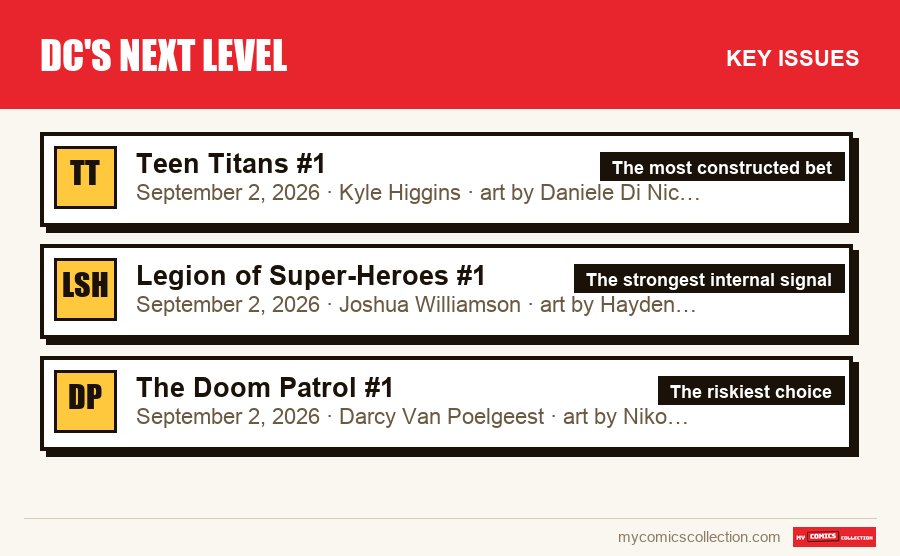
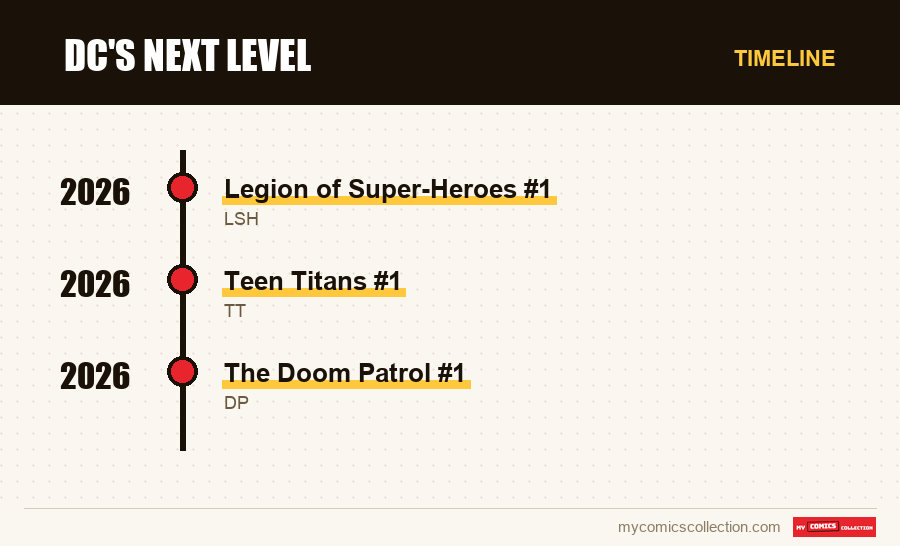
Next Level is a DC editorial label, not a parallel universe. Revealed in 2025 and opened in March 2026, it constitutes the "second act" of the All In initiative after the conclusion of the DC K.O. event, and its mission is precise: put second-tier characters back into production. On September 2, 2026, three issue #1s of this label came out together: Teen Titans (Kyle Higgins, art by Daniele Di Nicuolo), Legion of Super-Heroes (Joshua Williamson, art by Hayden Sherman) and The Doom Patrol (Darcy Van Poelgeest, art by Niko Henrichon). Among three simultaneous launches, the question is not which will be worth the most, but which has structural reasons to last. This article gives the grid: what the label commits, what the creative team reveals, and which signals really deserve to be followed.
A 2026 collector does not have an information problem: they have too much of it. Every Wednesday, a publisher announces a relaunch, a return, a milestone. What is missing is not the list of releases, it is a way to sort. And the case of the three issue #1s of September 2 is the perfect example of sorting impossible to do in your head: three historic teams, three serious creative teams, a shared label, and no obvious hierarchy between them.
The habit, in this situation, is to take all three and decide later. It is the most expensive and least informative solution. The one this article offers is different: read the wave as an industrial decision, reconstruct the publisher's reasoning from what it actually committed, and keep only what that reasoning justifies.
We write a month after release, on October 2, 2026. The three issues are therefore in circulation, but no market perspective exists yet at this time scale, and no serious price can be put forward. On the other hand, a month is enough to observe something else, far more useful: how the publisher itself treated its own label in the weeks that followed.
What Next Level exactly designates
Let's start with the vocabulary, because it is the source of most purchasing mistakes. Next Level is neither an event, nor a separate continuity, nor a catalog reboot. It is a programming label: a banner placed on a set of series that share an editorial intention, and nothing more.
This intention was stated publicly: the label was revealed at the 2025 New York convention, presented as the second act of the All In initiative, and devoted to the catalog's lesser-known heroes. It opens in March 2026, after the DC K.O. event closed the first act. The name itself is a program: it does not announce a break, it announces an additional floor.
For a collector, this definition has three immediate consequences.
First consequence: no promise of scarcity. A programming label imposes nothing on print runs. Each series is ordered for itself by retailers, based on its character and its creative team. The shared banner creates no closed collection you could complete, unlike a numbered miniseries or an event.
Second consequence: continuity is the main one. The Next Level series take place in the usual DC universe, the one you discover by entering through the classic door. What happens in them counts for the rest of the catalog, and vice versa. It is a fundamental difference from a line with separate continuity, where an internal event has no repercussion elsewhere.
Third consequence: the label is judged title by title. Since it guarantees neither format, nor duration, nor print run, it has no collective value. Saying "I collect Next Level" has no operational meaning, where "I collect the miniseries of such and such year" would.
Next Level's place between All In and the Absolute line
DC runs three different objects at the same time, and confusing them is costly. Here is how they fit together.
All In is the general initiative, launched in October 2024 and led by Scott Snyder and Joshua Williamson. It is not a series, it is a direction: the framework in which the whole catalog was reorganized after the conclusion of Absolute Power. Everything DC has published since falls within it, including Next Level.
The Absolute line was born at the same time, but follows an opposite logic. It is a parallel continuity, where the great characters receive rewritten origins: Batman, Superman, Wonder Woman and the others exist there in versions that do not communicate with the main continuity. It is the publisher's commercial engine, and by far: on the specialty-store register report of the week of September 22 to 28, 2026, the top three places were held by Absolute Batman #24, Absolute Wonder Woman #24, then, after a competing title, Absolute Flash #19. Absolute Batman's writer, for his part, mentions an order of magnitude close to 500,000 copies a month.
Next Level occupies the remaining position, and it is the most interesting to understand. Absolute captures attention on the best-known characters, in a new continuity. Next Level takes care of the catalog's depth, in the old continuity. One sells copies, the other maintains a heritage of characters.
This split is visible in the label's very makeup. On the first wave of March 2026, DC scheduled a new Batwoman series written by Greg Rucka, a Lobo by Skottie Young, a Deathstroke: The Terminator by Tony Fleecs. Followed a Zatanna written and drawn by Jamal Campbell on April 29, The Fury of Firestorm by Jeff Lemire in fifteen issues on April 8, Barbara Gordon: Breakout by Mariko Tamaki on May 13, The Deadman by W. Maxwell Prince in twelve issues on June 3. Then the three September teams. Then, on October 7, The Demon written and drawn by James Harren and Jonah Hex and the Shadow of Death written and drawn by Michael Walsh in six issues.
None of these character names is at the top of the publisher's sales. All are old properties, dormant or intermittent. That is exactly what the label announced, and it is a reassuring point: the editorial promise is kept, which is rare.
Why a publisher groups three relaunches on the same day
September 2, 2026 is not a calendar accident. Grouping three issue #1s on the same release date is a distribution decision, made months in advance, and it pursues identifiable goals.
It turns three fragile launches into an event. Taken alone, an issue #1 of a second-tier team drowns in a week of releases. Three together, under a shared banner, become news the specialist press talks about as a block. Attention is a scarce resource, and pooling it is the only way to make it sufficient.
It forces retailers' hand, in the right direction. A retailer orders by the issue, but thinks in waves. Three titles presented together are ordered together, and a shopkeeper who takes all three will have an interest in featuring them to move his stock. It is an in-store visibility lever that three scattered releases would never have produced.
It creates a reusable reference date. If one of the three titles settles in, the publisher will have a common point of origin to celebrate, reprint in collection and recall in its communications. A wave is a more durable editorial object than three launches.
DC also prepared the date. A week earlier, on August 26, 2026, the publisher put out a one-shot bearing the label's very name, written by Gerry Duggan and drawn by Fernando Blanco. A dedicated prologue, entrusted to a recognized writer, is an investment: you do not pay for an introduction issue for an operation you expect little from.
Remains the downside, which must be faced. Grouping also means putting three titles in head-on competition for the same reader budget. Someone who wanted to try a team relaunch will try only one, and the other two will pay for the comparison. A simultaneous wave mechanically produces a winner and two relative losers, whereas staggered releases would have given each its chance. That is why the question of sorting is unavoidable: the publisher posed it by scheduling this way.
The three issue #1s read as publisher decisions
We do not detail here the history of these three teams nor their historic issues, which belong to their respective guides. We only read what the assignment of creators reveals about the ambition placed in each title.
Teen Titans #1
The new series is identified by the publisher as the seventh volume of the title, which says a lot about the difficulty of the exercise: no formula has lasted durably since the 1980s. The assignment is nonetheless the most thoughtful of the three. Kyle Higgins wrote Nightwing between 2011 and 2014, meaning he knows the Robin family from the inside, and he has built since 2021 at Image a shared universe around Radiant Black, so he knows how to make a new team from scratch. The announced setup, with Red Hood as a reluctant mentor to a largely renewed group, combines the two skills. Daniele Di Nicuolo comes from the Power Rangers line and took part in a one-shot of Higgins's shared universe in 2023: the register is coherent.
Legion of Super-Heroes #1
It is the title whose assignment is the most revealing of the label's place in the house. Joshua Williamson is not just another writer: he is one of the two architects of All In and one of the two writers of DC K.O., after a four-year stint on The Flash from 2016 and an arrival on Superman in 2023. Entrusting a dormant team to the man who steers the editorial strategy means the publisher wants this title to count in its plans, and not merely exist. Hayden Sherman's art goes the same way: he is the one who established the look of Absolute Wonder Woman since 2024, one of the catalog's two biggest successes. Transferring this line to a catalog series is not a saving.
The Doom Patrol #1
The most unexpected assignment, and the one that deserves the most attention. Darcy Van Poelgeest is not a superhero writer: he comes from creator-owned, where he signed Little Bird with Ian Bertram at Image, an Eisner-awarded limited series. Niko Henrichon is the artist of Pride of Baghdad with Brian K. Vaughan, and a regular cover illustrator at both big publishers. Neither practices the monthly team mechanics. On any other franchise, it would be a casting mistake; on this one, it is the only tradition that ever worked, since the team's landmark versions were all entrusted to writers from elsewhere, from the 1989 rereading to the version edited by an alternative label in 2016.
Evaluating a relaunch cold, without waiting two years
The argument most often heard is that you must wait. It is true for market value, it is false for the keep decision: waiting two years means buying the three issue #1s now and deciding later, which is precisely the expense you wanted to avoid. There is a cold evaluation, which concerns not the future quality of the story but the probability that the series still exists in eighteen months.
Read the announced format before anything else
A series announced with a fixed number of issues and an open-ended announced series are not collected the same way. In the Next Level wave, some titles have a displayed end, twelve to fifteen issues, and others do not. A displayed end is good news for the collector: the object is finished, thus completable, and the publisher commits to a length. An open series may last five years or stop at the eighth issue, and nothing lets you know in advance.
Count the previous relaunches
It is the most brutal and most reliable indicator. A team on its seventh attempt is not a team that was forgotten: it is a team whose no formula has held. This does not condemn the new series, but it sets a realistic life expectancy, and explains why the issue #1s of these franchises are numerous on the secondhand market.
Measure what the publisher really committed
Not what it declared, what it paid. An editorial strategy architect on script, an artist from a hit title, a prologue one-shot entrusted to an established name, a bound format announced before the first issue even comes out: these are expenses, and an expense commits more than a statement of intent. Conversely, a relaunch entrusted to a team with no history at the publisher and with no prologue signals a minimal stake.
Check the hook to continuity
A relaunch tied to the universe's current events has outside reasons to continue: it serves other series. An isolated relaunch holds only through its own sales. Concretely, a team title that borrows a central character from a major franchise is more protected than a title whose cast interests only itself.
Watch the third and sixth issues, not the first
The first issue measures only a curiosity, largely built by communication. The real information arrives at the third, when the order curve has stabilized, and at the sixth, when the publisher decides whether or not to extend. For these three series released on September 2, the useful deadline therefore falls in winter 2026 and spring 2027. Issue-by-issue tracking in your collection tool makes this observation automatic.
Decide by default not to keep
This is the step nobody applies. A collection is built by refusal, not by accumulation: the sound rule is that every issue #1 is set aside unless an explicit reason brings it in. A copy bought for no named reason is a copy that will clutter a binder and that no buyer will look for. The general collection management method starts from the same principle.
The signals worth something
Four clues deserve to enter the decision, because they inform on real scarcity or probable duration.
The creative team, read as a resource allocation. Not for their talent, which is subjective, but for what their assignment costs the publisher. A writer who could be employed on a high-print-run title and who is placed on a catalog series represents an owned opportunity cost, therefore an intention. It is the most solid signal of all because it predates release and depends on no rumor.
The second printing, and only if documented. A second printing says two useful things: that the first sold out at retailers, and that there now exist two states of the object of which one, the first, becomes identifiable. Mind the reading: a second printing is not good news in itself, it can signal an underestimation of orders as much as a success. Our article on the difference between first printing and reprint details what it changes at resale.
The place in continuity, verified and not assumed. If a character from the relaunched series appears in another publisher title in the following months, the series is plugged into the rest. This is observed by reading the releases, not the announcements. It is a slow but reliable signal.
The announcement of a collection. A publisher that schedules the bound version before the end of the initial arc has already estimated a demand. It is a modest but real financial commitment, and it often arrives before the rest of the information.
And those that are noise
The number of alternate covers. It is the most misleading indicator of the current market. An abundant variant program measures the order volume hoped for, not the scarcity obtained. On a heavily ordered release, a cover presented as very limited may exist in a number of copies far above the entire print run of a confidential series. Real scarcity is only established afterward, by the number of copies kept in good condition. How print runs work is explained in our guide on print runs, and the scarcity estimation method in another.
A single week's ranking. A weekly register report, even covering more than six hundred equipped stores, measures a week and specialty points of sale. It says nothing of a market share, even less of an annual trend, and it is worth nothing for judging a series launched a month earlier. We return to what these reports say and do not say in our analysis of the specialty distribution market.
The label itself. A banner creates no value. The editorial lines of the last thirty years have shown it in both directions: some produced durable series, others vanished without a trace, and in both cases the label was never what the market remembered. What it remembers are runs and characters.
The volume of online discussion. It measures the intensity of an expectation, that is, exactly the variable that precedes a disappointment. Speculative bubbles are recognized by this decoupling between conversation and copies sold, and our markers of the signs of a bubble apply fully to a wave of relaunches.
Which ones to keep, and under what conditions
Here is the answer, formulated as a conditional rule rather than a ranking, because a ranking would be a disguised prediction.
Keep the title whose creative team cost the publisher the most, in a single copy, main cover, first printing. In the September 2 wave, it is the assignment of an editorial strategy architect and of an artist from a very high-print-run title that constitutes the heaviest commitment. It is no guarantee of quality or value: it is the bet whose reasons are verifiable today.
Keep a second title only if you read it. Reading is the only use whose return does not depend on the market. If one of the three series really interests you, it enters the collection on that basis, and the question of its value becomes secondary. It is an explicit reason, thus valid in the sense of step 6.
Buy the third only if a new fact appears. A documented second printing, a return of the central character in a major title, the announcement of an extension beyond the first arc. Without a new fact, the copy will remain available on the secondhand market for years, at a price that will not rise.
Have none of the three graded for now. A main-continuity relaunch issue #1, released a month ago, is an abundant object whose high grade is the expected condition rather than a distinction. The cost of grading is known, the value of the object is not. The reasonable order is the reverse: keep cleanly, observe the winter, decide afterward. The operation remains possible later; the reverse is not true.
And do not constitute the wave as a lot. Three issue #1s bought together because they came out together do not form a collecting set: the label is not a series, it has no numbering, and nobody will look for "the September 2 wave" in ten years. There are only three independent objects, two of which are very probably too many.
Keeping count of a wave of relaunches
Relaunches pose a tracking problem long series do not: the titles carry the same name as their predecessors. For each of these three teams, half a dozen series with the same title coexist in the catalog, each with its own issue #1, and an isolated copy quickly becomes impossible to place. It is the first cause of resale error on these franchises.
Three reflexes suffice to avoid it, and they take a minute at purchase. Record the series year along with the number, because it is what distinguishes homonyms. Note the cover and printing while the object is in your hands and the information is legible on it. Enable release tracking on the title you decided to follow, so that the third and sixth issue deadline comes up without thinking about it.
In the app, this identification is done at entry, and the list of missing issues updates itself on the titles followed. For the rest of the DC catalog, our guides on building a DC collection, the publisher's key issues and the 2026 calendar give the framework in which these three series fit. The question of preservation format, single issue or collection, is addressed in our comparison of bound editions.
What this wave teaches beyond itself
Next Level is interesting because it is the opposite of a stunt. A discreet label, characters with no immediate speculative value, varied formats, some writers from creator-owned, a modest prologue. Nothing in this operation seeks to produce a rare object, and that is precisely what makes it legible: when a publisher is not playing scarcity, its decisions become interpretable.
The method lesson goes beyond these three issues. Faced with a wave of relaunches, the only data usable before release are the format, the history of previous attempts and the allocation of creators. Everything else, the banner, the variants, a week's ranking, the rumor, describes the expectation and not the object. A collector who sticks to the first three will sometimes be wrong about the story's quality, but rarely about the quantity of copies they bought for nothing.