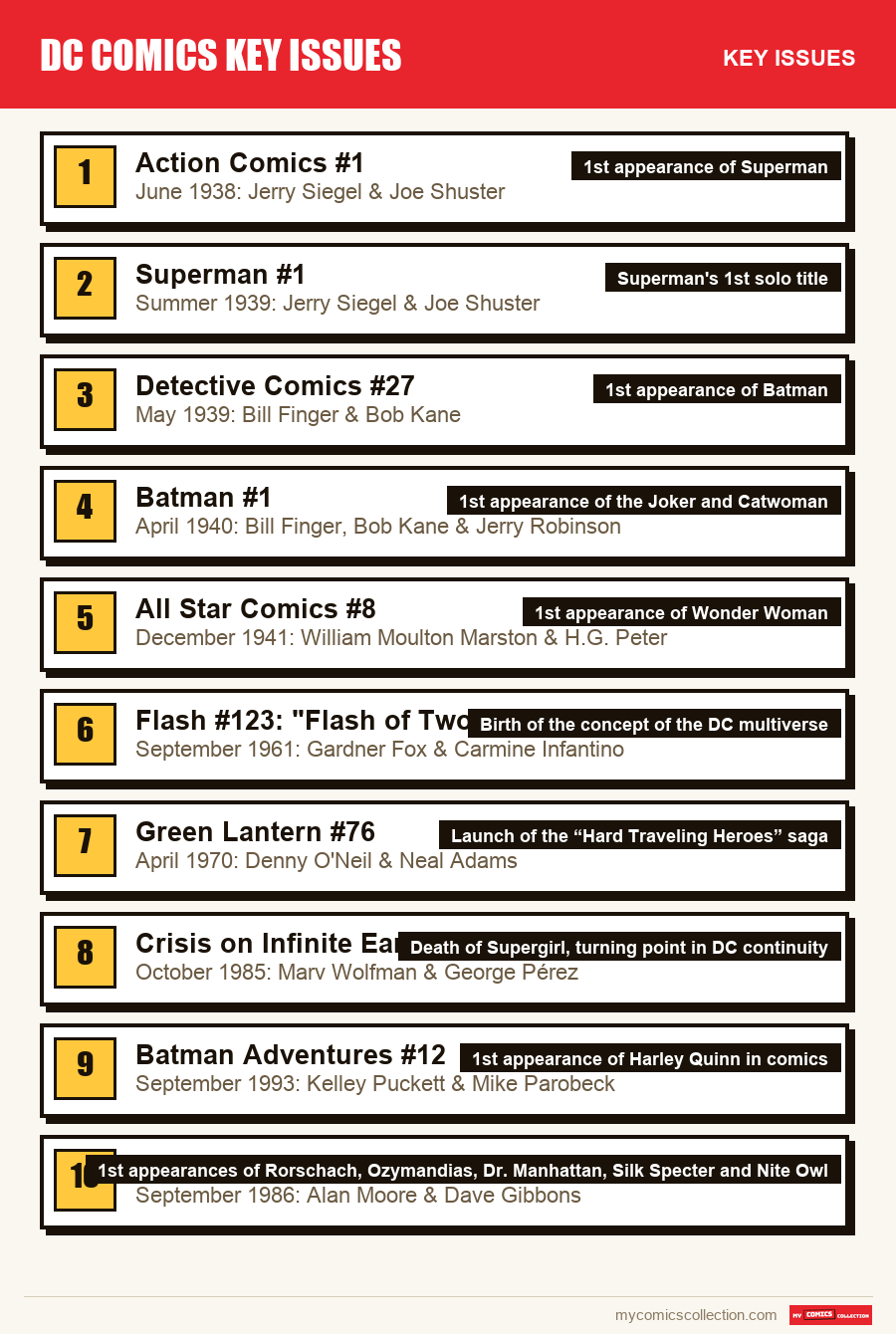
Key issues of DC Comics are the issues that introduced a character, a storyline turning point or a major editorial era change. The top three remain Action Comics #1 (1938, 1st appearance of Superman), Detective Comics #27 (1939, 1st appearance of Batman) and Superman #1 (1939): these three titles have all sold over a million dollars in recent years, Action Comics #1 having even crossed the 15 million dollar mark during a recent private sale. Below this Golden Age peak, Silver, Bronze and Modern Age issues like Flash #123, Green Lantern #76, Batman Adventures #12 or Watchmen #1 remain accessible and continue to be in active demand, with odds that range from a few hundred to several thousand dollars depending on the CGC grade.
Unlike a general guide which retraces the complete history of DC Comics from 1934 to today or which lists all the notable titles as our overview of key DC Comics issues, this article intentionally focuses on a different angle: understanding why certain numbers reach peaks while others, just as narratively important, remain affordable. The rating of a comic doesn't just depend on "who appears in it": it depends on the original print run, the number of copies listed in the CGC census, the fragility of the newsprint of the time, and the relative rarity of high grades. To construct this guide, we cross-referenced sales documented by Heritage Auctions, ComicConnect and CGC themselves, as well as public census data from Census CGC. When a figure is cited, it corresponds to an actual, sourced sale or to a recently observed market range; when no reliable comparable sale exists for a given grade, we indicate it by its rarity or its census rank rather than giving an invented price. Ten issues structure this file, from the Golden Age of 1938 until the Modern Age turning point of the 1990s. Each illustrates a different mechanism of value creation: first appearance of a founding character, launch of an editorial age, significant death in a crossover, or birth of a character who has become cult thanks to a television or cinema adaptation.
How DC built a century of seminal issues
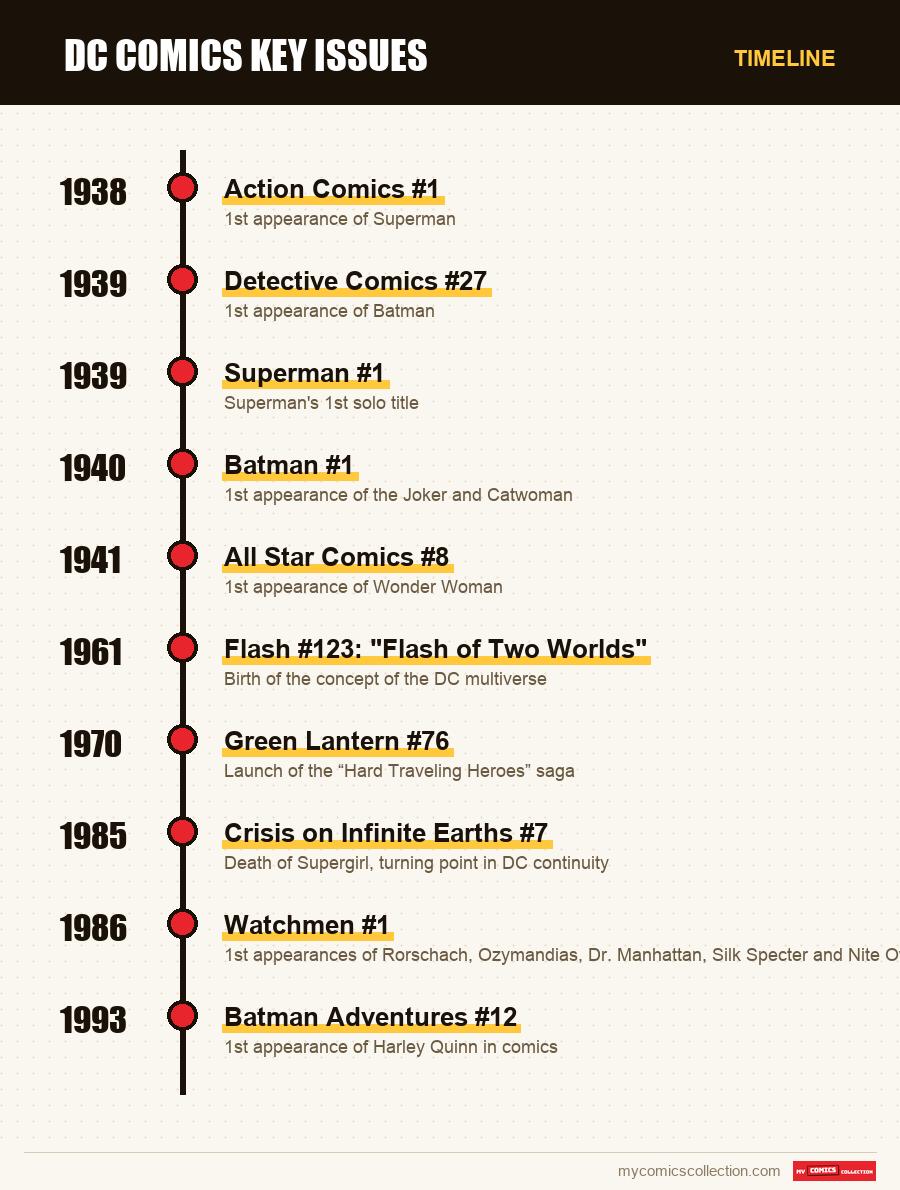
DC Comics was not born suddenly in 1938: the company found its origins in National Allied Publications, founded in 1934 by Malcolm Wheeler-Nicholson, before merging with Detective Comics Inc. - whose name gave the abbreviation "DC" which became lastingly established from the 1940s. It was this house which published, in June 1938, Action Comics #1 and unknowingly launched the whole superhero genre. The following year, in May 1939, Detective Comics #27 introduced Batman, giving the publisher its two mainstays for the next eight decades. Each major DC editorial period subsequently generated its own wave of key issues. The Golden Age (late 1930s: late 1940s) saw the birth of Superman, Batman, Wonder Woman, The Flash and Green Lantern in their original versions. The Silver Age, symbolically opened by Showcase #4 in 1956 at DC, reintroduced characters under a modernized identity: it was in this context that Flash #123 popularized the concept of the multiverse in 1961. The Bronze Age, from 1970, brought a more adult and social writing, embodied by the O'Neil/Adams tandem on Green Lantern. Finally, the Modern Age, from the mid-1980s, redefined DC continuity via pivotal events like Crisis on Infinite Earths, while allowing the emergence, via the animated series of the 1990s, of characters who have become icons like Harley Quinn. This editorial continuity over nearly 90 years explains why the market for key DC issues is so stratified: a surviving Golden Age copy is mechanically rare because the newsprint of the period is deteriorating and because the comics were designed as disposable publications, while a Modern Age issue benefits from a massive circulation and better conservation, which limits its value despite its narrative importance.
Action Comics #1
The booklet that literally created the superhero genre. Sold for 10 cents when it was released, it was long considered disposable: hence its extreme rarity today: specialists estimate that there are only around a hundred known examples left, of which only 78 are listed in the CGC census and 44 in Universal grade (without restoration). A VF+ 8.5 graded copy sold for $6 million at Heritage Auctions in April 2024. Most recently, a CGC 9.0 graded copy sold at a private sale for $15 million, becoming the most expensive pop-culture collectible ever traded.
Superman #1
Barely a year after Action Comics #1, DC launches the first magazine dedicated entirely to Superman, with a new original cover and previously unpublished stories in addition to reprints. A copy found in a northern California attic by three brothers while sorting through their deceased mother's house was authenticated CGC 9.0: the highest grade ever recorded for this issue. It sold for $9,120,000 at Heritage Auctions on November 20, 2025, an all-time record at the time of the sale, before being surpassed a few months later by the private sale of Action Comics #1.
Detective Comics #27
“The Case of the Chemical Syndicate” introduces a powerless masked vigilante, radically different from Superman: a formula that would become DC's trademark. Only 77 examples appear in the CGC census, and barely a handful exceed grade 7.0. A CGC 7.0 copy set a new record by selling for $2,318,000 at Heritage Auctions, surpassing the previous best sale for the same copy ($1.74 million at Goldin Auctions in 2022). The title had crossed the symbolic milestone of a million dollars in 2010, with a CGC 8.0 copy selling for $1,075,500.
Batman #1
Less than a year after his debut in Detective Comics #27, Batman obtained his own title, and immediately inherited his two most enduring adversaries: the Joker and "the Cat" (future Catwoman). The CGC has certified more than 270 examples, but more than half (around 148) feature restoration or are incomplete, making healthy, well-preserved copies particularly sought after. The CGC 9.4 copy, the only one at this grade and not exceeded in the census, sold for $2,220,000 at Heritage Auctions in January 2021.
All Star Comics #8
It is here, and not in her own title, that Wonder Woman officially makes her debut, at the end of the issue, before receiving her own magazine a few months later. A CGC 9.4 copy set a record for this title by selling for $1,620,000 in June 2022. The character later got his solo title, Wonder Woman #1 (summer 1942), whose highest copy ever sold publicly-a CGC 9.0 copy-reached $291,100 in 2016; an unrestored Grade 8.0 example was valued at $120,000 in 2020, and a Grade 5.0 sold for $43,650 in 2017.
Flash #123: "Flash of Two Worlds"
This issue brings together Barry Allen, the Flash from the Silver Age era, and Jay Garrick, his predecessor from the Golden Age: inventing in the process the notion of Earth-Two and, more broadly, the very principle of the multiverse which still structures DC continuity today. A CGC 9.4 copy from the Western Penn pedigree sold for $23,000 in June 2004, a record for the title; most recently, an unretouched example of the same grade was valued at $18,000 in May 2019, illustrating the stability of demand for high Silver Age grades.
Green Lantern #76
DC entrusts Green Lantern to the O'Neil/Adams duo, who associate him with Green Arrow for a series of 14 stories tackling racism, poverty and corruption head-on: an editorial shift so significant that it is considered by some historians as the symbolic starting point of the Bronze Age at DC. The title also appears in 13th position in the Overstreet ranking of the 25 best Bronze Age comics. Copies graded CGC 9.0 and above regularly exceed $1,000, and a CGC 9.6 copy has traded for nearly $7,000.
Crisis on Infinite Earths #7
This issue contains one of the most discussed moments in DC's editorial history: the death of Supergirl at the hands of the Anti-Monitor, drawn by George Pérez from a script by Marv Wolfman, as part of the crossover that redefined the entire DC continuity. Unlike the Golden Age issues, the circulation of this event was massive and widely distributed on newsstands, so that even the high grades remain accessible: according to market tracking data, a CGC 9.8 copy trades on average around $100, with more than 200 sales recorded since 2003 and a positive cumulative return over the long term: proof that narrative importance and material rarity are two distinct things.
Batman Adventures #12
Harley Quinn was first created for the animated series Batman: The Animated Series before making the jump to print in this spinoff issue of the series. Long underestimated by traditional price guides, the title experienced a spectacular surge in its value at the time of the release of the film Suicide Squad in 2016, during which time CGC 9.8 copies sold for around $2,000. More recently, CGC 9.8 sales have stabilized around $1,700, while mid-grades like 7.0 trade around $600.
Watchmen #1
Published under the DC label, this 12-issue maxi-series has permanently transformed the perception of the comic book as an adult literary form, to the point of being the only graphic novel included in Time magazine's list of the 100 best English-language novels. The massive print run at the time limits the rarity: more than 630 copies of number 1 are listed in CGC grade 9.8, the maximum reached to date. Recent sales of CGC 9.8 copies have ranged between $420 and $630, a sign of stable rather than explosive demand for this cult title.
Collecting this series?
Track what you own, what you are missing and what your collection is worth. 7 day trial.
Start my trial →The impact of adaptations on the rating of DC characters
The DC key numbers market reacts very directly to film and television news, with a lag of a few weeks to a few months between the announcement of a project and the peak of searches on the marketplaces. The most documented case remains that of Harley Quinn: her rating on Batman Adventures #12 had remained relatively stable for more than twenty years, until the announcement and then release of the film Suicide Squad in 2016, driven by the interpretation of Margot Robbie, which caused the high ratings to climb to their historic highs. The phenomenon has been reproduced, to a lesser extent, with each new appearance of the character in the cinema: Birds of Prey in 2020, then The Suicide Squad in 2021. On the founding characters, the effect is more diffuse but just as real. Successive Batman film releases: the Tim Burton/Joel Schumacher trilogy between 1989 and 1997, Christopher Nolan's The Dark Knight trilogy between 2005 and 2012, then Matt Reeves' The Batman in 2022: have each maintained a steady demand for Detective Comics #27 and Batman #1, without causing the same spectacular spikes as for a supporting character like Harley Quinn, precisely because the base of potential buyers for these Golden Age trophies is already international and captive. Wonder Woman saw a sharp boost in searches and sales around the time of the release of the 2017 film starring Gal Gadot, directly benefiting All Star Comics #8 and Wonder Woman #1. The Flash, brought to theaters in 2023, generated one-off interest in Flash #123 as the birth certificate of the DC multiverse, a concept central to the film's storyline. Television series play a comparable role: the transition of Crisis on Infinite Earths to mega-television crossover status at The CW between 2019 and 2020 brought the original 1985 comic book back into the spotlight, while the Watchmen series broadcast by HBO in 2019, an alternative sequel to the 1986 comic, maintained an active buyer base in the high ranks of number 1 despite its abundant circulation. These cycles of media attention almost never affect the material scarcity of an issue: they only modify, temporarily, the intensity of demand over a supply that remains fixed.
DC Key Numbers Buying Guide
- Systematically check the CGC census before bidding: for Golden Age issues like Action Comics #1 or Detective Comics #27, the number of copies listed at a given grade radically changes the value of a piece; the same nominal grade can be worth very differently depending on whether it is the only known example or one of several dozen.
- Beware of Undeclared Restoration on Pre-War Titles: on Batman #1, more than half of the copies certified by CGC present a restoration or are incomplete: a figure which reminds us that the difference in value between a "Universal" copy (without restoration) and a restored copy can be considerable, even with an identical displayed grade.
- Distinguish the real first appearance from the first solo title: Wonder Woman first appears in All Star Comics #8 before getting her own magazine: a key nuance that explains why the two issues have different price trajectories despite a direct narrative connection.
- Don't confuse cultural importance with rarity: Crisis on Infinite Earths #7 marks a major plot turning point but remains accessible in high grades, because the circulation at the time (mid-1980s) was much higher than that of Golden Age comics; Conversely, a more confidential Bronze Age issue like Green Lantern #76 may be worth more in high grade than a Modern Age blockbuster with a massive circulation.
- Always compare CGC grade 9.8 and grade 9.6 before purchasing: on Modern Age titles printed in mass, the price difference between these two grades can represent several times the base amount, while the visual difference is sometimes minimal; our guide to the difference between a CGC 9.0 and a CGC 9.8 details the precise criteria which separate these levels.
- Favor copies with white pages over old titles: the quality of the paper directly influences the subgrade and therefore the final value, particularly on publications before the 1970s whose newsprint yellows quickly.
- Set a budget by rarity level rather than by character: a beginner can aim for accessible Bronze or Modern Age numbers (a few dozen to a few hundred dollars) before considering a five or six-figure Golden Age, keeping in mind that the resale of an ultra-rare trophy often requires going through a specialized auction house rather than through a general channel.
- Cross-reference several recent sales, not just one: an isolated record sale (like the $15 million for Action Comics #1) does not reflect the current market for lower grades of the same title; favor an average of several recent transactions at the grade that really interests you.