DC Comics is the oldest American superhero publisher. With over 85 years of history and iconic characters like Batman, Superman, and Wonder Woman, collecting DC is both a passion and an investment. But the DC universe is vast and its numbering complex, New 52, Rebirth, Infinite Frontier, so many reboots that blur the reference points for both beginner and veteran collectors.
DC Comics is the oldest American superhero publisher. With over 85 years of history and iconic characters like Batman, Superman, and Wonder Woman, collecting DC is both a passion and an investment. But the DC universe is vast and its numbering complex, New 52, Rebirth, Infinite Frontier, so many reboots that blur the reference points for both beginner and veteran collectors. This guide helps you navigate it all, identify the essential series and key issues, and organize your DC collection intelligently.
The major DC series to collect
DC Comics has published some of the longest and most important series in the history of American comic books. Here are the pillars of any serious DC collection:
- Detective Comics (since 1937), The longest-running comic book series in history, still ongoing. Issue #27 (1939) contains the first appearance of Batman and is one of the most sought-after comics in the world.
- Action Comics (since 1938), The birthplace of Superman. Issue #1 is the most expensive comic ever sold, with a value exceeding 3 million dollars for high-quality copies.
- Batman (since 1940), The Dark Knight's solo series, which has featured the greatest writers and artists in the industry.
- Superman (since 1939), The iconic Man of Steel series, running parallel to Action Comics.
- Wonder Woman (since 1942), The first superheroine to have her own series, a cultural symbol as much as a pillar of the DC catalog.
- Green Lantern : From Hal Jordan to John Stewart, a series rich in galactic lore and key issues.
- Justice League of America / Justice League : The quintessential DC team series, essential to the publisher's history.
- The Flash : A pioneering Silver Age series, with key issues among the most important in comics history.
The record to remember: Action Comics #1 (1938) is the most expensive comic ever sold: a copy in CGC 9.0 reached $3.25 million in 2021. Even a copy in CGC 1.5 is worth several hundred thousand euros.
Essential DC key issues
Collecting DC without knowing its key issues is like navigating blind. Here are the issues that define the publisher's history and that every serious collector should have on their wishlist:
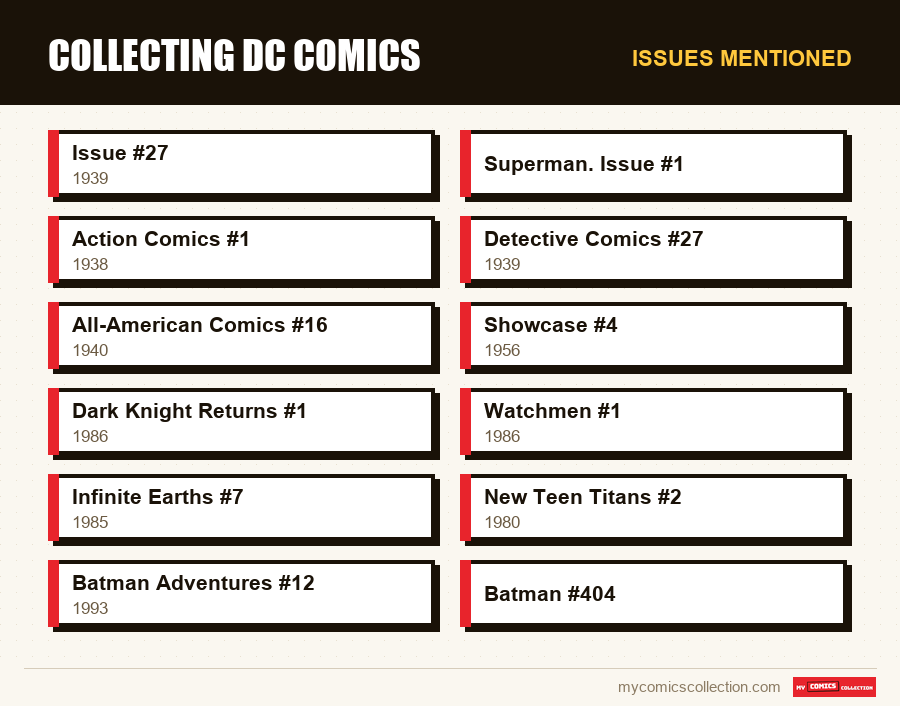
- Action Comics #1 (1938), First appearance of Superman. The Holy Grail of comic book collecting. Value: several million dollars.
- Detective Comics #27 (1939), First appearance of Batman. One of the most valuable comics in the world, out of reach for most collectors, but essential to know about.
- All-American Comics #16 (1940), First appearance of Green Lantern (Golden Age, Alan Scott). A major Golden Age key issue.
- Showcase #4 (1956), First appearance of the Flash (Barry Allen) Silver Age version. This issue officially marks the beginning of the Silver Age of comics.
- The Dark Knight Returns #1 (1986, Frank Miller), An aging Batman returns from retirement. A narrative revolution that redefined the character forever.
- Watchmen #1 (1986, Alan Moore & Dave Gibbons), The absolute masterpiece of American comics. Published by DC, this mini-series forever changed the way superhero stories are told.
- Crisis on Infinite Earths #7 (1985), The death of Supergirl. One of the most significant moments in DC history.
- Batman: The Killing Joke (1988, Alan Moore & Brian Bolland), A one-shot that explores the Joker's origin and redefines the Batman/Joker relationship.
- New Teen Titans #2 (1980), First appearance of Deathstroke (Slade Wilson), now an omnipresent character in the DC universe.
- Batman Adventures #12 (1993), First appearance of Harley Quinn in comics, born from the Batman animated series. A perfect example of a key issue created by pop culture.
The surprise key issue: Batman Adventures #12 is now worth between 300 and 800 euros depending on condition, a perfect example of how a "simple tie-in" issue becomes a major key issue thanks to media adaptations. Absolutely worth checking if you have DC comics from the 90s.
The complexity of DC reboots: New 52, Rebirth, Infinite Frontier
One of the great difficulties of collecting DC is the proliferation of reboots and continuities. Unlike Marvel, DC has carried out several complete universe resets, which considerably complicates tracking series and issues.
- Crisis on Infinite Earths (1985-86) : The first major reboot. DC simplified its parallel universes into a single Earth. Major characters die (Supergirl, Flash). It's the founding act of modern DC continuity.
- Zero Hour (1994) : An additional simplification attempt after Crisis. Mixed results, but several important key issues came from it.
- Flashpoint / New 52 (2011) : Total reboot of the DC universe. All series restart at #1 with a new continuity. Batman, Superman, Wonder Woman... everything starts over. A shock for collectors and a challenge for numbering.
- DC Rebirth (2016) : Return to origins. DC attempts to reconcile the old continuity (pre-New 52) with the changes introduced in 2011. Series restart at #1 (or resume their historical numbering for some).
- Infinite Frontier (2021) : The new DC continuity, which integrates the multiverse as a central element of the narrative.
Advice for collectors: Always specify the era or volume of the series you're looking for, Batman New 52 , Batman Rebirth , Detective Comics Vol. 1... My Comics Collection lets you clearly distinguish volumes and eras for each DC series.
Collecting this series?
Track what you own, what you are missing and what your collection is worth. 7 day trial.
Start my trial →How to organize your DC collection
Given the complexity of the DC universe, multiple characters, successive reboots, parallel series, it's essential to have a clear organizational method. Here is the recommended process:
Choose a character or an era
Start by defining the scope of your collection: a character (Batman, Superman...), an era (Golden Age, Silver Age, Bronze Age, Modern Age, New 52, Rebirth), or a creator (Frank Miller, Grant Morrison, Alan Moore, Geoff Johns). Don't try to collect everything at once, DC is too vast.
Import your series into My Comics Collection
Import your DC series from the app's catalog. Each volume is clearly distinguished (Batman Vol. 1, Batman New 52, Batman Rebirth...), which prevents any confusion between the different continuities. Import takes just seconds per series.
Identify the iconic runs to complete first
Focus first on recognized runs: Frank Miller on Batman, Alan Moore on Swamp Thing, Grant Morrison on JLA, Geoff Johns on Green Lantern. These runs are self-contained and have proven artistic and collecting value.
Organize by character then by publication chronology
Physically, store your DC comics by main character, then in chronological order of publication within each character. This organization will allow you to find any issue quickly and visualize the progress of each run.
Appraise and identify key issues in your collection
Once your inventory is complete, review your issues in light of DC key issues. You may own a Batman Adventures #12 or a Showcase #4 without knowing its value. My Comics Collection helps you identify and appraise these hidden treasures.
Must-collect cult DC runs
Beyond the series and key issues, certain creator runs have become absolute references in DC comics history. Here are the essentials:
- Batman #404-407, Batman Year One (1987, Frank Miller & David Mazzucchelli), Batman's origin reworked by Frank Miller. Essential and accessible: only 4 issues, but a foundational run.
- Batman: The Long Halloween (1996-97, Jeph Loeb & Tim Sale), 13 issues that tell the hunt for a serial killer over a year. A perfect run, often compared to the best crime novels.
- Grant Morrison's JLA (1997-2000), Morrison reinvents the Justice League as grand cosmic spectacle. One of the most ambitious runs in DC history.
- Geoff Johns' Green Lantern & Blackest Night (2004-2010), The resurrection of Hal Jordan and the Blackest Night event, which redefined the DC cosmos.
- Scott Snyder's Batman New 52, Court of Owls (2011-2013), The best Batman run of the modern era, with a masterful introduction of a new threat to Gotham.
- Alan Moore's Swamp Thing (1984-1987), Moore revolutionizes the character and invents a new type of storytelling for DC. A founding run for the Vertigo imprint.
- Neil Gaiman's Sandman (1989-1996, Vertigo/DC), 75 issues of mythology, poetry, and fantasy. The most literary work ever published by DC. A collection unto itself.
FAQ, DC Comics Collection
Organize your DC collection intelligently
My Comics Collection helps you track your DC series issue by issue, identify key issues in your collection, and never buy a duplicate again.
Free 7-day trial, No commitment