It is its author's biggest commercial success and the cheapest collectible series of his work. As of August 29, 2026, it displays $10.00 gross median out of 134 advertisements, with numbers at 1,87 $. The considerable print runs of the 1980s explain everything: what sold best at the time is what costs the least today. Only one number escapes the rule, that of a first appearance:$327.22 certified median.
The series deserves better than its status as a dated commercial success, and its price makes it especially easy to check out for yourself.
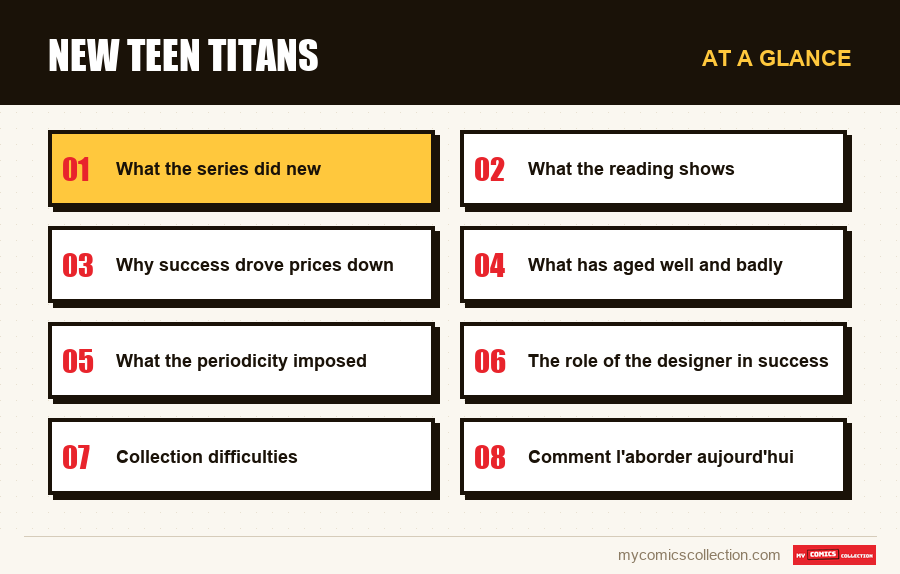
This article outlines what's new in the series, what the reading shows, where the value is concentrated, and how to approach it today.
What the series did new
Four things which were not practiced in the group story at that time, and which explain its success.
A truly differentiated distribution. Each member has their own voice, personal problem and rhythm. The group is not a collection of powers but a collection of people who don't tolerate each other at times.
Consistent continuity. Decisions are made over dozens of issues, relationships evolve, and nothing is put back in place in the next episode.
Lives outside of costume. A significant portion of the pages take place without action, in ordinary conversations and situations. It was unusual and that’s what kept the audience loyal.
Constructed antagonists. Recurring adversaries have their own motivations and codes, and some come back enough to become characters in their own right.
These four traits have since become the norm. This is the fate of influential series: what they introduced seems banal because everyone took it up, and it takes an effort to measure the gap with what was done before.
What the reading shows
The body of the series
In gross terms, the range noted goes from $1.87 to $450.00 on 134 ads, for a median of 10,00 $. Côté certifié, on compte 30 annonces and a median of $199.95.
Mid-series issues at $2.49 are common.
First appearance number
Brut : médiane 31,64 $out of 80 ads. Certified: 53 annonces, $87.99 to $1,999.99, median 327,22 $.
This is the only reference in the series to stand out.
Une recherche bruitée
The query on this number also goes back to the homonymous series and subsequent relaunches. The raw median must be read with this reservation.
Comparaison interne
The horror series by the same author displays 15,99 $of raw median: more expensive, although it is much less known.
Method: statement from August 29, 2026 on fixed price advertisements, with a separate count depending on whether the copy is raw or under shell. The amounts quoted are those hoped for by the sellers and nothing else.
Why success drove prices down
The mechanism is simple and it applies to all the production of this decade.
The draw follows the demand. A series that sells well is printed in increasing quantities, and these quantities remain in circulation indefinitely.
La conservation commence. This is the time when buyers start protecting their numbers. There are therefore numerous copies in good condition, which prohibits any state premium on current issues.
Demand does not follow the same curve. The public of the time has aged, and renewal is done through collections rather than original issues.
The result is what we see everywhere: the notoriety of a series does not increase its ordinary numbers, it increases its identified references. Thirty certified ads at $199.95 confirm this for this series.
A method reservation on the key number. The research that isolates it also goes back to series with similar titles and subsequent relaunches, which inflates the number of announcements and pulls the raw median downward.
The certified side is more reliable: the examples are described precisely and the homonyms are little involved. This is why the $327.22 certified median is a better indication than the $31.64 raw median on this reference.
What has aged well and badly
You have to be precise, because the series is judged as a whole in both directions.
Has aged well: the construction of the characters. The relationships, the grudges and the developments hold up perfectly, and this is what remains effortlessly readable forty years later.
Has aged well: the density. These issues contain a lot (text, scenes, characters) compared to the current production. An issue can be read in a surprising amount of time.
Has aged poorly: the pathos. Certain interior monologues and certain crisis scenes are heavy, in a period convention which requires tolerance.
Has aged poorly: the treatment of certain characters. Female figures and secondary characters are written according to conventions that the series itself contradicts elsewhere, which produces notable inequalities.
These reservations are real and they do not cancel out the rest. A forty-year series can be read while accepting its conventions, as one does with any work of its time: the alternative being not to read anything old.
What the periodicity imposed
A production constraint explains part of what we read, and it is worth exposing.
A successful monthly series must appear every month, without exception, with a team that cannot double its pace. This imposes choices that no author would make freely.
The first is the use of link numbers: episodes that do not advance the main plot and serve to keep the date. They exist here and are easy to spot: autonomous subplot, lack of consequence, return to the previous situation.
The second is arch stretching. A story planned for three issues can take up five if the next one is not ready, which produces passages where we go in circles.
A reader today, who reads in bound volumes, endures these passages without knowing the cause and concludes that his writing is weak. This is an industrial constraint, not a design flaw, and knowing it changes the way you go through these numbers.
Collecting this series?
Track what you own, what you are missing and what your collection is worth. 7 day trial.
Start my trial →The role of the designer in success
It would be unfair to attribute this success to writing alone, and the sharing is worth asking.
The designer of the founding period works with a density of detail and a number of boxes per page well above the average of his time. The crowds are really drawn, the settings stand upright, and the characters remain identifiable in small scale.
This graphic generosity is what makes a large cast credible. An economical design would have required the screenwriter to reduce the group or alternate attendance; here, everyone can be in the same box.
It also explains the density noted above. A page that contains eight panels tells more than a page that contains four, and the reading pace suffers: these issues are read more slowly than their pagination would suggest.
For a buyer, this has a direct consequence: the format matters more than other series. Such dense plates suffer from reduced reproduction, and an edition respecting the original format reads significantly more comfortably than a compact volume, where faces and backgrounds become difficult to distinguish.
Collection difficulties
Des titres voisins
Several series with similar names coexist, including later revivals. The title alone is not enough to identify.
A very long series
Dozens of issues, plus annuals and spin-off series. Completeness requires real follow-up.
Deux circuits de vente
The period distinguished several distribution circuits, with mentions sometimes made on the cover.
Une offre pléthorique
Abundance makes sorting take longer than searching, and full batches are common.
Comment l'aborder aujourd'hui
Three recommendations that arise directly from the prices recorded.
Buy a batch from the beginning of the series. At $1.87 and $2.49 an issue, thirty or so consecutive issues cost less than a single certified copy of the key issue, and they give the series as it worked.
Lisez dans l'ordre. It's a series with significant continuity, and reading it out of order removes the main interest. This is one of the few series in this campaign where order really matters.
Only buy the key number if you want it for its own sake. It adds nothing to the reading and its price is part of a collection logic unrelated to the rest.
This approach provides access, for a few dozen dollars, to what remains one of the most constructed group stories of its decade. This is the best report of this whole file provided that you accept the conventions of the time.
Ce qu'il faut enregistrer
On a long series with strong continuity and similar titles, the sheet must ensure two things.
The exact series and number, never the title alone. Several series with similar names coexist, including later revivals with their own numbering. A sheet built on the title mixes sets that have neither the same creative team nor the same continuity.
This is the condition for knowing what is really missing, a question that quickly arises in a series of this length.
The last number read, distinct from the last number owned. On a series with significant continuity purchased in batches, you almost always have more than you read, and picking up at the right place after an interruption is what decides whether you continue.
These two fields deal with the problem of a series that is acquired quickly and read slowly, a configuration produced by low prices and rarely anticipated.
Questions fréquentes
Because circulation follows demand: a series that sells well is printed in increasing quantities which remain in circulation. Added to this is the beginning of conservation practices, which makes beautiful examples numerous. Notoriety does not increase ordinary numbers, it increases identified references.
The certified median of $327.22 from 53 listings, more reliable than the $31.64 raw median. The research which isolates this reference also goes back to series with neighboring titles and subsequent reminders, which inflates the gross count and pulls its median downward.
The pathos of certain interior monologues, based on a period convention, and the treatment of several female figures and secondary characters, written according to conventions that the series nevertheless contradicts elsewhere. These reservations are real and do not cancel out the construction of the characters, which holds up perfectly.
Yes, and it's one of the rare series in this file where order really matters: the continuity is consistent, decisions are made over dozens of issues and nothing is put back in place in the next episode. Reading it out of order removes the main interest.
From a batch from the beginning of the series. At $1.87 and $2.49 an issue, thirty or so consecutive issues cost less than a single certified copy of the key issue, and they give the series as it worked at the time.
How far have you read, how far have you bought?
On a series that we acquire in batches and read slowly, it is never the same number.