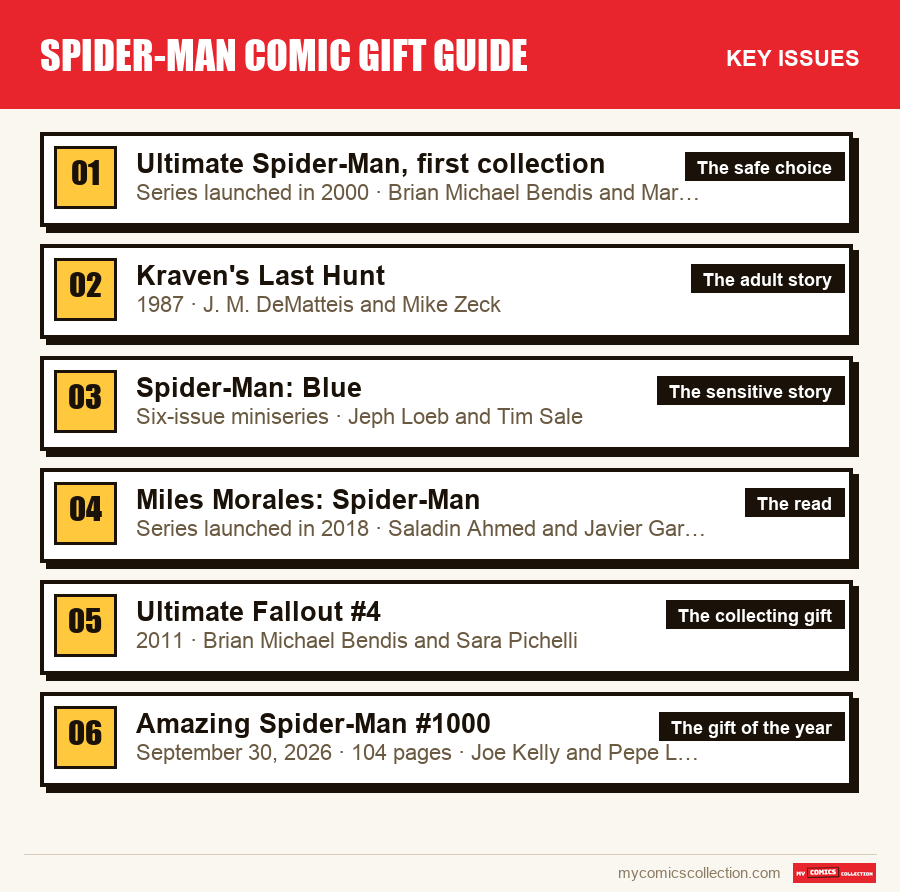
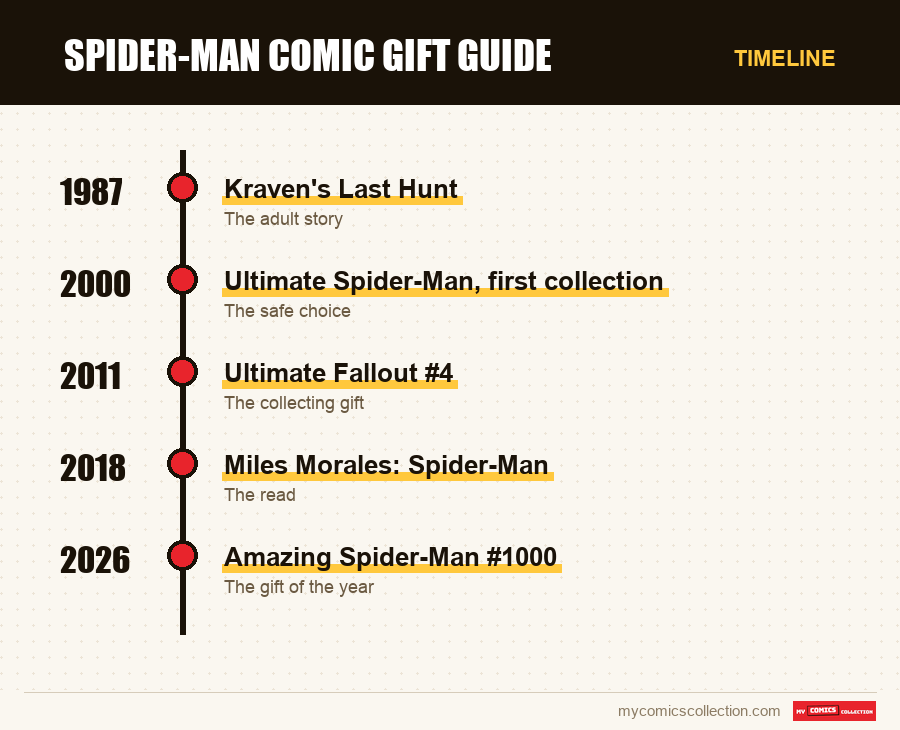
The right Spider-Man comic to give depends on the person, not on the character. For a movie viewer who has never read comics, give the first Ultimate Spider-Man collection by Brian Michael Bendis and Mark Bagley (2000), which retells the origin for a new reader. For an adult who wants a complete story, Kraven's Last Hunt (1987) or Spider-Man: Blue by Jeph Loeb and Tim Sale. For a Miles Morales fan, the Miles Morales: Spider-Man series by Saladin Ahmed (2018), or for a collector Ultimate Fallout #4 (2011), his first appearance. For a collector, Amazing Spider-Man #1000, out on September 30, 2026, a 104-page anniversary issue. General rule: a collected edition for someone who reads, a single issue for someone who collects, never the reverse.
Giving a Spider-Man comic seems easy: the character is everywhere, the shelves are full, and any volume bearing the red mask seems to do the job. That is precisely why the gift so often misses. A collected edition chosen for its cover lands in the middle of an ongoing plot, assumes twenty years of continuity, or is aimed at a reader who does not have the age or tastes of the person receiving it. The Spider-Man fan does not exist: there are fans, with very different entry points into the character.
This article does not propose a reading order, which our Spider-Man reading guide provides. It starts from the person you are giving to, and proposes for each profile a precise answer, a suitable format, and a mistake to avoid. We are in early October 2026, when the character's news is dominated by number 1000 of Amazing Spider-Man, which offers one more option to year-end shoppers.
Before choosing: two questions to ask yourself
The first question is simple: does the person read comics, or watch movies? A loyal viewer of the film saga knows the character, his loved ones, his big villains, but does not know the mechanics of a monthly series, nor volume numbering, nor storytelling conventions. They need a book that reads from start to finish. A comics reader, for their part, already has their habits, and the risk is not losing them but giving them what they already have.
The second question is about use: does the person want to read, or to keep? A collected edition is read, lent, gets a little worn. A collectible issue goes in a sleeve and never leaves its board. Giving a certified issue to someone who only wants to read is giving an object they will never open. Giving a collected edition to a collector of first editions is giving a book they may already own in another form.
These two questions are enough to place almost everyone in one of the profiles below.
Profile 1: the movie viewer
This is the most frequent case, and the one where the margin of error is greatest. The viewer likes the character, but does not know where to enter, and has little patience for a plot that starts in the middle.
Ultimate Spider-Man, first collection
The series was designed for a reader who knows nothing: it retells Peter Parker's origin in high school, with modern-paced dialogue and a continuity restarted from zero. The first collection tells of the bite, Uncle Ben's death and the hero's beginnings.
The alternative, for a younger viewer or one more drawn to current events, is the Ultimate Spider-Man series launched in 2024 by Jonathan Hickman and Marco Checchetto, which presents an adult Peter Parker, married and a father, in a universe where he only became Spider-Man late. It is an excellent gift for an adult who grew up with the movies and aged along with the character.
The mistake to avoid: giving the latest ongoing Amazing Spider-Man collection. It assumes years of reading and begins in the middle of a plot.
Profile 2: the adult who wants a complete story
Some people do not want to start a series. They want a book, with a beginning and an end, that they will read in one evening. For them, the best gift is a self-contained, acclaimed story that stands on its own.
Kraven's Last Hunt
Kraven the hunter buries Spider-Man and takes his place. A dark, psychological story, published in six parts spread across the three Spider-Man series of the time, and since collected in a single volume. It is one of the most esteemed stories of the character.
Spider-Man: Blue
Peter Parker, now an adult, remembers Gwen Stacy. A story of memory and grief, built around the character's early years, with Tim Sale's elegant art. It reads without knowing anything and touches even readers who are not looking for action.
The mistake to avoid: confusing "famous story" with "self-contained story." Some famous tales, like the death of Gwen Stacy, only carry their full weight for those who know the previous issues.
Profile 3: the Miles Morales fan
An important share of Spider-Man fans, often younger, entered the character through Miles Morales and the animated films devoted to him. For them, Peter Parker is not the center: it is Miles who matters. Giving them a classic collection means missing the mark.
Miles Morales: Spider-Man
A series centered on teenage Miles, his family, his neighborhood, his friends. It is accessible, fast-paced, and close to the spirit of the animated films. It is the best read for a young fan who wants to find the character as they discovered him.
Ultimate Fallout #4
The first appearance of Miles Morales. For a fan who collects, it is the reference issue. It is not a read: it is an object, to be given protected.
For a fan of the wider spider universe, there is a variant: Spider-Gwen, whose first appearance is in Edge of Spider-Verse #2 (2014). The Miles Morales hub gathers the useful pages for going further.
The mistake to avoid: buying "a Spider-Man" without checking which one is on the cover. For this profile, the difference between Peter and Miles is not a detail.
Profile 4: the collector and Amazing Spider-Man #1000
For a collector, the end of 2026 has an obvious pick: Amazing Spider-Man #1000. The issue came out on September 30, 2026, after its initial September 16 date was pushed back because of printing. It has 104 pages. The main story, "Ravaged," is written by Joe Kelly and drawn by Pepe Larraz, and introduces a new villain, Ravage. It is accompanied by anniversary stories by prestigious teams, among them Dan Slott and Marcos Martin, Brian Michael Bendis and Stuart Immonen, J. M. DeMatteis and Humberto Ramos, as well as Frank Miller with Peach Momoko, and Larry Lieber with Giuseppe Camuncoli.
More than 400,000 copies were ordered, which makes it an abundant issue. It is a good gift, but not for a reason of scarcity: it is a celebration object, a round number that marks a date in the character's history. A second printing is planned for October 28, 2026, with penciled covers by Romita Jr. and Rivera, and by Larraz.
Amazing Spider-Man #1000
Anniversary issue with the main story "Ravaged," the first appearance of Ravage, and a series of short stories by major authors of the character, plus an interview with Tom Holland.
For a more seasoned collector, another option is to fill a gap. The most appreciated gift is not always the most visible one: it is the issue that completes a run. Discreetly asking for access to the person's list, or to their tracking app, beats guessing. The pages for historic issues, like Amazing Spider-Man #300, then let you verify what you are buying.
The mistake to avoid: presenting number 1000 as an investment. With such an order volume, it is nothing rare, and giving it as an investment creates an expectation it will not fulfill.
Profile 5: the child
For a child, the rule is different: you need a short, colorful story, without marked violence, and a sturdy format. The character's darkest stories, like Kraven's, are to be set aside. Series designed for a young audience, often published in suitable formats, work better than a collection from the main series. The simplest criterion is to flip through: if a page strikes you as too text-dense for the child's age, it is.
The recent animated series devoted to the character's early days has also brought young viewers closer to the original comics. Our article on Your Friendly Neighborhood Spider-Man versus the comics indicates which issues it adapts, which lets you give a child the stories they already know from the screen.
The format: collected edition, single issue or certified issue
The collected edition, for reading
A complete, bound story that reads in one go. It is the default format for a reading gift, in the original version or in the French edition when one exists.
The single issue, to mark a date
A single issue, like #1000, lends itself well to a symbolic gift. Give it in a sleeve with a rigid board, never loose.
The certified issue, for an informed collector
Reserved for someone who knows the market and knows what a grade means. For a beginner, a sealed case is an object they cannot read and whose value they cannot gauge.
Read also
- Amazing Spider-Man #1000: seven stories, seven teams, and what to reread from each
- Ravage: who is the new Spider-Man villain born in #1000
- ASM #1000 second printing: recognizing the October 28 penciled covers
- Amazing Spider-Man: volumes and legacy numbering, from the 1963 #1 to #1000
- From #100 to #900: what each Amazing Spider-Man centennial told