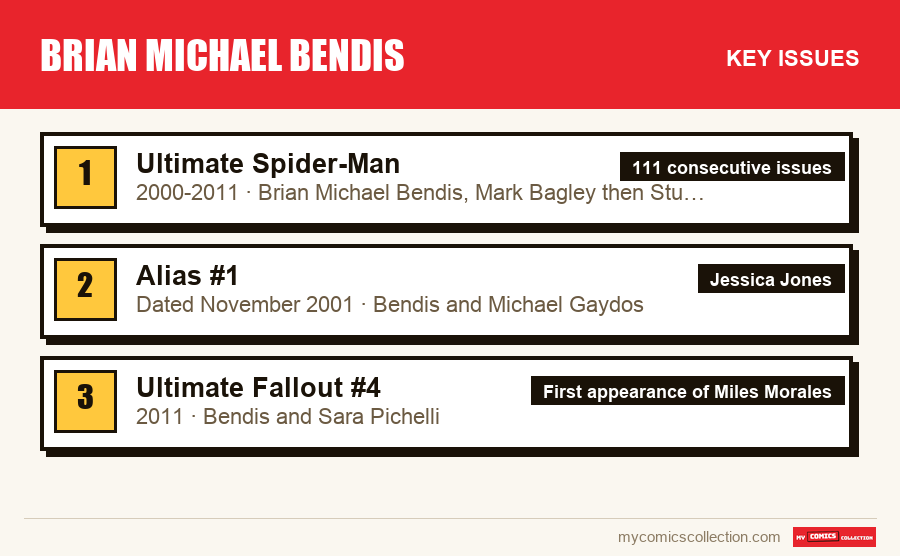
Brian Michael Bendis, born on August 18, 1967 in Cleveland, starts with black-and-white crime comics published almost at his own expense (Goldfish, Jinx, Torso) before launching Powers in 2000. That same year, Marvel entrusts him with Ultimate Spider-Man, which he writes from first issue to last, including 111 consecutive issues with Mark Bagley. He creates Jessica Jones in Alias (2001), holds down Daredevil with Alex Maleev, relaunches the Avengers and orchestrates House of M, Secret Invasion and Siege. In 2011, he creates Miles Morales with Sara Pichelli, then Riri Williams in 2016. In late 2017, he leaves for DC and debuts in Action Comics #1000. In 2026, he returns to his old ground twice: the story "The Gesture" with Stuart Immonen in Amazing Spider-Man #1000, and Jessica Jones: Alias #1, a five-issue miniseries with Michael Gaydos, scheduled for December.
Brian Michael Bendis is one of the few writers who shaped both the characters and the organization of an entire universe. During the 2000s, he wrote Marvel's most-read series, designed most of its big events, and created characters who are now at the heart of films, series and games. Then he left the house for its great competitor, before reappearing in 2026 on two of his creations.
His path has something improbable about it: a crime graphic novel author, long broke, who becomes in a few years the architect of the most powerful publisher in the field. This article follows him step by step, indicating for each stage what to read.
Cleveland, caricature and crime fiction
Bendis grows up in Cleveland, in a Jewish family, and attends a religious school whose teaching he partly rejects. At thirteen, he knows he wants to make comics. He admires George Pérez, both John Romitas, Jack Kirby, Klaus Janson and Frank Miller. Then he discovers the crime comics of Jim Steranko and José Muñoz, works his way back from there to the novels of Jim Thompson and Dashiell Hammett, and soaks up the visual rules of film noir.
In high school, he turns in a writing assignment that is a novelization of an X-Men story by Chris Claremont, and gets the top grade. At nineteen, he enters an art school in Cleveland while working in a comic shop. To make a living, he draws caricatures for the local press. He has described this period as almost a decade as a starving artist.
The independent years: Goldfish, Jinx, Torso, Powers
His first works appear at a small independent publisher, written and drawn by himself: Fire in 1993, A.K.A. Goldfish in 1994, then Jinx, from 1996, the story of a bounty hunter inspired by a Sergio Leone western transposed into crime fiction. There he meets friends and future collaborators, including Michael Avon Oeming, David Mack and Marc Andreyko.
In 1996-1997, he moves to Image, where his crime comics are reprinted and where he writes Sam and Twitch, a spin-off from the Spawn universe that he treats as a police procedural. In 1998, he co-writes and draws with Andreyko Torso, about Eliot Ness and a serial killer. In 2000, he publishes the autobiographical Fortune and Glory, and above all launches with Oeming Powers, a crime series in a world of superheroes, which receives many awards.
These years are essential to understanding what follows. Bendis forges his trademark there: overlapping dialogue, repetitions, silences, influenced more by David Mamet and Aaron Sorkin than by comics writers. It is this style that will shake up Marvel.
Ultimate Spider-Man: the launch of a universe
Ultimate Spider-Man
Spotted for Jinx, Bendis is hired to write the first title of a line aimed at a new generation of readers. He stretches the eleven-page origin of Amazing Fantasy #15 over seven issues, and the title often sells better than the main series. With Bagley, he does 111 consecutive issues, the longest collaboration of the same team at the publisher, ahead of Lee and Kirby on Fantastic Four.
Bendis writes every issue of the series, including its second incarnation, and several other titles of the line. It is this companionship with Peter Parker, in his teenage version, that explains his presence in the thousandth issue of the main series in 2026, alongside Immonen, his second artist on the title.
Alias and Daredevil: the street years
In 2001, he also takes on Daredevil, which he writes until 2006, about fifty issues, mostly with Alex Maleev. The run is one of the most admired on the character, with a secret identity revealed and a hero cornered. Our selection of Daredevil key issues places this period in the whole.
Alias #1
Still in 2001, Bendis inaugurates the publisher's adult imprint with Alias, the story of Jessica Jones, a former superheroine turned private detective. The series runs twenty-eight issues before the characters move into The Pulse.
The architect of the Avengers and the big events
From 2004, Bendis becomes the publisher's central writer. He dismantles the Avengers in "Avengers Disassembled," then relaunches them with New Avengers, a team that welcomes Spider-Man and Wolverine. He writes Secret War, then House of M in 2005 with Olivier Coipel, a crossover between Avengers and X-Men, and Secret Invasion in 2008. He follows with Dark Avengers, Siege in 2010, again with Coipel, and the 2010 Avengers relaunch with John Romita Jr.
Age of Ultron follows in 2013, then, as part of the general 2012 relaunch, All-New X-Men, where the original X-Men are transported to the present, with Stuart Immonen, and Uncanny X-Men. He also writes Guardians of the Galaxy. For almost fifteen years, he is the author whose decisions structure the whole of the publisher's universe.
In parallel, he keeps personal projects: Powers moves in 2004 to the imprint reserved for creator-owned work, where he also launches Scarlet with Maleev in 2010 and Brilliant with Bagley. He relaunches Spider-Woman in 2009, published both as an online animated version and as a single issue.
Miles Morales and Riri Williams
Ultimate Fallout #4
In 2011, after the death of the Ultimate universe's Peter Parker, Bendis and Sara Pichelli present a new Spider-Man: Miles Morales. It is arguably his most important creation, which became in a few years a full-fledged hero, in film as in comics.
In 2016, he also creates Riri Williams, a young inventor who takes up Iron Man's legacy under the name Ironheart. With Jessica Jones and Miles Morales, that makes three characters born under his pen who have had a screen adaptation.
DC, 2017: Superman
In November 2017, Bendis announces that he will now work exclusively for DC. His first story there appears in Action Comics #1000, with Jim Lee. He then writes the miniseries The Man of Steel, then the series Superman and Action Comics. He also publishes a line of personal creations at that publisher, and launches an animated series project around the Legion of Super-Heroes.
A curiosity: Bendis is the only writer present in all three true #1000 issues in superhero history. Action Comics #1000 in 2018, Detective Comics #1000 in 2019 with Maleev, and Amazing Spider-Man #1000 in 2026.
2026: the return to his creations
The year 2026 marks a visible return to the characters he brought to life or carried. In September, he signs "The Gesture" in Amazing Spider-Man #1000, with Immonen, echoing their shared period on Ultimate Spider-Man. In December, the publisher schedules Jessica Jones: Alias #1, first of five issues, with Michael Gaydos on art, for the character's twenty-fifth anniversary. It will be their third joint series devoted to Jessica Jones, after Alias and a 2016 to 2018 series.
We have no verified information beyond these two titles about his future projects. A New York convention takes place from October 8 to 11, 2026, and announcements are possible there, but nothing has been said there yet as these lines are written.
How to read Bendis
Ultimate Spider-Man
The natural entry point, accessible with no prior knowledge.
Alias and Daredevil
His two street-level series, the closest to his crime fiction origins.
New Avengers and the events
To understand how he organized the whole universe for a decade.
Miles Morales
The follow-up to Ultimate Spider-Man, and his most durable creation.
Bendis has received five Eisner Awards. He has taught graphic novel writing at university and published in 2014 a manual on the craft, Words for Pictures. He has also worked for television, notably on the adaptation of Powers, aired from 2015 to 2016.