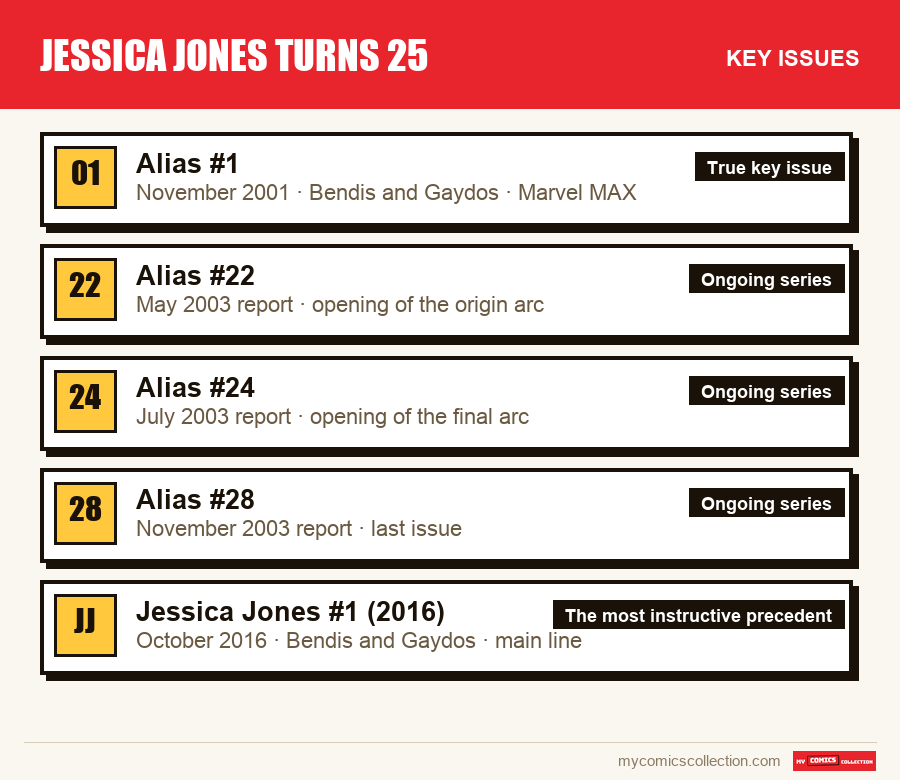
Jessica Jones turns 25 and Marvel schedules for December 2026 a five-issue miniseries, Jessica Jones: Alias #1, with the return of Brian Michael Bendis on script and Michael Gaydos on art. On the collecting side, only one issue truly deserves the word "key": Alias #1, dated November 2001, the character's first appearance and the first title published under Marvel's adult imprint, Marvel MAX. The North American store order report for November 2001 ranks it 37th with about 43,750 copies at $2.99. That is little. All the rest of her bibliography, including the issue #1s of her two other solo series, was ordered in larger quantity. The anniversary does not create scarcity: it shifts attention onto an already scarce object.
With Jessica Jones, the order figures of her various series draw a curve that runs counter to intuition: the issue that matters most is also the one printed in the smallest quantity, and the gap with what follows is not a nuance. It is documented, and verifiable on the public reports of the distributor of the time.
This article is written on October 2, 2026, before the December miniseries comes out: it contains no future price nor value for an issue that does not yet exist. What it does contain are print-run facts, a hierarchy of issues, and the distinction most "key issue" lists refuse to make, between a true market entry point and an ongoing-series issue sold as a milestone. The character's publishing trajectory is told elsewhere, in the file devoted to her history in comics. Here, we do not tell the story: we count the copies.
What December 2026 really puts on the table
Marvel's December 2026 schedule announces Jessica Jones: Alias #1, first of the five issues of a miniseries, written by Brian Michael Bendis and drawn by Michael Gaydos. It is precisely the duo that created the character and held the original series from start to finish. It is not a takeover by an heir team, nor a tribute entrusted to others: it is the same two signatures, on the same character, with the word Alias put back in the title.
It remains to measure what that changes. A new title, a first cover, and the attention of the specialist press for a few weeks. What it does not change: the quantity of 2001 Alias #1 that exists in the world. No editorial announcement reprints the past, and an anniversary acts on demand, never on the supply of an old issue.
Second point, often glossed over: this is not the first time Bendis and Gaydos have reunited on the character. In October 2016, Marvel already launched a monthly series titled Jessica Jones, written by Bendis and drawn by Gaydos, which lasted eighteen issues until May 2018. December 2026 is therefore their third collaboration on this heroine, not a return after a quarter century of silence. The consequence is direct: the demand linked to "Bendis and Gaydos reunite on Jessica Jones" was already tested in 2016, and the result in order volume is known.
Third point: five issues announced. A bounded format is not collected like an open series. It produces an issue #1 and a final issue, and nothing between them with the vocation of becoming a milestone, barring a narrative surprise.
Alias #1: the character's only true key issue
Jessica Jones's first appearance is Alias #1, dated November 2001, written by Brian Michael Bendis and drawn by Michael Gaydos. Three verifiable facts make it a thing apart, and none of the three is a matter of story.
First fact: it is the inaugural title of the Marvel MAX imprint. Marvel leaves the historic self-censorship code in 2001 and sets up its own classification. The imprint aimed at the adult readership starts with Alias, before Fury and U.S. War Machine. An imprint's first issue is a collecting category in itself, independent of the character: it documents a change in editorial policy. This gives Alias #1 two reasons to be hunted instead of one, and two audiences that do not completely overlap.
Second fact: the ordered volume is low. The report of orders placed by North American stores with the distributor of the time, for November 2001, ranks Alias #1 37th with an estimate of about 43,750 copies, cover price $2.99. The best-ordered title of the same report exceeds 168,000 copies: Alias #1 thus launches at about a quarter of the volume of its own month's headline issue.
Third fact: nothing foretold what followed. In November 2001, Jessica Jones has neither an audience nor an adaptation, and appears under an adults-only label that mechanically restricts her distribution. Stores ordered accordingly. Twenty-five years later, the character is one of the most identifiable of the Marvel 2000 generation: broad fame resting on an object printed in small quantity, exactly the configuration collectors look for.
Alias #1
The only issue in her whole bibliography that ticks both boxes the market really pays for: the first appearance of a lasting character, and a milestone in publishing history. The twenty-seven issues that follow have neither.
On a 2001 issue, the price gap between a common copy and a copy in superior condition makes up most of the equation, and the stapled spine of the format of the time ill withstands twenty-five years in a bin. Two readings avoid nearly all bad deals on this segment: what a print-run figure says and does not say, and how to tell a first printing from a reprint.
What the order figures say about the rest of Alias
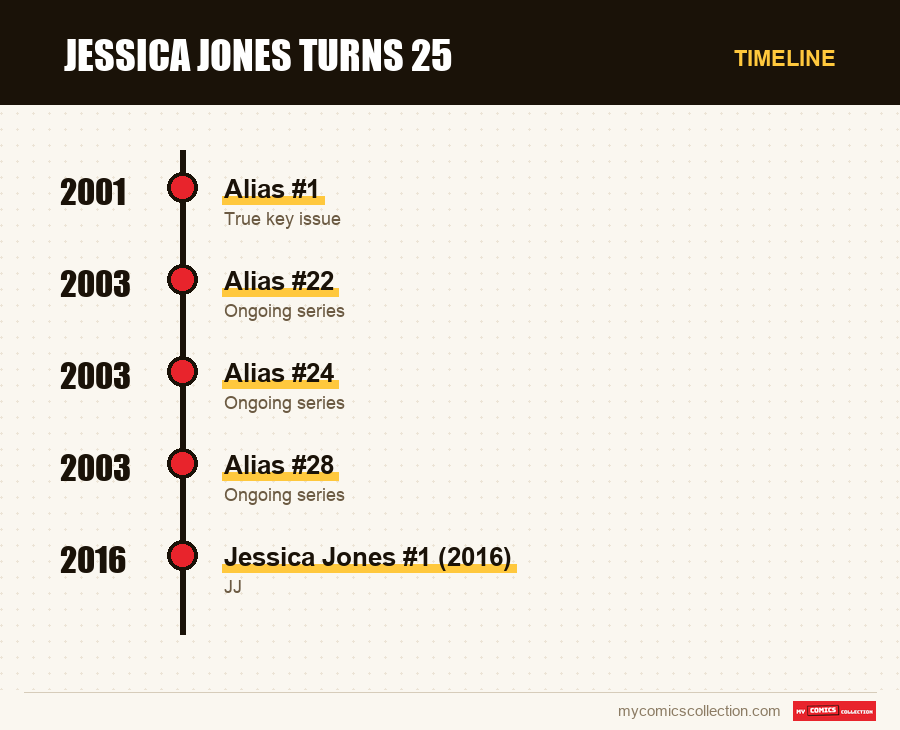
The series lasted twenty-eight issues. The public order reports let us follow four points of it, and the picture they form is instructive.
Alias #22
First of the two issues devoted to the character's origin, an arc that occupies issues 22 and 23. An important moment of the story, and the reason this issue is regularly sold as a milestone. It is not: an origin revelation told in flashback does not create a first appearance.
Alias #24
Start of the five-issue arc that closes the series by confronting Jessica with the Purple Man, from the 1960s Daredevil mythology. It is the series' most commented arc and the one the TV adaptation took up. That still does not make it a first appearance.
Alias #28
Final issue. The last issues attract a small completion premium, because they are missing more often from resold lots than the middle ones. It is a scarcity of use, not a scarcity of print run, and it is paid in euros, not in multiples.
What these three points establish matters more than each one taken alone: from 2003, the series plateaus around 27,500 to 28,000 copies ordered, with no drop-off. An established readership, small, loyal. Issues 2 to 28 therefore form a set homogeneous in scarcity, in which no issue stands out by its print run. Practical consequence: a complete run of Alias is bought as a lot, and the only tradeoff worth time concerns issue #1.
It remains to remember what these volumes measure. They are orders from North American stores to a distributor, not printer print runs nor sales to the final reader, and they exclude other channels as well as other countries. They give a reliable order of magnitude and relative hierarchy, not a count of surviving copies. For survivors in superior condition, the relevant tool is the census of certified copies, which we explain how to read elsewhere.
The false key issues you will be sold during the anniversary
An anniversary always wakes up approximate lists. Here are the three most likely confusions on this character, and why each does not hold up.
"Her real first appearance is in a 1963 comic." The character is indeed retroactively placed in continuity as an anonymous classmate in an Amazing Spider-Man issue of June 1963, at a time when she did not exist. It is a continuity insertion decided after 2001, not an appearance. This issue is already sought for other reasons, which makes the confusion convenient for a seller.
"The origin issue is worth more than issue #1." The argument seems logical and it is false. The market pays for first appearances because they are unique by definition. An origin, on the other hand, can be told, retold and contradicted as many times as the publisher wishes, and it has been.
"The arc adapted on screen became a key issue." An adaptation raises demand on what it makes recognizable, and that is first the character, so her issue #1. The arc's middle issues benefit from a side effect that quickly fades. The same mechanics produced the same misunderstandings on Daredevil's modern key issues.
The follow-ups: more abundant issue #1s, not scarcer ones
Jessica Jones had two other monthly solo series before the December 2026 one, and each produced an issue #1 that lists readily place next to Alias #1. The order volumes tell a different story.
The Pulse, fourteen issues from 2004 to 2006, moves the character from the adult imprint to the main Marvel line, in an investigative journalism setting. The February 2004 report ranks its issue #1 29th with about 51,116 copies ordered, some 17% more than Alias's issue #1. Issue #2 follows in March 2004 with about 45,479 copies, still above. The first two issues of her second solo series were therefore ordered in greater quantity than her first appearance.
The 2016 series, Jessica Jones, eighteen issues from October 2016 to May 2018 by Bendis and Gaydos, goes further. The October 2016 report ranks its issue #1 22nd with about 74,291 copies ordered, at $3.99: roughly 1.7 times the volume of Alias #1. It is the most important figure in this article after the 2001 one, because it documents what a return of the creator duo produces in orders. An issue #1 carried by attention is an abundant issue #1.
Jessica Jones #1 (2016)
The creator duo's return twelve years after the end of Alias, in the wake of the TV adaptation. Useful reading, well-ordered series, and the perfect example of what an anniversary or comeback issue #1 becomes: an object everybody owns. It is not a criticism of the series, it is a collecting datum.
Remain the appearances that count without being solo series. The wedding with Luke Cage is published in a New Avengers annual in 2006: it is the only non-solo-series issue one can legitimately call a milestone, because a civil-status event is not repeated. The birth of her daughter Danielle Cage occurs in the final arc of The Pulse, in issues 11 to 13. Finally, Jessica Jones is in the starting lineup of the second volume of New Avengers launched in 2010, with Luke Cage, Iron Fist, Mockingbird, Spider-Man, the Thing and Wolverine. A team integration is a career stage, not a market entry point: this issue remains an Avengers team issue #1 among many others.
The paradox to remember, figures in hand
Put end to end, her issue #1s rank as follows in order volume: Jessica Jones #1 of 2016 around 74,291 copies, The Pulse #1 of 2004 around 51,116, Alias #1 of 2001 around 43,750. The December 2026 one will have no public figure before its release. The desirability hierarchy on the secondhand market, for its part, is exactly the reverse: the more the character became known, the more her issue #1s were printed in quantity.
A consequence must be drawn that contradicts the anniversary reflex. The good news of December 2026, for anyone interested in this character, is not the December 2026 issue #1. It is that the miniseries puts Alias back into conversations, therefore into bins, therefore into the lots that readers will take off their shelves. The opportunity is on the side of supply that moves, not of novelty.
What the anniversary really does to demand
It is tempting to sum this up with a formula like "anniversaries raise prices." That would go too far, and we cannot quantify it here: no source consulted for this article publishes a dated price record for the last few weeks, and inventing a percentage would be exactly the flaw this site refuses. What can be described without inventing are mechanisms.
Demand concentrates, it does not spread
Attention goes first to the easiest object to name: the first appearance. The middle issues move little, even when they contain the passage everybody cites. An anniversary therefore widens the gap between Alias #1 and the rest of the series instead of narrowing it.
Supply wakes up with a lag
Individual sellers react after buyers. The first weeks of a publicized return therefore see fewer copies available, while dormant collections come out. A hurried collector buys in the least favorable phase of the cycle.
Certification comes in a wave
An anniversary triggers certification submissions. Copies in superior condition appear in numbers in the following months, which densifies the top of the census on this precise issue. Buying a certified copy just before such a wave is never the best moment.
The effect fades, the base remains
What remains is not the peak but the widening of the audience that knows the character. It is this base that explains why a small-print-run first appearance holds over time, and why an issue #1 ordered en masse does not.
How to approach December 2026 as a collector
Three decisions suffice, and none requires betting on a price.
On the December miniseries. Buy it to read it if the duo interests you, at cover price. An issue #1 of a miniseries bounded to five episodes, announced months in advance and carried by an anniversary, is the definition of a well-ordered issue. No calculation is needed, and that is restful.
On Alias #1. It is the only issue of the character on which an acquisition reflection makes sense. Two things to look at: the real condition, described and photographed on all four corners and the spine, and the exact nature of the copy offered. Collections and reissues of this title have been numerous for twenty-five years, and an identical cover does not guarantee a first printing. If you aim for a certified copy, our CGC grading guide indicates which grade level really changes something on an issue of this period.
On the complete series. The twenty-eight issues are homogeneous in scarcity: buying in a lot is almost always cheaper, and the classic mistake is to buy an incomplete lot without knowing it. Our issue-by-issue tracking and missing-issue detection tools solve the problem upstream. To place the value of what you already own, the free estimate gives an order of magnitude per reference.
One last remark. The most useful datum in this article is not the 43,750-copy figure, it is the fact that it is the lowest of the three and that the issue concerned is the most in demand of the three. A key-issue list that gives you no print-run volume gives you no way to check its hierarchy.