Your Friendly Neighborhood Spider-Man is a Marvel Studios animated series created by Jeff Trammell, whose first season of 10 episodes aired on Disney+ from January 29 to February 19, 2025. It tells the beginnings of a 15-year-old Peter Parker in an alternate reality where Norman Osborn, and not Tony Stark, becomes his mentor. Its visual style pays homage to the pages of Steve Ditko and John Romita, but its cast draws largely on much more recent Marvel characters: Nico Minoru (2003), Amadeus Cho (2006), Lonnie Lincoln, a.k.a. Tombstone (1988). Season 2 is expected in January 2027, a third is in development, and Marvel plans a comic Your Friendly Neighborhood Spider-Man #1 in December 2026, timed to this return.
Among the many animated adaptations of Spider-Man, this one holds a singular place. It officially belongs to Marvel's cinematic universe, but takes place in a parallel timeline. It pays homage to the drawing of the 1960s while populating Peter's high school with characters created in the 2000s. It keeps the hero's classic origin, while hooking it to a multiversal event. In short, it mixes, and that is precisely what makes it interesting to compare with the comics.
Before the series' return in January 2027 and the release of the comic that will accompany it, here is what it takes from the comics, what it transforms, and which issues to read to find the characters it features. This site already compares the comics to other animated series of the character; this one was missing from the family.
The series in a few facts
The project was announced in November 2021 under the title Spider-Man: Freshman Year. It was then to fit into the main continuity of the films. The team ultimately judged this frame too constraining and moved the story into an alternate reality, which let it revisit known characters and situations with more freedom. The definitive title was set in late 2023.
Jeff Trammell is its creator, head writer and showrunner, with Mel Zwyer as supervising director. Hudson Thames voices Peter Parker, a role he already held in the series What If...?. Around him, we hear Kari Wahlgren as Aunt May, Grace Song as Nico Minoru, Eugene Byrd as Lonnie Lincoln, Zeno Robinson as Harry Osborn, Colman Domingo as Norman Osborn, Hugh Dancy as Otto Octavius and Charlie Cox, who reprises Daredevil.
The first season was well received, notably for its action, humor and animation style, and won an award at the Children's and Family Emmy Awards. A second season was announced as early as July 2022; it is scheduled for January 2027. A third was announced in January 2025.
The style: a homage to Ditko and Romita
The first choice that strikes is visual. The three-dimensional animation is treated in flat colors, with marked outlines, to evoke the early years of Amazing Spider-Man, drawn by Steve Ditko then John Romita. You find the slender silhouettes, acrobatic poses and graphic webs of the 1960s.
It is a homage, not a copy. The costume design, the settings and the staging remain modern. But for a comics reader, the intention is legible: the series seeks the lightness and dynamism of the original Spider-Man, before the big dark sagas. It is, moreover, the most solid common point between the series and the comics: the spirit of the "friendly neighbor" that the title claims.
What the series changes from the comics
Norman Osborn as mentor
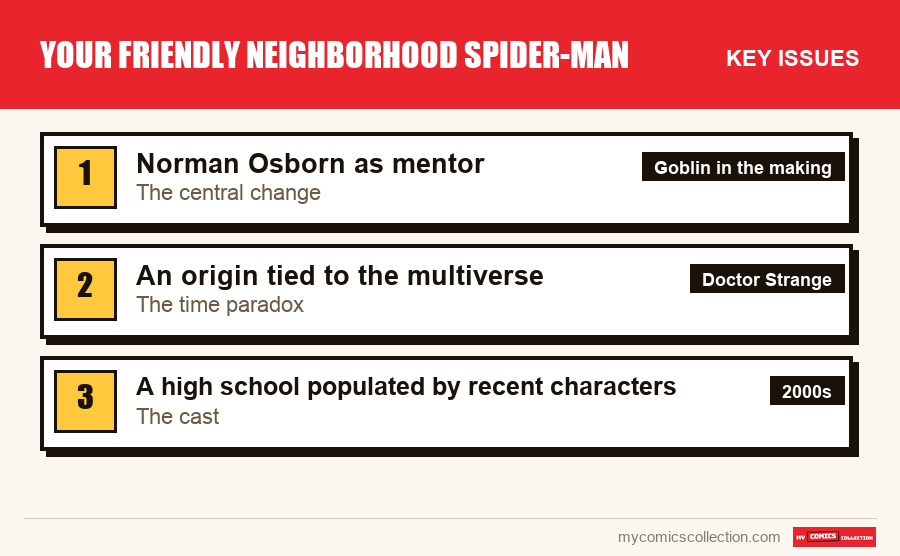
In the comics, Norman Osborn is first Spider-Man's masked enemy, then the father of his best friend. The series makes him Peter's mentor, in place of Tony Stark in the films. Trammell specified that Norman is not a hero and that his methods do not necessarily serve everyone's interest. The series plans to explore over several seasons his evolution toward the Green Goblin.
An origin tied to the multiverse
In Amazing Fantasy #15, Peter is bitten by a radioactive spider during a science demonstration. In the series, his powers arise from a time paradox caused by Doctor Strange while he fights a symbiote: the spider that bites Peter had received an injection of his own blood.
A high school populated by recent characters
In the 1960s comics, Peter's classmates are named Flash Thompson, Liz Allan or Gwen Stacy. Here, his best friend is Nico Minoru, a secret witch, and he meets Amadeus Cho, Jeanne Foucault, a.k.a. Finesse, or Lonnie Lincoln. All come from comics published decades after Spider-Man's creation, and most were never associated with him.
Harry Osborn, for his part, becomes an influencer there and Peter's tech support, his "guy in the chair", a nod to the films. At the end of the first season, he founds his own company to support young geniuses without exploiting them. Otto Octavius is a scientist who sells his technology to criminals, long before becoming Doctor Octopus. Daredevil crosses the hero's path there, with the voice of the live-action series' actor.
The series' characters and their origin in the comics
For anyone who wants to go back to the sources, here are the first appearances of the series' main characters, from oldest to most recent.
The pillars from 1962 to 1965
Peter Parker and Aunt May in Amazing Fantasy #15 (1962), the Chameleon in Amazing Spider-Man #1, Otto Octavius in #3, the Green Goblin in #14, Mac Gargan in #19 then under the Scorpion armor in #20, Harry Osborn in #31. Bentley Wittman, the future Wizard, appears as early as 1962 in Strange Tales #102, and Daredevil in his own #1 in 1964.
Tombstone, 1988
Lonnie Lincoln appears in Web of Spider-Man #36. In the comics, he is an albino crime boss with nearly indestructible skin; the series makes him a high school classmate drawn into a gang, who acquires his resilience after exposure to an experimental chemical.
Nico Minoru, 2003
Created by Brian K. Vaughan and Adrian Alphona in Runaways #1, she is the daughter of criminal sorcerers. The series keeps her magic and makes her Peter's best friend.
Carmilla Black, 2005, and Amadeus Cho, 2006
Carmilla Black, the comics' new Scorpion, debuts in the second Amazing Fantasy series, in #7. Amadeus Cho, a gifted teenager, appears in #15 of that same series, before becoming a close friend of Hercules then Hulk.
Finesse, 2010
Jeanne Foucault appears in Avengers Academy #1. In the series, she infiltrates Osborn's company on Daredevil's behalf.
The title and its ancestors in comics
The phrase "your friendly neighborhood Spider-Man" is almost as old as the character: it is how he introduces himself, and it gave its name to several comics series. A first series Friendly Neighborhood Spider-Man was launched in 2005, written by Peter David, and a second in 2019, written by Tom Taylor. Both share the idea of refocusing the hero on his neighborhood and its inhabitants, which fits the animated series' spirit well.
The comic announced for December 2026, Your Friendly Neighborhood Spider-Man #1, is explicitly timed to the second season. Its detailed content and its team are not part of what was confirmed at the time of writing this article; we will have to wait for release to know whether it extends the series' continuity or adapts its spirit. Number 1s tied to an adaptation often have a particular collecting history: strong demand at release, then stabilization, unless a character appears there for the first time.
What to read before season 2
To recover the series' spirit, the best starting point remains the first forty issues of Amazing Spider-Man, reprinted in collected editions, whose graphic energy the series takes up. For the relationship between Peter and the Osborns, the issues where Norman and Harry enter the scene are indispensable. To discover the newcomers, Runaways for Nico and Amadeus Cho's first adventures are the two most natural doors.
Finally, to compare with the character's other animated adaptations, the 2008 series and the 2012 one offer two useful counterpoints: one very faithful to the comics of the Lee and Ditko period, the other inspired by the Ultimate line. For a complete reading order, see our Spider-Man reading guide.
Read also
- Amazing Spider-Man #1000: seven stories, seven teams, and what to reread from each
- Ravage: who is Spider-Man's new villain, born in #1000
- ASM #1000 second printing: recognizing the penciled covers of October 28
- Amazing Spider-Man: volumes and legacy numbering, from the 1963 #1 to #1000
- From #100 to #900: what each Amazing Spider-Man centennial told