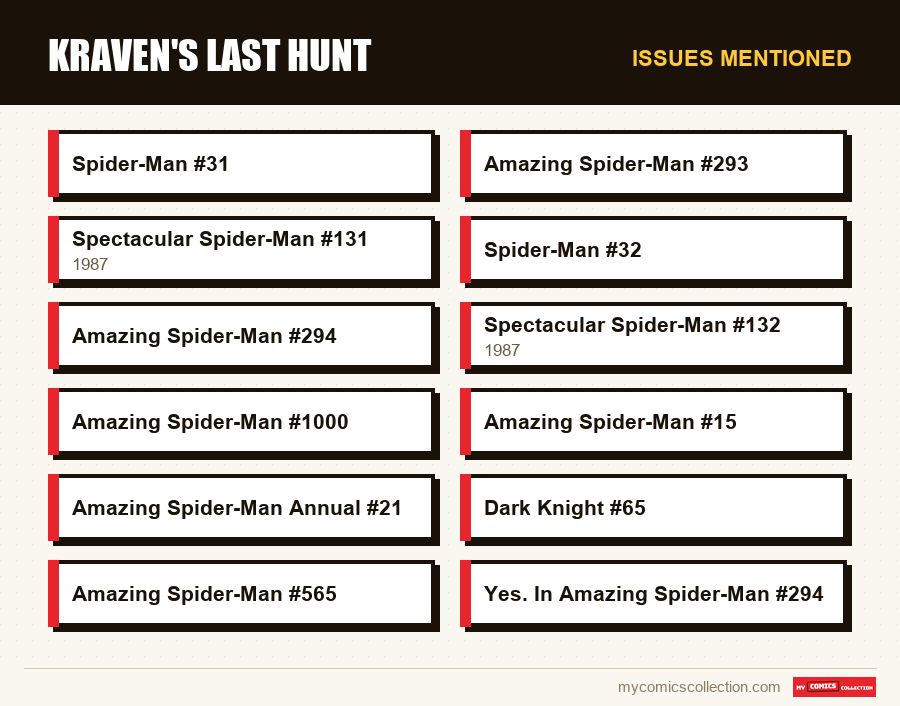
Kraven's Last Hunt is a six-chapter story published in 1987 across the three Spider-Man series of the time, written by J.M. DeMatteis, drawn by Mike Zeck and inked by Bob McLeod. The reading order is: Web of Spider-Man #31, Amazing Spider-Man #293, Spectacular Spider-Man #131 (October 1987 covers), then Web of Spider-Man #32, Amazing Spider-Man #294 and Spectacular Spider-Man #132 (November 1987). In it, Kraven buries Spider-Man alive, puts on his costume to prove his superiority, then takes his own life. The story follows closely on the wedding of Peter Parker and Mary Jane. DeMatteis does "Requiem for a Goblin" in 2026, with Humberto Ramos, in Amazing Spider-Man #1000.
Few Spider-Man stories are cited as often as the best ever written. Kraven's Last Hunt appears on almost every list, and part of the critical community places it at the top. It is nonetheless a story that asks a little organization of the reader: it does not appear in a single series, but across the three monthly titles that Marvel then devoted to Spider-Man, over two months.
This guide gives the exact order of the six issues, explains why it matters, and what you need to know to collect the arc in single issues. It does not return to the 2024 film, compared to the comics in our article on Kraven the Hunter, and it does not tell the whole life of the character: it concentrates on this one story.
The reading order of the six chapters
Marvel then published three monthly Spider-Man series: The Amazing Spider-Man, Peter Parker, the Spectacular Spider-Man and Web of Spider-Man. The arc passes from one series to the other, one chapter per title and per month.
Web of Spider-Man #31
October 1987. Kraven prepares for his last hunt. He sets a trap for Spider-Man, shoots him and buries him.
Amazing Spider-Man #293
October 1987. Kraven puts on Spider-Man's costume and roams the city in his place, with a brutality the hero has never allowed himself.
Spectacular Spider-Man #131
October 1987. Kraven stalks Vermin, a cannibal rat-man whom Spider-Man had never been able to beat alone, while Mary Jane waits for her husband.
Web of Spider-Man #32
November 1987. The resurrection chapter: Peter Parker climbs out of his grave. Zeck's cover, a hand piercing the earth, is one of the most famous of the decade.
Amazing Spider-Man #294
November 1987. Spider-Man finds Kraven. The hunter, convinced he has finally beaten his adversary, releases Vermin against him, then ends his own life.
Spectacular Spider-Man #132
November 1987. Spider-Man faces Vermin and hands him over to the police. The story closes on Kraven's burial, in the grave you had seen being dug since the beginning.
Remember the rule: Web, then Amazing, then Spectacular, twice in a row. It is the only difficulty of the arc, and it disappears once you know it. If you read in collected form, the order is already respected.
Why this story matters so much
Kraven, who appeared in Amazing Spider-Man #15 in 1964, was until then a second-tier villain: an aristocratic Russian hunter, proud, a bit dated, who came back regularly to be beaten. DeMatteis makes him a tragic figure. His Kraven is not a criminal, he is an aging man who wants, before dying, to prove he is worth more than the adversary who has always humiliated him. He does not only want to kill Spider-Man: he wants to be Spider-Man, and to be him better than he is.
The story works as a mirror. While Kraven becomes Spider-Man, Peter Parker, buried alive, wonders who he is. The arc takes up William Blake's poem "The Tyger", whose line about the "fearful symmetry" gave the project its original title, "Fearful Symmetry". The tone is grave, introspective, very far from the series' usual fights.
Timing matters too. The arc appears right after the wedding of Peter Parker and Mary Jane, celebrated in Amazing Spider-Man Annual #21 in 1987. DeMatteis makes this marriage the emotional center of the story: it is the thought of Mary Jane that lets Peter climb out of his grave. Our article on Mary Jane's key issues places this episode in the couple's history.
A story that looked for its character
The starting idea did not concern Spider-Man. In the mid-1980s, DeMatteis pitches a miniseries devoted to Wonder Man, in which the hero, buried, ends up climbing out of his grave. The project is rejected. The writer then adapts the script for Batman and the Joker, with no more success. He finally transposes it to Spider-Man, substituting Kraven for the planned villain, after rereading the hunter's entry in a Marvel encyclopedia.
The Batman version is not lost: DC published it in 1994 under the title "Going Sane" in Batman: Legends of the Dark Knight #65 to #68. Reading the two stories side by side shows what each character changed in the story.
On the art side, the script was entirely written when Mike Zeck began. He therefore drew the six covers before any interior page, starting with that of Web of Spider-Man #32, which he judged the most obvious. This method explains the remarkable visual unity of the six covers, all dark, all built around Spider-Man's black costume.
Collecting the arc in single issues
The six issues were published in 1987 in regular, high-circulation series. They therefore circulate in number, and the complete arc remains an achievable goal for a patient collector. Three points deserve attention.
The dark covers. Zeck's six covers rest on large black fields. These fields immediately show the slightest wear: creases, rubbing, chips on the spine. A copy that looks clean in a distant photo can reveal many defects up close. Always ask for close-up photos under raking light.
The imbalance between chapters. The two Amazing Spider-Man issues, the flagship series, are the most followed. Web of Spider-Man #32, for its cover, is also the subject of particular demand. The two Spectacular Spider-Man chapters are often the easiest to find, and sometimes the ones missing from a lot by pure chance. The articles on the key issues of Web of Spider-Man and of Spectacular Spider-Man place these chapters in their respective series.
Newsstand and direct versions. In 1987, each issue exists in a newsstand version, with a barcode, and a direct version, meant for specialty shops. The content is identical. Some collectors favor newsstand versions in good condition, which are rarer, but the gap is not systematic.
Web of Spider-Man #32
The central chapter, the one of the exit from the grave. Its cover is the image everyone associates with the arc, taken up and parodied many times since. It is the issue you keep if you keep only one, for the pleasure of the object.
Amazing Spider-Man #294
The chapter where Kraven ends his life. In the main series, it is a turning point: the death of a historic enemy, treated without spectacle. The character will remain dead until 2010, when the "Grim Hunt" arc brings him back.
No price guide is given in this article. To estimate a specific copy, the estimation tool starts from its real condition.
The sequels and echoes
DeMatteis, Zeck and McLeod reunited in 1992 for Spider-Man: Soul of the Hunter, a 48-page prestige-format graphic novel, which returns to Kraven's death. The story answered the unease of readers who saw in the Last Hunt a glorification of suicide.
The title "Kraven's First Hunt" has been given to two unrelated stories: a rereading of the character's first appearance, by DeMatteis, in a 1996 annual, and the arrival of Kraven's daughter, Ana Kravinoff, in Amazing Spider-Man #565 to #567. A 1990 issue of What If? already imagined the version where Kraven fires real bullets and kills Spider-Man. In 2026, DeMatteis himself returned to the story with a new What If?, in which Peter, out of his grave, collapses psychologically facing Kraven.
DeMatteis in Amazing Spider-Man #1000
On September 30, 2026, Marvel publishes Amazing Spider-Man #1000, a 104-page anniversary issue. Among the stories entrusted to the character's historic writers, DeMatteis does "Requiem for a Goblin", drawn by Humberto Ramos. The title leaves little doubt about its subject, and it extends another part of his Spider-Man career: DeMatteis wrote the character for a long time, and often explored the relationships between Peter Parker and the Osborn family.
For a reader discovering DeMatteis with this anniversary issue, Kraven's Last Hunt is the work to read next. It shows what distinguishes the writer in the character's history: the will to take the inner torments of his heroes and villains seriously. Our Spider-Man reading guide places the arc in the whole of the series, and the Spider-Man hub gathers the other pages devoted to the character.
Reading in collected form
The arc was collected in an album less than two years after its publication, and it has been reprinted many times since, alone or with Soul of the Hunter. All these editions respect the reading order and reproduce Zeck's six covers. It is the simplest and cheapest way to discover the story, before possibly setting off in search of single issues.