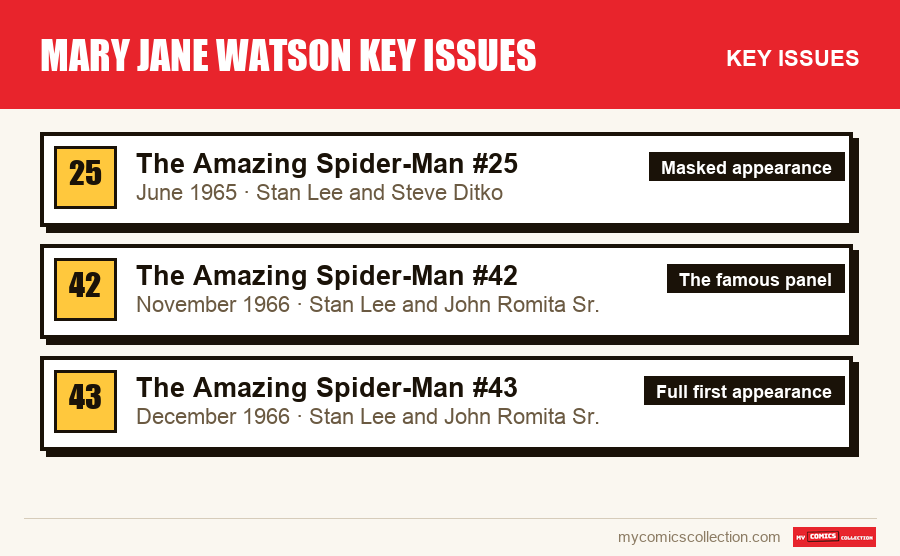
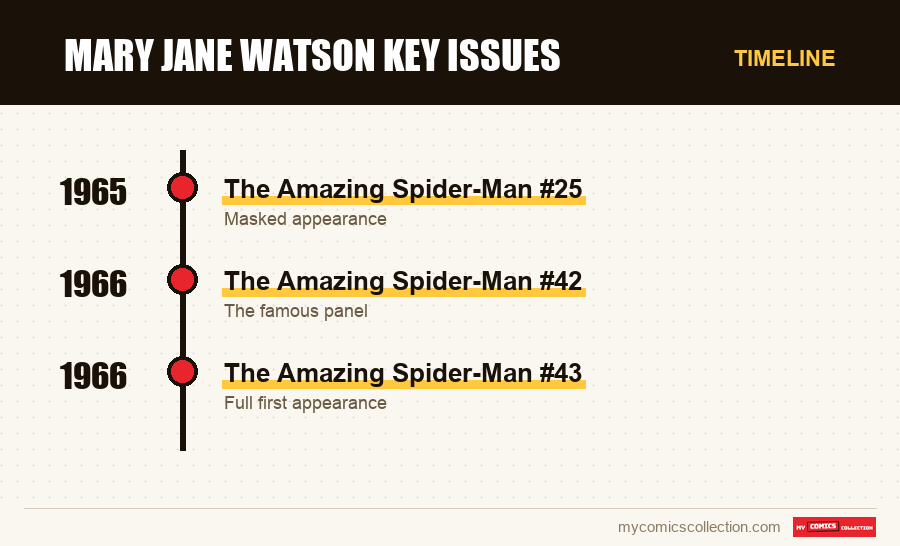
Mary Jane Watson does not have one first appearance, she has three depending on the criterion used. She is mentioned in The Amazing Spider-Man #15 (August 1964), shown from behind with her face hidden in #25 (June 1965), then revealed in the final panel of #42 (November 1966) with the line "Face it, tiger… you just hit the jackpot!". Part of the market therefore considers that the full first appearance is #43 (December 1966), the first issue where she exists across several pages. All three issues are collected, for different reasons. The rest of her path comes down to a few milestones: Annual #21 (1987) for the wedding, One More Day (2007-2008) for its erasure, and since December 2024 her move into Venom, closed by the Queen in Black crossover in summer 2026. Her own series, Friendly Neighborhood Mary Jane, arrives in November 2026.
Collecting a supporting character who became central poses a problem that title heroes never pose. Spider-Man has one first appearance and only one: everyone knows which, nobody debates it. Mary Jane, for her part, entered comics in small touches, over more than two years, at a time when nobody at the publisher knew she would become the wife of the best-selling character in the catalog. Result: three issues legitimately claim a title, and the vocabulary used by sellers does not always cover the same reality.
This blur is not anecdotal. It is precisely where hurried buyers get lost, paying for an issue for what it is not, or missing a cheaper copy carrying the same narrative event. Understanding the exact chronology of these three issues is therefore the first skill to acquire on this character, even before talking about condition or print run.
The rest of her publishing path is simpler to read, but no less interesting: a fiancée, a wife, a fictional widow, the heroine of her own series, and for two years a symbiote host. It is October 1st, 2026, and her next series has not yet come out.
Why Mary Jane's first appearance is disputed
The debate exists for a strictly material reason: the publisher stretched out her arrival over more than two years, by narrative choice, and no market rule decides between the different forms an appearance takes.
The sequence is as follows. In August 1964, in the fifteenth issue of The Amazing Spider-Man, a young woman's aunt tries to have her meet Peter Parker. The first name is spoken, the character exists on paper, but nothing is shown. In June 1965, in the twenty-fifth issue, she is finally in the panel: except that her face is hidden by an element of the scenery, and the reader sees none of it. Descriptions of this issue diverge between sources on the exact nature of the object that masks her, which says a lot about the level of precision of the catalogs in circulation. Then silence, for over a year.
November 1966, issue 42. The face appears, drawn by John Romita Sr., in the last panel of the episode, accompanied by a line that became one of the most reproduced in the publisher's history. It is an entrance, not an appearance in the sense of a role: one panel, one line, end of issue. December 1966, issue 43: she is there for good, across several pages, and the story finally gives her something to do.
Three defensible positions flow from this sequence, and that is what makes the question insoluble.
Position 1: the first appearance is #25. This is the most literal reading. The character is physically present in the panel, identified by the story, at a date when she existed nowhere else. That her face is hidden does not change her presence. It is the position that best respects chronology.
Position 2: the first appearance is #42. This is the dominant reading among the general public and in most reference works. The argument: an appearance assumes that the reader can recognize the character, and it is in #42 that the face, hair color and personality arrive in one block. It is also, by far, the most memorable of the three issues, because the panel in question became an autonomous pop-culture image.
Position 3: the full first appearance is #43. This is the technical reading, that of the collector who distinguishes the brief appearance from the full appearance. In this grid, #25 is a partial appearance, #42 an appearance in the last panel, and #43 the first where the character really takes up space. You find this notation on graded copies of #43.
None of these three positions is wrong. They simply answer three different questions: when did the character appear, when did she become recognizable, when did she start to play. The only error is to believe that one of the three is the official right answer, because there is no authority to render it.
The three issues of the debate, one by one
The Amazing Spider-Man #25
The issue where the character enters the panel without entering the reader's gaze. It is also the only one of the three drawn by Steve Ditko, which is no detail: the visually identifiable Mary Jane, red-haired and worked like a star, is a creation of the Romita era that follows. #25 therefore contains the character's appearance before she had her definitive look.
The Amazing Spider-Man #42
The issue that almost everyone designates as the first appearance, and the one whose demand is the broadest. Its strength is not narrative but iconographic: the last panel, with the line "Face it, tiger… you just hit the jackpot!", has been taken up, parodied and quoted for sixty years. A buyer who wants a single issue of the character almost always wants that one, for a perfectly rational reason: it is the image they have in mind.
The Amazing Spider-Man #43
The informed collector's issue. This is where the character holds a role, speaks, goes out with Peter Parker, and becomes an element of the serial instead of a promise. The issue also contains the Rhino's origin, which gives it a second collecting motive independent of the character who interests us.
What this debate concretely changes when buying
A terminology disagreement becomes a financial risk as soon as it ends up in a listing. Here is the method so that it costs you nothing.
Decide what you are buying before looking for a price
The three issues do not serve the same use. If you want the image everyone recognizes, it is #42 and there is no substitute. If you want the first issue where the character physically exists, it is #25. If you want the full first appearance in the strict sense, it is #43. Comparing their prices with each other makes no sense: they are three different objects.
Read the exact wording, not the listing title
"First appearance", "full first appearance" and "first appearance of the face" designate three distinct things, and all three circulate on these issues. A listing title is worth nothing: only what is written on the label of a graded copy matters, or what the seller is able to describe precisely. A seller who cannot say which of the three notations applies to their copy has not identified their object.
Verify that the announced issue matches the photographed issue
Issues 42 and 43 follow each other, share the same creative team and the same period cover graphics. Confusion is easy, sometimes involuntary. On a comic of this value, the cover must be fully legible in the photo, number included, before any price discussion.
Do not buy a price, buy a documented condition
On 1965 and 1966 comics, the value gap between two copies of the same issue far exceeds the gap between the three issues of the debate. Condition, whiteness of the pages and the absence of undeclared restoration weigh far more than the terminology quarrel. A modest but honestly described copy is a better purchase than a flattering, poorly documented one.
Record the notation you chose in your own tracking
At the time of purchase, note which reading you chose and why. In five years, facing a buyer or an insurer, you will no longer remember the reason that made you prefer one issue to the other, and it is that reason that gives your description its value.
The publishing milestones after 1966
Past the origins debate, the character's path reads as a succession of shifts, and each leaves an identifiable issue behind.
Issue 257 and issue 259 (1984). Two issues that, a few weeks apart, transform the nature of the character. In the first, she lets Peter Parker know she has long known who he is under the mask, which ends years of mix-up. In the second, the story finally goes back to her childhood and gives the character a difficult family past, where she had until then only served as a worldly counterpoint. It is from this pair of issues that the adult character as we know her today dates, and they remain largely underestimated in collecting.
Issue 290 (1987) and Annual #21 (1987). The proposal first, the ceremony after. Amazing Spider-Man Annual #21, written by David Michelinie, with a cover by John Romita Sr., contains the wedding itself. This issue remained famous beyond comics, because the publisher accompanied its release with a ceremony performed in public in a New York stadium in 1987, officiated by Stan Lee before tens of thousands of people. It is one of the rare issues of the period whose commercial event has its own posterity.
One More Day (2007-2008). The four-part story, spread over The Amazing Spider-Man #544 and #545, Friendly Neighborhood Spider-Man #24 and Sensational Spider-Man #41, in which Peter Parker and Mary Jane accept a deal with Mephisto: Aunt May's life in exchange for their marriage. The marriage is not dissolved, it is erased, which is very different. #545 carries the conclusion. It is a paradoxical collecting issue, one of the most disliked by the character's readers and one of the most discussed in her history, which guarantees it persistent demand.
One Moment in Time (2010). The follow-up, spread over issues 638 to 641, charged with explaining how the couple never married in the new version of the story. An indispensable piece for anyone who wants to understand the current state of continuity, and the only way to read the period without a logical gap.
When she takes the lead
The character has carried her own title on several occasions, and it is a part of the collection entirely distinct from following Amazing Spider-Man. These series are generally easier to find and less costly, which makes them a good entry.
The first serious attempt dates from 2004, with a four-issue miniseries aimed at a young readership, written by Sean McKeever and drawn by Takeshi Miyazawa, followed in 2005 by a second miniseries from the same team. These two objects opened the way to Spider-Man Loves Mary Jane, launched in December 2005 by the same creative team, which remains the most accomplished attempt to tell the character's universe from her point of view rather than from the hero's.
In October 2019, the publisher launches The Amazing Mary Jane, a six-issue miniseries written by Leah Williams and drawn by Carlos Gomez, which sends the character to Hollywood and finally embraces her job as an actress as a narrative engine rather than as scenery. The character has also shared the billing of miniseries with Black Cat, in two distinct titles, one of them by Jed MacKay.
For the collector, these series have a particular interest: they are recent, rarely complete on the secondary market, and nobody hoards them. Rebuilding a six-issue miniseries is done without difficulty when you know what you are looking for, and it is exactly the kind of hunt where an issue-by-issue tracking makes the difference compared to a search done from memory.
The 2024 turning point: Mary Jane becomes Venom
The striking fact of the last two years does not play out in a Spider-Man series but in a Venom series. In December 2024, the publisher launches All-New Venom, written by Al Ewing and drawn by Carlos Gómez, built on a riddle: the identity of the symbiote's new host is hidden from the reader for several issues. Hypotheses circulated all winter, and the answer dropped in the fifth issue, released on April 2, 2025: the host is Mary Jane Watson.
This choice is not a passing disguise. It places the character at the center of an entire franchise, with its own register, far from the role of the hero's companion. The symbiote gives her a power she has never had, and the story makes it something uncomfortable rather than heroic. For anyone collecting the modern key issues of the Venom franchise, it is the event of the period, and it falls in a title that Mary Jane collectors were not watching.
This period closes in summer 2026 with Queen in Black, a five-issue crossover written by Al Ewing and drawn by Iban Coello, started in July 2026. The event comes directly out of Ewing's work on Venom and stages a cosmic confrontation between Knull and Hela, the latter taking the throne and the head of an army of symbiotes. Mary Jane holds her role as host to the end. Several satellite miniseries accompanied the crossover, devoted to Hela, to Thor, to Eddie Brock and to a gathering of characters.
In between, in August 2026, the publisher released Mary Jane: Face It, Tiger #1, a large-format anniversary issue celebrating the character's sixty years, made up of several short stories by different teams, including one by Ashley Allen and Phil Noto. This last detail is no accident of distribution: it is the duo of the series that follows.
Friendly Neighborhood Mary Jane, November 2026
The next step is dated and documented, but not yet out. Friendly Neighborhood Mary Jane is a five-issue miniseries, written by Ashley Allen and drawn by Phil Noto, whose first issue is announced for November 4, 2026.
The starting point is clear: after Queen in Black, the character is separated from the symbiote. She founds her own production company, Watson Productions, and becomes a producer, which logically extends her acting career toward something she controls. The plot pits her against the Chameleon, who attacks her new business, and she has to count on her own resourcefulness, supplemented by a gift left by Venom whose nature the publisher has not detailed.
What this series adds, in collecting terms, comes down to three things. First, it enacts the separation of the character and the symbiote: the issues where Mary Jane is Venom become a closed period, bounded from December 2024 to summer 2026, which is exactly the kind of clean delimitation the market likes. Next, it sets up a version of the character who exists without Peter Parker or the symbiote, for the first time in a title with her name since 2019. Finally, it makes Phil Noto the reference artist of this version, after his short story of August 2026.
What cannot be said, however, is what this first issue will be worth. As of October 1st, 2026, it has not come out, no copy circulates, and there is no price guide for it. Anyone who tells you today a value for this issue is fabricating a number. The only reasonably predictable thing is general: a number 1 of a highly anticipated miniseries is printed in quantity, and its scarcity will be measured in several years, not several weeks.
Building a coherent collection around the character
A Mary Jane collection presents a practical difficulty: it crosses at least four titles, over six decades, without any series being continuously devoted to her. A handwritten list becomes unreadable after about twenty issues.
Three levels of reading let you structure the whole. First the original core, that is, issues 25, 42 and 43 of Amazing Spider-Man, with the notation you retain for each. Then the narrative shifts: 257, 259, 290, Annual #21, #545, the 638 to 641 sequence. Finally the series bearing her name, from 2004 to 2026, which can be completed independently and form the accessible part of the whole.
In the app, two reflexes settle most of it. Record for each old issue the exact notation appearing on your copy, grading label included: it is the only way not to relive the debate each time you reopen the question. And activate tracking on ongoing titles, because a five-issue miniseries starting in November is completed effortlessly if the deadline comes up, and inevitably gets gaps if it does not.
For anyone starting out, the wisest buying order often inverts the order of prestige: start with the series bearing her name, which can be obtained complete without difficulty, then the shifts of the 1980s and 2000s, still largely accessible, and keep the 1965 and 1966 core for last, when you know exactly which of the three readings is yours. The reverse, that is, buying the expensive piece first with a vague idea of what it contains, is the most common way of getting this character wrong.