Lex Luthor is born in Action Comics #23, dated April 1940, from the pen of Jerry Siegel and the pencil of Joe Shuster. This issue is one of the scarcest of the publisher's Golden Age, and it remains out of reach for almost all collectors. The good news is that this character has been deeply rewritten four times, and each rewrite produced an accessible entry point: the scientist who goes bald by accident in 1941, the Smallville teenager of 1960, the industrialist of The Man of Steel #4 in 1986, and the origin story signed Mark Waid in Superman: Birthright in 2003. Waid is in fact returning to the subject with "Lex Luthor: Year One," whose story continues in Action Comics #1105 on December 9, 2026. This article ranks these milestones and says where to start when the reference issue is unreachable.
There is a category of characters whose collection starts with a wall. Not a difficulty, not a patient search: a wall. Their first appearance belongs to a handful of copies that change hands in public sales, and the ordinary collector will never enter that room. Lex Luthor is one of them, and that is what makes his case interesting, because the rest of his bibliography is, on the contrary, almost abnormally accessible.
The reason is simple and lies in how the publisher has treated its main antagonist for eighty-five years. Luthor was not told once and then varied. He was recast every time the publisher reset its universe, and each recast came with a complete origin story. Result: where an ordinary villain has a single priceless key, Luthor has a priceless key and four perfectly usable service doors.
Editorial news makes the exercise useful now. Action Comics #1105, dated December 9, 2026, continues an arc titled "Lex Luthor: Year One" written by Mark Waid. This title is not neutral: Waid has already written this character's origin once, more than twenty years ago, and he returns to it while holding the series since 2024. Before buying anything off the shelf this winter, it is worth knowing where this story fits in an already long lineage.
"Year One" by Mark Waid is a second time
Mark Waid has held Action Comics since issue 1070, first for a twelve-episode weekly serial that ended at issue 1081, then full time from issue 1087. This path matters, because an author established on a title for several years does not devote a whole arc to the main adversary's origin by chance. He does it when he feels he has the mandate to change something structural.
Now, Waid has already done exactly that. Superman: Birthright, a twelve-issue limited series published from September 2003 to September 2004, drawn by Leinil Francis Yu and inked by Gerry Alanguilan, was not just a retelling of Superman's beginnings. It was also a rewrite of Luthor, and the boldest since 1986. Waid reestablished there the youthful bond with Clark Kent in Smallville, made Luthor lose his father Lionel and his hair in a single experiment accident, and founded his company on the search for extraterrestrial life. The villain stopped being a businessman turned criminal to become again a researcher driven mad with jealousy by the arrival of a real extraterrestrial.
This version had a brief official existence. Birthright was written outside continuity, then adopted as the canonical origin in place of John Byrne's Man of Steel, then set aside by the continuity reshuffles that followed Infinite Crisis. The publisher entrusted a new origin to Geoff Johns and Gary Frank with Superman: Secret Origin, six issues published from September 2009 to August 2010. For a 2026 reader, this means an author today sees his work from twenty years ago as a lead he did not have time to exhaust. It is the same movement that brings several creators back to their own characters this winter, and which we discuss in our analysis of creator returns.
A necessary clarification: as these lines are written, early October 2026, nobody knows what "Year One" actually changes. No market value exists on Action Comics #1105, and anyone who announces to you today the future value of an issue that is not yet printed is manufacturing a number. What exists is a date, an author, an arc title and a twenty-year precedent. That is already a lot to decide whether to follow the series.
The starting wall: a 1940 first appearance
The character appears in Action Comics #23, dated April 1940, about two years after the launch of the title and its hero in Action Comics #1. He is a red-haired criminal scientist, perched in a tower, who provokes a war to profit from it. Two details of this first version always surprise: he has hair, and he has no first name. The "Lex" will come later.
This issue combines all the factors that make a comic unreachable. It dates from an era when paper was consumed then thrown away, it belongs to a series whose first issues were collected intensively, and it carries the first appearance of the publisher's best-known antagonist. The practical consequence, for a collector, is that it is not about saving longer: it is about giving up on that copy and building otherwise. Our page devoted to the first appearance of Lex Luthor details this issue and explains why this scarcity is structural and not circumstantial.
You should also know that a second 1940 issue maintains a lasting confusion. Luthor comes back very quickly in the hero's eponymous series, and the cover dates of the era, quarterly on one side and monthly on the other, do not always allow the actual reading order to be settled. For the collection, retain the simple hierarchy: Action Comics #23 is the recognized first appearance, the rest belongs to editorial history and not to the market.
The milestones of the reinventions, in order
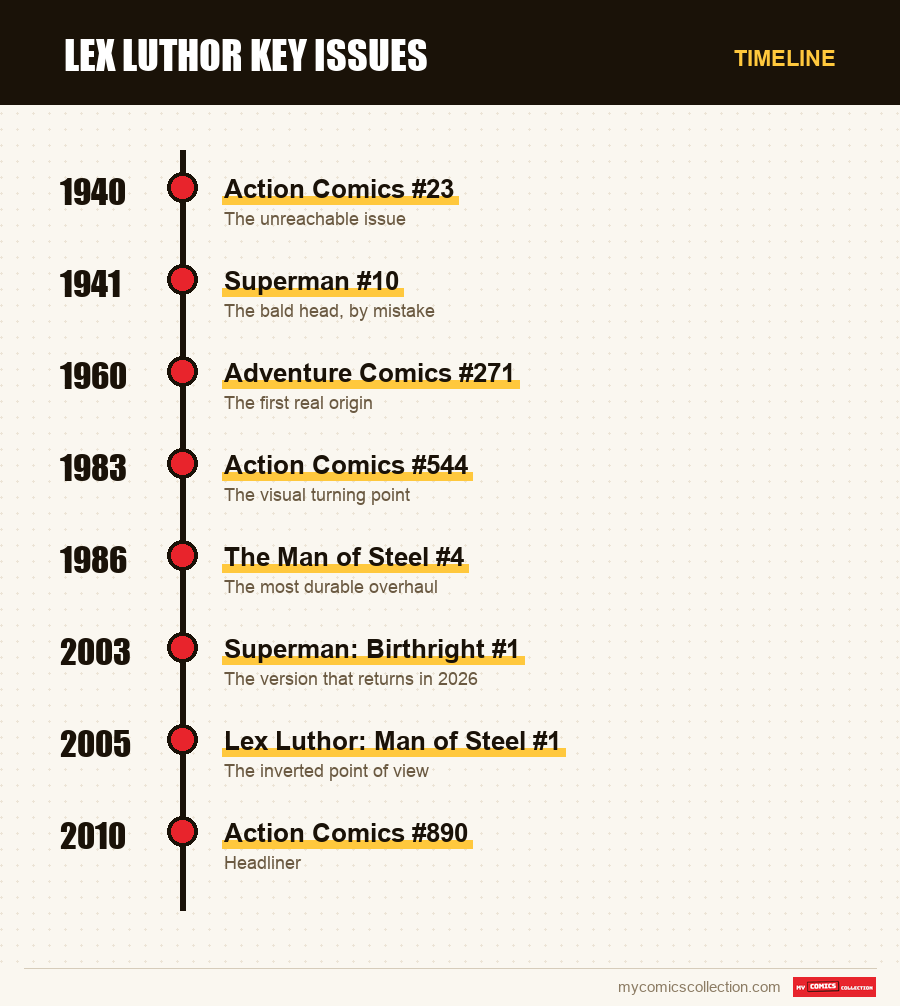
Here are the issues that mark a change in the character's nature, and not simply a good story. The ranking is chronological, because that is the order in which the transformations answer each other.
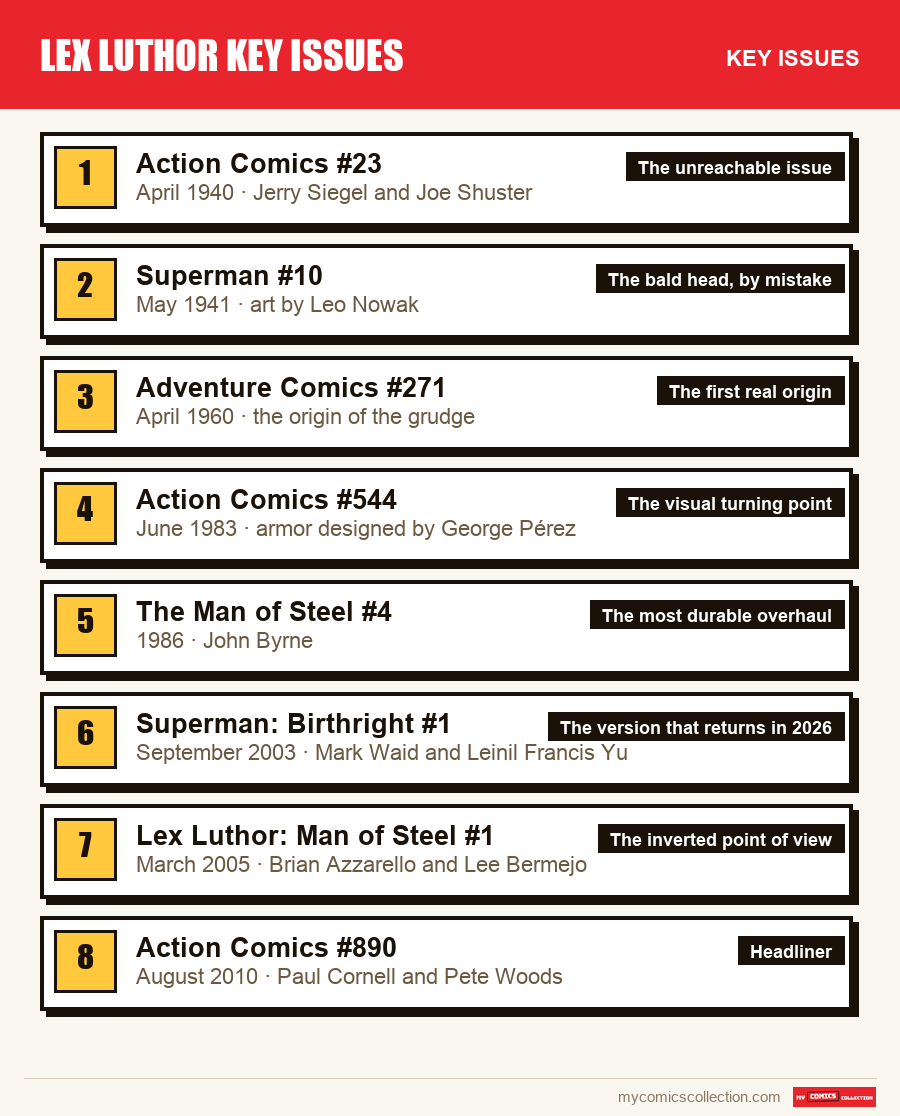
Action Comics #23
First appearance. A red-haired scientist, a tower, a war provoked for personal enrichment. Everything that will define the character for eighty-five years is already there, except his appearance and his first name. It is the absolute key, and it is also the only one of the lot that fits no normal budget.
Superman #10
The best-known detail of the character's iconography is a drawing error. Leo Nowak drew him bald, mistaking him for a stockier henchman, and the publisher kept the error. It would take until 1962 for Siegel to fold this hair loss into a revised biography, in other words for a graphic blunder to become a story element.
Adventure Comics #271
Twenty years after his creation, the character finally receives a motive. The teenage Luthor admires the young Superboy, works in his laboratory in Smallville, and loses in a fire an artificial life form, his research notes and his hair, eaten away by chemical fumes. He holds the hero's intervention responsible and swears revenge. The whole dynamic of the following sixty years comes out of this page.
Action Comics #544
The green and purple battle armor appears here, and it solves a forty-year-old problem: how can a man with no powers physically face a Kryptonian. The same episode liquidates the strangest period of his biography, that of Lexor, a planet under a red sun whose inhabitants held him a hero, where he had married and had a son. While testing his armor, he destroys this world and his own family along with it.
The Man of Steel #4
John Byrne removes the mad scientist and installs the industrialist: the most powerful citizen of Metropolis, a businessman the law cannot reach, inspired by real figures of finance and media of the era. Byrne also gives him a childhood of misery and abuse, and a first founding crime, sabotaging the brakes of his parents' car to collect the insurance. This reading has held for forty years and still feeds most adaptations.
Superman: Birthright #1
Twelve issues until September 2004, and a Luthor become a researcher again, obsessed with extraterrestrial life, a disappointed friend of Clark Kent in Smallville, disfigured by the same explosion that kills his father. The ongoing arc by the same author makes this limited series clearly more interesting to reread than it was two years ago.
Lex Luthor: Man of Steel #1
Five issues published from March to September 2005, told from inside his head. The argument has remained famous: humanity gives its trust to a stranger simply because he has our face. The character is not excused there, he is made coherent, which is far more unsettling. The series was reissued under the simple title Luthor, notably in an adult-label version in 2019.
Action Comics #890
The most direct precedent for the 2026 arc. For sixteen issues, until 904 in October 2011, the villain becomes the main character of Action Comics in the hero's absence, in a story that leads him to a fusion with an entity from the Phantom Zone. A historic title of the publisher entrusted to its antagonist: the series has already done it, and it went well.
Three characters under a single name
A collector who approaches this catalog without a grid wears themselves out, because they believe they are following one character when they are following three. Telling them apart changes purchase decisions.
The first is the scientist. He runs from 1940 to 1986, he belongs to the Golden and Silver Ages, and his issues are either unreachable or surprisingly calm. It is the period when origin stories are built by successive additions, sometimes by accident, like the 1941 baldness folded into the story twenty-one years later. Collecting this era means accepting to work through collections rather than isolated issues.
The second is the industrialist. He is born in 1986 and dominates forty years. He is the easiest to collect, because print runs of the late 1980s and 1990s are abundant and very fine copies still circulate. He is also the version adaptations feed on, which creates occasional demand tension with each screen release.
The third is the man of power: elected president, then removed before the end of his term after acknowledging a manipulation, and later an occasional ally of the heroes against cosmic threats. This sequence of the 2000s and 2010s produces numerous and inexpensive issues, because their interest is narrative and not heritage. It is collected by arc, never by single copy.
This typology explains an anomaly many collectors notice without explaining: for this character, the price hierarchy does not follow the hierarchy of narrative importance. The issue that founds his psychology in 1960 stays in the shadow of a 1940 first appearance that contains almost nothing of what he became. We develop this point in our page devoted to Lex Luthor's key issues.
Where to enter when the reference issue is inaccessible
It is the useful question, and it has a four-step answer. None of these steps presupposes buying a 1940 comic.
Read the first appearance in collected form, not as a copy
The third volume of the The Superman Chronicles collection, published in August 2007, gathers Action Comics #21 to 25 as well as issues 4 and 5 of the eponymous series. In other words, a single softcover book contains the character's first appearance and his immediate returns of 1940, in publication order. It is the most honest way to own the content when the object is out of reach, and it is no stopgap: Golden Age stories read better in sequence than in isolation.
Choose a single modern origin as a backbone
You do not need all four. Take the 1986 one if you want to understand the adaptations, the 2003 one if you want to follow the ongoing arc of the author who wrote it, the 2009 one if you want the most recent official continuity before the following decade's resets. All three exist in collected form, all three are printed in large numbers, and none costs the price of a Golden Age issue.
Buy the turning-point milestones, not the appearances
A character this old counts hundreds of inconsequential appearances. Keep only the issues where something changes nature: the baldness, the grudge, the armor, the business-executive costume, the seizure of power. Five or six well-chosen issues tell this career better than a hundred accumulated issues, and the collection stays legible to anyone who looks at it.
Settle the grading question once
Having a 1940 or 1960 issue certified is justified, because condition conditions everything in those eras and authentication has value in itself. Having a 1986 or 2005 issue found in good condition certified is justified much more rarely. Ask yourself the question by decade, not by issue, and consult our CGC grading guide before committing fees.
What is dated for winter 2026-2027, and what is not
Only two appointments are established to date, and it is important not to confuse them with promises.
The first is Action Comics #1105, on December 9, 2026, which continues "Lex Luthor: Year One." It is a release date, nothing more: neither a number of copies, nor a list of alternate covers, nor an indication of scarcity. The second is the film Man of Tomorrow, announced for July 9, 2027, directed by James Gunn, with David Corenswet in the hero's role and Nicholas Hoult in Luthor's. A year ahead of a theatrical release means that screen-related demand effects have not begun, and that it is still early to anticipate anything.
You should also know that a major convention takes place from October 8 to 11, 2026 and that announcements are expected there on several of the publisher's titles. At the time of writing, nothing has been said there: any information presented as coming from these panels is premature. In the same way, the January 2027 programs are not published beyond a few isolated titles, and we commit only to confirmed dates.
On values, this article's position is explicit: we cite no amount. No source consulted publishes a recent and dated market record on this character, and an undated figure is worth nothing, since the secondary market moves from one quarter to the next. What can be said without risk, however, is the hierarchy: the 1940 first appearance is an order of magnitude apart, the 1960 origin is far below its importance, the 1983 and 1986 overhauls are affordable, and everything after 2000 is a reading purchase. A serious estimate of your own copies is built on observed sales, never on current listings.
Keeping a Luthor collection without duplicating it
The trap with this character is not the price, it is the invisible duplicate. Four origins, reissues under different titles, a collection that changes name between two editions: it is very easy to buy the same story twice under two covers. The 2005 series is called sometimes Lex Luthor: Man of Steel, sometimes Luthor. The 1986 limited series carries a title that is confused with that of the 2013 film. And the same 1960s arc reappears in several Silver Age anthologies.
The defense is mechanical. Record each acquisition at the issue level and not at the collection title level, note the form of the copy, original issue or reprint, and let the collection tracking tool flag the overlaps. On a bibliography spread over eighty-five years, it is the difference between a reasoned collection and a redundant shelf. The hub devoted to the character groups our pages by issue, and an up-to-date inventory keeps you from rebuying what you already own.
For anyone starting this winter, the most efficient order is counterintuitive: start with the 2005 series, which requires no prerequisites, follow with Birthright to understand what the ongoing arc takes up, then work down to 1986 and 1960 to see the successive layers. The 1940 first appearance remains at the end of the road, and probably out of reach. It does not matter: this character is one of the few whose every aspect can be understood without ever touching his most expensive key.
Frequently asked questions
It is Action Comics #23, dated April 1940, written by Jerry Siegel and drawn by Joe Shuster. The character is a red-haired criminal scientist, with no first name: he is simply named Luthor. This issue belongs to the publisher's Golden Age and counts among its hardest-to-find releases, in every condition. For a collector, the right decision is generally to read this story in collected form rather than chase a period copy, because the content is republished while the object itself cannot be reproduced.
Because an artist made a mistake. Leo Nowak drew him bald in Superman #10, dated May 1941, mistaking him for a stockier henchman, and the publisher kept the error rather than correcting it. It took until 1962 for Jerry Siegel to fold this hair loss into a revised biography, attributing it to a laboratory accident. It is one of the best-documented cases of an accidental detail becoming an identity trait: today, no adaptation gives him a head of hair.
There are four, and they do not say the same thing. Adventure Comics #271, dated April 1960, gives the first: the Smallville teenager who loses his research and his hair in a fire and holds the young hero responsible. The Man of Steel #4, in 1986, replaces it with that of an industrialist born of poverty. Superman: Birthright, from 2003 to 2004, rewrites it again. Superman: Secret Origin, from 2009 to 2010, takes over. Choose the one that matches the era you are reading.
It is an arc written by Mark Waid in Action Comics, whose issue 1105 continues the story on December 9, 2026. Its main interest is biographical on the authors' side: Waid had already written an origin of this character in Superman: Birthright in 2003, and he has held the series since issue 1070. Following this arc is justified if you already read the series or if that first version had struck you. On the other hand, buying several copies hoping for a gain has no foundation: nothing is known about print runs.
It depends only on the decade. On a 1940 or 1960 issue, certification makes sense: condition determines almost all the value, and authentication protects against an unmarked restored copy. On a release from the 1980s, 2000s or 2020s, the math is rarely favorable, because print runs were abundant and copies in good condition remain numerous. The practical rule is to decide by period rather than issue by issue, and never to have a comic certified whose real scarcity you do not know.
Man of Tomorrow is announced for July 9, 2027, with James Gunn directing and Nicholas Hoult in the role. A year before release, no price movement is observable and no source consulted publishes a dated record on this character. What the medium's history shows is that screen effects concentrate on a very small number of issues, generally a first appearance or a specific costume taken up on screen, and that they often fall back after release. Buying now to read is reasonable. Buying to resell in a year is a bet.
With Lex Luthor: Man of Steel, five issues by Brian Azzarello and Lee Bermejo published between March and September 2005, later reissued under the single title Luthor. The series tells the universe from his point of view and requires no prior knowledge of continuity. Follow with Superman: Birthright if you want to understand what the ongoing arc takes up, then with The Man of Steel of 1986 for the version adaptations still feed on. Three readings are enough to cover the essentials.
Yes, and it is the most interesting precedent for the 2026 arc. From Action Comics #890, in August 2010, to issue 904 in October 2011, Paul Cornell and Pete Woods entrusted him with the whole title in the hero's absence, over sixteen issues that lead him to a fusion with an entity from the Phantom Zone. He has also carried two limited series in his name, in 2005 and in the reissues that followed. An antagonist able to hold a series without his hero is rare, and that explains the editorial confidence he enjoys.