In December 2026, three creative teams return in the same month to the work that made them known a quarter-century earlier: Brian Michael Bendis and Michael Gaydos with Jessica Jones: Alias #1 (of 5), Paul Jenkins with Wolverine: Origin III, The Dark Age #1 (of 5, art by Cafu), and Garth Ennis and John McCrea with Hitman: It Was the Nineties Special #1 on December 9. It is not a coincidence but a calculation: a round anniversary is planned years in advance, and the name of a known team secures retailers' orders better than a new concept. The history of the medium shows that these returns succeed when there was a story left to finish, and fail when there was only a date to celebrate. For the collector, a return shifts attention, never the number of copies in existence.
Three series, three different character publishers, the same quarter, and the same mechanism: the original team returns to its work twenty-five years later. Taken one by one, each of these returns looks like good news for readers who loved these series in 2001. Taken together, they look like something more interesting: a strategy, decided separately by two publishers, from the same observation about the state of the market.
This article treats none of these characters in particular. It treats the phenomenon: how a publishing house decides to call back a creator to an old work, how to recognize a sequel that had a reason to exist, and what the history of the medium says about the return on these operations. The precedents cited are dated and verifiable, because it is the only way not to confuse an analysis with an impression.
It is October 2, 2026. The three December titles are announced in the catalog, none has come out, and none of the announcements expected at the New York convention of October 8 to 11, 2026 has yet been made. Everything that follows therefore concerns what is public on that date, and a century of precedents.
What is really announced for December 2026
Let us begin with the factual, because the rest depends on it. Three publications, three different configurations of what we call a return.
At Marvel, Jessica Jones: Alias is a five-issue miniseries marking the character's twenty-fifth anniversary, with her original writer and artist reunited. Also at Marvel, Wolverine: Origin III, The Dark Age is likewise a five-issue miniseries: Paul Jenkins returns twenty-five years after the first Origin, but with another artist, Cafu, on a story set in the character's 1950s. At DC, Hitman: It Was the Nineties Special is a single issue dated December 9, 2026, signed by the complete original duo.
These three formats do not say the same thing. A five-issue miniseries is a moderate but real commercial commitment: it justifies a collected edition, it occupies five months of calendar, it assumes you think you can hold the reader beyond the first issue. A single issue is a much more prudent gesture: it celebrates without promising anything, and if it works, it becomes the prologue to something else. The third case, that of a team stripped of its artist, is the most fragile of the three, and we will see why.
One piece of context is worth noting because it contradicts the idea of a duo reconstituted for the occasion: Ennis and McCrea are already publishing together in November 2026 a horror single issue at Image, The Snail. The month before their return at DC, they are working side by side on another project. It is not a reunion, it is the continuation of a collaboration that never really stopped.
The original works, and why 2001 comes back three times
The concentration on December 2026 is first explained by a calendar coincidence twenty-five years old: fall 2001 was, for these three series, a moment of launch or turning point.
Alias appears under Marvel's MAX imprint, reserved for adult readers, and has twenty-eight issues published between fall 2001 and the end of 2003, written by Bendis, drawn by Gaydos, with covers by David Mack. Origin, for its part, is a six-issue miniseries published between November 2001 and July 2002, and its credits deserve close examination: the story is credited to Bill Jemas, Joe Quesada and Paul Jenkins, for art by Andy Kubert and colors by Richard Isanove. Jenkins wrote the text, but the project was born from an editorial leadership decision, not from a creator's pitch. We will come back to it, because it changes the nature of his return.
Hitman is the different case of the three. Tommy Monaghan first appears in The Demon Annual #2 in summer 1993, as part of the Bloodlines crossover, then gets his series in 1996: sixty issues until 2001, sixty-one counting the annual, created and driven from beginning to end by Ennis and McCrea. December 2026 therefore marks not the twenty-fifth anniversary of a start, but the twenty-fifth anniversary of an end. It is a nuance that matters: returning to a series you concluded yourself is not returning to a series you launched.
A figure from the time gives the measure of what was at stake then. The sixth and last issue of Origin ranked second in sales for the January 2002 period, with 166,997 copies on preorder. These are order quantities of the time, not today's market values, and they remind us that these series were not niche objects: they were printed massively.
The editorial calculation behind a return
An original creator's return is not a favor done to former readers. It is a product, and it is decided on criteria that can be reconstructed.
The first is predictability. A round anniversary is the only date in the editorial calendar you know twenty-five years ahead. A publisher can reserve it, negotiate contracts, line up an artist and plan a collected edition without depending on a film, a series or an internal event. In a trade where almost everything slips, that is a rarity.
The second is the reduction of order risk. Retailers order firm, several months ahead, on the basis of a visual and credits. A known team name is the most readable information you can give them: they know who bought the original series, and they know those customers are still there. A new concept, however good, does not supply that marker. It is exactly the logic described in our analysis of how the market files by author rather than by character.
The third is the 2026 market context, and it is unusually favorable. In the point-of-sale week of September 22 to 28, 2026 across more than 600 equipped stores, DC weighs 41.29% and Marvel 28.62%, with six DC titles in the top 10. Above that, a few titles absorb volumes not seen in a long time: Amazing Spider-Man #1000, out on September 30, 2026, passed 400,000 preorders, sold out the same day, and had nine covers sent back to press. Terminal #1 printed 300,000 copies where the publisher had hoped for 100,000. In a market that absorbs, a bet on nostalgia costs little and pays off fast.
The fourth concerns the target. Alias was a series for adults, Hitman a title with very dark humor, Origin a prestige object. Readers who were twenty in 2001 are forty-five in 2026, with a budget, and the reflex of buying single issues. Yet the same market sees arriving, according to retailers interviewed in recent reports, a young and numerous audience asking where to start. Publishers serve the two audiences with distinct products, and the wave of returns is the share meant for the first. The Midnight Universe line launched in October 2026, three number 1s with parental advisory, falls under the same demographic reading.
The fifth is more prosaic: December's calendar has room. The market's best-selling title, Absolute Batman, stops after its number 25 on October 28, 2026 and publishes no issue in December, before resuming at number 27 in February 2027. A month without a locomotive is a month where a catalog title can be seen.
Finally, a leadership element to be read with caution: Stephen Wacker is presented as Marvel's new editor-in-chief. A program backed by anniversaries and identified teams is, for a new leadership, the least risky way to open. It is an interpretation on our part, not a statement from the publisher.
These three works have already had a return
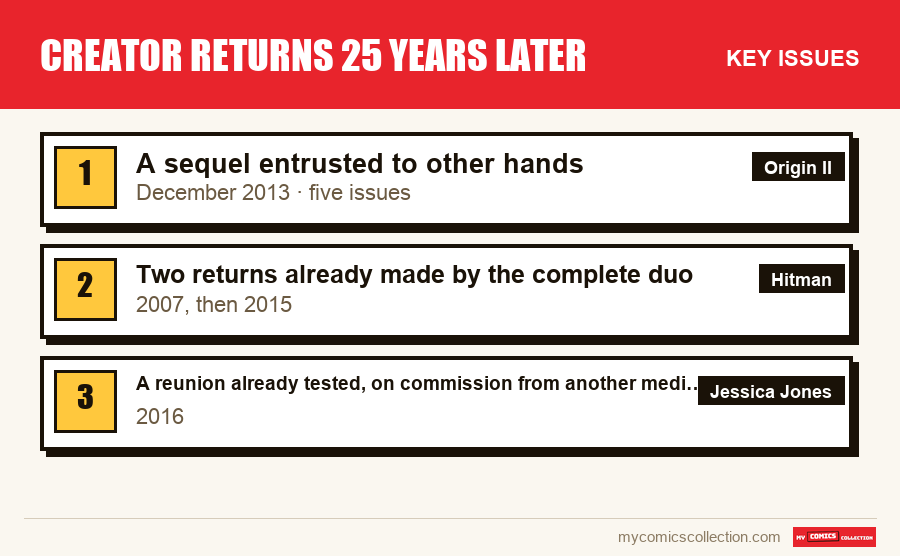
Here is the point almost nobody notes, and the most useful for judging December 2026: none of these three works is at its first extension. The three precedents exist, they are dated, and they played out very differently.
A sequel entrusted to other hands
Marvel unveiled a sequel to Origin at San Diego Comic-Con in 2013, for a first issue in December 2013. It was not written by Paul Jenkins but by Kieron Gillen, and drawn by Adam Kubert, brother of the original artist. Five issues, a collected edition in March 2015, and an edition gathering the two series in January 2017.
Two returns already made by the complete duo
Ennis and McCrea came back to their character as early as 2007, with a two-issue miniseries crossing Tommy Monaghan and the Justice League, presented as the lost story that had not found its place in the monthly series. It had first been planned in four issues in another collection. The same writers signed in 2015 a new six-issue series in the same universe of secondary characters.
A reunion already tested, on commission from another medium
Bendis and Gaydos got back together a first time in 2016 on a regular series devoted to the character, conceived as the editorial extension of her television adaptation. The original duo was therefore intact, but the commission came from an audiovisual calendar, not from an anniversary.
Three precedents, one lesson: the creator return has become a common, repeatable practice, whose effects blunt with each iteration. The one of December 2026 opens nothing, it belongs to a series.
Legitimate sequel or nostalgia operation: six questions
The distinction is not a matter of taste. It can be tested, and the medium's precedents supply the scale. Here are the six questions we systematically ask when faced with an announcement of this type.
Was there an unfinished story left?
It is the most discriminating criterion. A work interrupted midway calls for a legitimate sequel by construction. A work concluded by its creators calls for none, and the return must then justify its existence otherwise. The December case where this criterion is most clearly met is the one that explicitly announces an unexplored period of the character's past.
Is the team complete, and recently active together?
A writer who returns alone, with an assigned artist, does not reconstitute a work: he rewrites in a setting. The visual part of a comic is not an interchangeable dressing. Conversely, a duo that has never stopped working together reconstitutes nothing, it continues.
Does the format commit the publisher?
A single issue tests. A five-issue miniseries bets. A regular series believes. Reading the format as a declaration of the publisher's confidence is generally more reliable than reading its press releases.
Does the sequel accept contradicting the original?
Returns that rewrite what already existed fail almost systematically, because they ask the reader to give up what had attached them. Those that add without touching survive better.
Does the original still read without the sequel?
If so, the sequel is a bonus and the reader risks nothing. If the sequel becomes the mandatory passage to understand the original, it is the sign of a self-feeding franchise, and the start of trouble.
Who decided on the return?
A project proposed by its creators and a project commissioned by an editorial leadership do not produce the same object. The credits of the original work often contain the answer: when the publisher's executives appear there as co-creators of the story, the writer's return is not that of a moral owner but of a contractor called back.
The precedents that held
Three returns, in the medium's recent history, are regularly cited as successful. They have in common that they answer yes to the first question.
The clearest is The Sandman: Overture, by Neil Gaiman and J. H. Williams III, six issues published from October 2013 to September 2015, seventeen years after the end of the original series. It was both a commercial success, with a first issue ranking eighth in sales for October 2013, and a critical success, crowned with the Hugo Award for best graphic story in 2016, the artist having also received an Eisner Award in 2015. Its recipe is simple: it tells what precedes the first issue of the series, that is, a space the work had left empty and that nobody else had filled.
The second is Miracleman. The story by Gaiman and Mark Buckingham was interrupted in 1992 after two issues, because of the publisher's bankruptcy, and it resumed at Marvel in October 2022, some thirty years later, with the same two creators, Buckingham moving to co-writer credit from the fourth issue. Here again, it is about finishing, not celebrating.
The third is more confidential and very instructive: Games, a graphic novel by Marv Wolfman and George Pérez, the two creators of the New Teen Titans series from 1980 to 1984. The project was started in 1989 and 1990, abandoned after a change of publisher and the artist's departure to another title, taken up in the early 2000s at the creators' own initiative, and published in 2011. About twenty years between the start and the release, for a book nobody expected anymore. The decisive factor is the same: the material existed.
The precedents that failed
The failures are more numerous, and even more instructive, because they all go wrong the same way.
The textbook case is The Dark Knight Strikes Again, by Frank Miller and Lynn Varley, three issues published from December 2001 to February 2002, fifteen years after the work it followed. The order figures are spectacular: 174,339 preorders on the first issue, which took first place in December 2001 sales, 155,322 on the second, 171,546 on the third, again first in February 2002 sales. The critical reception, for its part, was mixed to negative, with complaints about both the art and the story, and the work remains considered far inferior to the one it extended. An extension was published starting in 2015, co-written by Miller and Brian Azzarello, with several artists. It is the perfect demonstration of an asymmetry to keep in mind: a return sells on the original's reputation, and it sells before it is read.
The second is Heroes Reborn, in 1996 and 1997. Marvel brought back two star artists who had left four years earlier to found a rival publisher, and entrusted them with four of its historic titles. Sales first jumped. Then one of the two's contract was terminated by the publisher after six issues, for insufficient sales on his two titles, which were reassigned. The operation lasted a year, twelve issues per title plus a thirteenth added for a closing crossover, before the characters returned to their usual universe. Let us retain the sequence, for it repeats: order spike at the announcement, drop-off within a few issues, organized exit.
The third is Spider-Man: Chapter One, thirteen issues from December 1998 to October 1999, written and drawn by John Byrne, which reinterpreted the character's first adventures by modernizing them. Modest success, immediate controversy, and above all a rare sanction: the series was, in practice, taken out of continuity, relegated to a parallel reality identified as such, the original stories regaining their canonical status and the following writers deliberately avoiding any reference to it. It is the fate reserved for returns that answer yes to the fourth question of the test.
A fourth case, less clear-cut, deserves to be cited because it resembles the most fragile of the three December returns. Marvels: Eye of the Camera, in 2008, extended a four-issue miniseries published from January to April 1994. The original writer, Kurt Busiek, was indeed there, but the painter who had made the work's visual identity did not return, and a co-writer was added from the third issue. A sequel with half the team is another work, and it is judged as such.
When the creator refuses to return
There is a borderline case that sheds light on all the others: the one where the creator says no and the publisher publishes anyway, because it holds the rights.
In 2012, DC published a series of prequels to Watchmen, eight miniseries and a single issue, thirty-seven issues in all, without Alan Moore. The original work's writer called the project completely shameless and explained that its value came precisely from its being a self-contained work, not an extensible franchise. Artist Dave Gibbons took a more measured position, recalling that the 1986 series was the complete story they had wanted to tell, while saying he understood the publisher's reasons.
This episode sets the legal framework of everything above, and it holds for the three December 2026 returns. None of these creators owns the characters he returns to. Jessica Jones belongs to Marvel, Tommy Monaghan to DC. An original creator's return is therefore never a right exercised: it is an invitation accepted. That does not disqualify it, it situates the decision. Our articles on series owned by their creators and on the creator-linked premium detail the difference in regime between the two worlds.
The collector's reading: does a return raise the original work?
Let us come to the only question that matters to someone who collects. The honest answer comes in two parts.
First part, what a return never does: it does not change by one copy the number of original issues in circulation. The 1993 to 2003 series we are discussing were printed at industrial levels, we have an idea with the 166,997 preorders of the last issue of Origin. Supply is frozen and abundant. A return therefore acts only on the demand side, and temporarily.
Second part, what it really does: it produces a window of attention. New readers look for where to start, former readers want to reread, and the search concentrates on a few precise objects for a few weeks. This tension is seen above all where supply is structurally narrow, that is, on certified copies in high grade, whose number depends not on the print run but on what was kept intact. On reading copies, abundance absorbs demand without flinching. Our analysis of the resale premium of graded copies explains this gap, and the one on the effect of relaunches on key issues shows that these windows close fairly quickly.
Three conditions must be met for a return to produce an effect that lasts beyond the window.
The first is that the original be short and finished. A series of twenty-eight issues or sixty concluded issues is an object you can decide to complete, hence an object you look for. A regular series of four hundred issues is not completed on a whim.
The second is that the return send the reader back to the original instead of replacing it. That is where the arithmetic often turns against the collector: a return is almost always accompanied by reprints, collected editions, sometimes facsimiles, which offer the same content without the object. A reader satisfied by a collected edition never looks for the single issue. The supply of content rises, the supply of objects does not, and demand is split between the two. Our comparison between facsimile and original copy and the one between collected editions and original issues treat this point in detail.
The third is that the attention not already be consumed. It is the most important caveat on one of the three December 2026 cases: when a television adaptation has already introduced a character to a very wide audience, then a comics series has already been published in its wake, the 2026 return arrives on plowed ground. Curious readers have already searched, and those who wanted the original already have it. The character's history is detailed in our article on her comics history, and the comparison with the screen in the one that pits the series against the comics.
A fourth, negative condition deserves naming: the return must not damage the original. The two most telling precedents are those where the sequel was rejected by readers, then by the publisher itself. In those cases, the original work did not suffer, but the sequel brought nothing and ended up with no collecting value of its own. A 2026 number 1 printed to match the demand of a bull market is, by construction, an abundant object. Our guides on how to understand a print run and to estimate an issue's real scarcity recall that no print run estimate is published for comics released since 2022, which rules out claiming that a recent issue will be rare.
To be clear about what we will not write: no source consulted publishes a numeric price movement on these series as of October 2, 2026, and the three December issues are not out. Any price guide value announced today on these titles is made up. What can be said is limited to a hierarchy and a mechanic, and that is already enough to decide what to do.
What to do, concretely, faced with a return announcement
The practical conduct follows directly from everything above, and it is economical.
First, separate the two purchases. Buying the December issue because you want to read the sequel is a good motive, entirely defensible, and has nothing to do with collecting. Buying the December issue thinking you hold a rare piece is a bad bet on an object that will come out in quantity.
Next, know where you stand on the original run before the window of attention opens. The interest of a return, for a collector, is almost never the new issue: it is the pretext to finish an old series you had left on the way. You still have to know what is missing, which assumes an up-to-date inventory rather than an approximate memory. That is precisely the role of a collection tracking app, and it is also the reason why windows of attention are paid for dearly when approached without a list.
Finally, let the announcement pass. Most of the demand movement happens between the announcement and the release, not after. When the three December 2026 issues are on the shelf, what was going to move will have moved, and the market will have become readable again. Our markers on the signs of a speculative bubble and on reading the fall 2026 relaunches give the same advice for the same reason.
One last word on the honesty of the exercise. The three December 2026 returns do not have the same solidity under the six-question test, and we will only know which was right after reading. What the history of the medium lets us assert is that the criterion that best predicted success, from one decade to the next, is neither the team's fame, nor the volume of preorders, nor the roundness of the anniversary. It is the existence of a story that remained to be told.
Frequently asked questions
Because fall 2001 was, by coincidence, a moment of launch for two of these series and of conclusion for the third, and a twenty-five-year anniversary is the only date a publisher can plan a very long time ahead. Three circumstantial factors are added: a market for new product that absorbs high volumes in 2026, a depleted December on the DC side since the market's best-selling title publishes no issue, and an audience of forty-somethings who bought these series when they came out. Both publishers made the same decision separately, from the same observation.
It acts on demand, never on supply: not one additional copy is destroyed or created. The effect is therefore a window of attention of a few weeks, concentrated on certified copies in high grade, where supply is structurally narrow. On reading copies, abundance absorbs demand. Three conditions must be met for the effect to last: a short, finished original, a return that sends back to the original rather than replacing it, and attention not already consumed by an earlier adaptation. Failing that, the movement closes.
The most discriminating criterion, from reading the precedents, is the existence of an unfinished story. The best-received returns of the medium extended an interrupted work or filled a space left empty by the original. Next come the integrity of the team, the chosen format as a measure of the publisher's commitment, the refusal to contradict what existed, and the preserved autonomy of the original work. A sixth criterion is often decisive: whether the project was proposed by its creators or commissioned by an editorial leadership.
The Sandman: Overture, six issues from October 2013 to September 2015, seventeen years after the end of the original series, with its writer joined by a new artist. First issue eighth in sales for October 2013, Hugo Award for best graphic story in 2016, Eisner Award for the artist in 2015. Its success comes from its object: telling what precedes the very first issue, hence a territory the work had deliberately left empty. Another example, the October 2022 resumption of a story interrupted in 1992 by its publisher's bankruptcy, with the same two creators.
The Dark Knight Strikes Again, three issues from December 2001 to February 2002, fifteen years after the work it extended. Orders were enormous, 174,339 preorders on the first issue, first place in December 2001 sales, then 155,322 and 171,546 on the following ones. Critical reception was mixed to negative, on the art as on the story. It illustrates the fundamental asymmetry: a return sells on the original's reputation, and it sells before it is read. Order figures therefore say nothing about quality, and nothing about what follows.
No, and it is a point of vigilance. Of the three December 2026 cases, two bring together the original writer and artist, the third brings back the writer with another artist. The medium's history shows that this configuration is the most fragile: a sequel published in 2008 did bring back the writer of a 1994 miniseries, but not the painter who had made its visual identity, and a co-writer had to be added along the way. The visual part of a comic is not an interchangeable dressing.
Not when the characters belong to the publisher, which is the case of the three December 2026 series. The clearest precedent dates from 2012: a publisher put out thirty-seven issues of prequels to a major work without its writer, who publicly opposed it, explaining that the work's value came from its autonomy. The artist held a more measured position. A useful conclusion for judging any announcement of this type: an original creator's return is never a right exercised, it is an invitation accepted.
As a read, yes, if the project interests you. As a collectible, the bet is bad for a mechanical reason: a highly anticipated number 1 is printed to match demand, hence produced in quantity, and the 2026 market absorbs high print runs. A new difficulty is added: no print run estimate is published for comics released since 2022, which makes the future scarcity of any new release simply unobservable. Claiming that a December 2026 issue will be rare is a supposition, not information.