On the second-hand market, not everyone stores their booklets in the same way. Some sellers abandon classification by series and character to organize their stock in the name of the designer. The August 30, 2026 survey around Gambit and X-Men No. 8 of 1992 gives a clear illustration of this: the cheapest ad on the list, at $2.00, is entitled « X-Men, Jim Lee, Marvel Comics - 1991 - Select Your Issues: Combine and Save » and puts the author's name before that of the series. Around this lot, 23 listings for verified copies are asking between $39.99 and $495.00, with a central value of $125.00. These are amounts requested that day, not completed transactions, and a single statement says nothing of a trend.
A collector looking for a booklet almost always starts with the same gesture: he types in the title of the series and the number. It's logical, that's what the cover says, that's what the inventory sheets say. But this entrance is not the only one that exists, and it is not even the one that all sellers use to store their merchandise. By browsing the advertisements noted on August 30, 2026 on a general auction site oriented towards the American market, around Gambit and number 8 of the X-Men published in 1992, an observation is necessary: the cheapest line in the entire survey is not a series ad. This is an author announcement.
“X-Men, Jim Lee, Marvel Comics - 1991 - Select Your Issues: Combine and Save”, at $2.00, places the name of the artist in second position in its title, before the publisher and before the year, and offers the visitor the opportunity to choose their own issues from a grouped stock. The seller did not sort his booklets by narrative arc or by character: he grouped them together because they bear the same graphic signature. This way of doing things is not an anecdote. It describes a principle of classification parallel to classification by series, and which changes both the way of searching for an ad and the way of maintaining your own collection.
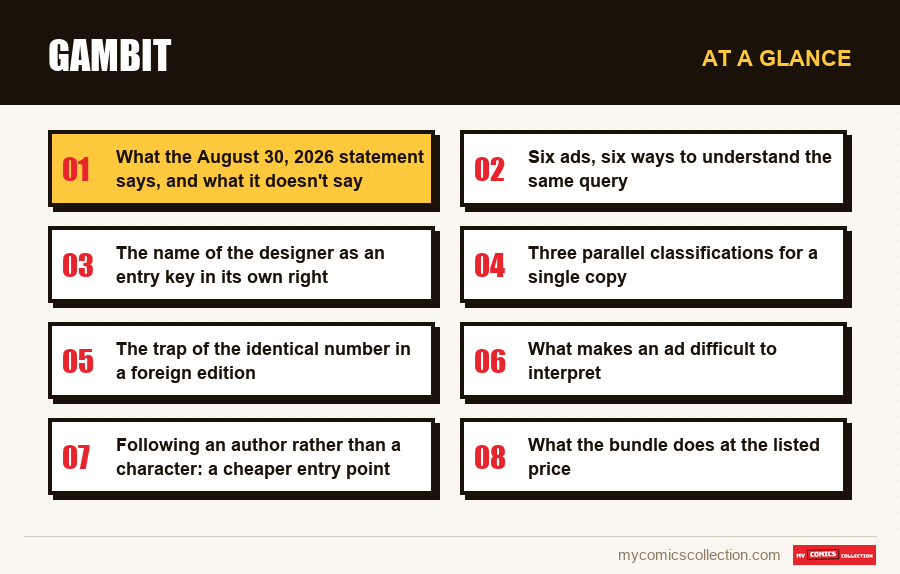
What the August 30, 2026 statement says, and what it doesn't say
Let's start by putting the figures with the precautions they require. The query "Gambit None of these amounts correspond to a concluded transaction: they are sums displayed by sellers who hope to obtain them, at the moment the statement was taken. A price asked and a price paid are two different objects, and confusing the two is the first possible misinterpretation.
Second precaution: 23 announcements are a modest number. On such a narrow basis, the central value of $125.00 describes the average ask position of the day, nothing more. It does not say where the balance point between buyers and sellers is, and it would not stand to be presented as a reference level. As for the maximum of $495.00, it reflects the ambition of an isolated seller; a single copy displayed twelve times more expensive than the cheapest on the list does not redefine a market, it simply broadens the range of hopes.
Third precaution, the most important: this reading was taken on a single date. A single measurement has no derivative. It cannot rise, nor fall, nor stabilize, because there is no previous point with which to compare it. Any sentence like “the stock is going up” or “the rating is going down” would be a pure fabrication here. What we have is a photograph of the offer displayed on a Sunday in August 2026, useful for understanding how the market is organized, silent on the direction it is taking.
Six ads, six ways to understand the same query
The list of cheapest unverified ads is more informative than the price range, because it shows what a results page actually looks like. At $2.00, the bundle is named after the cartoonist. At $2.16, « X-Men #8 (1992) VF Newsstand », which corresponds well to the booklet sought. At $2.50, « Friendly Neighborhood Spiderman Vol. 1! U Pick! », which has nothing to do with it: another title entirely, put together by the mechanics of research. Also $2.50, « X-Men #8 (Marvel Comics May 1992) », which also matches. And at $2.71, « Essential X-Men #8 FN/VFN (1996) Marvel Comics UK », a British reissue magazine which also has a number 8.
The lot classified in the name of the designer
At $2.00, this ad places an entire stock under a graphic signature and lets the buyer compose their selection. The price displayed is that of an entry point, not that of a specific copy: what you will actually pay depends on the numbers selected and the seller's grouping scale.
The American issue of 1992
Two advertisements designate it unambiguously, at $2.16 and $2.50, one specifying the state and the distribution circuit, the other indicating the publisher and the month of publication. These are the two lines in the statement that literally answer the initial query.
The unrelated title
At $2.50, an offer for a completely different series arrives in the same list. It is neither misleading nor malicious: it simply shares enough words with the query to be escalated. She reminds us that a results page is not a validated selection.
The British reissues magazine
At $2.71, a 1996 publication published in the United Kingdom is also numbered 8. Nothing in the number indicates that it is a compilation published in another country. This is the most discreet trap in the survey, and the easiest to commit in good faith.
These five lines are not distinguished by their price: they all fit within a range of seventy-one cents. They are distinguished by what they are. A bundled author offer, two copies of the booklet in question, a series foreign to the subject and a reissue foreign to the country. In other words, out of five proposals under three dollars, only two correspond to what the request asked for. Sorting here is not done by amount. It is done by reading the title, line by line.
A low amount is never enough information to decide. In this survey, the five least expensive advertisements are less than a dollar apart while designating four different objects: an author's lot, the American issue, another series and a British reissue. The price gap says nothing about the nature gap.
The resulting practical rule is simple: before comparing two prices, you must have established that the two advertisements relate to the same object. Until this verification is made, a numerical comparison is meaningless, regardless of the apparent precision of the amounts.
The name of the designer as an entry key in its own right
Let's return to the $2.00 ad, because that's the crux of the argument. Its title combines the title of the series, the name of a designer, that of the publisher, a year and an invitation to compose your own selection. The seller thus indicates that he has a homogeneous whole, and the homogeneity he claims is not narrative: it is graphic. What connects the fascicles of his stock is not a continuous plot, it is a hand.
For a buyer, this opens a door that character search leaves closed. A collector who only ever queries “Gambit” will not see this lot rise in its usual results, since the character's name does not appear there. You have to remember to query the name of the author to come across it. Conversely, someone who follows a designer will see series appear that they would not have thought of, because the same signature has circulated from one title to another. The search key literally determines the scope of what can be found.
This mechanism has nothing specific to a name or an era. As soon as an author is identifiable and sought after, sellers have an interest in grouping together what they have of him, because this gives them a selling point where isolated issues have none. Classification by author is thus a commercial response to a real need: there are buyers whose unit of collection is neither the series nor the character, but the work of a person.
We must measure what this implies for the search. The same ad can be invisible for three requests and visible for a fourth, without anything in the subject itself having changed. It's not the stock that varies, it's the angle from which you look at it. A collector who uses only one key is therefore working structurally on a portion of the market, and he has no way of knowing what he is missing until he has tried another entry.
Three parallel classifications for a single copy
The important point is that none of these rankings replace the others. A booklet simultaneously belongs to a series, which gives it its title and number; to one or more characters, who determine the community of readers who are looking for it; and to a creative team, which gives it its look and its authorial value. These three affiliations coexist in the same physical object, and they are not deduced from each other.
It is exactly for this reason that an inventory sheet which only records one of these three dimensions deprives itself of the other two. A database that only knows the title and number will never be able to answer the question “what copies do I have by this designer?” ". A database organized by character will not be able to say “which series have I discovered by following this scriptwriter?” ". And a database classified by author alone will not be able to reconstruct a continuous series. The missing information cannot be recovered after the fact without reopening the boxes.
This apparent redundancy is actually what makes a collection searchable. The same copy must be able to be found from three different paths, because we do not know in advance by which path we will look for it. When a collector wonders if he already owns an issue, he sometimes thinks "number 8", sometimes "the one with Gambit", sometimes "the one I found so beautiful". Three thoughts, three inputs, one object.
The practical consequence is seen at the time of group purchasing. If you acquire several issues in a batch stored in the name of a designer, the common origin of the batch is information which disappears immediately if it is not noted. Six months later, the copies are scattered in the storage by series, and there is no longer any reminder that they arrived together, for the same reason, at the same average unit price. This loss is silent and definitive.
The trap of the identical number in a foreign edition
The British magazine of reissues raised to $2.71 deserves a separate discussion, because it illustrates a confusion that nothing indicates to the buyer in a hurry. It is a 1996 publication, published in the United Kingdom, and bears the number 8: the same number as the 1992 American issue sought. Two distinct objects, two countries, two dates, a single number.
A serial number is not a universal identifier. It only makes sense within the series that carries it, and it restarts with each new publication. A reissue compiled for another market receives its own numbering, which does not follow that of the original edition and has no guaranteed correspondence with it. The content of a British issue 8 is not necessarily that of the American issue 8, and may group together several episodes or cut out a single one.
The trap is all the more ordinary because it does not imply any bad faith. The announcement is honest: it indicates the year, it indicates the country, it indicates that it is a publication of reissues. Everything is written. What is missing is the vigilance of the reader who scanned the results, stopping at the title and the figure. When two lines read "X-Men" and "8", the eye concludes that they mean the same thing, and it is wrong.
The solution comes down to a habit: read the title to the end, and consider the country of publication and the year as part of the identity of the object, just like the number. A file that notes “X-Men No. 8” without further clarification becomes ambiguous at the very moment it is written, and will remain so. To explore this mechanism in more detail, see why the foreign edition has a different number.
Collecting this series?
Track what you own, what you are missing and what your collection is worth. 7 day trial.
Start my trial →What makes an ad difficult to interpret
The query decides which field is visible
Querying a character, a series or an author does not return the same ads. An offer listed under a designer's name remains invisible to those who only search by character, even though it may contain exactly the desired booklet.
A single date is not a trend
The statement for August 30, 2026 provides a snapshot of the offer posted that day. Without a prior point of comparison, it does not allow any assertion about a price movement, in one direction or the other.
Price claimed ≠ price paid
The 23 verified copy listings range from $39.99 to $495.00. These are pending requests. The maximum reflects the hope of a seller and does not constitute a market reference.
The bundle hides its unit price
A $2.00 ad that invites you to choose your numbers displays a call threshold, not a rate. The actual cost per copy depends on the selection chosen and the grouping scale applied by the seller.
The same number, two publications
A British magazine from 1996 and an American booklet from 1992 both bear the number 8. The number alone is never enough to identify a copy outside its series and country of publication.
A foreign title in the list
An ad for a completely different series appears among the cheapest results. Nothing automatically excludes it: it is up to the reader to exclude what does not correspond to what they are looking for.
Following an author rather than a character: a cheaper entry point
There is a pleasant consequence to this parallel classification. A reader who decides to follow a designer rather than a character creates a perfectly coherent reading path, and he generally does so at a lower cost. The copies he's targeting aren't necessarily the ones that carry an event premium: first appearance, pivotal episode, issue that everyone is clamoring for at once. They are ordinary fascicles of an ordinary series, the only common point of which is the hand which drew them.
The statement shows this in detail: the cheapest ad on the list is precisely the one in the name of the author, and it offers to compose your own selection. This is a $2.00 entry into a stock. Nothing like the verified copy range, where requests start at $39.99. The two worlds coexist on the same results page and are not aimed at the same buyer.
This path has another merit: it teaches how to look. A collector who brings together booklets around the same designer ends up identifying constants of composition, framing, treatment of faces, which no reading by plot reveals. He learns to recognize a board before reading its signature. It's a reader's skill, and it can be built without a particular budget.
Finally, it has the advantage of availability. Highly Demanded Episodes are rare by construction, since their rarity is what makes them in demand. The episodes that an author has simply drawn over the course of his time on a series are abundant. A collection project built on this abundance progresses quickly, which is far from negligible when you are starting out. See also how to buy X-Men without leaving your budget behind, and the hub dedicated to Jim Lee to browse what is linked to this signature.
What the bundle does at the listed price
A “pick your numbers, bundle and save” type of offer works according to a logic that must be understood before comparing anything. The amount highlighted is that of the cheapest item in stock, the one which allows the lowest possible threshold to be displayed in the results. It plays a calling role: it attracts the click, and that is its function.
What the buyer will actually pay depends on three things that the ad doesn't summarize in a number: the numbers he chooses, whose individual prices vary within the same lot; the bundling scale, which reduces the marginal shipping cost as the selection grows; and the total number of copies retained, which determines the point at which bundling becomes advantageous. The actual unit price only appears once the order is placed.
This does not make the formula bad, on the contrary. For a collector who has several holes to fill in the same series or around the same author, the bundled offer is often the most economical route on the market. But it imposes a recording discipline: when the order arrives, you must distribute the total cost over the copies received and note this real unit price in each person's file. Without this, the collection will contain copies that no one will ever know what they cost.
The same reasoning applies to everything that accompanies the booklet in the package. The elements inserted at the time of publication count in the identity of the copy, and their presence or absence is noted upon receipt: see why the inserts are part of the booklet. Likewise, the way in which a character was constructed sheds light on what we are trying to bring together:mystery as a concept en donne un aperçu.
What to note when purchasing comes from an author rating
The designer and the screenwriter, when they are the ones who motivate the purchase. If the booklet enters the collection because it bears a specific signature, this signature is the reason for the existence of the card and must appear explicitly there. A copy acquired for its design and registered under its serial number alone becomes, a few months later, indistinguishable from a copy purchased for any other reason. Naming the two roles separately also allows us to find a reading path built on a screenwriter even though the drawing changes during the series.
The exact series and number, including when the ad did not highlight them. An offer placed in the name of an author may not specify the number in its title, since the buyer chooses it himself. It is therefore upon receipt that you must note the full title of the series and the number on the cover, and write them down as they are. The seller's storage logic does not become the collection's storage logic: what enters the file is the identity of the issue, not the way in which it was presented at the time of purchase.
Le pays d'édition, systématiquement. The survey contains a British publication of reissues which bears the number 8, exactly like the American issue in question. Writing “No. 8” without mentioning the country creates an irreparable ambiguity in its own base, and makes any subsequent verification impossible. The country of publication is not a scholarly precision: it is what distinguishes two objects that the number alone makes identical.
The actual unit price when the item comes from a bundle. The amount displayed in the ad is a call threshold, not the cost of the booklet received. It is therefore necessary, once the order arrives, to break down the total paid for the copies obtained and enter this result in each form. Without this distribution, the collection accumulates entries whose cost can no longer be reconstituted, and we lose all ability to compare a future purchase to what we have actually spent in the past.
The condition observed by oneself, upon receipt. An ad may mention a state, or none at all: several lines of the statement contain only the title, year and publisher. What the seller wrote remains his description; what must go into the form is what we saw when opening the package, copy in hand. Recording the condition at this precise moment sets a dated reference point, useful for everything that follows: conservation, possible resale, or simple observation of deterioration.
Because it gives them a selling point that isolated numbers don't have. An ad like the one raised to $2.00 on August 30, 2026, which puts the name of a cartoonist before the publisher and the year, is aimed at a buyer whose unit of collection is the work of a person rather than a plot. This classification responds to a real demand: there are collectors who follow a hand from one title to another.
No. An offer titled in the name of an author does not necessarily contain the name of the character, and will therefore not come up in a search by character, even if it contains exactly the desired booklet. It is the search key which delimits the visible field. Questioning the series, the character and the author successively gives three different lists, the overlap of which is often partial.
They describe the offer posted on August 30, 2026, from $39.99 to $495.00, with a central value of $125.00. These are requested amounts, not closed sales. Twenty-three announcements also constitute a modest number: on such a narrow basis, no conclusion on a price level would be tenable, and a measurement taken on a single date obviously does not allow any development to be noted.
By treating the country of edition and the year as components of the identity of the copy, in the same way as the number. The survey contains a 1996 British issue of reissues numbered 8, like the 1992 American issue sought. Nothing in the number itself distinguishes them. Only a complete reading of the title, then verification upon receipt, allows a decision to be made.
Often yes, for those who have several gaps to fill at once, but the amount displayed is not the price of a copy: it is the stock entry threshold. The actual cost depends on the numbers selected and the seller's grouping scale, and is only known once the order is placed. It is then necessary to distribute the total paid over the copies received to have a usable unit price.
A file that remembers the author, the series and the country
A copy belongs to a series, a character and a creative team at the same time. My Comics Collection records these three dimensions in the same file, with the price paid and the condition noted upon receipt, so that each issue remains findable by the path you will think of later.