
Gambit arrives in 1990 with an untold past. This emptiness is not an accessory of the character: it is his definition. A hero built on secrecy is caught in a trap with three exits, and all three close. Revealing everything trivializes it, revealing nothing tiredly, revealing bits and pieces transforms waiting into a recognized writing defect. On the market side, a statement from August 29, 2026 on its first issue shows sixty-three ordinary advertisements demanding from $9.99 to $583.47, median $199.99, and one hundred and eighteen verified copy advertisements demanding from $94.99 to $9,999.99, median $339.22: these are amounts requested on a single date, not sales concluded, and a single date does not show any trend.
There is a category of characters about whom we cannot say what they are without starting with what we do not know about them. Gambit has been there since 1990. His profile, if one tried to write it honestly, would have a blank line in the most important place, and this blank line would be precisely what catches the attention. Readers do not first remember his abilities or his appearance: they remember that he drags something unsaid behind him, and that this something is presented as serious.
The device seems innocuous. He is not. A character whose main argument is a secret contracts a narrative debt from his first panel, and this debt bears interest. Each appearance where the secret is recalled without being paid increases the amount owed. Each author who takes up the character inherits the balance from his predecessor, without having chosen to borrow it. And the day someone decides to settle the accounts, the payment is necessarily lower than the sum claimed, because this sum was fixed by the imagination of thousands of readers and not by the screenwriter. This is the subject of this article: understanding why the mystery works so well as a plot and so poorly as a structure.
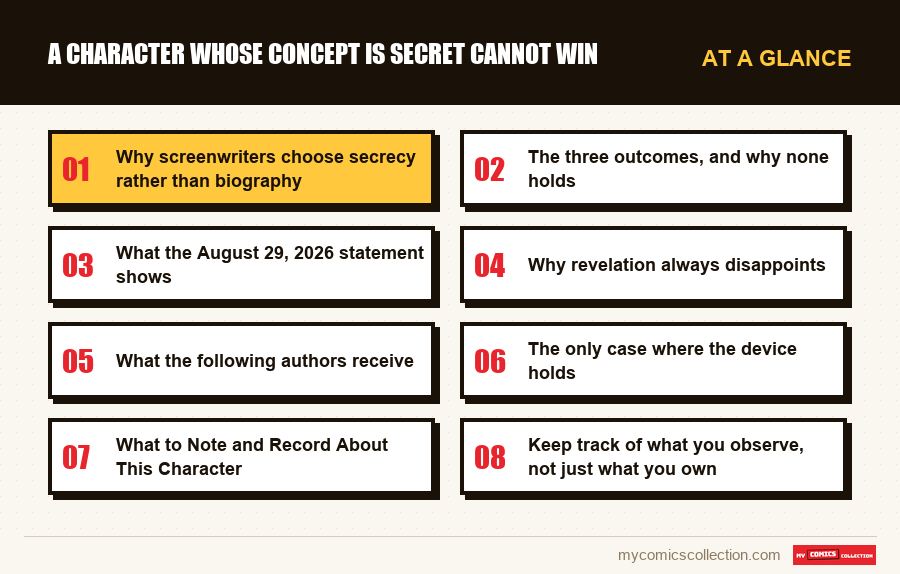
Why screenwriters choose secrecy rather than biography
Writing a past requires decisions. You have to name a city, a job, a family, a mistake, and each of these decisions closes doors. A character with a complete biography immediately becomes less flexible: you can no longer make him appear anywhere, he carries dates and consequences. Secrecy closes nothing. It creates permanent tension and does not commit the author to any content. It is an investment whose initial cost is zero and the return is immediate.
The second advantage is more subtle: secrecy makes a character interesting before we have decided what he is. A newcomer to an established team must find their place, and finding it takes time; the reader must learn to be interested in him. A heavy past bypasses this stage. The character is immediately given a depth that he has not yet merited, because the reader assumes that such a carefully guarded secret necessarily conceals something considerable. Depth is postulated, not constructed.
The third advantage is structural. A secret shared between the character and the reader creates complicity; a secret kept in front of the reader creates anxiety. In the second case, each ordinary scene takes a second reading: is the character silent because he has nothing to say, or because he has something to hide? The author gets gratuitous ambiguity into sequences that would otherwise be flat. No other narrative tool produces so much effect for so little writing.
These three advantages explain the massive adoption of the process and its maintenance over the years. They also explain why no one, at the moment, perceives the problem. A device that costs nothing to install gives the illusion that it will cost nothing to dismantle. It's the opposite: the lighter the installation, the more expensive the demolition, because nothing has been planned to organize it.
The three outcomes, and why none holds
Reveal all
Full revelation transforms a character defined by a question into a character defined by an answer. Now a response is an ordinary fact: it occupies a few pages, it is assimilated, and the next day it becomes part of the decor. What distinguished the character from the other members of his team was spent in one episode, with no replacement planned.
Never reveal
Indefinite silence works for a few years, then becomes visible as silence. The reader stops wondering what's behind it and starts wondering if the authors know it themselves. At this tipping point, secrecy no longer produces tension: it produces suspicion towards the writing, which is the opposite of the desired effect.
Révéler par fragments
The middle ground is to deliver bits and pieces, an allusion here, a half-confession there. It prolongs the tension, but each fragment is an additional promise. After a certain number of fragments, the reader no longer counts the clues: he counts the missed appointments, and the process switches from figure of speech to recognized lack of writing.
The fourth outcome, which is not one
What remains is the rewriting: declaring that the previous version was false and proposing another. She postpones the deadline but destroys the only thing that gave weight to the secret, the certainty that it bore on a real fact. A revisable past is no longer a past, it is a variable, and a reader does not worry about a variable.
This table is not a criticism of this or that screenwriter. This is a property of the device itself. A narrative secret is a non-renewable resource: we can choose the speed at which we consume it, not avoid consuming it. Any appearance of the character takes part of the stock, including appearances where the past is not mentioned, since the reader continues to wait. The counter runs even when the author is not using it.
A precision that applies to everything that follows in terms of numbers. The amounts cited come from a survey carried out on August 29, 2026 on the advertisements published for the first issue of the character. These are sums that sellers ask for, not sums that buyers have paid, and copies passed by a verification body are counted separately from ordinary copies.
A reading taken on a single date cannot, by construction, show any movement: it would take at least two spaced readings to speak of an increase or decrease, and I only have one. Likewise, the highest amount in a list tells nothing about the level of transactions; it reflects the hope of an isolated seller. The median is the only value that resists this kind of noise, because an extreme does not move it.
What the August 29, 2026 statement shows
On this issue, the count is unusual in a specific sense. Listings for regular copies number sixty-three, with requests ranging from $9.99 to $583.47 and a median value of $199.99. There are one hundred and eighteen advertisements for copies passed by a verification body, from $94.99 to $9,999.99, median $339.22. The usable fact is the ratio between the two numbers: one hundred and eighteen against sixty-three, almost double.
Worded carefully, this says one thing and one thing only: in this booklet, the verified offer largely dominates the ordinary offer. This is not a general observation on the numbers sought, it is not a measure of the ease of reselling, and it is not information on the direction of prices. It is a snapshot of the composition of the offer at a given moment, on a single title. Any extrapolation beyond this sentence would be invented.
The difference between the two medians, approximately one hundred and forty dollars, merits the same caution. He does not compare the same object twice: a verified copy is accompanied by an evaluation of its condition, an ordinary copy is not, and the description that the seller gives is his sole responsibility. Comparing the two medians therefore amounts to comparing two markets which do not have the same entry rules, not to measuring additional value.
The most useful point for a collector is elsewhere, in the amplitude. On the ordinary side, from the lowest to the highest, the ratio exceeds fifty times. Verified side, it exceeds a hundred times. Such a dispersion means that no single figure represents this fascicle: saying “it is worth such and such an amount” has no meaning here, only a range accompanied by a state condition at a. This is exactly the kind of nuance that ready-made lists of values erase.
Why revelation always disappoints
Let's assume the best-case scenario: a talented author finally decides to write the character's past, and he writes it well. Disappointment still happens, and for a reason that has nothing to do with the quality of the text. During the years of silence, each reader filled in the blank in their own way. He did not wait for a revelation: he made one, adjusted to what troubles him personally, and therefore perfectly calibrated for him. No written version can beat a version tailor-made by its recipient.
There is a second, more arithmetic mechanism. Accumulated wait is a quantity that grows over time; revelation is a fixed quantity, limited by the number of pages that can be devoted to it. The longer the wait, the wider the gap between the two. A secret kept for two years can be paid for; a secret kept for twenty years can no longer be kept, because there is no event serious enough to justify twenty years of evasion.
The third mechanism relates to the nature of the content. To be up to the task, the revelation must be terrible; to remain compatible with a character that we want to continue to follow, it must remain forgivable. These two requirements contradict each other. Too heavy, it makes the character inaccessible and requires contortions to rehabilitate him; too light, it does not justify the previous silence and makes the character appear as someone who was dramatizing. The space between the two is narrow and shrinks as the wait lengthens.
Finally, the revelation retroactively changes the meaning of the episodes already published. Scenes that functioned on ambiguity become readable in only one way, and this unique reading is often less rich than the one attributed to them. The reader not only loses the future of the mystery, he loses part of his reading past. It’s this double dipping that makes the feeling of loss so enduring.
Collecting this series?
Track what you own, what you are missing and what your collection is worth. 7 day trial.
Start my trial →What the following authors receive
A main trait already spent
The author who picks up the character after the reveal inherits someone whose most cited characteristic no longer exists. He must reconstruct one, without being able to delete the one that has been consumed, since it remains in the readers' memory as the reference identity.
A cluttered timeline
The past, once written, becomes a constraint of date: everything we say must now agree with it. What was a free zone where you could place anything becomes a corridor with walls, and each new idea must check that it fits there.
A frozen reputation
The character remains labeled by the revelation long after it has ceased to be told. Summaries, presentations, reading notes mention it first, and an author who would like to work on something else comes up against an already formed expectation among the reader.
An unbalanced stock of episodes
The previous apparitions are divided into two blocks of unequal value: those which fueled the mystery and those which came afterwards. The first ones are difficult to reread once the answer is known, which damages the coherence of the whole for a new reader who discovers everything suddenly.
A scrambled number hierarchy
The identification of important episodes is reorganized around the revelation, while the episodes which prepared the ground lose their status. For those who follow a series over time, the map of passages not to be missed changes without warning, and the old benchmarks become misleading.
A temptation to start again
For lack of anything better, the next author is encouraged to reinstall a secret to regain the lost tension. The second secret works less well than the first, because the reader has already seen the mechanism work and knows how it ends.
The only case where the device holds
All of the above describes a secret relating to a fact: an act committed, a concealed identity, a former affiliation. This type of secret is perishable because a fact, once stated, is definitively stated. There is, however, a variant which is not exhausted, and it deserves to be distinguished carefully, because it closely resembles the other from the outside.
This variant shifts the question. She no longer asks “what did he do”, but “which side is he on”. The secret no longer concerns an event of the past, it concerns a present disposition: the loyalty of the character, what he will choose when the two camps he cares about oppose each other for good. This question has no definitive answer, because today's answer does not bind tomorrow's answer. It can be placed indefinitely without ever being sold.
The practical difference is clear. A factual secret reveals itself once and disappears; a secret disposition is replayed in each new situation, and each response calls for another. The character who betrays then redeems himself has not exhausted the question, he has fueled it: the reader now knows that he is capable of it, which makes the next time more tense and not less. The resource is replenished instead of being consumed.
This variant also has the advantage of not requiring anything improbable. A factual secret must be enormous to justify its maintenance; an ambiguity of loyalty needs no enormity, only consistency of behavior. It survives creative team changes, because it doesn't ask the next writer to know a story: it asks them to put the character in an uncomfortable position, which any plot can provide.
A character constructed this way has no score to settle. It does not accumulate debt, it has no revelation to prepare, it does not condemn its future authors to inherit a void that they will have to fill or maintain. It is the only form of the process that has survived the decades without turning against the person who uses it, and it is also the one that we notice the least, precisely because it never promises anything.
What to Note and Record About This Character
Separate, in your follow-up, the mystery episodes and the revelation episodes. These two blocks do not read in the same way and do not lend themselves to the same use. A reader who discovers the character today benefits from knowing which ones set up the question and which one answers it, otherwise he will approach the first ones already knowing the ending, which deprives them of their effect. A simple mention in your notes, installation episode or resolution episode, is enough to preserve the reading order.
Note the offer ratio observed on the first issue, with its date. One hundred and eighteen advertisements of verified copies for sixty-three ordinary advertisements, taken on August 29, 2026: this is a state of the offer, not a permanent characteristic of the title. Registered without its date, this report becomes a false fact in six months. Recorded with it, it becomes a usable point of comparison the day you have a second one.
Record the amplitude, not a single value. On this booklet, requests range from $9.99 to $583.47 on the ordinary side and from $94.99 to $9,999.99 on the verified side. Using the median alone, $199.99 on one side, $339.22 on the other, gives a false impression of precision. What protects against a bad purchase is knowing that the same number is requested at levels separated by a factor of one hundred depending on the status displayed.
Distinguish, copy by copy, what is verified from what is described. For this character more than for others, your inventory will mix the two, since the verified supply is in the majority on this date. An item whose condition is based on the seller's description and an item rated by an organization do not occupy the same position in a collection, even if they have the same number. The field that separates them must exist from the first entry.
Date each of your price observations as an observation, not a value. An amount recorded on a day is the price asked for that day by a given seller. Writing “value: $199.99” in an index card creates a certainty that does not exist; writing “requested on August 29, 2026, median of sixty-three announcements” creates reusable data. The difference between the two formulations decides what your grades will be worth in five years.
Because the absence of a past immediately produces the effect that a biography would take years to construct. The reader assumes that a sustained silence conceals something important, and he grants the character a depth that has yet cost no one anything. This is an extremely effective writing shortcut, provided you accept that it will have to be paid for later.
It may be well written, but it cannot satisfy. During the wait, each reader made their own version, adjusted to what touches them, therefore unbeatable. The published version arrives in the face of thousands of personal versions better suited to their recipient than it ever could be. Disappointment is not a lack of execution, it is a consequence of the system.
This means exactly one thing: on this issue, as of August 29, 2026, the verified offer largely dominates the ordinary offer, one hundred and eighteen advertisements against sixty-three. This observation concerns the composition of the offer on a date, on a security. It says nothing about ease of resale, nothing about a trend, and it does not translate to other numbers.
No. An isolated maximum reflects the hope of a single seller, not an observed level. On this same listing, verified copies are asking for $94.99. The value that resists this kind of extreme is the median, $339.22 on the verified side, and even then it is only a request made that day, not a completed transaction.
Yes, the one which concerns a provision and not a fact. As long as the question is "which side is he on" rather than "what has he done", no answer closes the subject: each choice of the character revives the uncertainty instead of extinguishing it. This is the only variation that does not leave a gap for subsequent authors to fill.
Keep track of what you observe, not just what you own
A number asking for between ten and almost ten thousand dollars depending on the condition is not just an inventory line. My Comics Collection allows you to record actual condition, the distinction between verified and described copy, and your dated statements, so your grades remain true a year from now.