
A detachable insert (collectible card, folded poster, cut-out coupon) is part of the copy as it was sold. It is removed without leaving a visible trace on the cover, and two copies bearing the same number may therefore differ without the photo showing it. On a Gambit ad survey carried out on August 30, 2026, only one in five adverts specifies that the supplement is there; the others remain silent, which affirms neither its presence nor its absence. The practical consequence is simple: a collection sheet must carry a completeness field with three states (present, absent, unverified) and “unverified” must remain an acceptable response.
There is a category of difference between copies that no cover photograph can resolve. The paper is the same, the number is the same, the apparent condition is the same, and yet one of the two objects is missing an element that belonged to it at the time of its sale. This is the case for any booklet delivered with an inserted supplement: a sheet of collectible cards slipped between two notebooks, a poster folded in four in the center, a coupon to cut out at the bottom of an interior page. These elements were designed to be detachable. Many have been. And the cover has no memory of it.
The character of Gambit offers a convenient field of observation for this mechanism, not because he is a special case, but because the titles which bear his name go through a period when inserted supplements were a common editorial practice. A survey of current advertisements conducted on August 30, 2026 on a general auction site in the American market shows to what extent information on these supplements circulates poorly: it appears when a seller chooses to give it, and disappears everywhere else. This text describes what this statement allows us to assert, what it does not allow us to assert, and how a collector can draw from it a rule for keeping a record.
What exactly the August 30, 2026 statement says
Before any interpretation, it is necessary to establish the nature of the figures. What was observed were advertisements published and still open on this date: sums that a seller displays and hopes to obtain. None are a done deal. An amount requested and an amount paid are two distinct quantities, and the first only provides information on the intention of the person who sets it. Furthermore, the measurement was taken only once, on a single date: it shows by construction no movement, neither increase nor decrease, and any reading of the trend here would be a pure invention.
The query “Gambit Gambit 1 1999” gathered 175 listings without certification, ranging from $0.99 for the lowest to $249.95 for the highest, with a central value of $9.99. The copies verified by an organization were counted separately, as they should since they do not compare to the rest: there are only 11, between $48.00 and $125.00, with a central value of $75.75.
Eleven announcements are too few. A workforce of this size becomes completely distorted as soon as a seller removes or adds a part, and no conclusions about a price level of the verified examples can be drawn from it. I point it out here and I will stick to it: the figure is reported because it was measured, not because it demonstrates anything. Likewise, the maximum of $249.95 does not designate any observed price; it's the top of a scale of expectations, and it only takes one optimistic salesman to produce it.
Five announcements at the bottom of the ladder, and what they reveal
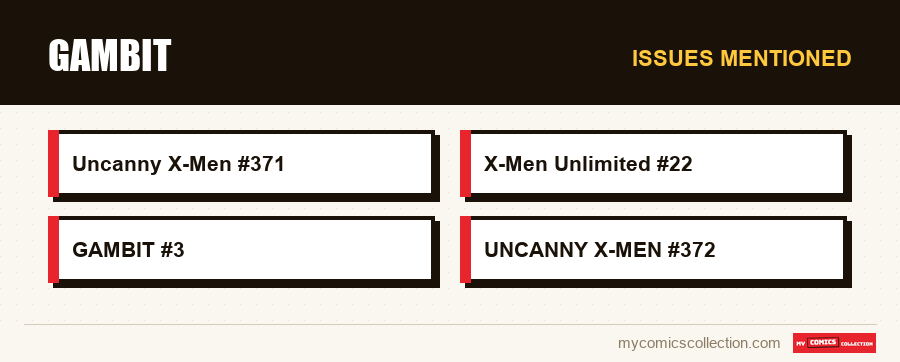
The most instructive thing about this statement is not the dispersion of the amounts but the content of the labels. The five cheapest ads were read one by one, and their composition says more than any average.
A title that is not the one sought
The cheapest ad, at $0.99, is for "Uncanny X-Men #371 NEWSSTAND (1999) [...] Mid Grade." It comes up because the name of the character appears somewhere in its textual environment, not because it concerns the book in question. A second ad at $2.99 is under the same title, under number 368, and a third is on “X-Men Unlimited #22 - Rogue, Gambit, Higher Grade VF/NM” at $2.50.
A declared structural defect
At $2.03, the ad “GAMBIT #3 detached staple” advertises a detached staple. It is a defect which does not appear any more in a front photo than the absence of an insert: you must open the booklet or trust the person who describes it. The seller chose to say it, and this short sentence is worth more than a long status adjective.
An explicitly present supplement
At $2.99, “UNCANNY X-MEN #372 NM MARVEL COMICS 1999 GAMBIT WITH GOT MILK?” TRADING CARDS” indicates that the copy is accompanied by its collectible cards. The seller opened, looked, noted, and recorded the finding in his title. This is exactly the gesture whose absence renders all other examples indeterminate.
The silence of the vast majority
Only one in five ads mentions the insert. The other four don't talk about it, and this silence means nothing. It does not mean that the supplement is there, nor that it is missing. He means that the question was not asked, or that the answer was not deemed worthy of writing.
The lesson is in one sentence: the only two truly descriptive ads in the set are the one that declares a defect and the one that declares an extra charge, and those are two ads for less than three dollars. The quality of a description does not match the amount requested. A seller who demands a lot has no obligation to say more, and nothing in this statement suggests that he should do so.
A seller who mentions the insert tells you two things: that the supplement is there, and that he took the trouble to check it. This second point matters as much as the first, because it tells you about the reliability of everything else in its description.
Conversely, a silent seller hides nothing. He simply did not produce the information. It remains available: just ask for it before purchasing. A question asked in writing, the answer to which is kept, transforms uncertainty into data.
Why the question seems futile, and why it is not
On a three-dollar booklet, there is something absurd about wondering about the presence of a sheet of cards. The item costs less than a coffee, the insert will make no difference to what you pay, and the energy spent writing to the seller far exceeds the financial stakes. This objection is fair, and it would be dishonest to brush it aside.
However, it ceases to be valid as soon as the same mechanism applies elsewhere. The principle (a detachable element, removed without visible trace, absent from the photo) depends neither on the price nor the era. It is valid for an old booklet containing a cut-out coupon, for a central poster of an anniversary number, for any piece sold with a separable accessory. What is at stake at three dollars on a current example is at stake on a completely different scale on a sought-after example, and the collector who has become accustomed to asking the question about the former will naturally ask it about the latter.
This is why it is better to acquire the reflex where it costs nothing. A habit is not invented the moment it becomes profitable; it is built on cases without issues, and it is available the day the issue appears. The three-dollar booklet is an ideal training ground, precisely because a mistake is harmless.
It should be added that the question does not always have a clear answer. Some issues have never included a supplement, and it would be ridiculous to look for one. Others included one whose presence is today more frequent than its absence. Knowing whether the booklet you are looking for belonged to the first or second category is a prerequisite, and this is information that is part of documentary work, not advertising.
A misleading median: when the statement mixes several titles
The central value of $9.99 observed on the 175 unverified ads deserves to be looked at closely, because it does not say what we think. Three of the five cheapest ads examined are for titles different from the one searched. A character's name appears in the titles of several series, in participation descriptions, in keywords that sellers add to expand their audience. A query based on this name therefore picks up a mixture.
This contamination is not a marginal accident: it affects the distribution environment. A median calculated on a heterogeneous set describes the heterogeneous set, not the targeted fascicle. It is not false: it simply answers a question other than the one asked. Taking $9.99 for “the price of this booklet” would be a reading error, not a calculation error.
The same caution applies to the top of the ladder. A maximum of $249.95 in a mixed set can denote a lot, a variation, a particular edition, or simply a single seller's expectation. Nothing in the statement allows us to decide, and we must therefore refrain from deciding.
This phenomenon has a cousin that is worth knowing: the same issue can have different numbering depending on the market, which further confuses the statements. The question is developed in the foreign edition has a different number, and it combines with that of the inserts to make certain comparisons frankly risky.
Invisible defects on a cover photo
The missing insert is just one member of a larger family. The statement yielded a second example, with the loose staple declared at $2.03. The common point of these defects is structural: they concern the interior or the way the notebook is held, and a front photograph, even excellent, does not reveal them. Here are the main ones, with the question to ask for each one.
The supplement inserted
Collectible cards, insert advertising leaflet, cutting board. It can be removed with one gesture and leaves no mark on the cover. The question to ask: is the original supplement still in the booklet?
Le coupon découpé
Some interior pages had a return slip. Its cutting leaves a hole in the page and often an amputation on the back. The question to ask: are all the interior pages complete?
The central poster
A folded double page, designed to be detached and pinned. Removing it weakens the notebook and may damage other pages. The question to ask: is the centerfold in place and attached?
The detached staple
The defect explicitly declared in the statement. The booklet appears intact when closed, but the notebooks no longer hold together. The question to ask: are the staples holding the pages, and is the paper around them torn?
La pagination incomplète
One or more pages torn off during handling. Nothing is seen until you count. The question to ask: does the number of pages correspond to the original one?
Interior annotations
Price listed, name of first owner, coloring on one box. Invisible on a photographed cover. The question to ask: does the booklet bear inscriptions, and where?
None of these questions are aggressive, and none imply bad faith on the part of the seller. They simply request information that has not yet been produced. A serious seller answers it in a few lines; a seller who refuses to answer has also given you useful information.
Collecting this series?
Track what you own, what you are missing and what your collection is worth. 7 day trial.
Start my trial →The field of completeness: three states, never two
All of the above converges towards a single practical consequence, and it concerns the way in which one keeps one's collection. If the presence of an insert changes the value of a copy, and if this presence is not legible in a photo, then the card must carry this information, and it must also be able to carry the admission that we do not know it.
A card with two states, present or absent, forces one to lie. The collector who has not opened his copy, or who bought it without asking the question, finds himself faced with a choice between two statements, neither of which is true. He will check one of the two at random, or leave the field empty, and in both cases the card will become less reliable than silence. A third state-unverified-solves the problem by making ignorance declarable.
This third state has a property that the other two do not have: it is revisable without contradiction. Going from “unverified” to “present” is an enrichment. Going from “present” to “absent” is a correction, that is, the admission of a previous error. The difference is psychological as well as documentary, and it determines the probability that the file will one day be updated.
What to note, and what to record
Note the state of completeness with three values, never with two. Each copy likely to have included a supplement must bear the words “insert present”, “insert absent” or “unverified”. The third term is not a stopgap: it is the most frequent and most honest value for a copy purchased remotely. A sheet that cannot express uncertainty will produce false certainty.
Record the exact wording of the ad at the time of purchase. The ad “with its collectible cards” and the silent ad are not the same, and six months later you will no longer remember which one you had in front of you. Keeping the seller's sentence, as it was written, freezes the state of the information at the time of the decision and allows us to know later whether the item was described or only shown.
Separately note the declared structural defect. A detached staple, like the one mentioned in the statement, belongs to the same family as the missing insert: it is invisible from the front and it changes the nature of the object. It deserves its own field, separate from the general condition assessment, because an otherwise very clean example can have this defect without the overall description suggesting it.
Record the date of your price statement and its nature. The amounts observed on August 30, 2026 are amounts claimed, taken only once. A sheet that keeps a price without keeping these two details transforms a one-off observation into a stable reference, which it is not. Write the date, write that these are requests and not sales, and write if the verified copies were counted separately.
Mark copies whose title identification remains doubtful. A statement based on a character's name mixes several series, as three of the five cheapest listings showed. If you are not sure that your card indicates the title and not a number of a neighboring series where the character appears, note it. A reported uncertain identification is infinitely better than an assumed false identification.
Ask the question before, rather than observing afterwards
The time when verification costs the least is before the purchase. Once the copy is received, the absence of an insert is no longer information but a dispute, and a dispute relating to an element which had been neither promised nor excluded is poorly resolved. The seller said nothing, the buyer asked for nothing, and no one is wrong.
The question to send is one line and requires no expertise: ask if the original supplement is still present in the booklet. It has three possible outcomes, and all three are exploitable. An affirmative answer gives you the information and tells you about the seriousness of the seller. A negative response allows you to renegotiate or give up knowingly. A lack of response is itself a signal, and leaves you free to move on.
This reflex is naturally part of a broader purchasing process, where we seek to pay the right price for a correctly identified object. The general principles of this approach are detailed in buy X-Men without breaking the bank, and the completeness check constitutes one of the least expensive and most profitable actions.
There remains one point on which we must remain modest. This statement describes a moment, on a platform, for a set of requests. It says nothing about what is happening elsewhere, nor what will happen. Its value is methodological: it shows how completeness information circulates (poorly, by exception, at the discretion of the seller) and this observation does not depend on any date.
A character whose editorial history makes it difficult to identify
Finally, a word must be said about the particular context in which these titles take place. The character appears in several regular series, in limited series, and as a secondary figure in the titles of the group to which he is attached. The same name therefore covers several parallel numberings, some of which restart at one.
This configuration has a direct consequence on the question of inserts: it increases the opportunities to confuse two objects. A supplement associated with a number in one series may be mistakenly assigned to the homonymous number in another. The completeness check therefore first assumes an exact identification, otherwise it relates to the wrong issue.
This part of ambiguity is not only documentary; it is also due to the construction of the character, whose opacity was a deliberate narrative force. The subject is covered in mystery as a concept, and it sheds light on why the titles devoted to him have multiplied in various forms. For the chronology of the series and their sequence, l'histoire éditoriale du personnage provides the framework in which to place each issue before questioning its content.
Identify first, verify then, record finally: the order is not indifferent. A completeness check carried out on a misidentified booklet produces false and lasting data, more harmful than a box left empty.
This information cannot be read on the amputated copy, since the removal leaves no trace on the cover. It comes under the editorial documentation of the title, which can be consulted in the catalog or in the descriptions of complete copies. Some advertisements give it involuntarily: the one which specifies “with its collectible cards” attests at the same time that the booklet included them.
No, and that's an important point. On the statement of August 30, 2026, only one in five advertisements mentions the supplement. The silence of others reflects an absence of information, not a concealment: most sellers did not open the copy or did not consider the detail useful. It is up to the buyer to ask the question, and there is nothing to interpret the silence one way or the other.
No. Eleven announcements constitute too small a number to support a conclusion: the removal or addition of a single piece would significantly shift the whole. The values recorded, from $48.00 to $125.00 with a midpoint at $75.75, are reported because they were measured, not because they establish a level. These are amounts requested, not sales concluded.
Because the query mixes several series. Three of the five cheapest listings examined are for other titles, bumped up because the character's name appears in their wording. A median calculated on this mixture describes the mixture, not the specification sought. The figure is not false, it answers a different question than the one asked.
Yes, because the two do not mean the same thing. An empty field may result from an oversight, a file created too quickly or lost data. "Not verified" is an explicit statement: you know the question exists and you know you haven't answered it. It is a revisable state without contradiction, whereas a “present” checked by default will one day have to be corrected.
Keep the completeness of each copy in its file
An insert present, absent or not verified, a structural defect declared by the seller, the exact wording of the ad and the date on which you read it: this is information that is lost in a few months if it is not written anywhere. My Comics Collection allows you to attach them to each issue, find them instantly and correct them as you check.