The same Gambit story can circulate under two different numbers depending on the country of publication: where the American edition displays Uncanny X-Men 266, a Brazilian edition of the same content is numbered 65, because the series was relaunched there from its own first issue. Direct and verifiable consequence in the statement of August 30, 2026: of the cheapest advertisements for the query “Gambit Uncanny X-Men 266”, only one gives the correspondence between the two numberings. Other foreign editions, if they exist, remain invisible to any search by number. This is not a subject of rating: it is a subject of findability, in search engines as well as in your own inventory.
The numbering of a booklet resembles a key. It is short, it is printed on the cover, it is used to classify, to search, to check a box in a follow-up list. We end up treating it as if it identified the story itself. It identifies no such thing: it identifies the position of an object in a given editorial collection, decided by an editor, in a country, on a date. Change country, the local publisher often starts from its own number one, and the key breaks. The story is the same, the cover is sometimes the same, the number no longer has any connection.
The Gambit case makes this mechanism visible because it concerns a first appearance, therefore an object that many people are explicitly looking for by its number. The list of advertisements carried out on August 30, 2026 on a general auction site, American market, shows exactly what this break produces: a Brazilian advertisement presents under number 65 a story published in the United States under number 266, and it is only because the seller took the trouble to write the two numbers side by side that the object appears in the search. Without this manual entry, the copy would have been completely impossible to find for someone searching by the American number. This article starts from this unique observation and draws from it what it implies for the maintenance of a collection.
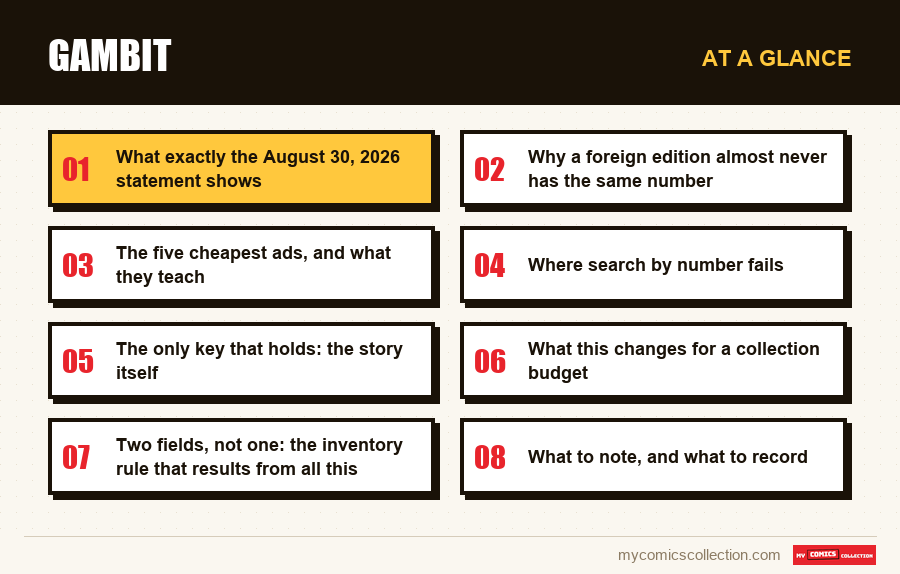
What exactly the August 30, 2026 statement shows
Indispensable clarification before any comments: the amounts cited below are sums that sellers requested on August 30, 2026, in advertisements then online. None are completed transactions. No one has paid these amounts in this statement, and there is no indication that anyone will pay them. A displayed amount expresses a seller's intention, not an observed market level.
Second clarification, just as important: the copies passed by a verification body were counted separately from the others. Mixing them together would produce a statistical mush, because a verified copy and a raw copy are not the same product and are not aimed at the same buyer. On the query “Gambit Uncanny X-Men 266”, the statement therefore separates 73 unverified ads on one side and 107 verified ads on the other.
On the unverified side, the amounts requested range from $9.99 to $750.00, with a median value of $199.95. On the verified side, the range goes from $89.99 to $2,950.00, with the median being $324.99. These upper limits do not describe a price: they describe the hope of a seller who has the right to display what he wants, and whose ad can remain online indefinitely without ever finding a buyer. The maximum is the least informative data of the entire survey.
You must also refuse an obvious temptation. This reading was taken on a single date. It therefore does not contain any information on a movement, a progression, a settlement or a season. A photograph taken at a moment in time does not show any movement, no matter how carefully we look at it. Any sentence like “it goes up” or “it goes down” here would be a pure fabrication, and this article will not write any of them.
A structural detail is worth noting for its own sake: there are more verified ads than ordinary ads, 107 versus 73. On a highly requested number, verification therefore becomes the default state of the offer rather than a minority option. This changes what a buyer encounters first when they type in the query, and it also changes what a raw copy seller must do to stay visible amidst that majority.
Why a foreign edition almost never has the same number
The local editor starts from scratch
When a series arrives in a new country, the publisher who publishes it opens its own collection. He numbers from his first issue, not from the number that the series had reached elsewhere. The story published under number 266 in the United States is thus found in 65 in the Brazilian edition noted on August 30, 2026.
The cutting is not the same
A national edition can group together several issues in a single volume, or on the contrary split a story. The difference between the two numberings is therefore not a simple constant subtraction that would be applied once and for all: there must be a story-by-story correspondence.
The local title also differs
The name of the publication is often translated or replaced. A search by title then fails for the same reason as a search by number: the character string entered does not exist anywhere on the searched object.
Nothing obliges the seller to bridge the gap
Writing both numberings in an ad title is a voluntary gesture. The seller who omits it is not cheating and hiding nothing: he describes his object as it is printed. Its ad will simply remain invisible for the vast majority of searches.
It is this last point which shifts the subject from the terrain of value to that of rediscoverability. An object that does not appear in any search is not misvalued: it is absent. It does not appear in the comparison made by the buyer, it does not weigh on any estimate, it never becomes a point of reference. It exists physically and does not exist documentaryly.
Of the five cheapest listings in the survey, only one mentions both the local number and the original number. This single announcement is the only thread that connects the two objects. Remove it, and nothing in the search result would indicate that the story exists under another number elsewhere.
This means that a seller who matches is providing a real service to both himself and the buyer. This also means, symmetrically, that a buyer should never conclude from the absence of results that an object does not exist: he can simply search with the wrong key.
The five cheapest ads, and what they teach
The bottom of the range is often the most informative part of a survey, because that's where objects congregate that are not what the query was looking for. The five cheapest ads for the query “Gambit Uncanny Five out of five are something else.
The cheapest of all, at $9.99, is a copy of the issue following, whose ad title nevertheless cites the number sought. Another, at $14.95, is an even further away number, and also cites the number sought in its wording. These two ads appear in the results because their text contains the searched string, not because they offer the desired object. A buyer in a hurry can confuse. A poorly informed inventory can too.
The third, at $17.94, is a 2024 reissue with blank cover. It bears the same number as the original while being an object manufactured more than thirty years later. The issue therefore not only poorly distinguishes foreign editions: it also does not distinguish the original from its modern reprint. Two fundamentally different objects share the same key.
The fourth, at $19.99, is a set of thirteen issues sold grouped together and presented as “must-haves”. Thirteen issues for twenty dollars, that is to say a little more than a dollar and a half each. We can draw a conclusion about the vocabulary, if not about the market: when a qualifier is applied to thirteen objects at once at this price level, it no longer selects anything. “Inescapable” is here a word of presentation, not a property of the object.
The fifth, at $37.07, is the Brazilian edition mentioned above: number 65 locally, for the story published under number 266 in the United States. It is the only one of the five to explicitly establish the correspondence between two numberings, and it is the starting point for everything that follows.
Where search by number fails
The query only finds what writes it
An ad search engine compares character strings. He doesn't know that a local number corresponds to a foreign number. An edition that does not write the original number in its title will never appear, no matter how patient the researcher.
Local publication date is not the original date
The foreign edition often appears years after the original. Filtering by year of publication then excludes the desired object. The only stable date is that of the original publication of the story.
The translated title breaks the second key
When the number fails, we usually fall back on the title. But the title of the publication was also replaced locally. The two most obvious keys fall at the same time, for the same reason.
Lots drown out unity
A set of thirteen issues at $19.99 appears in the results in the same way as a single copy. Comparing without reading the wording is like comparing a single object and a package.
Neighboring numbers go up
Two of the five cheapest ads are for other numbers whose label mentions the number you are looking for. The noise does not come from an engine error: it comes from sellers quoting a known number to be seen.
Reissue shares key to original
A 2024 reprint bears the original number. An inventory that only knows the number will record a new object in place of a vintage booklet, without any alert being triggered.
Collecting this series?
Track what you own, what you are missing and what your collection is worth. 7 day trial.
Start my trial →The only key that holds: the story itself
If the issue does not survive the crossing of a border and if the publication title does not survive translation, there remains one thing that does not change: the story. Its story title, the creative team behind it, and the date it first appeared. These three elements do not depend on any local editorial decision, because they describe the content and not its packaging.
This is also how reference catalogs reason, which link each national publication to an original work rather than creating as many independent entities as there are countries. The local numbering becomes a property of the copy, in the same way as its language or format, and not the main identifier. This is exactly the reversal that we need to make in our own monitoring.
In practice, this means that we do not record “the 266” but “the story originally published in such issue, of which I have the Brazilian edition bearing number 65”. The sentence is longer, it is also the only one that remains true if you later buy another national edition of the same story. A growing collection always ends up coming out of a single country, if only because foreign editions are often more affordable than the original.
This reasoning applies well beyond a single character. Any long series translated in several countries produces the same difference, and the editorial history of the X-Men provides particularly dense terrain, since the series was relaunched, renumbered and reissued multiple times before even crossing the slightest border.
What this changes for a collection budget
There is an economic consequence to this invisibility, and it is not what we think. It does not concern the value of the object, which is not measured here, but the competition it faces. An ad that doesn't appear in any standard search is seen by very few people. It is therefore not subject to the same pressure as the announcements which rise to the top.
The buyer who knows how to build a query on the local numbering, or on the national publication title, accesses a part of the offer that others do not see. This requires knowing the match in advance, which goes back to the previous point: the match is information to be collected and stored, not something the search engine will provide.
However, we must be careful not to deduce a price level from this. The statement contains only one foreign edition. A number of one is not a sample, it is an anecdote. We can say absolutely nothing from this single announcement about what foreign editions are worth in general, or even about what this one is worth: we can only note that it exists and that it bears another number. Any numerical conclusion would be an invention.
The same caution applies in reverse. The fact that verified copies outnumber others says nothing about what a raw copy actually costs: it only says what the posted offer looks like on a given day. For those who build their approach around the budget rather than the rare piece, the question of achats X-Men à petit prix plays out precisely in these poorly indexed areas, where the offer is little looked at because it is poorly named.
Two fields, not one: the inventory rule that results from all this
An inventory line that contains only one number cannot describe a multinational collection. It forces you to choose between two truths: either you write the number printed on the object you own, and you will no longer find the story when you search by the original reference; either you enter the original reference, and your sheet no longer describes the object placed in your box.
The way out is to refuse choice. Two distinct fields: the local number, as printed, with mention of the country and the publication which bears it; and separately the original reference of the story. The first allows you to recognize your copy when you have it in hand. The second lets you know that you already have this story when an opportunity presents itself in another guise.
This separation at the same time solves the problem of reissue. The 2024 reprint with blank cover shares the original reference with the 1990 issue, but is distinguished by everything else: year of manufacture, publisher, cover feature. Two fields, plus an edition mention, and the two objects stop confusing each other.
It finally solves the batch problem. A set of thirteen numbers does not fit in one line: it fits in thirteen lines, or in none. Treating it as a single entry because it was purchased at once amounts to leaving thirteen objects without a record, with the certainty of repurchasing one of them later.
What to note, and what to record
Note the local number with its country and publication.“65” alone means nothing and will become frankly misleading the day you come across another 65 in another series. “Number 65 of the Brazilian edition” is usable data, because it carries within it the frame of reference in which the number has meaning. A number without reference is a source of error, not information.
Save the original story reference separately. It is this field, and this field alone, which will tell you that the Brazilian edition and the American copy contain the same story. Without it, your inventory contains two unrelated entries and you have no way of knowing that you are purchasing the same content twice.
Document correspondence as soon as you encounter it. It comes from an announcement, from a catalog card, from a printed masthead on the back of the booklet. It is rare, it is scattered, and it is not easily found a second time. The statement from August 30, 2026 shows this bluntly: out of five announcements, only one gave it. Information encountered by chance and not noted down is information lost.
Explicitly mark reissues as such. The 2024 reprint with blank cover bears the original number and yet is not the original item. A “reissue” box checked on the form prevents a new copy from silently occupying the place of a period booklet in your follow-up, and also avoids unpleasant surprises the day you take it out again.
Break up the lots into as many lines as there are booklets. The thirteen issue set for $19.99 is a single purchase but thirteen separate items. Until they're entered one by one, your inventory doesn't know what's in it, and the word "must-have" in the ad won't help you find which one you already have.
Because the local publisher opens its own collection and numbers it from its first issue. Resuming a high number from the launch would make no commercial sense for an audience new to the series. It is a trivial editing decision, applied in many countries, and it mechanically produces the difference observed on August 30, 2026 between a local number 65 and an original number 266.
No, and that's the main pitfall. The gap is not a constant: a national edition can group several issues into one volume, skip episodes, or change pace along the way. A subtraction that works on one story may give a wrong result on the next. The correspondence is verified story by story, never by formula.
No. These are amounts requested by sellers in online advertisements on August 30, 2026, on a general auction site in the American market. No transaction is recorded. A posted amount expresses what a seller hopes to get, which is very different from what a buyer actually paid.
The report includes 107 verified advertisements compared to 73 ordinary ones on the same request. This is an observation of an offer on a date, not an explanation. We can only remember one practical consequence: on this number, a buyer first encounters copies passed by a verification body, and the two sets must be compared separately since they do not relate to the same type of product.
No way. The seller describes his item as printed, which is completely honest. It simply deprives itself of visibility, since no one will look for its booklet with the number it displays. Providing correspondence is a service provided, not an obligation, and its absence is never a warning signal about the quality of the ad.
Two fields rather than one, without thinking about it
My Comics Collection lets you register a copy with its original reference and local numbering, so that your foreign editions stop disappearing from your own inventory.