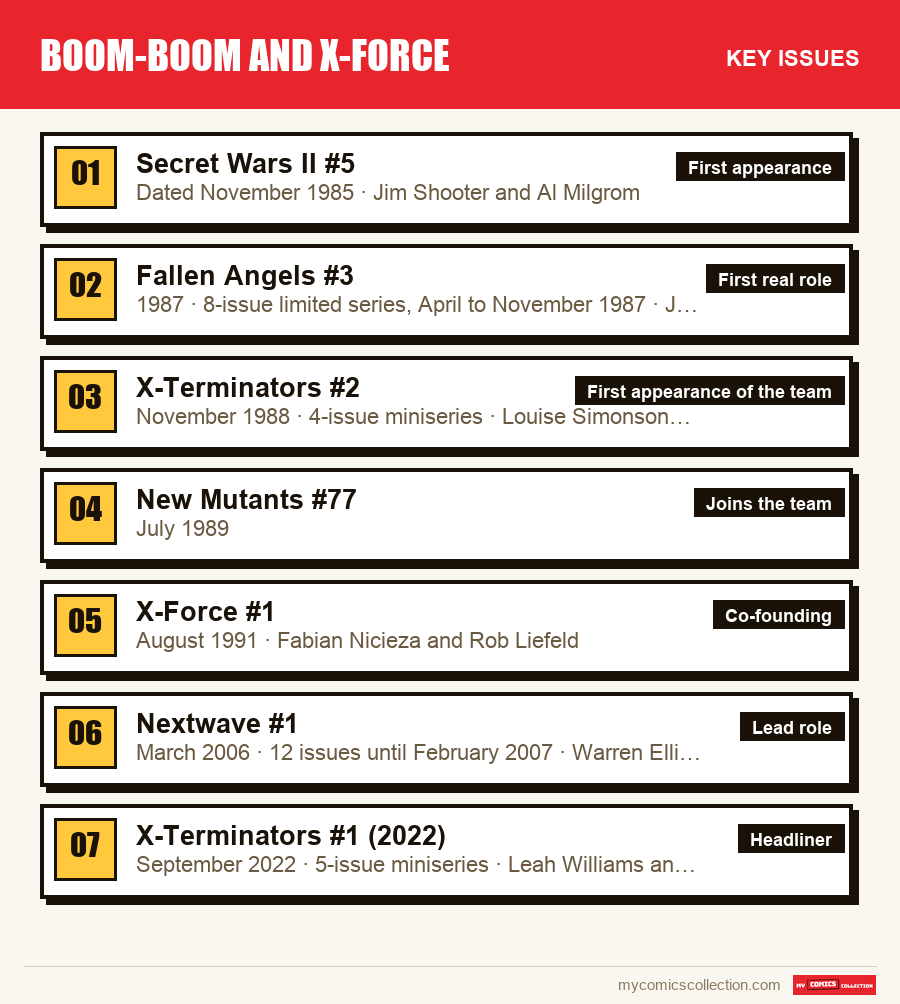
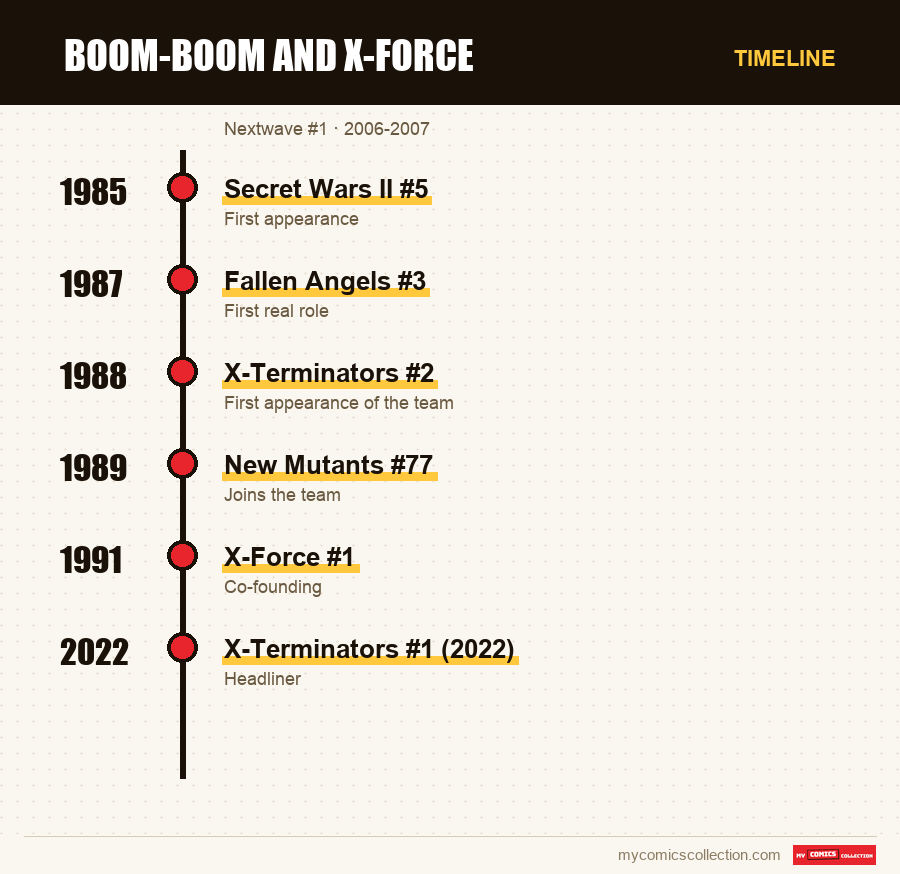
Tabitha Smith, a.k.a. Boom-Boom, takes the lead of X-Force in Fugitive X-Force #1, announced by Marvel for December 2026, after Cable's mind turns out to be compromised. It is the first time in thirty-five years that she leads the team she co-founded. Her real first appearance is not a mutant issue: it is Secret Wars II #5 (dated November 1985), by Jim Shooter and Al Milgrom. Next come Fallen Angels #3 (1987), the first X-Terminators of 1988, her arrival on the team with New Mutants #77 (July 1989), then the turning point of New Mutants #98, #100 and X-Force #1 (August 1991), whose record print run permanently killed scarcity. This article ranks her issues by real solidity, and separates what is scarce from what is merely expensive to produce.
There are two ways to collect a second-tier character who comes back to the forefront. The first is to buy the #1 of their new series and stop there. The second is to go back up the chain of their appearances, accepting that the most interesting issues are almost never the ones people talk about. Boom-Boom is a textbook case because her editorial path crosses, almost exactly, the two decades when the comic market changed most in nature.
Her file is also a good exercise in method. Tabitha Smith co-founded, in 1991, the most massively printed team in Marvel's history. In other words, she is present in issues that millions of people still own, and in a few others that almost nobody has looked for. Knowing how to tell the two categories apart is worth more than any hunch about what the December 2026 announcement will set off.
What December 2026 changes for Tabitha Smith
Marvel has scheduled Fugitive X-Force #1 for December 2026. The announced premise fits in one sentence: Cable's mind is compromised, and Boom-Boom inherits command of a team on the run. The word "fugitive" in the title says enough about the tone, and the place given to Tabitha says even more.
To understand why this is notable, you have to measure what X-Force's hierarchy has always been. Since 1991, the team has changed its makeup a good dozen times, but almost never its authority: Cable, then Wolverine, then Beast, then Cable again. Tabitha Smith went through these reshuffles as a member, as an extra, then as an absentee. Giving her the leadership overturns a balance of power established since the team's co-founding, in which she already took part.
Secret Wars II #5: the first appearance nobody looks for
This is the anomaly of the file, and it deserves to be stated up front. Boom-Boom does not first appear in a mutant title, but in the fifth issue of a crossover event that posterity has not been kind to.
Secret Wars II #5
First appearance of Tabitha Smith. She is a runaway teenager, endowed with a power she herself describes as "time bombs": spheres of energy that she shapes by hand and detonates at will. The code name still varies across the stories of the time, between Time Bomb and Boom-Boom, and it is the second that will stick. Jim Shooter, then Marvel's editor in chief, wrote the series himself, which explains why a minor character is introduced there without the mutant franchise having been consulted.
1987 to 1989: three series to establish a character
Between her first appearance and her entry into the team that will make her visible, Tabitha Smith goes through three titles, all short-format or second-tier. For a collector, this period has a virtue: print runs there are clearly lower than what will come next.
Fallen Angels #3
Boom-Boom joins the Fallen Angels in the third issue, recruited by Ariel after a clash with Iceman. The series brings together a deliberately motley cast, where Sunspot and Warlock rub shoulders with Multiple Man, Siryn, Chance and a few creations unique to the miniseries. The title never had a direct descendant, but this is where Tabitha stops being a silhouette and becomes a character with a voice.
X-Terminators #2
The first incarnation of the X-Terminators brings together young mutants gathered in X-Factor's orbit, including Boom-Boom, Rusty Collins, Rictor, Skids, Leech and Artie Maddicks. The miniseries takes place on the margins of the "Inferno" storyline, and it is in the second issue that the team appears in full. Tabitha is already written there as the uncontrollable element of the group, a trait that will stay with her until 2026.
New Mutants #77
Tabitha Smith joins the New Mutants. This is the step that matters most for what follows, since X-Force will be born two years later from this lineup. She arrives in an already established group, under a leadership that is about to change, and then goes through the whole mutation of the title without being pushed out. Few New Mutants members can say as much.
The 1990 and 1991 turning point, seen from Boom-Boom
The sequence running from New Mutants #87 to X-Force #1 is one of the most commented on in the medium's recent history. We are not going to tell it again: the detail of New Mutants #98 and its market value is covered in our dossier devoted to that issue, and the case of the false Domino in our history of Neena Thurman. What interests us here is narrower: Tabitha Smith's position in this turning point.
She occupies a rare place there, that of the continuous witness. New Mutants #87, dated March 1990, installs Cable as the new mentor in place of Magneto, under the pen of Louise Simonson and the pencil of Rob Liefeld. New Mutants #98, dated February 1991 and put on sale on December 11, 1990, introduces Deadpool, Gideon and the fighter long believed to be Domino. New Mutants #100, dated April 1991, closes the series and is the first appearance of X-Force as a team. Boom-Boom is present from the beginning to the end of this sequence, and she is among the members kept for the new lineup.
This detail has a concrete consequence for the collector. The three most in-demand issues of this period are in demand for characters other than her. In other words, nobody buys New Mutants #98 for Boom-Boom, and nobody will. Her own issues are elsewhere, in the 1985 to 1989 period, and that is good news: they do not suffer the attention premium that Deadpool's and Cable's appearances impose on the whole end of the series.
X-Force #1: five million copies, and what that destroys
X-Force #1 came out in August 1991, on a script by Fabian Nicieza from plots and pages by Rob Liefeld. The founding team has seven members: Cable, Boom-Boom, Cannonball, Feral, Shatterstar, Warpath and Copycat under Domino's identity. Siryn will join the group in the third issue.
The issue was sold polybagged, with a trading card available in several versions, and it sold about five million copies. It is a record for the publisher, and it is also the most decisive fact of this whole file.
Why? Because a quantity of this order does not get absorbed. An issue printed at five million copies and bought in large part by people who kept it intact will remain abundant in thirty years as in sixty. Demand can double, triple, collapse: the available stock remains such that it absorbs everything. This is not a judgment on the series, which was a genuine reading success and which durably established a new register at Marvel. It is a supply datum.
X-Force #1
First issue of the series, with Boom-Boom among the seven founding members. Historically major, commercially record-setting, and objectively one of the most common comics of its era. Worth owning for the consistency of a collection devoted to the character, without expecting a scarcity that does not exist.
The reshuffles, and why she falls out of them
The rest of X-Force's path explains why Boom-Boom long disappeared from the radar. The first series lasts until issue 129, in 2001, before being reworked into X-Statix, which changes almost the entire cast. The original team returns for a six-issue miniseries in 2004, drawn by Liefeld.
Then comes the decisive shift. In the wake of Messiah Complex, a dark and militarized version of the team forms and gets its own series in February 2008, written by Craig Kyle and Christopher Yost, drawn by Clayton Crain. This series ends in September 2010 as part of Second Coming. It is replaced as early as October 2010 by Uncanny X-Force, by Rick Remender and Jerome Opeña, with Wolverine, Psylocke, Deadpool, Archangel, Fantomex and E.V.A.
The finding is clear: as X-Force becomes a special operations unit populated by elite fighters, a character whose dominant trait is teenage unpredictability no longer finds her place there. Boom-Boom was not pushed aside out of disinterest, she was made incompatible with the concept the franchise chose to follow for nearly twenty years. That is what makes the December 2026 reversal legible: Marvel is not reinstating her in the elite team, the team is becoming fugitive again.
Nextwave #1 and X-Terminators 2022: the two titles that belong to her
In the meantime, Tabitha Smith has carried two series where she was not a supporting piece. For a collector interested in the character rather than the team, they are the two most relevant issues after her 1980s appearances.
Nextwave #1
Tabitha Smith is one of the five main characters, alongside Elsa Bloodstone, Monica Rambeau, Aaron Stack and the Captain. Warren Ellis explained that he chose her for the openly odd nature of her code name as much as for her fighting abilities. The series has a lasting reputation as a peak of the comedic register at Marvel, and it has remained readable independently of any continuity.
X-Terminators #1 (2022)
Revival of the 1988 team's name, this time under the "Destiny of X" banner, with a quartet made up of Boom-Boom, Dazzler, Jubilee and Laura Kinney. Tabitha is the driving force of the story, and the tone embraces the lineage of the original miniseries while playing in a far more brutal register. It is proof, four years before Fugitive X-Force, that the publisher considered the character capable of carrying a title.
How to build this lot without going wrong
Start by taking inventory of what you already have
If you have been collecting mutants for a while, you probably own X-Force #1 and several issues of the first series without having thought of them in terms of Boom-Boom. Take stock before buying anything: on a path this scattered, the first saving comes from the inventory, not from negotiation. Our issue-by-issue tracking is for exactly that.
Target the 1985 to 1989 period first
Secret Wars II #5, Fallen Angels #3, X-Terminators #2 and New Mutants #77 share a characteristic that nothing will make up for: they were printed before the print-run frenzy of the early 1990s. They are the only issues in this file where relative scarcity works in your favor.
On the 1991 issues, choose the condition, not the issue
On a comic printed in several millions of copies, the question is never "where to find it" but "which one to keep." Examine the corners, the flatness of the cover and, in the case of a polybagged copy, the absence of pressure marks. A mediocre copy of an abundant issue has no room for progress.
Only have graded what justifies it
Grading has a fixed cost, whatever the comic. It is justified on an already excellent copy of a sought-after issue, or on an intact polybag whose interior condition must be attested. It is not justified on an average copy of a common issue. The CGC grading guide details the thresholds beyond which the operation makes sense.
Wait for the release before judging Fugitive X-Force
An announced #1 has no material existence. Print runs of current limited series are far below those of 1991, but a miniseries only becomes a reference if it leaves something behind: a costume, a status, a new character. None of that is visible on release day.
What this file teaches beyond Boom-Boom
Tabitha Smith's case sums up a rule that holds for many secondary characters of the mutant franchise: their most famous issue and their scarcest issue are almost never the same. Sorting your comics by character rather than by series brings these gaps to light, where shelving by title masks them, and it is one of the uses for which a tracking app makes a difference. For a numbers-based reading of what you already own, start from your inventory rather than from anticipations: an estimate of your copies says more than a forecast about an issue that has not come out.