Tommy Monaghan, a hitman for Gotham's Irish mob, was born from the pen of Garth Ennis and the pencil of John McCrea in The Demon Annual #2, a 1993 annual tied to the Bloodlines crossover. His own series, Hitman, ran at DC from April 1996 to April 2001: 60 issues, an annual and a #1,000,000 issue. The milestones to know are the 1993 annual, the short story in Batman Chronicles #4 in spring 1996, Hitman #1, #9 which introduces Sixpack, #18 which launches Section Eight, and above all #34 "Of Thee I Sing", a meeting with Superman crowned with the 1999 Eisner for best single issue. The duo returns to the character with Hitman: It Was the Nineties Special #1, on December 9, 2026, twenty-five years after the series ended. A niche collection: few certified copies, high grades hard to find, demand driven by readers.
There are two ways to miss out on a Hitman collection. The first is to believe that a character born in a forgettable annuals crossover is not worth following, and to let the issues pass for fifteen years. The second is to treat it like a Batman series, that is, to assume copies can be found whenever you look, at the grade you want, at the moment you want them. Both mistakes have the same source: you reason about the title's prestige instead of reasoning about the number of copies in circulation.
The subject is back in the news for a specific reason. On December 9, 2026, DC publishes Hitman: It Was the Nineties Special #1, written by Garth Ennis and drawn by John McCrea, that is, the return of the character's two creators to their own creation after twenty-five years of editorial silence. This kind of event does two things to a niche back catalog: it brings readers back to issues they had never looked for, and it suddenly reveals how thin the available supply is.
This article lists what exists, with exact dates and issue numbers, then says frankly what it implies when you want to build the series. No price is given: on a title this lightly certified, nobody has price series full enough to be honest, and scarcity there is measured differently than in amounts.
Where Tommy Monaghan comes from
In summer 1993, DC filled its annuals with Bloodlines, a crossover whose principle fits in one sentence: extraterrestrial parasites feed on human spinal marrow, and the rare victims who survive the bite see their metagene activate. The operation unfolds in chapters, including "Outbreak", "Earthplague" and "Deathstorm", each covering a handful of annuals, before a concluding miniseries. The commercial intent is transparent: manufacture about thirty new characters in one season and see which ones take.
The outcome is harsh. Nearly all of these New Bloods never found a readership, and many were liquidated during the big events of the following decade. Only one came out of it with an independent career: Tommy Monaghan, who appeared in The Demon Annual #2, the annual attached to the "Deathstorm" chapter, whose cover is by John McCrea and whose story is simply titled "Hitman".
The detail to remember, because it explains everything else, is how the character uses his powers. The bite of the Glonth parasite gives him X-ray vision and moderate telepathy, with two side effects: his eyes turn entirely black, iris and cornea included, and prolonged use of his gifts costs him physically. Monaghan therefore does not become a superhero. He becomes a hitman who specializes in the contracts others refuse, those targeting metahumans and supernatural creatures, and who relies far more on improvisation and marksmanship than on his abilities.
A useful clarification for anyone hunting the annual: the first appearance is in a Demon annual because Ennis was then writing that series, which he took over from issue 40. Monaghan returns there afterward, in the "Hell's Hitman" arc (The Demon #42 to 45) then in "Suffer the Children" (#52 to 54). A companion article in this batch deals precisely with Etrigan and Jason Blood, and that is where to go for the host series; here, we only look at what concerns Tommy.
The series: April 1996, April 2001, sixty issues
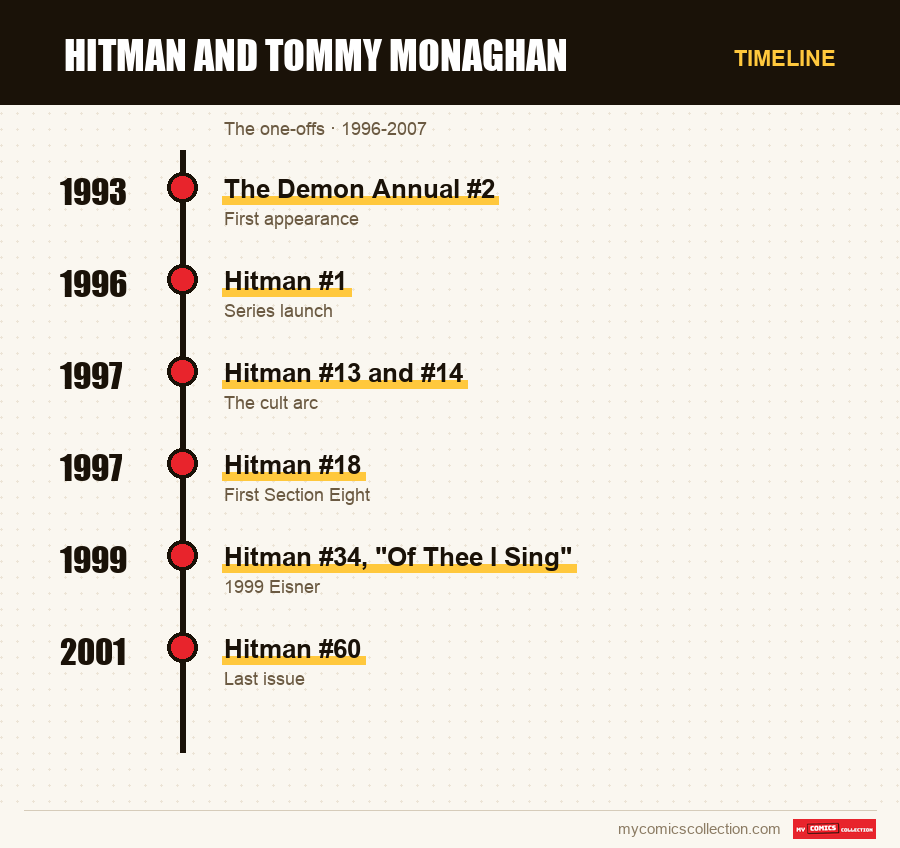
Hitman starts with an issue dated April 1996 and ends at issue 60, dated April 2001. Ennis writes the entire title, McCrea draws everything except one issue, #21, entrusted to Steve Pugh. Five years of roughly monthly publication, mostly twenty-two-page episodes, and an editorial perimeter you need to understand: unlike Preacher, which the same writer ran in parallel under the Vertigo label, Hitman appears in the DC universe proper.
This difference is not administrative, it is collectible. A Vertigo title lives in its bubble, with its characters and its readership. A title housed in the main continuity crosses the house's stars: Batman, the Joker, Catwoman, Green Lantern, Etrigan and Superman all pass through the series, and it hooks into the events of the moment, from The Final Night to DC One Million then No Man's Land. For a buyer, that means part of the demand on certain issues does not come from Hitman fans, but from Superman or Batman collectors who want a specific appearance. That is exactly what sets #34 apart from the rest of the series.
The other consequence of this positioning is the tone. The title is designed for an adult readership, treats violence in a black-comedy register, and never sought the general public. It was nonetheless recognized: Hitman received the National Comics Award for best new comic internationally for 1997, and Dogwelder, a Section Eight supporting character, was voted best new character of the same year by the readers of a specialized magazine of the time.
The pivotal issues, in order of importance
The entries that follow only cover issues whose date, creative team and content are established. They do not say what each is worth: they say why it is in demand, which is the lasting information.
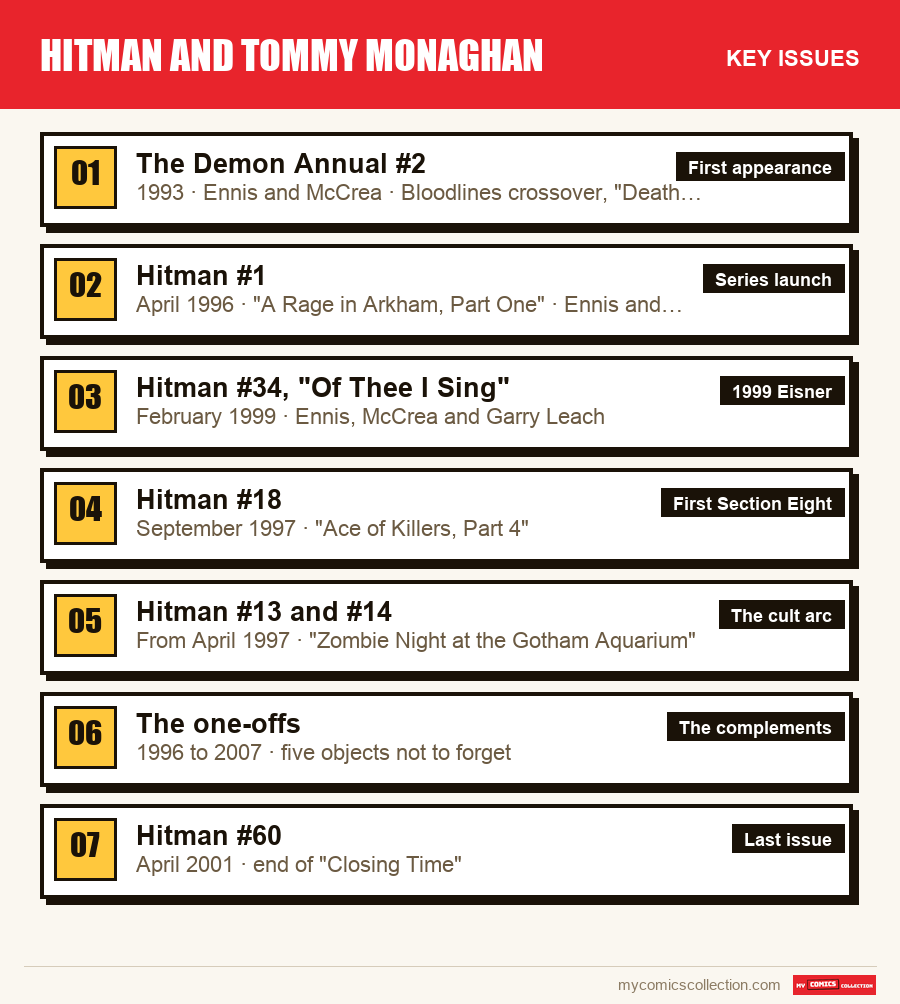
The Demon Annual #2
The founding piece, and the only one whose status is not up for debate. The story titled "Hitman" sets up in a single issue the Glonth bite, the powers, the black eyes, Sean Noonan's bar, Pat Noonan, and the Dubelz brothers' vendetta that would last several years. It is also, incidentally, the only issue of the entire Bloodlines crossover whose legacy rests on something other than 1990s nostalgia.
Hitman #1
First issue of the solo series, opening a three-part arc where Monaghan breaks into Arkham for a contract on the Joker, crosses paths with Batman and Detective Tiegel, and discovers the job was set up by a demonic entity, the Mawzir, agent of the Lords of the Trigger. It is the most comfortable reading entry point, and the most sought-after issue of the series after the 1993 annual.
Hitman #34, "Of Thee I Sing"
The issue that brought the series out of its circle. Monaghan crosses paths with Superman on a Gotham rooftop, right after a space rescue where the man of steel could not bring back the last astronaut. There is no fight: there is a conversation about what America asks of its symbol, and a hitman who lifts Superman's spirits without Superman guessing what he is doing there. The issue won the 1999 Eisner for best single issue, awarded to Ennis and McCrea.
Hitman #18
In the middle of the "Ace of Killers" arc, Sixpack assembles his band of improbable superheroes: it is the first appearance of Section Eight as a team, and of Dogwelder, its most famous member. These characters had a life of their own, with All-Star Section Eight in 2015 then Sixpack and Dogwelder: Hard-Travellin' Heroz in 2016, both times by Ennis and McCrea.
Hitman #13 and #14
Two issues, an aquarium, reanimated sea creatures, and the worst-executed contract of Monaghan's career. It is the story readers cite first when asked to explain why they love the series, and it appears as such in the anthology of selected pieces published in 2019.
The one-offs
Batman Chronicles #4, dated spring 1996, contains a Hitman story by Ennis and McCrea that precedes the series' launch and serves as a launching pad. Hitman Annual #1, dated October 1997, offers "A Coffin Full of Dollars", drawn by Carlos Ezquerra. Hitman #1,000,000, dated November 1998, is the tie-in to the DC One Million crossover. Hitman/Lobo: That Stupid Bastich, dated September 2000, is a one-shot drawn by Doug Mahnke. Finally JLA/Hitman #1 and #2, published from November 2007, are the return of Ennis and McCrea six years after the series ended, for the story that had never found room in the monthly.
Hitman #60
The series ends as it had warned it would, and the last issue closes the "Closing Time" arc begun in #53 in September 2000. A last issue of a mature series is never printed at the level of the first: it is mechanically one of the least printed issues of the run, and one of the hardest to find in decent condition.
The crossover with the house's stars
A collector coming from Superman or Batman can approach Hitman from a narrower angle, and it is a defensible strategy. Three objects are enough then.
#34 first, for the meeting with Superman. The short story "How To Be A Super-Hero!", written by Ennis in the same period in Superman 80-Page Giant #1, next: Superman accompanies Sixpack on an imaginary patrol there and calmly explains why you do not burn down prisons. And finally JLA/Hitman, where Monaghan is recruited by Batman because the League needs someone who survived the Bloodlines virus, and where the moral question is asked frankly: the League disapproves, Superman admits to admiring his courage.
On the Batman side, the series provides the opposite of a prestigious appearance. Monaghan is a minor nuisance to the vigilante, and the running gag rests precisely on that. Batman's appearances are numerous but rarely decisive for an issue's price, with the exception of the Batman Chronicles #4 story, which benefits from the dual status of precedence and Batman title.
What "niche character" means when you buy
It has to be said bluntly, because it is the most useful information in this article: Hitman is not a difficult collection because the copies are expensive. It is difficult because there are not many in circulation, and because those in circulation are often average.
The certified population is small. Getting a comic graded costs a fixed amount per copy, independent of its value. On a title where most issues do not justify that expense, almost nobody does it. Result: for most of the sixty issues, there are almost no certified copies, and the rare ones that exist concentrate on the 1993 annual, #1 and #34. This situation has two opposite effects. On one hand, a certified copy in high grade has almost no comparables, so nothing fixes its value. On the other, the absence of comparables makes any estimate fragile, in both directions.
High grade is rare for material reasons. Issues from the late 1990s were bought by adult readers who read them, not by speculators who sealed them. Add the annual format for the first appearance, the period paper and inks, and you get a population whose center of gravity sits at fine to good condition, not mint. A truly clean copy of The Demon Annual #2 is a much scarcer object than its reputation as a "1990s comic" suggests.
Demand comes from readers, not speculators. This is the most important and least understood characteristic. Reader demand rises slowly, by recommendation, and falls very little: people looking for Hitman are looking because they were told to read it, and they do not resell six months later. Speculator demand, conversely, doubles in three weeks on a movie announcement and evaporates just as fast. Concretely, that means you should not expect any sudden movement from this title, nor fear a collapse. You should expect slowness, on supply as on demand.
Supply is irregular, not expensive. On a highly demanded title, the problem is the price. Here, the problem is availability: weeks go by without a specific issue appearing on the secondhand market, then a whole collection breaks up and ten issues come out at once. The right method is therefore not to watch a price, it is to know at all times what you are missing so you can decide in minutes when a lot shows up.
A method to build the series without getting it wrong
Start with the complete list, one-offs included
Sixty issues, the annual, #1,000,000, the Lobo one-shot, the two JLA/Hitman, the Batman Chronicles #4 story and the Superman 80-Page Giant #1 one. An incomplete Hitman collection is almost always incomplete on this second half of the list, because the numbering does not flag it.
Buy the mid-run in lots
Issues with no first appearance or guest star are not hunted one at a time: the time spent and the shipping cost more than the comics. Wait for sets, and accept duplicates as the price of a fast catch-up.
Reserve your demanding budget for three objects
The 1993 annual, #1 and #34 are the only ones whose condition will determine the value of the whole. On these three, wait for a nice copy rather than taking the first one available. On the other fifty-seven, a readable, clean condition is more than enough.
Check the annual as an annual, not as a monthly
On a glued square spine, defects hide where you do not look: crushed spine edge, first signature coming loose, vertical crease in the center, corners rounded by handling. Ask for photos of the spine and the back before buying, not just the cover.
Decide on grading by exception
Getting a mid-run issue certified makes no economic sense: the cost of the operation exceeds the object. The question only arises seriously for the first appearance and, possibly, for #34 if you hold a remarkable copy. To decide, first read what grading measures and what it does not.
Record each entry the same day
On a series you complete through opportunities over years, memory becomes unreliable fast. Note the issue, the observed condition and the price paid in your inventory at the time of purchase: that is what will later let you recognize a good deal in a few seconds.
The December 2026 return: what is known, what is not
Hitman: It Was the Nineties Special #1 is dated December 9, 2026, written by Garth Ennis and drawn by John McCrea. That is all that is established, and it is already considerable: the title states its period, the original duo is complete, and the release falls twenty-five years after issue 60 of April 2001. Worth noting in passing, the same duo is putting out a horror one-shot at another publisher in November 2026, The Snail: the collaboration is nothing like a forced reunion, it never really stopped.
What nobody can say today, on the other hand: the print run, the number of covers, whether or not the house's stars appear, and of course what the special contains. Any quantified announcement on these points, at this date, is an invention. The fall conventions may bring clarifications, and they will have to be read when they are published, not anticipated.
What editorial history lets us predict with some confidence, though, is the behavior of the back catalog. An author's return to a niche title almost always produces the same sequence: a wave of reading recommendations, demand that first goes to bound collected editions then to the first appearance, and a drying up of supply in original issues for a few months, the time for sellers to realize what is going on. On an abundant title, this wave is not visible. On a title where almost nothing is in circulation, it is visible immediately.
The practical conclusion is plain and solid: if you want the 1993 annual, now is the time to look for it, not to speculate but because the availability window is the real variable. If you want to read the series, collected editions exist in seven volumes and an anthology, and they are made for that. And if you want both, clearly separate the reading budget from the collecting budget: it is the only way not to pay for a reading copy at the price of a collectible.