Man of Tomorrow opens in theaters on July 9, 2027. James Gunn writes and directs it, David Corenswet returns as Superman and Nicholas Hoult as Lex Luthor, the two characters reluctantly allying against Brainiac, played by Lars Eidinger. Filming has been finished since August 26, 2026: the film is in post-production, so nine months remain before release. For a collector, this duration is the only good news in the announcement. It leaves time to verify what you buy, compare several copies and refuse an offer, three things impossible in the weeks following a viral first trailer. This article lists what is confirmed about the film, the issues its existence puts back in circulation, and above all the method to apply over nine months rather than one.
An announced superhero film acts on the secondary market like advance notice. It creates no scarcity: the issues concerned already existed, in unchanged numbers, the day before the announcement. It creates only attention, and attention moves much faster than copies. It is from this gap that regretted purchase decisions are born, those where you pay in three days a price you would have negotiated in three months.
It is October 2, 2026. Man of Tomorrow comes out in nine months and a little over a week. It is neither a distant film whose happening is uncertain, nor an imminent film everyone is already talking about. It is exactly the intermediate window, the only one where a collector works without pressure. The purpose of this article is to use it.
What is confirmed about the film as of October 2, 2026
Let us start with the solid part, because it is broader than you might think. Man of Tomorrow is not a rumor: it is a shot film.
The title and date were revealed in September 2025, by Gunn, Corenswet and Hoult themselves, each publishing an illustration signed by an in-house artist: Jim Lee, Jorge Jiménez and Mitch Gerads. The three images showed Superman and Luthor, the latter wearing his armor, which immediately steered commentary toward a confrontation or an alliance between the two.
Gunn was explicit on a point that matters for reading the film: it is not Superman 2, and it is not a direct sequel. He described the project as the next story of a saga, and as "as much a film about Lex as a film about Superman". He also ruled out from the start the scenario of a film uniting Superman and Batman.
Brainiac was confirmed as the main antagonist in November 2025, after Gunn had published the cover of his second script draft, adorned with an anatomical plate of a brain. Lars Eidinger was chosen in late December 2025, at the end of what was presented as a worldwide search. The actor did a filmed test then an audition in Atlanta, underwent a three-dimensional scan of his body and shot his scenes from May to the end of August 2026.
Filming began on April 20, 2026, mainly at Trilith Studios in Georgia, under the working title Exodus, with days in Cincinnati, in Macon for the Daily Planet newsroom, and in the United Kingdom. Gunn announced the end of filming on August 26, 2026, after about 93 days spread over four months. The film is announced as part of the first chapter of the universe, titled Chapter One: Gods and Monsters.
The known cast is broad, and it is the most useful element for a collector. Around Superman and Lex Luthor return Rachel Brosnahan as Lois Lane, Skyler Gisondo as Jimmy Olsen, Isabela Merced as Hawkgirl, Edi Gathegi as Mister Terrific, Nathan Fillion as Guy Gardner and Frank Grillo as Rick Flag Sr. Three arrivals are added: Milly Alcock as Supergirl, Aaron Pierre taking up the Green Lantern John Stewart of the series Lanterns, and Xolo Maridueña bringing his Jaime Reyes to the new universe. Adria Arjona was hired in April 2026 after several auditions, and several outlets had her in the role of Maxima, while others wrote that her character was not established with certainty.
That is the solid part. The soft part deserves to be named too, because this is where buying errors lodge: the precise plot is not published, the trailer has not come out, Arjona's role is not officially confirmed, and no list of supporting characters is closed. A major convention takes place October 8 to 11, 2026 and announcements are expected there: as long as they have not landed, they do not exist.
Why a film announcement puts issues back in play
The mechanism is always the same, and it is worth describing once and for all, because it then lets you reason alone about any release.
A film does not touch a series, it touches entries. Concretely, four categories of issues wake up. First, the first appearance of the central character, because it is the only unique object in the whole publishing history. Next, the first appearance of the version the film seems to adopt, which is often much later and much more abundant. Then the issues from which the film draws a recognizable image, costume, ship, poster, armor, because the public identifies them on screen. And finally the story whose title or structure is taken up, which becomes the recommended reading for everyone at the same time.
These four categories do not behave the same way. The first appearance of an old character is rare and not very sensitive to news: condition and certification weigh more there. That of a modern version is far more abundant, and it is therefore on it that attention produces the most abrupt movements, up as well as down. Issues with a strong image are the most unpredictable, since a single trailer shot is enough to point to one nobody had anticipated. As for the story taken up, it almost always exists in collected form, which cushions demand on the original issues.
Retain the practical consequence: the category that moves fastest is also the one where supply is broadest. It is a good ratio for those who wait, and a bad one for those who rush.
The issues this release brings back into the conversation
What follows is not a ranking by value, and no dollar figure appears in it. It is a map: where each element of the film comes from, and what state the corresponding supply is in.
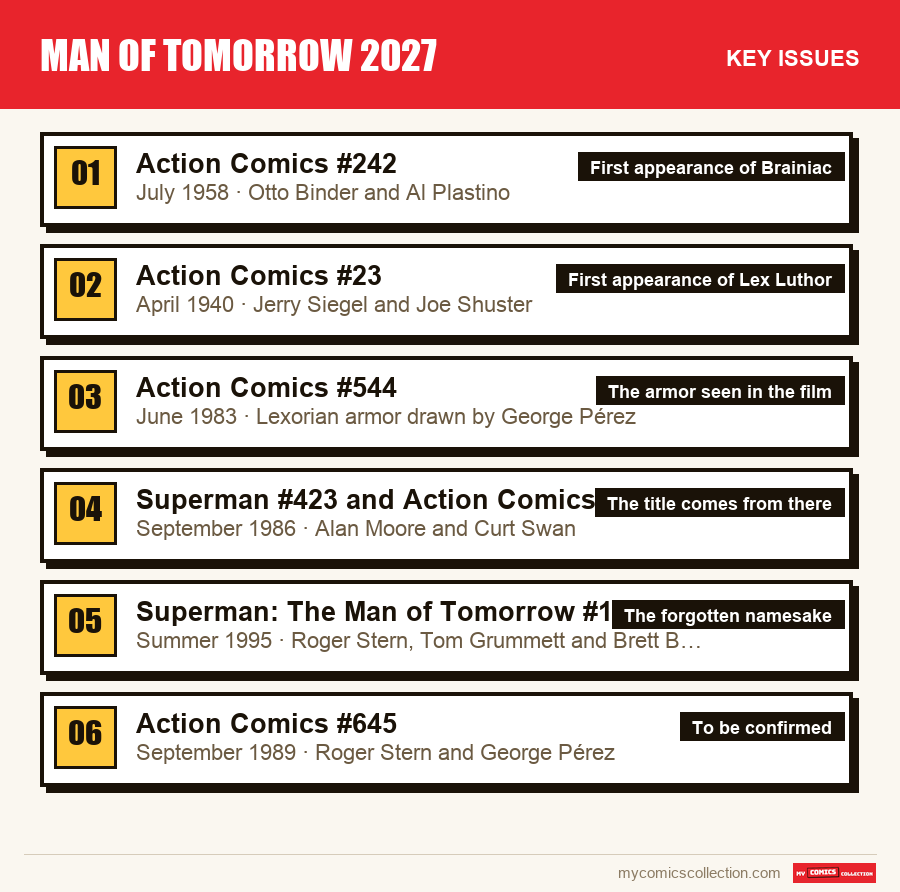
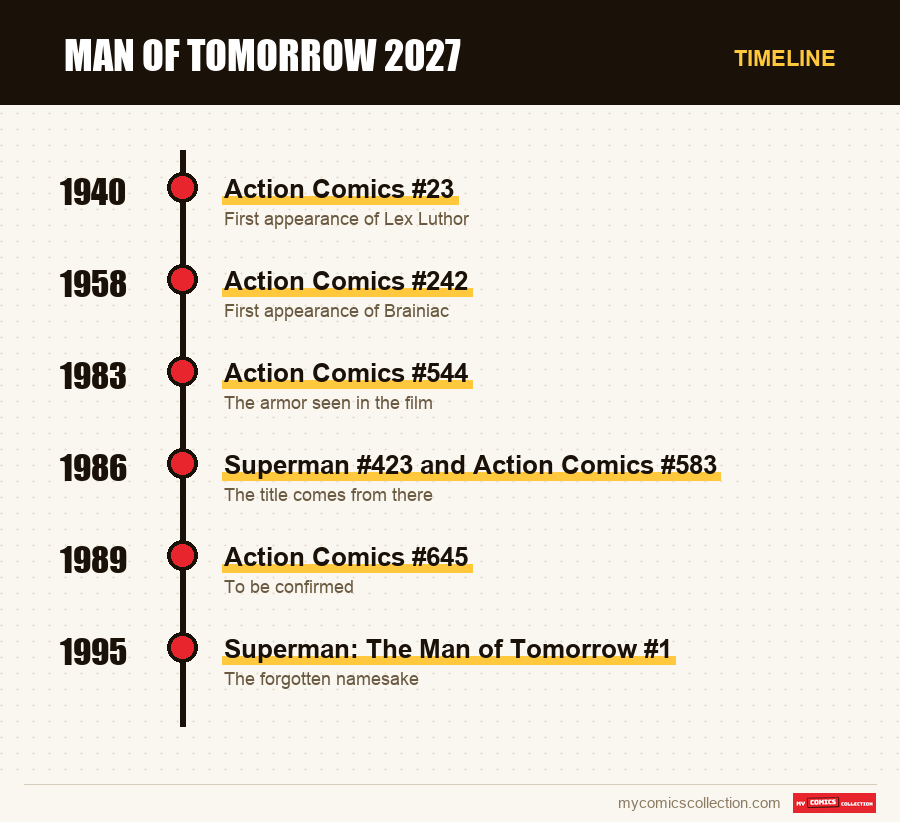
Action Comics #242
This is the single entry of this whole file. Brainiac, real name Vril Dox, is born here, and with him the Kryptonian city of Kandor shrunk and kept under glass, an image the character has dragged along for nearly seventy years. A film whose main antagonist is Brainiac makes this issue structurally unavoidable, without producing a single extra copy.
Action Comics #23
If the film is "as much a film about Lex" as about Superman, this entry mechanically returns in searches. The issue is of the same family as Action Comics #1: a scarce Golden Age where condition dominates everything else and where certification is not a comfort but a condition of transaction.
Action Comics #544
This is the perfect example of the third category. The announcement illustrations showed Luthor in armor, and the production had a wearable version made for Hoult, designed by Judianna Makovsky with Legacy Effects. Several commentators noted its fidelity to the pages. Yet this armor has a dated origin: it appears in this 1983 issue.
Superman #423 and Action Comics #583
"Whatever Happened to the Man of Tomorrow?" is a two-part story published in 1986, written by Alan Moore with the support of historic editor Julius Schwartz, drawn by Curt Swan, inked by George Pérez and Kurt Schaffenberger. It was meant to close the old continuity before its overhaul. Nothing indicates that the film adapts this story: what it takes up is an expression that has designated Superman since the 1930s. The coincidence is nonetheless enough to bring these two issues back up reading lists.
Superman: The Man of Tomorrow #1
The film's title also matches that of a quarterly series published from 1995 to 1999, sixteen issues, written first by Roger Stern then by Louise Simonson and J.M. DeMatteis. It belongs to the period when four titles took turns telling a continuous story. It is the most literal namesake, and the most likely case of parasitic search.
Action Comics #645
This issue is the first appearance of Maxima, an Almerac warrior. It enters the discussion for a single reason: several outlets announced Adria Arjona in this role, and others wrote that her character remained uncertain. Maxima also has a direct link with the film's antagonist, since she joins Brainiac in the 1992 story where he takes control of Warworld before she turns against him.
One side effect remains to be known without dwelling on it: the three arrivals bring their own first appearances. Supergirl appears under that name in Action Comics #252 of May 1959, the Green Lantern John Stewart in Green Lantern volume 2 issue 87 dated January 1972, and Jaime Reyes in Infinite Crisis #3 of February 2006. A supporting film role rarely moves an entry lastingly: these issues mainly interest collectors who already wanted them.
Nine months before is not one month before
Here is the heart of the matter. Buying today and buying in June 2027 are two different decisions, and not for reasons of price: for reasons of information and choice.
At nine months, information is incomplete but supply is normal. You do not know which version of Brainiac the film adopts, you do not know whether Maxima is in the credits, you do not know which shot will become the film's image. On the other hand, the published listings come from sellers who do not have a film in mind, the descriptions are made without urgency, and you can compare several copies of the same issue over several weeks. You therefore buy under poor information conditions and good market conditions.
At one month, it is the exact opposite. Information is nearly complete: the trailer is out, the characters are known, the specialist press has published its reading guides. But supply has tightened, descriptions have been enriched with film-related arguments, and the seller knows as well as you what you are looking for. You buy under good information conditions and poor market conditions.
There is no universal right answer, there is a rule of distribution: issues whose interest does not depend on the film are bought now, those whose interest depends entirely on a confirmation wait for the confirmation. Brainiac's first appearance belongs to the first family, it was important before the announcement and will remain so after the release. Maxima's first appearance belongs to the second.
Take inventory before the wish list
Before adding anything, look at what you already have. On a series as long as Action Comics, many collections contain without knowing it an issue cited above. An up-to-date inventory avoids the duplicate, the most frequent expense before a release.
Separate the watch list from the buy list
A watch list carries dates and conditions: "if the role is confirmed", "after the first trailer". A buy list carries numbers and a minimum accepted condition. Mixing the two produces purchases triggered by emotion rather than by criteria.
Fix the condition before looking at listings
Decide coolly, issue by issue, whether you aim for a reading copy, a clean uncertified copy or a certified copy. This choice entirely changes the search scope, and it is much harder to hold once you have seen a beautiful photo. The guide on CGC grading details what certification brings and what it does not settle.
Observe for three months before buying an old issue
For a Golden Age or Silver Age entry, follow public sales over a quarter without buying anything. You will learn how often copies in the targeted condition pass through, information far more useful than an isolated price.
Date each decision
Note why and when you bought. It is what lets you, after the release, tell a good choice from a stroke of luck, and not repeat the same mistakes at the next release.
The classic errors of the pre-release window
They are few and very stable from one release to the next.
Buying a namesake. The case is served on a platter here, with a 1990s series that carries exactly the film's title. A listing can be perfectly honest and the connection still unfounded: the film's title creates no editorial link.
Confusing a rumor with a confirmation. Between September 2025 and April 2026, this film's casting gave rise to contradictory information published by serious outlets, then corrected, sometimes denied by Gunn himself. A role is confirmed only by the production.
Ignoring fees and turnaround times. At nine months, a certification has time to complete. At one month, it no longer does. If your plan assumes a certified copy for the release, the decision is made now, not in May.
Believing a release lifts an entire character. It moves specific entries. The rest of the bibliography does not move, and that is fortunate: it is what keeps reading accessible. Our overall guide on managing a collection starts from this principle.
The calendar to watch between now and July 2027
A few appointments structure the nine months ahead, and they are worth more than daily monitoring of announcements.
In the immediate term, the convention of October 8 to 11, 2026 is the first moment when information can drop. It is not known at the time these lines are written, and no collector should buy on the basis of what would be said there before it is said.
On the secondary market side, the useful reference of the year is not an issue but a set of pages: the original art of Superman #75 returned to public sale in 2026 for the first time in about thirty-three years. The episode recalls a rule that also applies to issues: scarcity is measured by frequency of appearance, not by media noise.
On the screens side finally, Man of Tomorrow is not alone. A film devoted to Clayface comes out on October 23, 2026, and we have detailed elsewhere the issues this release concerns. An eight-episode series around Jimmy Olsen is announced for mid or late 2027. The lesson is the same each time, and that is why you need a method and not a list: the next announcement will arrive before you have finished exploiting this one.
Before opening a single listing tab, start by updating your tracking and by taking stock of your missing issues. If your question concerns what you already own rather than what you might buy, our estimate page explains how to ask it. And for the character's reference list, see the key issues of Superman.