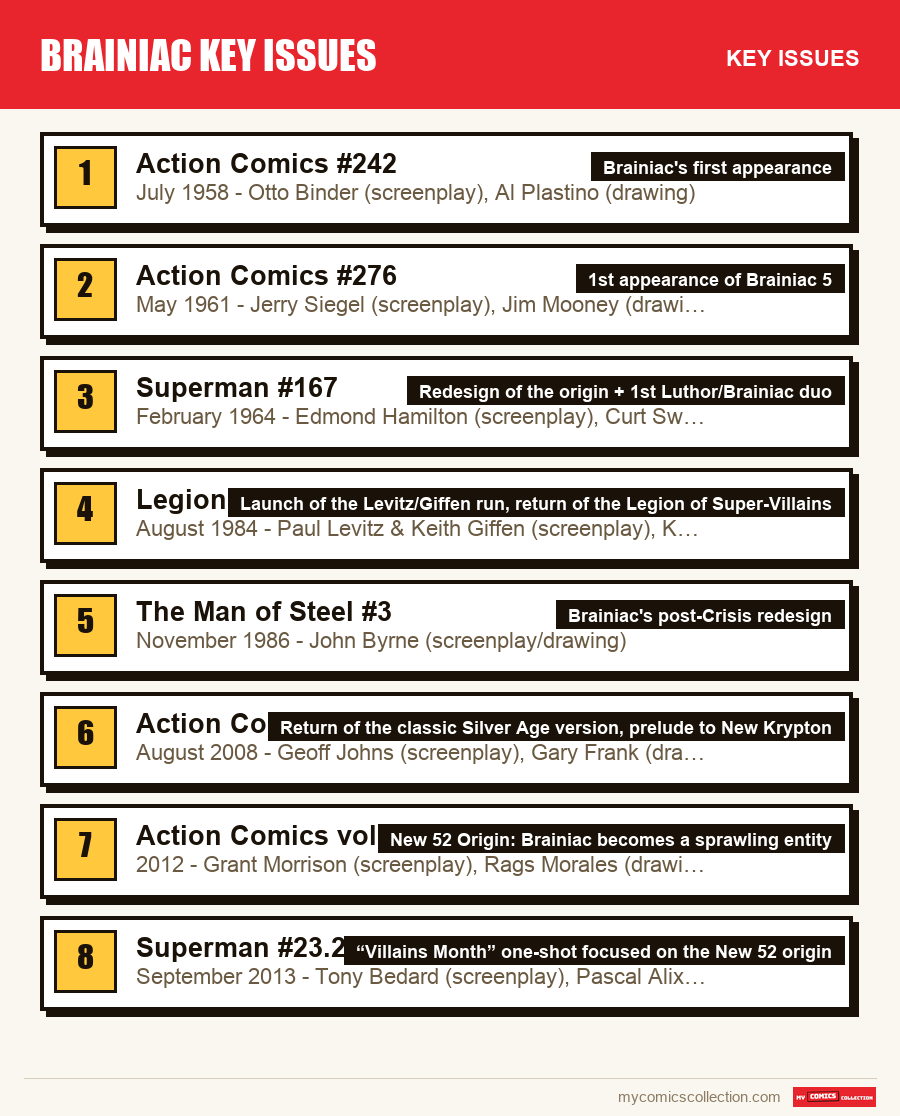
The absolute key number for Brainiac remains Action Comics #242 (July 1958), his very first appearance under the pen of Otto Binder and the pencil of Al Plastino, who introduces the bottle of Kandor into the same story. Documented sales range from approximately $475 in grade CGC 1.0 to over $25,900 in grade CGC 8.0, with a strong premium starting at grade VF (8.0) due to the dark purple cover, which is very prone to rubbing. Just behind, Action Comics #276 (1961, first appearance of Brainiac 5) and Superman #167 (1964, recast of the origin and duet with Luthor) form the essential Silver Age trio for those who want to collect the character's DNA.
Brainiac occupies a special place in Superman's gallery of antagonists. Where Lex Luthor embodies misguided human ambition, Brainiac represents a cold, external, almost cosmic threat: an intelligence that does not want to dominate humanity but to catalog it before erasing it. This editorial singularity resulted, over nearly seven decades of publication, in a handful of issues which each redefined the character (his origin, his appearance, his mythology) and which, logically, concentrate most of the market value linked to the name "Brainiac" on the vintage and modern comic book market.
This article adopts a deliberately narrow angle: it does not tell the complete biography of the character (for this, our retrospective dedicated to the history of Brainiac details his in-universe journey, his powers and his narrative arcs over six decades) but draws up the concrete list of numbers to know (and, when the data actually exists, how much they have sold for) for anyone who wants to build or complete a collection centered on this character. We add a reading of the market: how TV and animation adaptations have changed demand, and what reflexes to adopt before buying a graded or raw copy.
Before the list, a quick look at the editorial context is necessary to understand why certain issues weigh more heavily than others in collectors' minds.
Brainiac in the history of Superman: the milestones that structure his rating
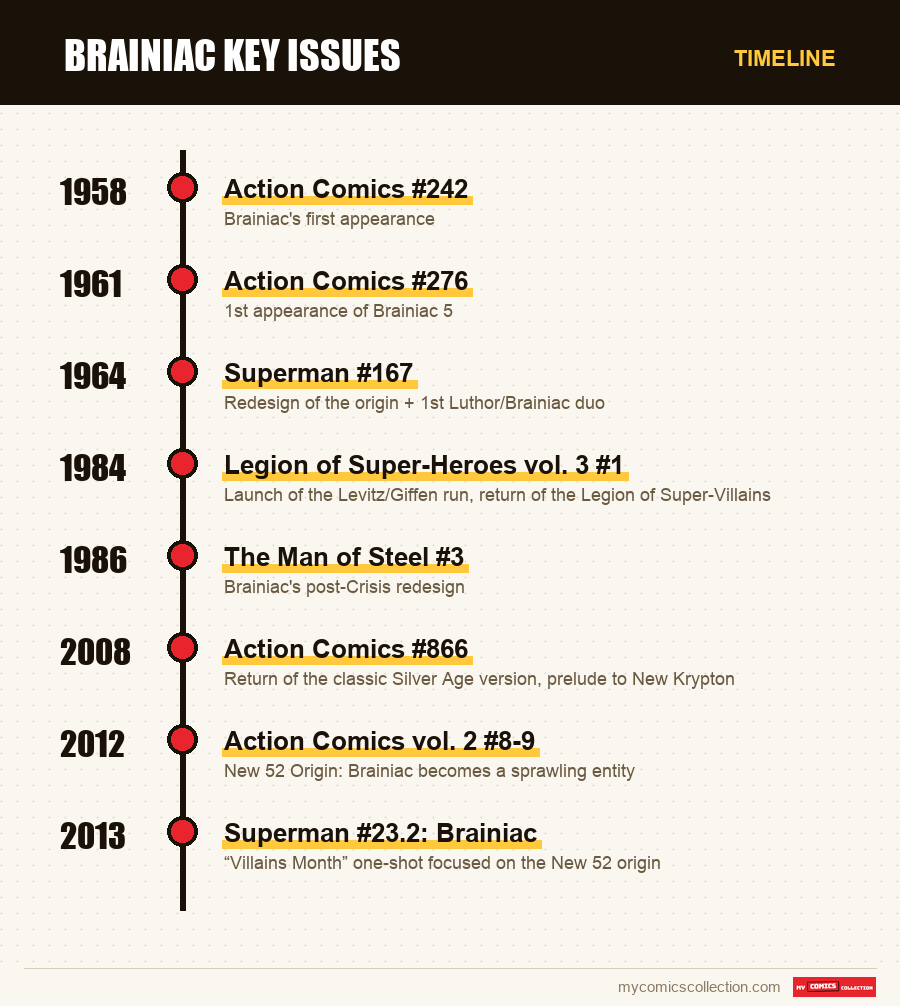
Brainiac was born under the pen of Otto Binder and the pencil of Al Plastino in Action Comics #242, dated July 1958. The character is directly adapted from an arc of the daily Superman comic strip published between April and August of the same year, where a similar entity had another name. DC decides to integrate it into the comic book with a definitive name and design, and takes the opportunity to introduce in the same story the bottle of Kandor, the miniaturized Kryptonian capital that Brainiac had reduced before the destruction of the planet. This editorial double, an iconic villain and a major narrative artifact born in the same issue, goes a long way to explaining why this comic is treated as a premier Silver Age piece, along with the first appearances of other major threats of the era.
The character then evolves in waves of retcons, each of which generates its own key number. In 1964, Superman #167 completely rewrites his origin: Brainiac is no longer a simple extraterrestrial scientist but a robot built by the Computer Tyrants of the planet Colu to spy on and invade other worlds. It is also in this issue that the now iconic design appears for the first time (the skull decorated with a grid of red diodes, presented as the character's sensory terminals) and that Lex Luthor allies himself with it for the first time. Three years earlier, in 1961, the mythology had already extended into the future with Action Comics #276, which presents Brainiac 5, a descendant of the 30th century claiming affiliation with the original villain but putting his "level twelve intellect" in the service of Good within the Legion of Super-Heroes.
The character then goes through the great post-reboot Crisis on Infinite Earths: John Byrne reinvents it in his seminal mini-series The Man of Steel (1986), where artificial intelligence is now housed in a synthetic body distinct from its original biological envelope. More recently, two milestones have marked the character in the modern era: the return of the classic Silver Age version orchestrated by Geoff Johns and Gary Frank in Action Comics #866 (2008), starting point of the "Brainiac" arc which prepares the New Krypton saga, then the complete overhaul carried out by Grant Morrison and Rags Morales in the beginnings of the second series Action Comics launched with the New 52 in 2011-2012, where Brainiac becomes a sprawling, quasi-Lovecraftian entity that reduces Metropolis itself to the scale of a bottle.
It is this succession of redesigns (origin, design, connection with the Legion, then post-Crisis and New 52 reinventions) which draws the list of key numbers below. For the complete history of the character, his in-universe biography and his powers, our article dedicated to the history of Brainiac remains the reference; here, we focus on the acquisition and market angle.
Action Comics #242
The founding number. Brainiac arrives on Earth aboard his ship to collect miniaturized cities across the galaxy, and the story immediately introduces the bottle of Kandor, the former capital of Krypton that he had already reduced before the destruction of the planet. The cover, dominated by a dark purple background that is very susceptible to rubbing and discoloration, makes high-grade examples particularly difficult to find: a point that is confirmed by surveys of the Silver Age collecting community.
Action Comics #276
This issue, published as a back-up in a Legion of Super-Heroes story, presents Querl Dox aka Brainiac 5, a 30th century descendant of Brainiac who claims a kinship with the villain while putting his extraordinary intelligence at the service of the heroes. The same issue also introduces Phantom Girl, Triplicate Girl, Shrinking Violet, Bouncing Boy, and Sun Boy, making this a pivotal piece for collectors focused on the Legion as much as the Brainiac lineage.
Superman #167
A major retcon: Brainiac is no longer presented as a simple alien genius but as a robot created by the Computer Tyrants of the planet Colu to infiltrate and invade other worlds. It is in this story, entitled "The Team of Luthor and Brainiac!", that the character first adopts his skull covered with a grid of red diodes, a design which will remain his visual signature for decades, and that Lex Luthor ally with him for the very first time in order to defeat Superman.
Legion of Super-Heroes vol. 3 #1
First issue of the third Legion of Super-Heroes series, this comic opens the five-part arc pitting the Legion against the Legion of Super-Villains and confirms Brainiac 5 as the scientific and emotional pillar of the group under the pen of Paul Levitz, one of the most recognized runs in the history of the title. Like the majority of Copper Age comics published in large circulations, it remains widely accessible in high grade.
The Man of Steel #3
In the miniseries that rewrites Superman's origin after Crisis on Infinite Earths, John Byrne reimagines Brainiac as an artificial intelligence capable of housing itself in a synthetic body distinct from its original biological medium: a conceptual overhaul that would lastingly influence subsequent incarnations of the character, all the way to his television avatar in Smallville. The issue is best known for the first Superman/Batman meeting in post-Crisis continuity, but remains a reference piece for tracing the evolution of the Brainiac concept.
Action Comics #866
First chapter of the five-part “Brainiac” arc which marks the return of Gary Frank to the title and replays the original Silver Age incarnation of the character, the same one that appeared in 1958. The story brings back the original Kandor bottle, leads to the death of Jonathan Kent and serves as a direct prologue to the “Superman: New Krypton” saga which will occupy the Superman titles for more than a year. A pivotal issue for those who follow the modern continuity of the character.
Action Comics vol. 2 #8-9
In the New 52 relaunch of the series, Grant Morrison and Rags Morales deliver a radically different version of the character: a Lovecraftian-inspired mass of metal tentacles who takes over industrial factories to manufacture an army of robots before shrinking Metropolis itself to the size of a bottle, presenting Superman with an impossible choice between saving Kandor or saving his adopted city. This diptych closes the original trilogy that began with the first issue of the series.
Superman #23.2: Brainiac
Published as part of "Villains Month" in September 2013, this one-shot delves deeper into Brainiac's New 52 origin as initiated by Morrison. Like all of the ".1" to ".4" titles of this event, it benefited from a limited edition with lenticular effect (3D) covers on the proportionally rarer copies, a format which created a collector's segment in its own right within the New 52.
Collecting this series?
Track what you own, what you are missing and what your collection is worth. 7 day trial.
Start my trial →The impact of adaptations on the rating
Brainiac has benefited from almost continuous screen exposure since the mid-2000s, and each new adaptation has mechanically brought the founding issues back into the spotlight. In Smallville, James Marsters plays Dr. Milton Fine, human avatar of Brainiac, for eight episodes of season 5, then returns for a four-episode arc in season 7 before a cameo in season 8 and a final episode in the final season. The series goes further in season 10 by introducing a "Brainiac 5" version also played by James Marsters, created by the Legion after reprogramming the original Brainiac: a direct nod to the lineage established in Action Comics #276 fifty years earlier. This recurring presence over nearly six seasons has maintained a deep demand among fans of the series for the character's original comics.
The character then found a new relay with the series Krypton (Syfy, 2018-2019), where Blake Ritson lends his features to a Brainiac described as a parasitic artificial intelligence who takes possession of the Voice of Rao, a religious figure from Superman's home planet. Although the series was canceled after two seasons, it brought back the character's "collector of civilizations" dimension: directly inherited from the original plot of Action Comics #242 and its connection with Kandor.
More recently, animation has taken over: the series Legion of Super-Heroes broadcast on Kids' WB between 2006 and 2008 already gave voice to Brainiac 5 (Adam Wylie), while My Adventures with Superman made Brainiac, voice of Michael Emerson, the main antagonist of its second season in 2024, alongside the arrival of Supergirl. This version, presented as a warrior artificial intelligence designed by Kryptonian scientists, owes a lot to Grant Morrison's reading of the character in the New 52. With each release of a series or season featuring Brainiac, the same phenomenon is repeated on the secondary market: an occasional revival of interest in Action Comics #242 and Superman #167, the two numbers which concentrate the symbolic capital of the character, whatever the adaptation medium.
Buying guide
- Always check the cover color of Action Comics #242. The cover's dark purple background is particularly prone to corner rubbing and fading; two examples of the same numerical grade can present a very different visual rendering depending on the actual state of this shade.
- Always compare a CGC 9.0 grade and a CGC 9.8 grade before choosing your budget- the price difference between the two may be disproportionate to the difference in actual conservation; OUR detailed comparison between grade 9 and grade 9.8 explains precisely where the cost/benefit balance point is for a key Silver Age number.
- Favor the Silver Age issues (Action Comics #242, #276, Superman #167) for long-term collectible value, and reserve the modern issues (Action Comics #866, Morrison's New 52 trilogy, Superman #23.2) to build an accessible and easily found collection in very high grade.
- Always ask for restoration history on any non-encapsulated Silver Age copy: an undeclared restoration can cause the value of a key number to drop by several tens of percent once discovered.
- On event one-shots like Superman #23.2, clearly distinguish the standard print from the lenticular cover variant "Villains Month": both have the same number but their rating differs significantly.
- Use a collection tracker to centralize your Brainiac numbers as you acquire them rather than relying on a paper list; OUR collection management application allows each copy to be cataloged with its grade and provenance.
- Before any offer, check the real rating on the eBay market rather than relying on a potentially old list price: the differences between paper guide and actual sales can be significant on Silver Age issues.
To delve deeper into the biographical dimension of the character (his powers, his different incarnations and the complete chronology of his appearances) head to our article dedicated to the history of Brainiac, complementary to this selection of key numbers. And to find all the comics, appearances and information related to the character on the site, the Brainiac character sheet centralizes all available references.