The Clayface film comes out on October 23, 2026, directed by James Watkins, from an original story and screenplay by Mike Flanagan rewritten by Hossein Amini, with Tom Rhys Harries in the title role. And there is good news for anyone looking for "the first appearance of Clayface": it does not exist in the singular. At least eight characters have carried the name since 1940, each with their own first issue. The film explicitly adapts Matt Hagen, the second bearer, who appeared in Detective Comics #298 dated December 1961. But it gives him the job of the first, Basil Karlo, a film actor, who appeared in Detective Comics #40 dated June 1940. Two issues, two eras, two radically different entry prices: knowing which one interests you is the whole point.
Most movie releases trigger a rush toward a single, easily named issue. One character, one first appearance, one object to hunt. Clayface breaks that reflex, and that is precisely what makes him interesting to collect. The name has changed hands eight times in eighty-six years, without any of those successions erasing the previous one. The former bearers come back, team up, marry, have children who in turn become Clayface. The result: there is no single first appearance, there is a genealogy.
This article is written on October 2, 2026, three weeks before the release. It therefore does two things, and only two. First, the complete map of the name's bearers, with the exact issue and exact date of each, so that you know what you are buying when you buy "a Clayface." Second, the precise identification of what the film adapts, because it is verifiable and it changes the hierarchy of the issues involved.
What this article does not do: announce price guide values. No reliable, dated price data is available for these issues at the time of writing, and an article that gave you a precise amount on a 1940 comic three weeks before a movie comes out would be making it up. The relative hierarchy, on the other hand, is solid, and it is more than enough to decide.
Why "the first appearance of Clayface" is a badly posed question
Clayface is not a character with a costume that others took over, like Robin or Batgirl. It is a name attached to a physical condition, and the condition was passed on by different means each time: a disguise, a bath of protoplasm, an injection, a genetic inheritance. Each of these mechanisms produced a distinct bearer, with its own starting issue, and none was retroactively canceled.
For a collector, this has three very concrete consequences. First, a listing sold as "first appearance of Clayface" can designate eight different objects, whose scarcity gaps are counted in orders of magnitude. Second, the bearer the general public recognizes is not always the one the comics installed first. Third, when a movie comes out, it does not update all the bearers at once: it designates one, and that is the one that moves.
The right question is therefore not "who is the first Clayface." It is "which Clayface, and for what reason." The map below answers the first half.
The map of the name's eight bearers
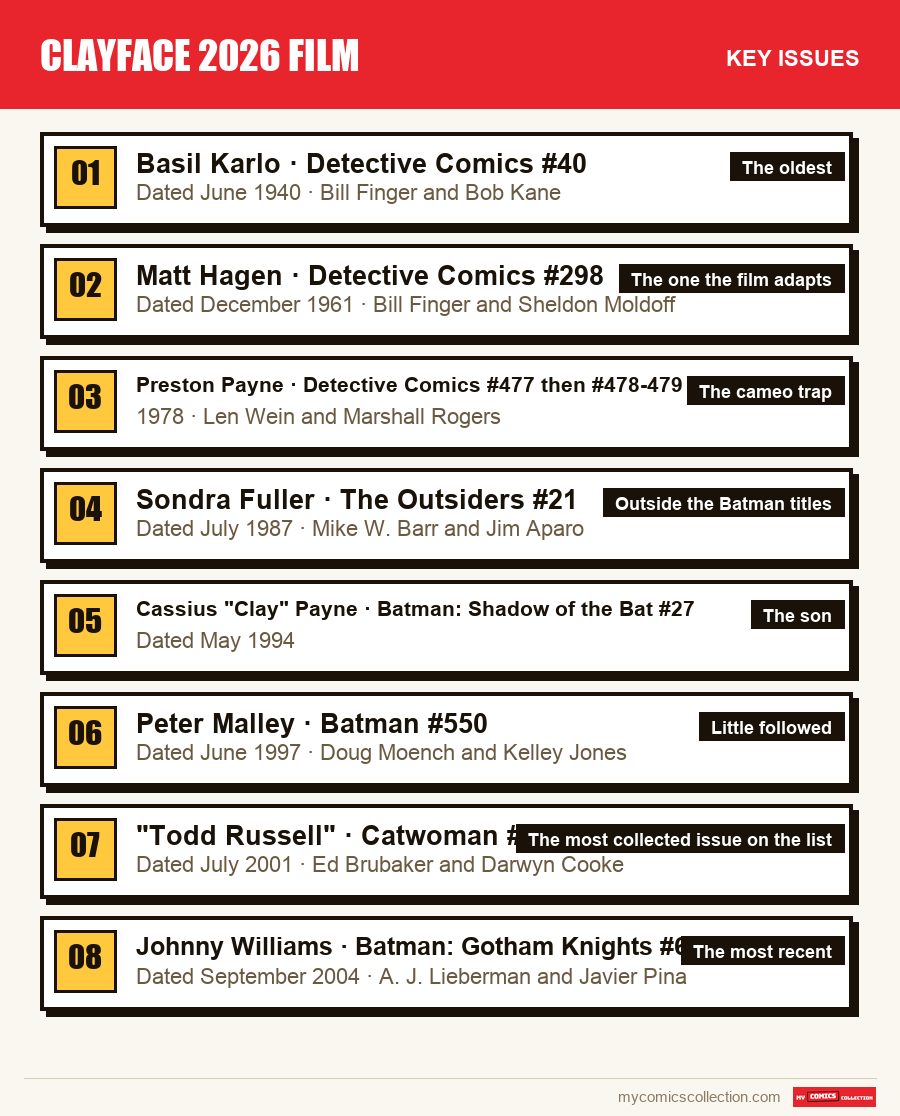
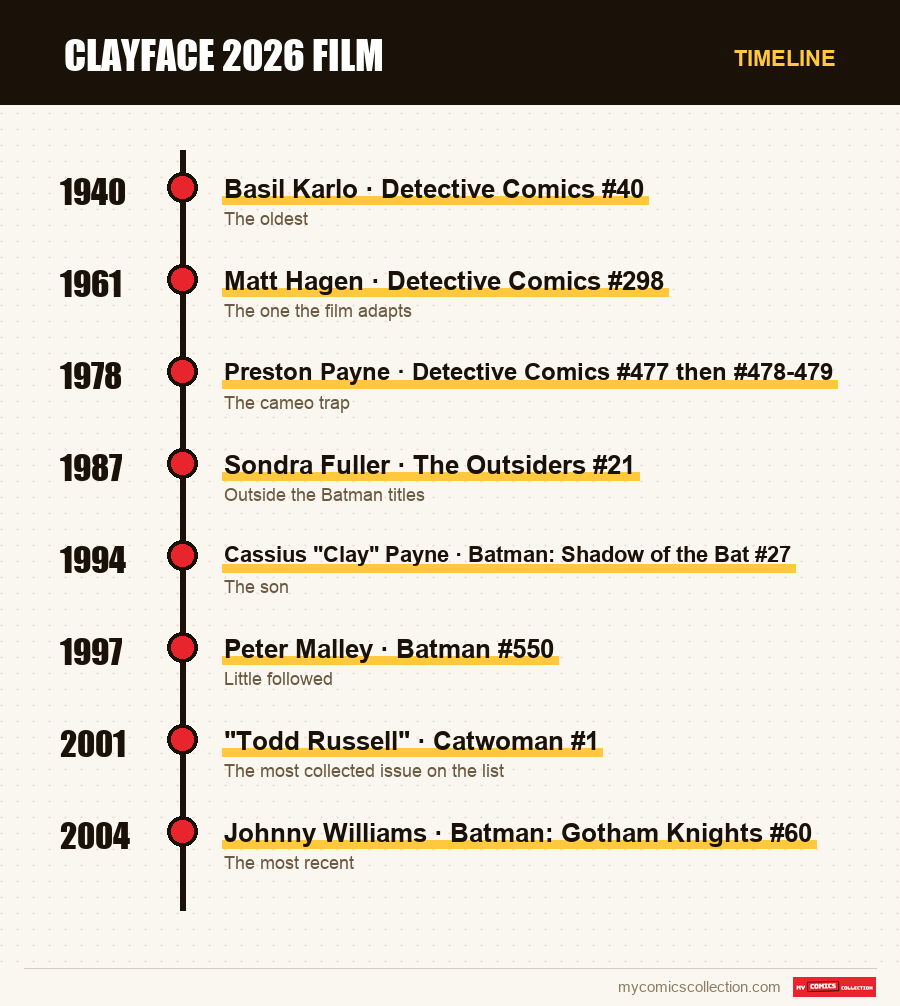
Each entry gives the first-appearance issue, the cover date and the creators. These are the only elements to remember if you keep one thing from this article.
Basil Karlo · Detective Comics #40
The first bearer is a second-rank actor, specialized in horror and romance, who loses his mind on learning that the remake of the film that made him known will be shot without him. He then takes up the costume of a villain he had played on screen and commits murders on the set. A crucial detail, and almost always overlooked: this Clayface has no powers. He wears a clay mask. The ability to deform himself, the one the name evokes today, he will only acquire decades later, by injecting himself with cell samples from his successors.
Matt Hagen · Detective Comics #298
Twenty-one years after Karlo, the name starts from scratch with an unrelated character: a treasure hunter who discovers a pool of radioactive protoplasm in a cave, immerses himself in it by accident and comes out able to take any shape. It is he who establishes the Clayface everyone has in mind, the one who liquefies and reshapes himself. He is also the only one of the eight whose name the 2026 film takes.
Preston Payne · Detective Comics #477 then #478-479
Here is the case where bibliographic precision changes the object you buy. Preston Payne appears at the end of Detective Comics #477, and his full first appearance is in #478 and #479. Both mentions circulate, and they do not designate the same issue. Payne suffers from hyperpituitarism, obtains blood from Matt Hagen to isolate an enzyme and injects himself with it. The shapeshifting powers do not last: his flesh begins to melt, and any contact transmits the dissolution. Hence the exoskeleton he never takes off.
Sondra Fuller · The Outsiders #21
The fourth bearer, sometimes called Lady Clay, does not appear in a Batman title but in The Outsiders, the spin-off team. It is an important practical fact: anyone looking for the whole genealogy by following only Detective Comics and Batman will miss her. She then enters the character's history by posing as the heroine Looker to approach Preston Payne at Arkham, and falls in love with him at the end of the affair.
Cassius "Clay" Payne · Batman: Shadow of the Bat #27
Payne and Fuller end up marrying and having a child, who inherits both their conditions. His name is a nod to the birth name of the boxer Muhammad Ali. He is the first bearer of the name who did not acquire it by accident or by choice, but by birth, which turns Clayface into a lineage rather than a series of coincidences.
Peter Malley · Batman #550
Sixth bearer, from the end of Doug Moench and Kelley Jones's run on the main series. He belongs to the category of episodic bearers, those the name passed through without a lasting mythology taking hold. For a collection, it is an entry to know about so as not to be wrong about a sale description, not a goal in itself.
"Todd Russell" · Catwoman #1
A remarkable case: this bearer is secondary, but the issue that introduces him is one of the most sought-after on this page, and not at all for him. Catwoman #1 from 2001 opens the series by Ed Brubaker and Darwyn Cooke, a relaunch whose graphic influence goes far beyond the character. It is an issue collectors hunt for the costume, the art and the tone, without always knowing it also contains an entry of the Clayface genealogy.
Johnny Williams · Batman: Gotham Knights #60
Eighth and last recorded bearer, in a 2000s secondary series now little followed. He closes the list and serves mostly as a boundary: when someone tells you "the last Clayface," it is him they mean, and not the character who holds the role in continuity today, who has gone back to being Basil Karlo.
What the film adapts, and what it recombines
Here is the most useful point of this article, and it is verifiable: the film takes the name of Matt Hagen, the second bearer, while giving him the job of Basil Karlo, the first. The character presented is a rising movie star who, after a severe facial disfigurement, volunteers as a test subject for a reconstruction, suffers side effects and sees his body turn into living clay, until he no longer recognizes himself.
In the comics, the treasure hunter Hagen was never an actor, and the actor Karlo was never originally protoplasmic. The film therefore fabricates a composite bearer: the name and physical condition of Clayface II, the profession and tragic logic of Clayface I. This is not a flaw of adaptation, it is a writing choice, and it is consistent with the announced register, that of body horror.
The consequence for a collection is twofold. On one hand, the explicit designation of Matt Hagen puts Detective Comics #298 in the front line: it is the issue whose character name the film bears. On the other, the choice of the actor's profession reopens the narrative interest of Detective Comics #40, because it is there, and nowhere else, that the story of a performer pushed off a shoot who becomes a monster can be found. Both issues are concerned, for two different reasons, and they do not play in the same accessibility category.
The film is also announced as the third of the DC cinematic universe under construction, in its first chapter. Filming wrapped on November 1st, 2025 and post-production is finished on the editing side. In the cast, Naomi Ackie and Max Minghella appear alongside Tom Rhys Harries, with Eddie Marsan and David Dencik notably in support.
The arc that ties the bearers together
If you are to read only one story to understand why this genealogy holds together, it is the Mud Pack story, opened in Detective Comics #604 dated September 1989, on the title then held by Alan Grant and Norm Breyfogle. An issue of Secret Origins published the same month accompanies the arc.
The principle is simple and effective: Basil Karlo, the powerless 1940 bearer, proposes to the others that they team up against Batman. Sondra Fuller gets Preston Payne out of Arkham by posing as a heroine, the alliance forms, faces Batman and falls apart. Karlo then betrays his accomplices, takes their blood and injects himself with both conditions to become what he himself calls the ultimate Clayface, able both to shapeshift and to dissolve by touch.
It is the pivot of the whole history of the name. Before 1989, there are four unrelated characters who share an alias. After, there is a family, a hierarchy and a dominant bearer who absorbed the others. It is also what explains why the Karlo of recent comics has powers that the 1940 Karlo did not, an apparent inconsistency that puzzles many readers who arrived through screens.
Why your memory of the character matches no issue
A large part of the public knows Clayface through the animated series of the early 1990s, where he is voiced by Ron Perlman and first appears in the episode Feat of Clay. This version carries the name Matt Hagen, but its origin is entirely rewritten: no cave, no protoplasm, but a corrupt industrialist and an addictive beauty cream.
In other words, the most widespread version of the character is already a hybrid, exactly like the 2026 film's. The name comes from the second bearer, the story comes from nowhere in the comics. It is one more reason not to buy an issue on the strength of a memory: the printed object that matches your mental Clayface may not exist.
This distinction also holds for what follows. If the film does well and a sequel takes up its own character, the issues concerned will remain those of Hagen and Karlo, not a new dedicated series that does not exist. No publication tied to the film is announced to date.
The current bearer is an ally, and that is recent
Since 2016, in the continuity that came out of Rebirth, Basil Karlo is no longer an adversary but a member of the team assembled by Batman, after being captured and fitted with a device that lets him keep a human form. He is looking for a definitive treatment. The starting point is Detective Comics #934, dated August 2016, written by James Tynion IV, and his journey continues over a long run of the title's issues, including #943, #948, #959, #963 and #964, then #970 to #974 and #981.
For a collection, this set forms a coherent, modern and therefore affordable block, which gives the character a depth that the first appearances do not contain. It is the simplest reading recommendation of this article: start there if you want to understand the character, and keep Detective Comics #40 and #298 as distinct collecting goals.
How to approach these issues three weeks before the release
The method that follows assumes no information you do not already have, and it works whatever your budget.
Choose your bearer before looking at a single listing
Hagen to follow the film, Karlo for the Golden Age and the logic of the character, Payne for a still-reasonable 1970s piece, Fuller or Cassius to complete the genealogy with less effort. A named goal protects you from impulse buying.
Check the exact issue, not the character name
A description announcing "first appearance of Clayface" without a number says nothing. Demand the title, the number and the cover date, and check them against the map above. The Payne case, cameo in #477 and full appearance in #478-479, is the most common trap.
On a 1940 issue, deal with condition before price
A Golden Age comic is judged by the solidity of the spine, the freshness of the cover, the absence of undeclared restoration. A piece from this era justifies certification by a grading service, if only to rule out hidden restoration. Our guide on CGC grading details what each tier implies.
Do not decide in release week
The three weeks before and after a release are the worst for buying: supply thins out, listings multiply and descriptions become approximate. If the goal is collecting and not betting, the useful window opens after, not before.
Record what you already own
On a genealogy spread across four series and eight issues, the duplicate is the easiest expense to avoid. A list kept up to date in a collection app answers the question in two seconds, even in a shop.
What we do not write, and why
Three absences in this article are deliberate. First, no amount. Price movements around these issues as the release approaches are the subject of no reliable, dated publication, and an invented figure is worse than no figure. What is solid is the hierarchy: Detective Comics #40 far above everything else, #298 next, then the #477-479 group, then the 1990s and 2000s bearers, largely accessible. For an up-to-date range on a specific copy, an estimate based on sales actually observed is worth more than a catalog average.
Second, no convention announcement. DC panels are scheduled in October 2026, and it is reasonable to expect the film to be mentioned there, but nothing had been said there at the time of writing. If a publication tied to the character is announced, it will be after this article was written.
Third, no hypothesis on a sequel, a spin-off or a derived series. The film comes out in three weeks, and its reception is unknown. The only thing that can be said with certainty is that the issues listed here will still exist afterward, whatever that reception, and that this is exactly why they are better to collect than bets.