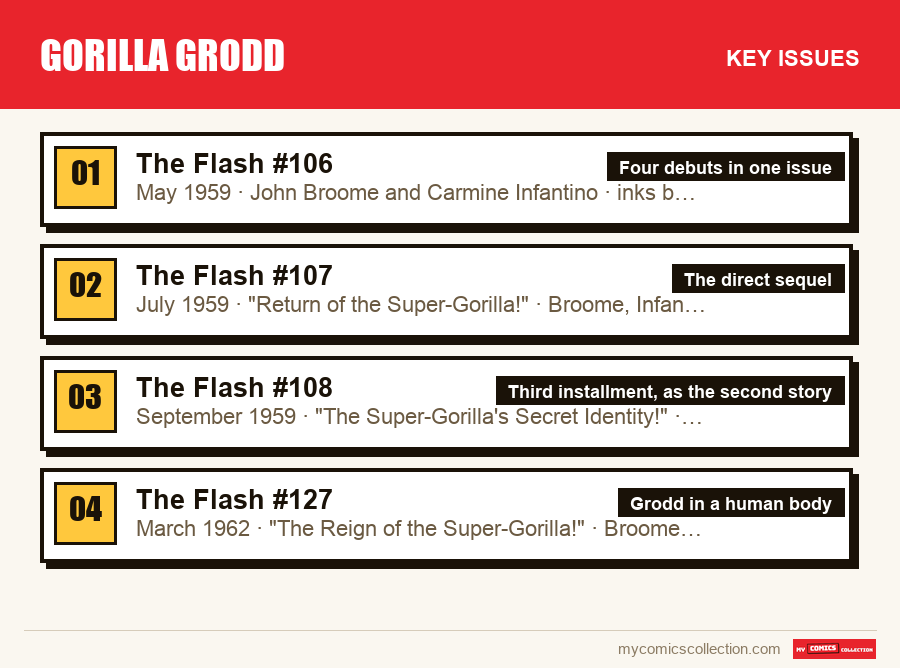
Gorilla Grodd's key issue is The Flash #106, dated May 1959, written by John Broome and drawn by Carmine Infantino (inks by Joe Giella, editorial direction by Julius Schwartz). The first story, "Menace of the Super-Gorilla," contains in one stroke the first appearance of Grodd, that of Solovar and that of Gorilla City. The second story in the same issue, "The Pied Piper of Peril!", also introduces the Pied Piper. A single issue, four documented debuts: that is what makes it a piece more in demand than Grodd's fame would suggest. Next come the two immediate sequels of 1959, then a few later milestones. The series The People v. Gorilla Grodd, eight episodes expected on HBO Max in 2027, shines a spotlight on a character whose keys come down to a handful of issues.
Grodd has never had a series in his own name. He has no recognizable costume, no anniversary celebrated by his publisher, and his name appears on none of the first-appearance lists collectors pass around. Yet as soon as an adaptation puts him front and center, the same question comes back: where do you start? The answer is unusually short, and that is precisely what makes it interesting to treat seriously.
The Grodd case has a particularity rarely encountered with this degree of clarity. His founding issue is not only his own: it carries three other debuts, including that of a place that has become a permanent setting of the DC universe. An issue that accumulates four catalog entries does not behave on the secondhand market like an issue that carries only one, and that changes how to look for it, pay for it and keep it.
This article lists what is verifiable as of October 2, 2026: issues, cover dates, story titles, creators, documented reprints. It also indicates, at the end, what we could not establish and therefore set aside, because a key-issue list that does not distinguish confirmed fact from copied rumor is worth nothing.
Why a TV series puts Grodd back at the center
The People v. Gorilla Grodd is announced for HBO Max in eight short-format episodes. What is public fits in few lines, and it is best to stick to that. The project is written and directed by Dan Perrault and Tony Yacenda, with Yacenda directing all the episodes. Skyler Gisondo plays Jimmy Olsen, Jimmy Tatro lends his features to Grodd, and the rest of the announced cast includes notably Wendell Pierce, Beck Bennett and Mikaela Hoover. Shooting began in early September 2026 in Georgia. Release is expected in 2027, after the release of the film Man of Tomorrow planned for July 9, 2027.
The narrative device is the most important element for a collector, and the one quick summaries flatten. It is not a story of a clash between a gorilla and a fast man. It is a mock courtroom documentary: Daily Planet journalists, Jimmy Olsen at the head, investigate Grodd's conviction for the murder of his father, king of Gorilla City, and the hypothesis of a miscarriage of justice. In other words, the series rests less on the character of Grodd than on Gorilla City as a society, with its institutions, its dynastic succession and its penal system.
This mechanism has a direct consequence. If the adaptation revolves around the place and its internal politics, the issues it brings back into the light are not only those where Grodd fights: they are those that built Gorilla City and its sovereign. Yet these issues are the same, since everything starts from the same 1959 issue. Nothing scatters here, and that is comfortable: the list stays short whichever entry is chosen.
Second consequence, less pleasant: an eight-episode short-format series broadcast on a platform is not a worldwide-budget film. It does not produce the same draft, and its claimed humorous register will not push a new audience toward 1959 issues. What such an announcement does fairly predictably is revive the attention of people who already collected Flash and realize they are missing an issue. The effect is real but narrow, and it bears on an already scarce supply.
The Flash #106: the founding issue, and what it really contains
The Flash #106
The first of the two stories is called "Menace of the Super-Gorilla." It contains the first appearance of Gorilla Grodd, that of Solovar and that of Gorilla City, as well as that of the Quadromobile, the vehicle Grodd uses to travel. The second story, "The Pied Piper of Peril!", by the same creators, introduces the Pied Piper and his flute. Both stories are inked by Joe Giella, and the cover is by Infantino and Giella.
This point deserves emphasis because it is often badly presented. Many lists treat #106 as "Grodd's first appearance," which is accurate but incomplete to the point of being misleading at purchase. A seller who describes his copy as the first appearance of a secondary adversary and a seller who describes it as the joint first appearance of Grodd, Solovar, Gorilla City and the Pied Piper are not selling the same object, though it is the same issue. Knowing what the issue contains is therefore, very concretely, a negotiating advantage.
The content of the main story is also worth knowing, because it explains the character's lasting place. Grodd is not born as a brute. He leaves Gorilla City to steal from Solovar a mental power, the Force of Mind, in order to take control of his own city's army. It is Solovar, held in a zoo where he passes himself off as an ordinary ape to preserve the city's secret, who comes seeking Flash's help. The hero does not win by force: he circles Grodd faster than Grodd can think, which makes him lose the stolen power. From the first story, the antagonism is thus set up as a duel between an intelligence and a speed, not between two musculatures.
Gorilla City and Solovar: the keys the lists forget
Key-issue lists are built on characters, because that is what people collect. They therefore miss places, though places often survive better than their story creators. Gorilla City is the clearest example in the whole Flash stable: it is a setting that has gone through every continuity overhaul and today serves as the frame of a TV series, sixty-eight years after its introduction.
Solovar, for his part, is a rare case of a character conceived from the outset as the moral counterpoint of his antagonist, and of the same species as him. He leads Gorilla City, he is presented as wise and endowed with psychic powers, and he has been rewritten several times, notably during the New 52 overhaul where he becomes a founding figure of his species. For a collector, the interest is practical: each major rewrite produces datable issues, and therefore objects to look for.
The conclusion is simple and counterintuitive. If you are looking for a piece to keep a long time in this corner of the DC universe, the fact that #106 carries at once the character, his virtuous double and their city counts for more than Grodd's relative popularity at a given moment. An issue several of whose elements can be reactivated independently of one another is structurally less dependent on a single adaptation.
The 1959 trilogy, then the following milestones
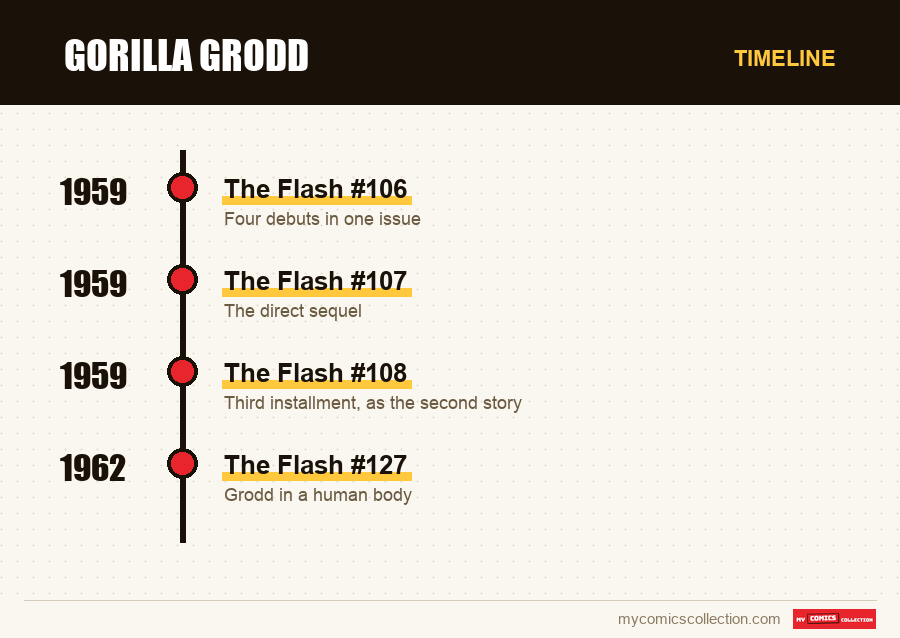
Grodd comes back very quickly, and twice in a row. The first three stories form a continuous whole that it makes sense to collect grouped, which is good news: the three issues are consecutive.
The Flash #107
Grodd had faked the loss of his mental power at the end of the previous issue. He escapes his Gorilla City cell, descends beneath the earth's crust and enslaves a people of bird-men to build a machine meant to bring the city's gorillas back to the state of ordinary animals. Solovar calls Flash back by means of a vibrational frequency recorded during his previous visit, a detail that durably sets up the idea of a technically superior, invisible city.
The Flash #108
Grodd escapes a third time, calling back his Quadromobile, now telepathically linked to his will, and builds a machine meant to make him evolve beyond the human. The story introduces the idea that will define the character for the following decades: Grodd does not want to destroy, he wants to occupy a place in human society. Mind the collecting detail: this story is the second story of the issue, the first being "The Speed of Doom!", unrelated to him.
The Flash #127
Grodd occupies here the body of a man, William Dawson, which sets up the consciousness-transfer ability that will come back abundantly afterward. It is an important issue for the character's powers: it explains why Grodd could, for sixty years, appear elsewhere than in jungle stories.
Two other issues of the same period are worth knowing without being of the same rank. The Flash #115 (September 1960), "The Day Flash Weighed 1000 Pounds!", by Broome and Infantino, puts Grodd as antagonist, and the issue also contains an Elongated Man story inked by Murphy Anderson. The Flash #172 (August 1967), "Grodd Puts the Squeeze on Flash!", again by Broome and Infantino with inks by Sid Greene, closes the character's classic period: Infantino will leave the series at #174.
For what follows, three landmarks suffice, because beyond them Grodd's appearances become too numerous to constitute keys. Secret Society of Super-Villains #4, dated December 1976, brings him into the villain-team register, far from the Flash universe. The Flash #13 of volume 4, dated December 2012, opens the "Gorilla Warfare" arc entirely written and drawn by Francis Manapul, which is the reference modern rewrite of Gorilla City. The Flash #40 of volume 5, dated April 2018, places him in Joshua Williamson and Carmine Di Giandomenico's long run. These three issues are affordable and easy to find, which makes them good reading entries before investing in a 1959 issue.
The talking gorilla, a Silver Age register
Grodd does not come out of nowhere. He arrives in a production where the intelligent gorilla is a common narrative device, to the point of having become a collectible in itself: some collectors assemble sets of gorilla covers, across all series, exactly as others gather wedding covers or courtroom scenes. This taste crosses publishers and genres, and concerns adventure and science fiction series as much as superhero titles.
A workshop legend has long circulated on this subject, according to which a publisher noticed that gorilla covers sold better and imposed a limit to avoid publishing several in the same month. We found no primary source allowing us to assert it, and so we do not assert it. What is established, on the other hand, is that the motif is widespread enough in the production of the time for a niche market to have formed around it, and that this market constitutes additional demand on the issues concerned.
The practical interest is twofold. First, it means competition on an issue like #106 comes not only from Flash fans: it also comes from fans of the motif. Second, it gives a low-cost reading lead for anyone who wants to understand the context of Grodd's creation, by getting titles from the same period where the device is used by other writers. The Silver Age conventionally begins with Showcase #4 in 1956, and our guide to the great periods of the comic book places the useful boundaries.
The reprint trap, particularly serious here
This is the point on which a buyer most often goes wrong with Grodd, and it is documented in black and white. "Menace of the Super-Gorilla" has been reprinted at least in The Flash Annual #1, in an edition replicating that annual, and in a deluxe anniversary collection devoted to the Flash character. "The Pied Piper of Peril!" has been reprinted in an 80-Page Giant and in a special reprint issue. And the entire issue #106 has been reprinted in several hardcover collections and in a series of softcover collections.
The most delicate case is that of the edition replicating the original annual. A replica is, by construction, made to resemble the piece it reproduces. Nothing illegitimate there: these editions exist to allow reading at a reasonable price. The problem arises when a listing describes them with the story title without specifying the format, which happens on the secondhand market without intent to deceive, through simple catalog approximation.
Demand the issue number, not the story title
"Menace of the Super-Gorilla" does not designate an object, but a story present in at least four different formats. The only unambiguous identifier is the pair of series title and number, that is The Flash #106, with a May 1959 cover date.
Ask for a photograph of the back and the bottom of the last page
The legal notices and the ads on the back date an issue far more surely than the cover, which is precisely the element a reissue reproduces. If the seller cannot provide these images, the purchase is not documented enough for an issue of this age.
Settle the raw versus certified question before looking
On a 1959 issue, certification settles in one operation the question of authenticity, that of condition and that of possible restorations. It has a cost and a delay. The decision depends on your budget and your horizon, not on the character: our CGC grading guide details the cases where it is justified.
Document your acquisition the same day
Format, number, cover date, condition, provenance, price paid. On a piece you may keep for twenty years, the record is worth as much as the object, and that is exactly what issue-by-issue tracking does.
If you fear confusing an original printing with a reissue, our guide to reprints and fakes on the Flash series describes the checks to carry out, and an estimate lets you place a copy before committing.
How to approach this collection through 2027
The series being expected in 2027 with no precise date to date, the window is wide, and that is an advantage. Buying long before a broadcast and buying in the month that precedes it are not the same decision: in the first case you buy an issue, in the second you buy an issue plus the collective attention of the moment. On a rare 1959 piece, whose supply is limited anyway and will not adjust to a rise in demand, the price gap between the two situations can be significant, and it corresponds to no difference in the object.
A reasonable hierarchy, if the budget imposes steps, reads as follows. First the three modern issues cited above, to read and understand the character without financial commitment. Then #127 and #115, less sought than the opening trilogy and easier to find in readable condition. Then #107 and #108, which complete the continuous story. And #106 last, not because it is secondary, but because it is the only piece on the list where the choice of condition and format truly commits you, and it is better to approach it once you have already handled issues of this period.
A word finally on Grodd's place in the rest of the DC universe, since the series ties him to the Daily Planet and therefore to the Superman galaxy. This tie has no counterpart in key issues: the character was born in the Flash series and his milestones stayed there. To understand how this universe structured itself to the point of allowing such a crossover, the reference issue remains The Flash #123, and our inventory of the Flash Silver Age keys covers the major pieces of the host series.
What we could not verify
Transparency about an article's limits is better than an article that fills its gaps. We set aside four things.
First, any numeric value. No source consulted publishes a dated, verifiable price for the issues cited at the time of writing. We therefore give no amount, for no issue, in no condition. Public sales of Flash Silver Age pieces exist, but we could not verify their detail with the degree of certainty a publication requires.
Second, the editorial legend of gorilla covers, treated above: widespread, but unsourced.
Third, the on-sale dates of the 1959 issues. We give the cover dates, which are those printed on the object and can be verified. The actual on-sale date preceded the cover date, but the gap is not constant and we could not establish it issue by issue.
Fourth, the narrative content of the TV series beyond its announced device. We do not know which issues it adapts, if it adapts any, nor how it treats the succession of Gorilla City. Details are expected at the fall 2026 industry events, starting with the New York convention running October 8 to 11, 2026, but as of this article nothing has yet been said there.