The single biggest risk in the Flash market is confusing an original with one of its many reissues: DC has reproduced its Silver Age keys in three distinct formats (Millennium Edition 2000, Showcase Presents collections, 2026 facsimile), and the series has been renumbered twice: making the label "Flash #1" actively misleading. For Showcase #4 (1956), the documented auction record is $900,000 for a CGC 9.6 (Heritage Auctions, January 2024); for a facsimile of the same issue released in 2026, the cover price is $3.99. Knowing how to tell them apart is non-negotiable.
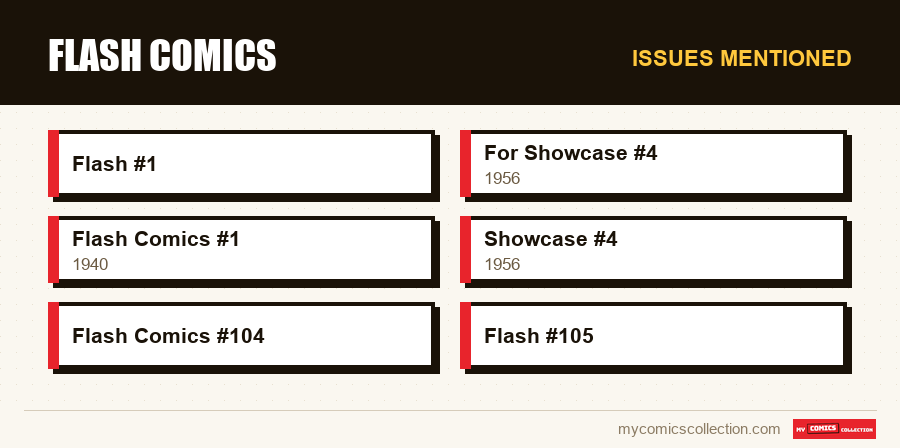
The Flash spans three eras of American comics. The Golden Age begins with Flash Comics #1 (January 1940, Gardner Fox & Harry Lampert): the first appearance of Jay Garrick. The Silver Age opens with Showcase #4 (September-October 1956, written by Robert Kanigher and John Broome, art by Carmine Infantino, inks by Joe Kubert): the first appearance of Barry Allen and the issue generally regarded as the starting gun of the Silver Age itself. Barry Allen's solo series ran as The Flash vol.1 from #105 (March 1959, continuing the numbering from Flash Comics #104) through #350 (October 1985). In 1987, Wally West took over in The Flash vol.2 #1 (Mike Baron / Jackson Guice). That double renumbering is the root cause of most confusion in collector searches.
This guide focuses on the verifiable physical markers that distinguish each original from its reissues. No eBay price is quoted for Silver Age keys (Showcase #4, Flash #105-139): our estimator returns no reliable signal on those issues, either one listing or zero results, and the reference sales come from auction houses.
Showcase #4 (1956): three versions, one issue number
Showcase #4 has been reproduced three times since its original publication. Here are the distinguishing markers for each version:
| Version | Date | Cover price | Primary visual marker |
|---|---|---|---|
| Original | September-October 1956 | 10 cents | No barcode; indicia reads "National Comics Publications, Inc."; period pulp paper, naturally browned |
| Millennium Edition | January 2000 | Different from original | Gold foil logo stamped on front cover; editorial essay added on interior pages; 2000 cover date |
| Facsimile Edition | July 2026 | $3.99 US | Modern barcode bottom-left; "Facsimile Edition" designation; multiple cover variants (foil, blank sketch) |
On a genuine 1956 copy, the 10-cent cover price is the first checkpoint. The indicia, the small text block inside the front cover, identifies the publisher as "National Comics Publications, Inc." (DC's corporate name at the time) and lists the 1956 publication date. The paper is period pulp, showing natural age toning across six decades. No barcode technology existed in the 1950s. A CGC 9.6 original sold for $900,000 at Heritage Auctions in January 2024: the all-time record for a Silver Age DC comic. Even a low-grade copy (CGC 1.0-2.0) trades in the hundreds to thousands of dollars.
The Millennium Edition (2000) is straightforward to identify: the gold foil logo stamped on the cover and the editorial essay added inside are absent from any 1956 original. The 2026 facsimile carries a contemporary barcode and a modern $3.99 cover price: no attentive buyer should be confused by either.
The "Flash #1" trap: vol.1 (1959) vs vol.2 (1987)
This is the most common pitfall on eBay. A search for "Flash #1" returns two completely different comics: different eras, different characters, different orders of magnitude in value:
| The Flash vol.1 #105 (1959) | The Flash vol.2 #1 (1987) | |
|---|---|---|
| Character | Barry Allen (Silver Age) | Wally West (Modern Age) |
| Writer / Artist | John Broome / Carmine Infantino | Mike Baron / Jackson Guice |
| Original cover price | 10 cents | 75 cents |
| Barcode | None | UPC newsstand or DC bullet direct edition |
| Numbering note | Continued from Flash Comics #104 (1949) | Full renumbering from #1 |
The Barry Allen solo series starts at #105: not #1: because DC chose to continue the legacy numbering from Flash Comics, which ended in 1949 at #104. That series ran #105 through #350 (1959-1985). The 1987 relaunch for Wally West began fresh at #1. Our eBay estimator returns 14 active listings for the query "Flash #1" with a median of €4: overwhelmingly vol.2 copies (a common modern-age comic) mixed with a handful of vol.1 listings, making that figure useless as a valuation reference.
Newsstand vs direct edition: the 1980s-1990s distinction
For Flash issues published between roughly 1979 and the mid-1990s, covering the final years of the Barry Allen run and the early Wally West era, the newsstand versus direct edition split is a recognised value driver. Both versions were published simultaneously but distributed through separate channels, and they are visually distinct:
- Newsstand edition: a standard UPC barcode appears in the lower-left corner of the cover, with the retail price printed alongside it.
- Direct edition: the DC Bullet logo (or a plain rectangle in some years) occupies the UPC box instead of a barcode.
Newsstand copies from the 1986-1995 window are today scarcer in high grade: sold on open racks, they absorbed handling creases that direct-edition copies, sold bagged in specialty shops, routinely avoided. CGC now formally designates "Newsstand Edition" on its label. For a key issue such as The Flash vol.2 #1 (1987), a high-grade newsstand copy can command a premium of 1.5x to 3x over its direct-edition counterpart from the same era.
Flash Comics #1 (1940): the Golden Age grail
Flash Comics #1 (January 1940, Gardner Fox & Harry Lampert) introduced Jay Garrick, the original Flash. This issue is a separate series:Flash Comics , not The Flash: and our estimator does not cover it. Value is established exclusively at auction: the documented record is $450,000 for the CGC 9.6 Mile High (Edgar Church) pedigree copy sold at Heritage Auctions in March 2010, one of the highest-graded examples known to the CGC census.
Think you have an original Flash? Get a free valuation with our tool based on real eBay sales to find its low, median, and high value.
Frequently asked questions
The original (September-October 1956) has no barcode, lists "National Comics Publications, Inc." in the indicia, carries the 1956 date and shows naturally browned pulp paper. The period cover price is the first indicator.
DC reproduced its Silver Age keys in three forms: the Millennium Edition (2000), the Showcase Presents volumes and the 2026 facsimile. The Millennium Edition is recognizable by its embossed gold logo and editorial essay; the facsimile by its modern barcode and the "Facsimile Edition" notice.
Because the series was renumbered twice: Barry Allen's vol. 1 runs from #105 (March 1959) to #350 (October 1985), then Wally West relaunches the series at vol. 2 #1 in 1987. Searching for "Flash #1" therefore leads to several very different issues.
Jay Garrick appears in Flash Comics #1 (January 1940, Gardner Fox and Harry Lampert) and Barry Allen in Showcase #4 (1956). The latter opens the Silver Age as a whole.
Because the estimator returns no reliable signal on these issues (a single listing, or none), and the reference sales come from auction rooms. It is better to check the physical markers before any purchase.