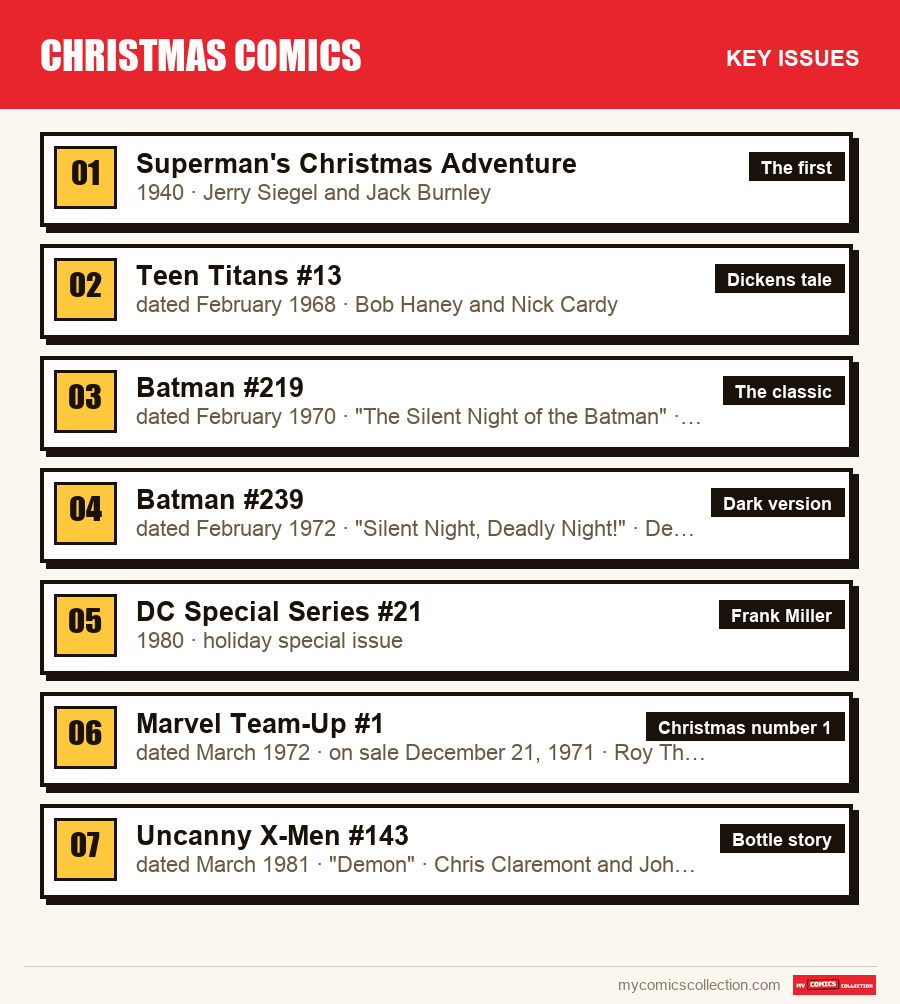
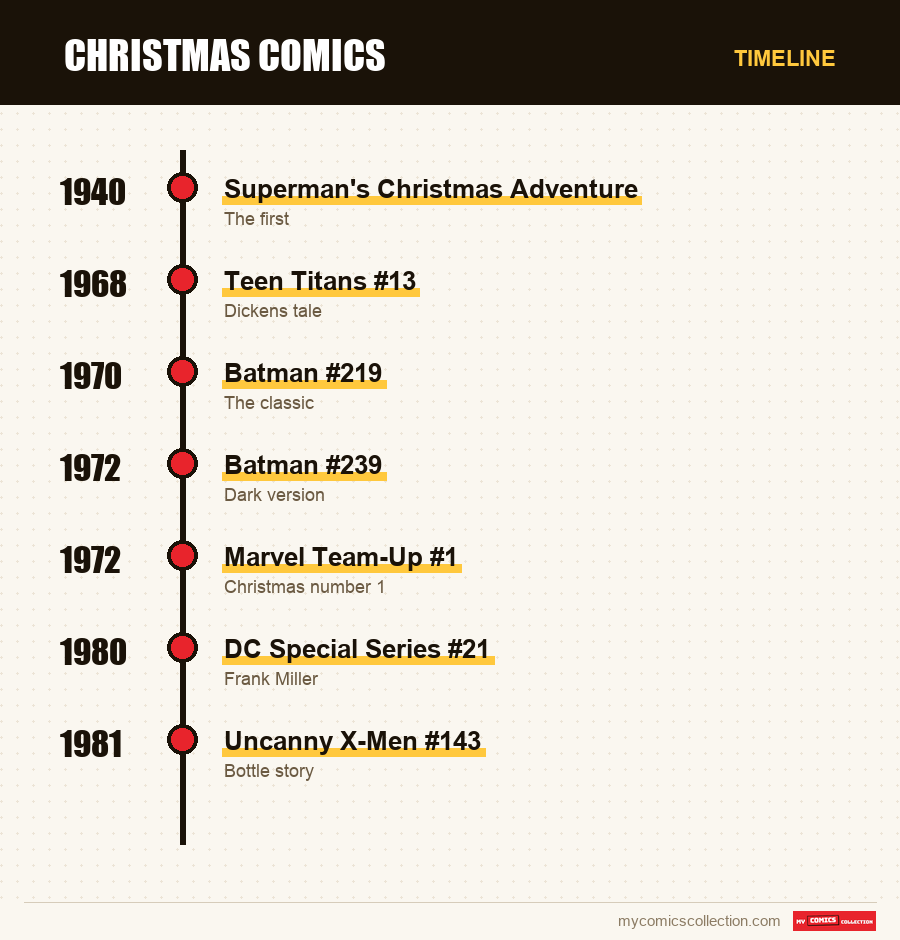
The big American publishers have been telling Christmas stories since 1940, and a handful of issues form the core to reread. At DC: Batman #219 (dated February 1970), whose story "The Silent Night of the Batman" is by Mike Friedrich and Neal Adams; DC Special Series #21 (1980), which contains the first Batman story drawn by Frank Miller; Detective Comics #826 (2007), the Joker's Christmas by Paul Dini; and Batman: Noël by Lee Bermejo (2011). At Marvel: Marvel Team-Up #1 (dated March 1972, on sale December 21, 1971), where Spider-Man and the Torch face the Sandman at Christmas, and Uncanny X-Men #143 (dated March 1981), where Kitty Pryde faces a demon alone on Christmas Eve. Added to these are the holiday anthologies, from Christmas with the Super-Heroes (1988-1989) to DC's Naughty List #1, announced for November 25, 2026.
Christmas stories hold a curious place in superhero comics. They are rarely decisive for continuity, almost never the origin of a major character, and yet some count among their authors' most reread tales. The format helps: a short story, an imposed setting, heroes shown for once away from the fight. It is often there that a writer says what he really thinks about his character.
This article is a reading guide. It does not try to say which issue to give as a gift, or what it is worth: it lists the standout holiday stories, checked one by one against their issue, date and creative team, and explains how to read them today. The issues cited were chosen because their content is documented, not because they are famous; a Christmas story that is reputed but cannot be found in the sources does not appear here.
The date trap: why Christmas falls in March
Before looking for a Christmas story in a collection, you need to know a rule that misleads many readers. The date printed on the cover of an American comic is not its on-sale date. It is generally two to three months later. An issue sold in December therefore often carries a February or March date.
The examples in this guide show it without ambiguity. Marvel Team-Up #1, a Christmas story, carries the date March 1972 but was on sale December 21, 1971. Uncanny X-Men #143, another Christmas Eve tale, is dated March 1981 and came out December 16, 1980. Looking for "December" in a list of issues therefore misses most Christmas issues. You have to look for February and March.
The rule has its exceptions. Uncanny X-Men #230, titled "'Twas the Night...", tells a Christmas but is dated June 1988 and came out in February: the series' schedule did not coincide with the holidays. And special issues, outside the regular series, sometimes carry the December date of the same year.
The Christmas stories at DC
Superman's Christmas Adventure
Two years after his creation, Superman already has his Christmas story, in a promotional publication distributed in stores, outside the regular series. Script by his co-creator Jerry Siegel. It is the starting point of a tradition: very early on, publishers understood that the holidays were an occasion to show their heroes to a wider audience than that of newsstands.
Teen Titans #13
"The TT's Swingin' Christmas Carol" transposes Dickens's tale into the universe of the young heroes, with the resolutely dated tone of the late 1960s. A testimony of the era as much as a story, to be read with a smile.
Batman #219
It is Batman's most often cited Christmas story. A short story, supplementing the issue's main tale: for once, Batman does not patrol, and the city does not need him to. Neal Adams, then in the process of redefining the character graphically, signs the art. The issue's main story, unrelated to Christmas, is by Frank Robbins and Irv Novick.
Batman #239
Two years later, the same title returns to Christmas, in a graver tone, under the pen of Denny O'Neil, who was then bringing Batman back toward the crime story. Reading #219 and #239 in sequence shows the character's turn in the early 1970s well.
DC Special Series #21
This special gathers several holiday stories, including a Jonah Hex tale, "The Fawn and the Star." It is best known for another: "Wanted: Santa Claus, Dead or Alive!", written by Denny O'Neil and drawn by Frank Miller. It is the first time Miller draws Batman, six years before The Dark Knight Returns. The story was reprinted at the head of Christmas with the Super-Heroes #1.
In the same vein, DC Comics Presents #67 (dated March 1984), by Len Wein and Curt Swan, literally has Superman meet Santa Claus. It is a light story, owned as such, and one of the rare ones where the Christmas figure is treated as a full-fledged member of the DC universe.
The anthologies: Christmas with the Super-Heroes
In the late 1980s, DC gathers its holiday stories into anthologies. Christmas with the Super-Heroes #1 reprints older stories, including Miller's. Issue #2, dated December 1989, offers new stories, including a Superman written and drawn by Paul Chadwick, the creator of Concrete. To discover several eras at once, these two issues are the most practical entry point.
The formula has been taken up regularly. DC Universe Holiday Special, dated February 2009, is an anthology of the same family. More recently, DC has made a habit of pun titles for its annual specials: DC's Very Merry Multiverse #1 (dated February 2021, out in December 2020), then DC's Grifter Got Run Over by a Reindeer #1 (dated January 2023, out at the end of 2022). In 2026, the tradition continues with DC's Naughty List #1, announced for November 25, 2026, whose content remains to be discovered.
The Joker's Christmas and Bermejo's
Detective Comics #826, dated February 2007, is titled "Slayride." Paul Dini, one of the writers of the 1990s animated series, has Robin get into the Joker's car on a holiday evening. It is one of the tensest stories of the lot, and a good demonstration of what Dini can do with the Joker in a single issue.
Batman: Noël, an album by Lee Bermejo published in 2011, is of another format: a complete story, designed as a book, which transposes Dickens's A Christmas Carol into Gotham. The highly worked art makes it one of the most beautiful objects on this list. For an adult reader who does not read series, it is the most accessible title.
The Christmas stories at Marvel
Marvel Team-Up #1
"Have Yourself a Sandman Little Christmas!": Spider-Man and the Human Torch face the Sandman during the holidays. What makes the issue remarkable is its place: a series' first issue built around Christmas. Marvel Team-Up will become the title of Spider-Man's team-ups for more than ten years, and it begins under the garlands.
Uncanny X-Men #143
On Christmas Eve, Kitty Pryde, still a teenager, is alone in the X-Men's mansion when a demon gets in. Claremont and Byrne make it a survival story, which many readers compare to the horror cinema of the time. The issue immediately follows Days of Future Past and marks the end of Byrne's collaboration on the series.
Seven years later, Uncanny X-Men #230, "'Twas the Night...", by Claremont and Marc Silvestri, returns to Christmas with a very different team, then based in Australia. The issue is dated June 1988, which makes it hard to find for anyone looking for a "December" issue.
Marvel also published its own anthologies. Marvel Holiday Special #1, dated December 1991, opens with a story written by Scott Lobdell and drawn by Dave Cockrum. Later, Gwenpool Special #1, out on December 9, 2015, a holiday issue gathering several stories, contains the first story of Gwenpool, a character who was born first on variant covers. It is one of the rare cases where a Christmas special matters in a character's history.
Elsewhere: Hellboy and Lobo
The holidays are not reserved to the two big publishers. At Dark Horse, the 1997 Hellboy Christmas Special entrusts Mike Mignola and other creators with putting the character in a Christmas setting, with the deadpan humor that characterizes him. For readers who follow the character, it is a welcome detour between two darker stories; our history of Hellboy places this special in its chronology.
At the other extreme, The Lobo Paramilitary Christmas Special, in the early 1990s, written by Keith Giffen and drawn by Simon Bisley, sends DC's most brutal bounty hunter to eliminate Santa Claus. It is an openly owned parody of holiday stories, to be reserved for an informed audience.
Putting together your holiday reading
For an evening: three short stories
Batman #219 for gentleness, Uncanny X-Men #143 for tension, Detective Comics #826 for darkness. Three eras, three tones, less than an hour of reading.
For a reader who does not read comics
Batman: Noël, by Lee Bermejo. A complete book, with no prerequisites, resting on a tale everyone knows.
For a comics history enthusiast
DC Special Series #21 and Frank Miller's first Batman, then Christmas with the Super-Heroes #2 to see how DC evolved the formula in the late 1980s.
For a series collector
Marvel Team-Up #1: a Christmas story that is also the first issue of a long series. It is the only issue on this list to combine both statuses.
Reading the original or a reprint
Most of the stories on this list have been reprinted in collections or anthologies, which lets you read them without hunting for the original. It is the simplest route for the 1970s and 1980s issues, whose copies in good condition are becoming harder to find. But a themed Christmas collection sometimes mixes eras without clearly indicating the origin of each story: check the contents page, which should cite the original issue.
For a collector, the original keeps an interest of its own when the issue matters for a reason other than Christmas. Marvel Team-Up #1 is a first issue, Uncanny X-Men #143 belongs to the Claremont and Byrne period, DC Special Series #21 contains a milestone of Miller's career. Those three are filed with their series, and not in a "Christmas" box. Gift ideas for the season, for their part, are gathered in our guide to comics to give a collector, and the winter release calendar in our 2026-2027 collector's agenda.
Filing Christmas issues in your collection
The natural reflex is to create a "Christmas" box or shelf. It has a flaw: it separates issues from their series, and you end up looking for Uncanny X-Men #143 in the wrong place. It is better to leave each issue in its place and create a themed list in your inventory, pointing to each copy. Add to the record the title of the Christmas story when it is only one story among others, as for Batman #219: it is the information you forget and then search for.
Finally, remember to note the on-sale date next to the cover date. It is what explains why a "March" issue talks about Christmas, and it is what lets you reconstruct a given year's holidays at a publisher.